
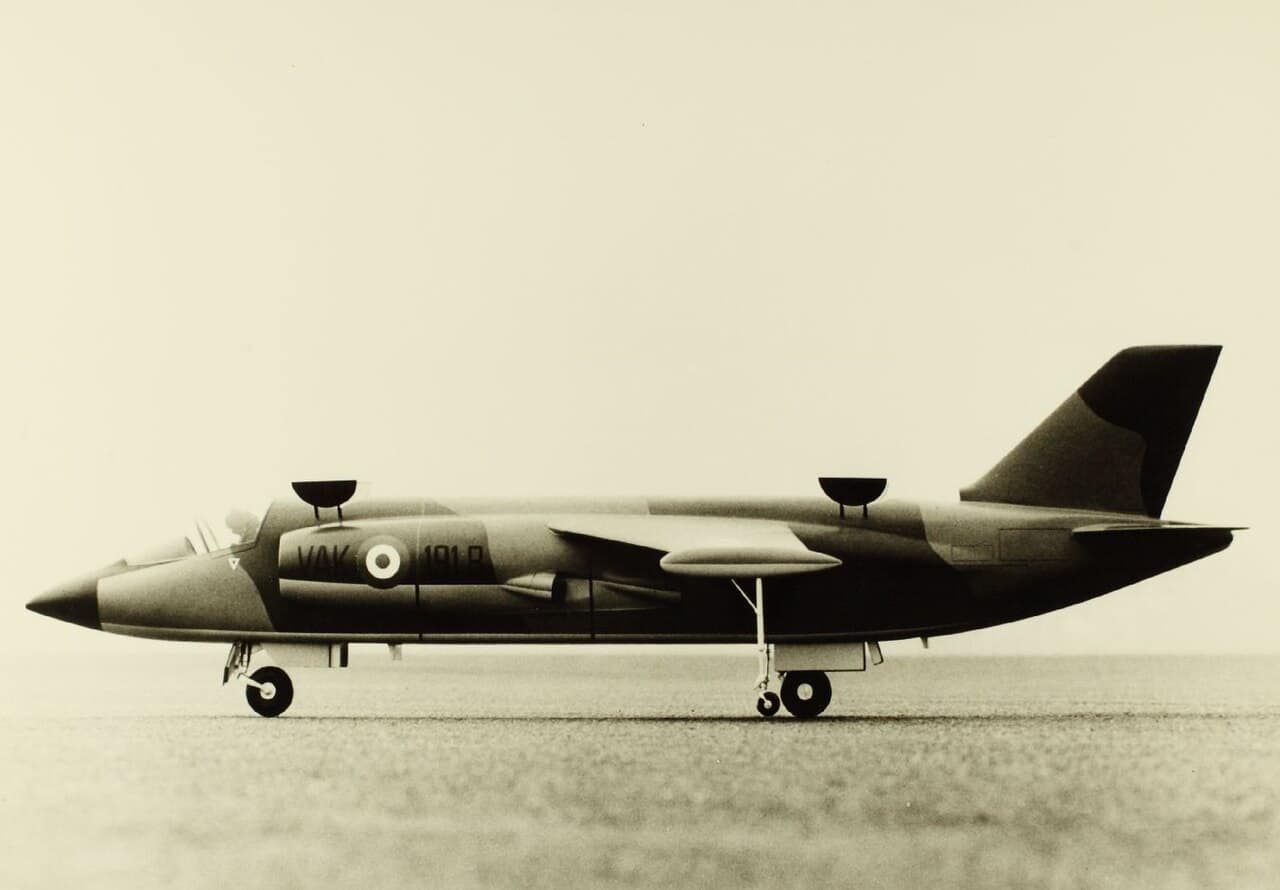
It is a grey morning at Bremen, late in the summer of 1971. On the concrete apron stands a stubby, hunched little jet, its camouflage still factory-fresh, the marking VAK 191 B painted along the nose. Three engines spool up at once and the noise is physically violent — a single vectored-thrust turbofan in the belly and two slim lift jets buried fore and aft of the wing, all screaming together. Slowly, impossibly, the aircraft lifts straight off the ground. It hangs there on columns of hot gas, trembling, held in place by puffer jets hissing from its nose, tail and wingtips. For a few seconds, West Germany has its own jump jet.
For a country forbidden from building combat aircraft only fourteen years earlier, this was an extraordinary moment. The VFW VAK 191B was meant to be the future: a vertical-takeoff strike fighter that could scatter into forests and clearings when Soviet missiles cratered NATO’s runways, then strike back. It flew. It hovered. It transitioned to wingborne flight and back again.
And then it lost — not to the enemy, but to physics and arithmetic. By 1975, after roughly 91 flights, the programme was dead. The Harrier, simpler and built around one good engine, took the prize. This is the story of the German jump jet that did almost everything right and still could not win.
Quick Facts — VFW VAK 191B
- Role: Experimental VTOL strike / reconnaissance fighter
- Origin: West Germany (Vereinigte Flugtechnische Werke / VFW-Fokker, Bremen)
- Intended to replace: the Fiat G.91 under the NATO NBMR-3 requirement
- Propulsion: 1× Rolls-Royce/MAN Turbo RB193-12 vectored-thrust turbofan (45.2 kN / 10,200 lbf) plus 2× Rolls-Royce RB162-81 lift turbojets (26.5 kN / 6,000 lbf each)
- First flight: 10 September 1971; first hover at Bremen 20 September 1971; first full transition at Munich 26 October 1972
- Prototypes built: 3 (single-seat)
- Flights flown: ~91, programme 1971–1975
- Length / wingspan: ~14.7–16.4 m / 6.16 m
- Max speed: ~1,100 km/h (high subsonic; a supersonic dash was a design goal, never reached)
- Survivors: Deutsches Museum Flugwerft Schleissheim; Wehrtechnische Studiensammlung Koblenz; one in storage at Bremen
A jump jet born from a nuclear nightmare
The logic behind the VAK 191B was bleak and entirely rational. In a major war with the Warsaw Pact, NATO planners assumed that fixed airbases in West Germany would be among the first targets — cratered by missiles or neutralised by nuclear strikes within the opening hours. An air force tied to long concrete runways could be destroyed before it ever flew a sortie.
The answer, in theory, was dispersal. Vertical-takeoff aircraft could hide in forest clearings, on stretches of road, behind hills — survive the first wave, and then retaliate. The VAK 191B was conceived to carry a nuclear weapon into exactly this role, a deterrent that could not be wiped out on the ground. That nuclear strike mission was later abandoned by the German government, one of many shifts that would erode the project from within.
The requirement itself came from NATO. In 1961 the alliance issued NBMR-3, a specification for a VTOL combat aircraft to succeed the Italian Fiat G.91 light attack jet. West German industry — only allowed to build combat aircraft again since 1957 — was determined not to be left behind in what was then the most fashionable idea in aviation.
Three companies, one improbable aircraft
To pursue the strike-fighter requirement, Focke-Wulf and Weser Flugzeugbau merged in 1961 to form Vereinigte Flugtechnische Werke. Italy’s Fiat joined the venture, fittingly, since the aircraft was meant to replace Fiat’s own G.91 — the designation “191” signalled a successor to the G.91, and the “B” marked it as the second of four studied configurations. The name itself was bureaucratic poetry: Vertikalstartendes Aufklärungs- und Kampfflugzeug, vertical-takeoff reconnaissance and strike aircraft.
The Deutsches Museum, which preserves the first prototype today, sums up what the machine was supposed to be:
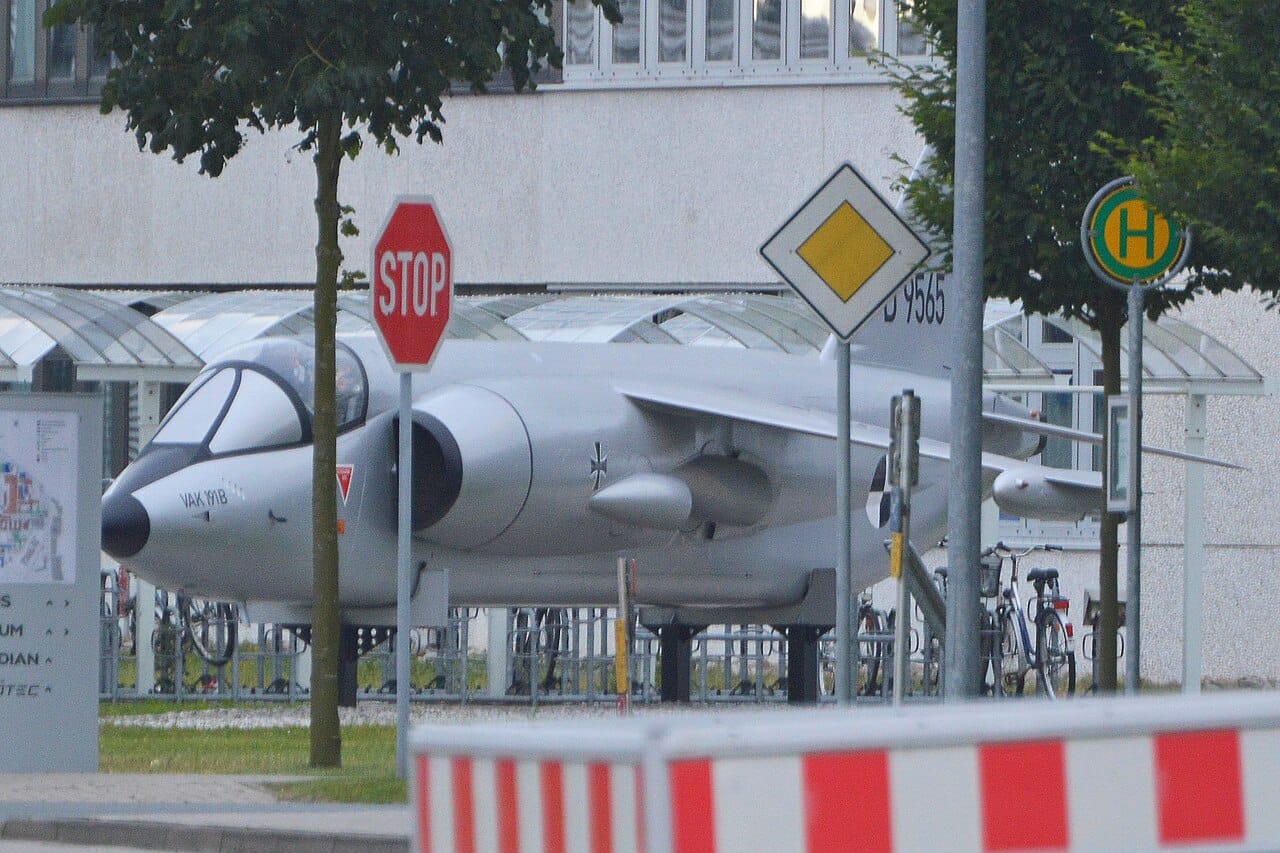
The image below shows that surviving first prototype, marked D-9565, preserved decades after its flying days. The bicycle-style landing gear — one wheel forward, twin wheels aft, with outriggers near the wingtips — was forced on the designers by the engine occupying the centre of the fuselage, exactly as on the Harrier.
Three engines, one fatal compromise
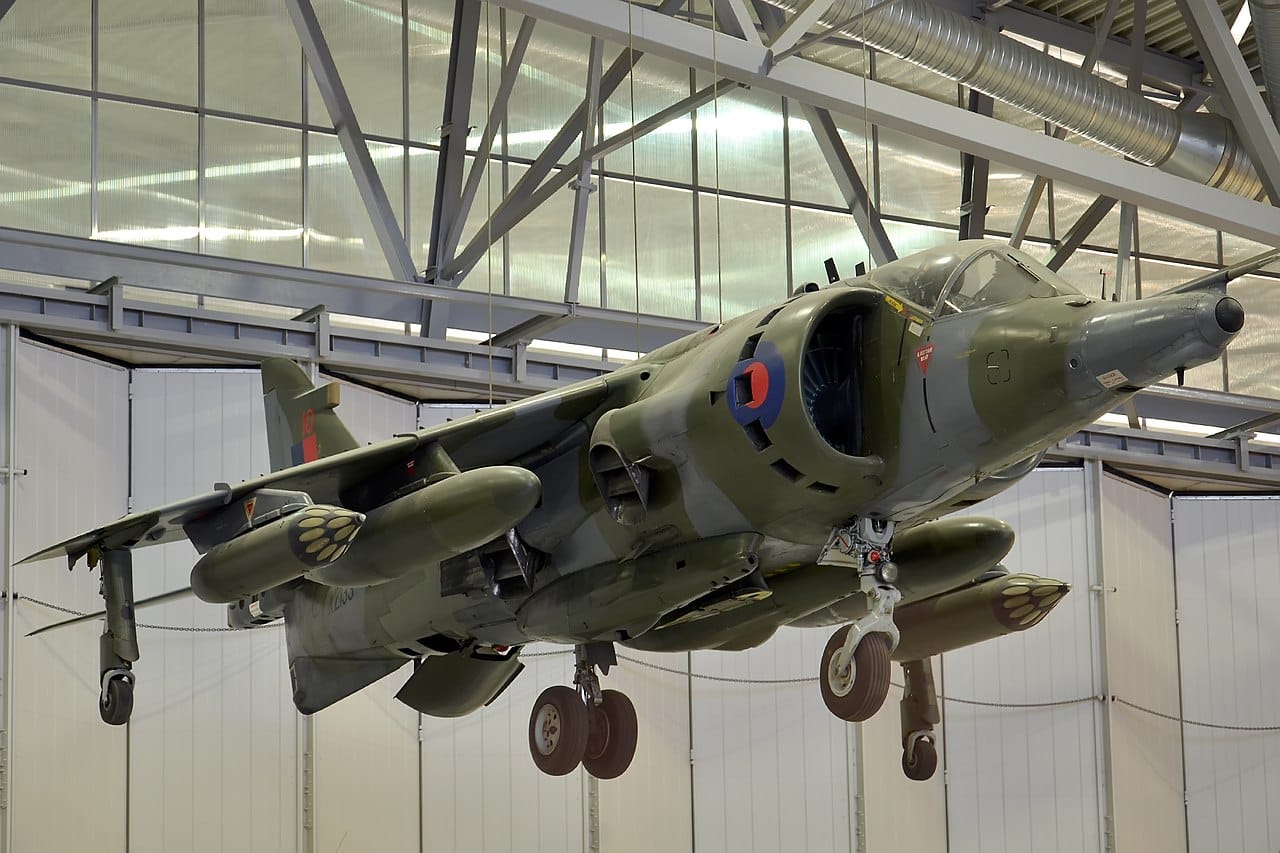
Here lies the heart of the VAK 191B story. The British Harrier solved vertical flight with a single, brilliant device: the Rolls-Royce Pegasus, a vectored-thrust turbofan with four rotating nozzles that swivelled the engine’s entire output from horizontal to vertical. One engine, doing everything.
VFW’s engineers judged that a single Pegasus-class engine large enough to lift their fighter would create too much drag in cruise. So they split the job. The aircraft was built around a Rolls-Royce/MAN Turbo RB193-12 — a vectored-thrust turbofan derived from the Rolls-Royce Spey, configured like a smaller Pegasus, producing 45.2 kN (10,200 lbf). To that they added two Rolls-Royce RB162-81 lift turbojets, mounted near-vertically: one directly behind the cockpit, one aft of the wing, each contributing 26.5 kN (6,000 lbf). In a hover, the optimum was a roughly 50–50 split between the cruise engine and the two lift jets.
It worked. But the arithmetic was unforgiving. In forward flight, those two lift engines did nothing except sit there — dead weight, dead volume, dead drag, carried for the few seconds of every mission when the aircraft was actually hovering. The Harrier carried no such passengers.
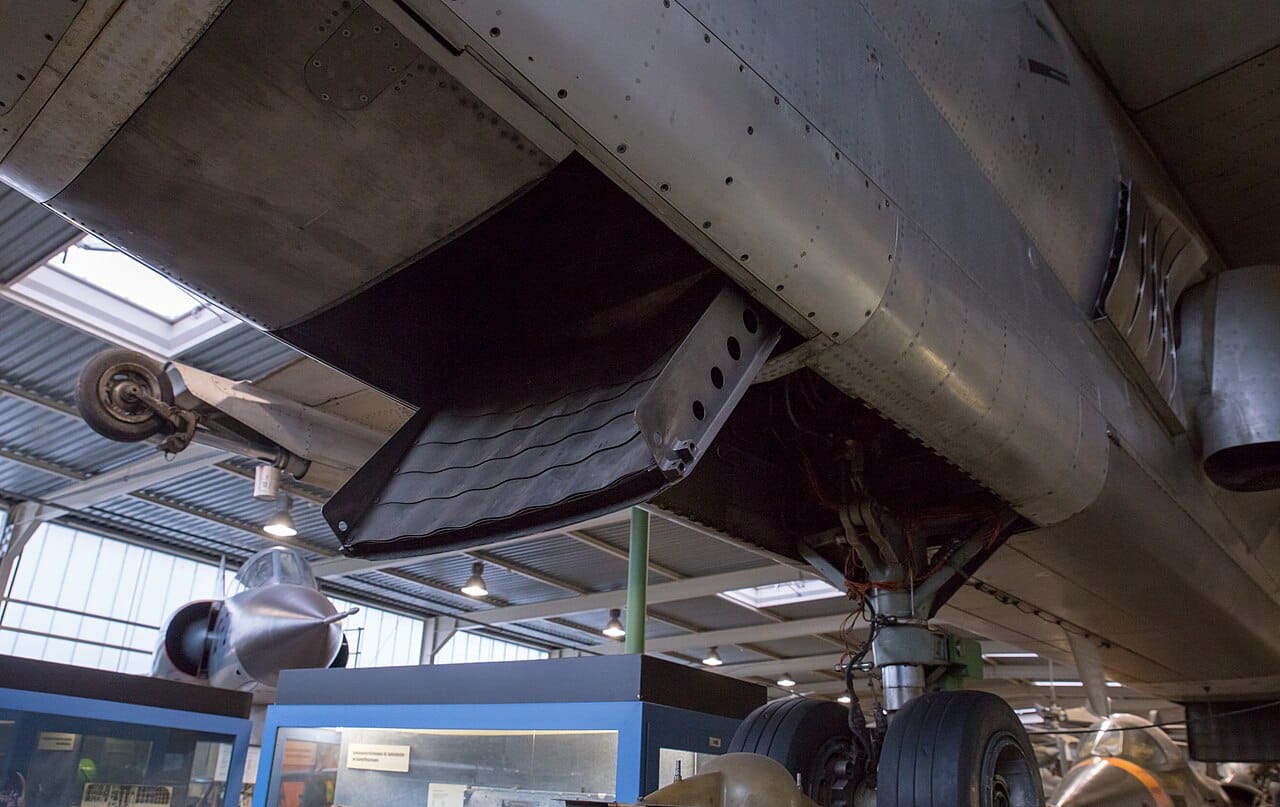
The consequences cascaded. Two lift engines meant more weight, which meant the small cruise engine struggled to deliver a competitive thrust-to-weight ratio. The wings were small and highly loaded. The aircraft was clever, complex and heavy — everything the Harrier was not. The American aviation historian Greg Goebel puts the verdict plainly:
To be fair to VFW, the VAK 191B was no crude lash-up. It carried a triple-redundant electronic fly-by-wire flight control system — genuinely advanced for the era — a Martin-Baker zero-zero ejection seat (essential for an aircraft that might fail while hovering a few metres up), and an elaborate bleed-air puffer system to control attitude in the hover, with thrusters in the nose, tail and wingtips. The lift engines were even cross-coupled so that the failure of one would shut down its opposite number, preventing the aircraft from flipping over.
A modern documentary on the VAK 191B — the jet designed for the future that got stuck in the past.
It flew — and that was the problem
The flight test record was, on its own terms, a success. After a decade of development — the first prototype rolled out at Bremen in 1970 — the maiden flight came on 10 September 1971. The first true hover at Bremen followed on 20 September 1971. The decisive milestone, the first full transition from vertical to wingborne flight and back, was achieved at Munich on 26 October 1972, the trickiest manoeuvre any VTOL pilot performs.
Across roughly 91 flights through 1975, the three prototypes demonstrated that the configuration was viable. They were later used to test fly-by-wire concepts that fed into the Panavia Tornado programme — arguably the VAK 191B’s most lasting contribution.
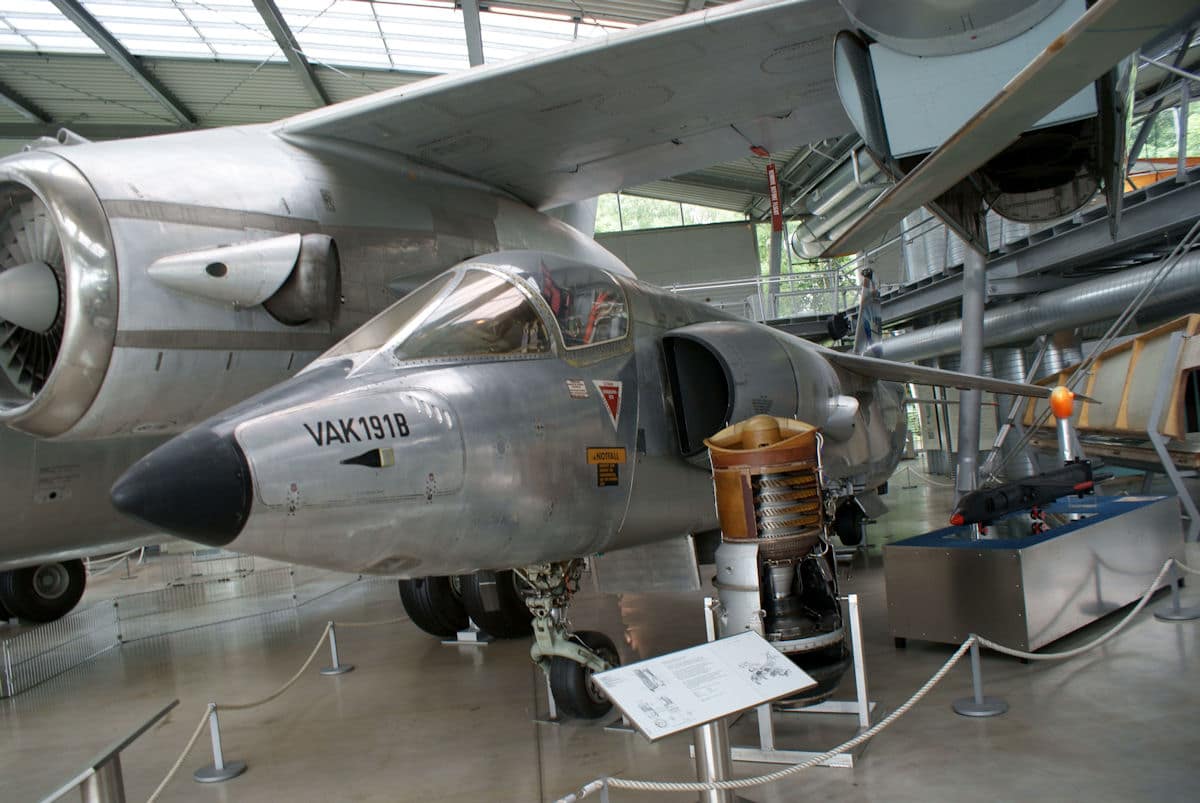
The museum’s nose-on view below shows the sliding intake lips — they slid forward to feed the engine extra air during the high-demand seconds of vertical takeoff and landing.
Beaten by the engine that kept getting better
The killing blow was external. While VFW wrestled with three engines, Rolls-Royce kept refining the single Pegasus. Each new version produced more thrust, and the Harrier — one engine, larger wings, a far better thrust-to-weight ratio, genuinely useful in a dogfight and capable of rolling short takeoffs — simply pulled away. By comparison the VAK 191B was a heavier, more complicated solution to a problem the British had solved more elegantly.
Politics finished what physics started. NATO lost interest in the NBMR-3 requirement; Germany dropped the nuclear strike role; Italy withdrew from the partnership in 1967, taking with it an agreed 40 per cent of development funding; and a parallel German-American “Advanced Vertical Strike” project briefly looked more attractive before it too was cancelled in 1968. As early as 1968, VFW reclassified the VAK 191B as a pure experimental programme. The planned batch shrank from six aircraft to three. It was never going to enter service.
The VAK 191B was not an isolated folly. It was one symptom of a continent-wide obsession. Through the 1960s, dozens of VTOL prototypes flew — tail-sitters, tiltjets, lift-jet monsters — in Britain, France, the United States and Germany alike. Of all that effort, only the Harrier reached operational service. The rest were defeated by the same brutal trade-off: vertical flight is technically possible, but the compromises it demands rarely justify the cost.
Period footage of the VFW VAK 191B during German VTOL demonstrations in 1975.
What survives
All three prototypes outlived the programme. The first sits in the Deutsches Museum’s Flugwerft Schleissheim at Oberschleißheim near Munich, alongside the other two German jet VTOL experiments — the EWR VJ 101C fighter and the Dornier Do 31 transport. The second is held by the Wehrtechnische Studiensammlung in Koblenz. The third was placed in storage in 1976 and is reported to be at Airbus in Bremen.
Stand in front of the Schleissheim aircraft today and the lesson is written in its proportions. It is too stubby, too heavy, too clever — a machine that carried two engines it could only use for seconds at a time. The VAK 191B did not fail because German engineering fell short. It failed because the engineering was asked to beat arithmetic, and arithmetic always wins.
Sources: VFW VAK 191B, Wikipedia; Deutsches Museum Flugwerft Schleissheim; Greg Goebel, “German Jet VTOL: VJ 101C, Do 31 & VAK 191B”, airvectors.net; Flight International, 13 April 1972.
Related Questions
What was the VFW VAK 191B?
The VFW VAK 191B was an experimental West German vertical-takeoff-and-landing (VTOL) strike fighter of the early 1970s, built by Vereinigte Flugtechnische Werke. It was designed to replace the Fiat G.91 under a NATO requirement and to operate from dispersed sites if airbases were destroyed. Only three prototypes were built and the programme was cancelled in 1975.
How did the VAK 191B take off vertically?
It used three engines. A central Rolls-Royce/MAN Turbo RB193-12 vectored-thrust turbofan provided lift and cruise, while two Rolls-Royce RB162-81 lift turbojets — one behind the cockpit, one aft of the wing — added pure vertical thrust. In a hover the load was split roughly 50–50 between the cruise engine and the lift jets, with puffer jets controlling attitude.
Why did the VAK 191B fail when the Harrier succeeded?
The Harrier used a single vectored-thrust Pegasus engine for everything. The VAK 191B added two separate lift engines that were dead weight in forward flight, giving it a poorer thrust-to-weight ratio, more complexity and small, highly loaded wings. As Rolls-Royce kept boosting Pegasus thrust, the simpler Harrier pulled decisively ahead.
When did the VAK 191B first fly?
The first prototype made its maiden flight on 10 September 1971. The first hover took place at Bremen on 20 September 1971, and the first full transition between vertical and wingborne flight was achieved at Munich on 26 October 1972.
How many VAK 191B were built and how many flights did they make?
Three single-seat prototypes were built, after the original plan for six was cut back. Together they flew roughly 91 flights between 1971 and 1975 before the programme was ended.
What was the VAK 191B originally meant to do?
It was intended as a nuclear-capable VTOL strike fighter that could disperse to forest clearings and roads, survive a first-wave Soviet attack on NATO airfields, and then retaliate. The nuclear strike role was later dropped, and the aircraft became a pure technology demonstrator.
Where can you see a VAK 191B today?
One prototype is displayed at the Deutsches Museum Flugwerft Schleissheim near Munich, alongside the EWR VJ 101C and Dornier Do 31. A second is held by the Wehrtechnische Studiensammlung in Koblenz, and the third was reported to be in storage at Bremen.
What is the VAK 191B’s legacy?
Although it never entered service, the VAK 191B helped pioneer triple-redundant fly-by-wire flight controls, and its prototypes were used to test concepts that fed into the Panavia Tornado programme. It also stands as a clear case study in why most 1960s–70s VTOL fighter projects failed while the Harrier endured.
0 Comments