

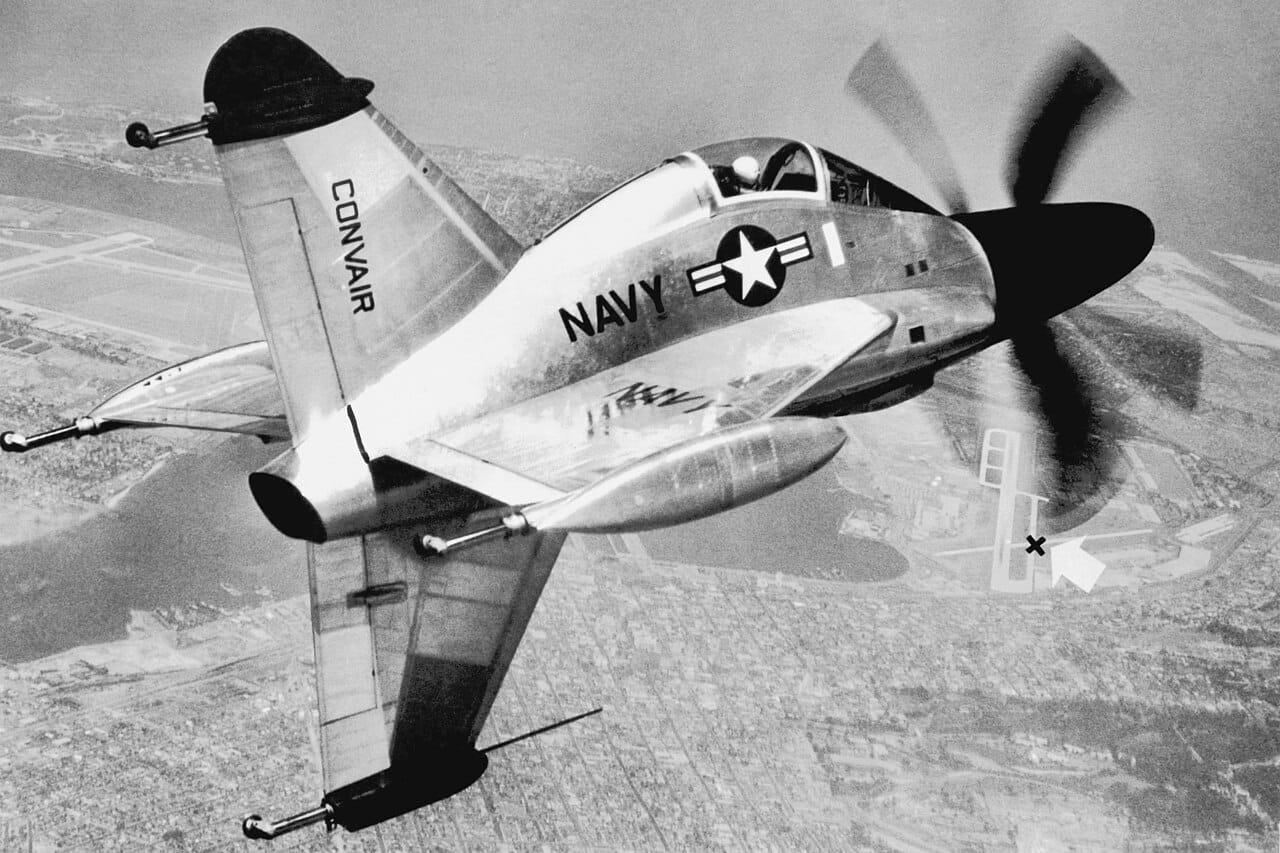
The aircraft sits on its tail in the hangar. The pilot climbs a ladder, then climbs another, until he is sitting almost flat on his back, looking straight up at the hangar ceiling. He starts the twin-section Allison turboprop driving its 16-foot contra-rotating propellers. He releases the brakes. The Convair XFY-1 Pogo lifts straight up, like a model rocket, accelerates to 250 knots, transitions to horizontal flight, and roars off across the California desert.
Then he has to land it. By looking backwards over his shoulder. While the aircraft hovers vertically and falls, very slowly, towards the ground. Most pilots could not have done it. James F. "Skeets" Coleman was the only test pilot to master the complete vertical-to-horizontal-to-vertical-to-landing sequence — and he made it clear he thought nobody else should have to try.
Quick Facts
Aircraft: Convair XFY-1 Pogo
Type: Tail-sitter VTOL fighter prototype
Engine: Allison YT40-A-16 turboprop, 5,500 hp, contra-rotating 16-ft propellers
First tethered flight: 29 April 1954
First full transition: 2 November 1954
Pilots qualified: 1 (J.F. "Skeets" Coleman)
Project end: 1 August 1955 — cancelled before second pilot trained
A Fighter for Every Ship
The US Navy's pitch in the early 1950s was simple. Suppose every destroyer, frigate, and supply ship had its own fighter — not catapult-launched, not on a deck, but stored vertically in a small hangar and flown straight up off a steel mat. The fleet would have air cover everywhere, all the time. The size of the aircraft carrier fleet would, in theory, no longer matter.
To make this work, somebody had to build a fighter that could take off and land vertically from a small platform. Convair and Lockheed both got contracts. Convair's answer was the XFY-1 Pogo: delta-wing, contra-rotating propellers, 5,500 horsepower in an airframe with a takeoff weight around 16,000 pounds.
Vertical Was the Easy Part
Coleman made the first tethered hovers inside Moffett Field's giant Hangar One in April 1954. Free flight followed. Vertical takeoff was, surprisingly, manageable. Transition to horizontal flight was smooth. The aircraft handled like a brick once it was on its side, but it flew.
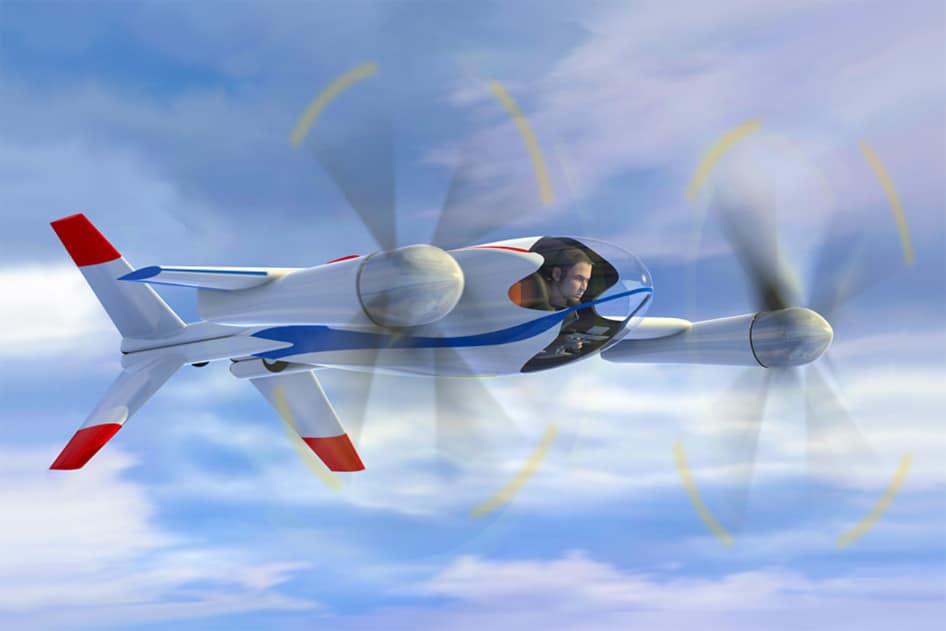
The problem was landing. To land, the pilot had to slow to a hover, transition the nose from horizontal to vertical, and descend tail-first. Looking forward, he saw nothing but sky. Looking down, he saw the cockpit floor. The only way to see the ground was to look back over his shoulder, while flying a heavy turboprop precisely on its propeller-thrust as it sank toward earth at one or two knots.
Coleman had to learn to fly the descent using peripheral vision and instruments alone — a skill no other aircraft demanded of its pilot, and one he found deeply uncomfortable every single time.
The Day Jets Won
While Convair was wrestling with the Pogo's landing problem, conventional jet fighters were getting faster, longer-ranged, and more capable. By 1955 the F-9F Panther was already obsolete. The Pogo was firmly subsonic — slower than a Korean War-era MiG-15 — while the new jets were pushing toward Mach 2. Its payload was negligible. And it required a unique, expensive pilot training pipeline that no fleet could afford.
The Navy cancelled the programme on 1 August 1955. The aircraft Coleman flew now belongs to the National Air and Space Museum, though it is currently in storage rather than on public display.
The Idea Refuses to Die
VTOL fighters did not go away. The British eventually solved the problem with the Hawker Harrier — vectored thrust nozzles, conventional cockpit. The Russians tried with the Yak-38. America has the F-35B, with its lift fan. None of these aircraft, however, are tail-sitters. The XFY-1 Pogo is the only aircraft in aviation history that took off from a vertical position by sitting on its propellers, and the only fighter that ever made the full transition from vertical to horizontal flight and back. It worked. Just barely. Once.
Sources: National Air and Space Museum, Convair type history, J.F. Coleman test reports.
Related Questions
What was the Convair XFY-1 Pogo?
The Convair XFY-1 Pogo was an experimental VTOL fighter prototype that took off and landed vertically, sitting on its tail like a rocket. Powered by an Allison turboprop driving 16-foot contra-rotating propellers, it was built for the US Navy in the early 1950s to test whether small ships could carry their own fighters.
How did a tail-sitter aircraft land?
A tail-sitter like the Pogo landed by hovering vertically, tail-down, and descending slowly to the ground. The pilot had to look backward over his shoulder to judge the descent - an extraordinarily difficult task. Other designs approached vertical flight differently, such as the hook-launched Ryan X-13 Vertijet.
Why did the Navy want a VTOL fighter?
The Navy imagined giving every destroyer, frigate, and supply ship its own fighter, stored vertically in a small hangar and launched straight up off a steel mat. This would provide air cover everywhere without aircraft carriers. Convair and Lockheed both received contracts to build experimental tail-sitters to test the idea.
Who flew the Convair XFY-1 Pogo?
Test pilot James F. "Skeets" Coleman was the only pilot to master the Pogo’s full vertical-to-horizontal-to-vertical landing sequence. He completed the first full transition on 2 November 1954 and made clear that he believed no one else should have to attempt such a demanding and dangerous flight.
Why was the XFY-1 Pogo cancelled?
The Pogo programme ended on 1 August 1955, cancelled before a second pilot was even trained. Vertical take-off and landing proved far too difficult and dangerous for routine fleet use - especially the backward-looking vertical landing. Ambitious VTOL fighters kept failing for similar reasons, like the never-flown Bell XF-109.
0 Comments