
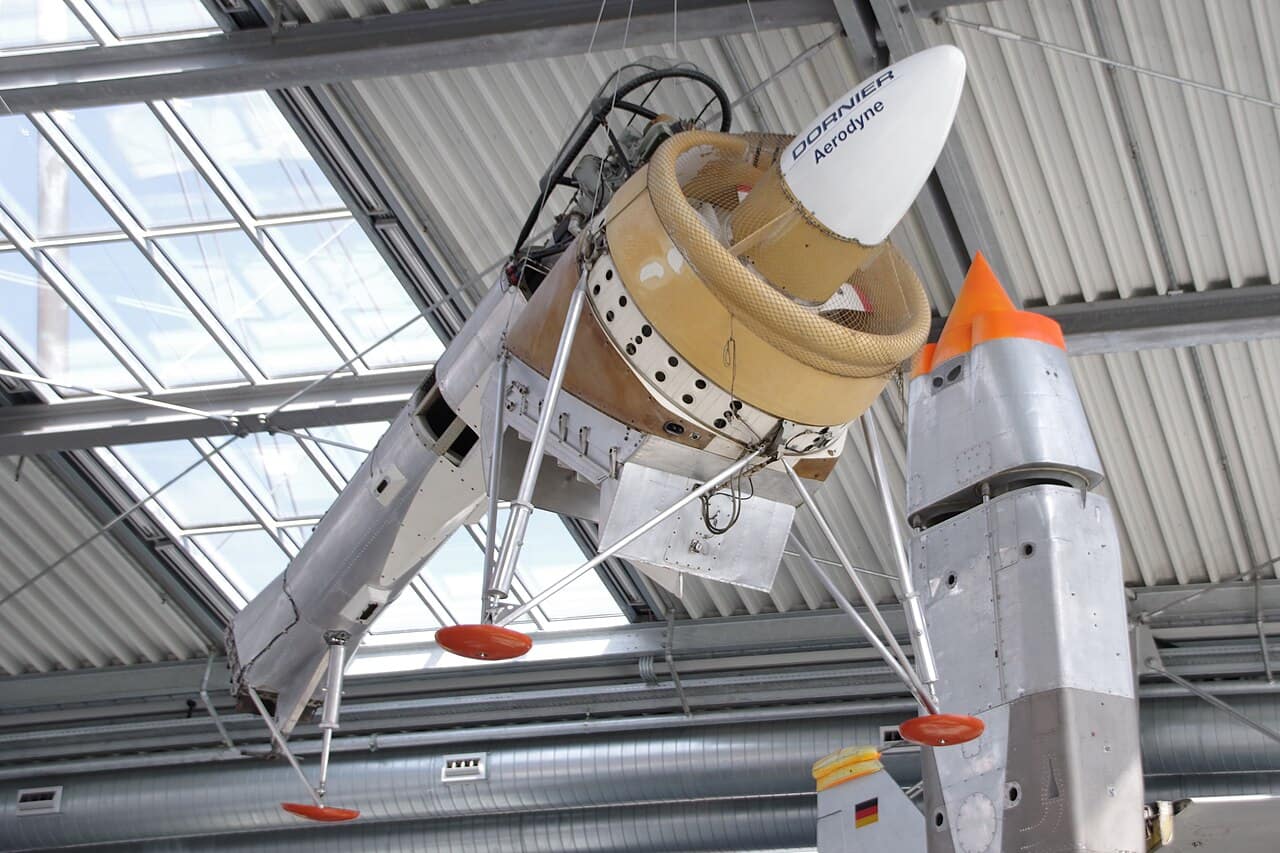
It is the morning of 18 September 1972, on a Dornier test field beside Lake Constance. There is no cockpit to climb into, no pilot to brief. The machine on the apron looks less like an aircraft than a fat steel cigar laid on its side: a smooth cylindrical body roughly the length of a small van, with no wings whatsoever and a gaping circular intake at the nose. An engineer flips a switch on a remote box. The single fan buried inside the body spools up, the deflector flaps at the tail bite into the slipstream — and the wingless thing lifts cleanly off the ground and hangs in the air.
This was the Dornier Aerodyne E1, and it remains one of the strangest flying machines ever to leave the ground. It threw out the single assumption every other aircraft is built on — that you need a wing to fly — and replaced it with one bold idea: that a single ducted fan could make both the lift and the thrust at once. Behind it stood Alexander Lippisch, the man who gave the world the delta wing and the rocket-powered Me 163, chasing the most radical configuration of his long career.
It flew. It hovered. And then, barely ten weeks later, it stopped — for good.
Quick Facts — Dornier Aerodyne E1
- Type: Wingless, unmanned VTOL experimental aircraft (research UAV)
- Designer / concept: Alexander Lippisch; built by Dornier Flugzeugwerke
- Customer: West German Federal Ministry of Defence (BMVg)
- First flight: 18 September 1972 · Programme ended: 30 November 1972
- Powerplant: one MTU 6022 A-3 turboshaft, 370 shp (280 kW)
- Length: 5.5 m (18 ft) · Width: 1.9 m (6 ft 3 in) · Fan diameter: 1.1 m (3 ft 7 in)
- Empty weight: 435 kg (959 lb) · Number built: 1
- Intended role: land- or ship-based reconnaissance drone
- Survivor: the sole prototype, at the Deutsches Museum (Flugwerft Schleissheim) since 2000
The man who distrusted wings
To understand the Aerodyne you first have to understand Alexander Lippisch (1894–1976), because few engineers spent a longer career questioning what a wing should look like. Born in Munich, he traced his fascination with flight to watching Orville Wright demonstrate an aircraft over Berlin in 1909. By the 1920s and 1930s he was Germany’s leading authority on tailless aircraft and swept, triangular planforms — the delta wing, the shape that would later define supersonic fighters from the Mirage to the modern hang glider.
His most famous creation was the Messerschmitt Me 163 Komet, the rocket-powered interceptor of the Second World War: a tiny, tailless, swept-wing dart that was among the fastest aircraft of its era and unlike anything else in the sky. After 1945 Lippisch worked in the United States, including a long stint at the Collins Radio Company in Cedar Rapids, Iowa, where his attention drifted toward ground-effect craft. In 1966 he set up the Lippisch Research Corporation — and it was from that restless workshop of ideas that the Aerodyne concept reached the West German government.
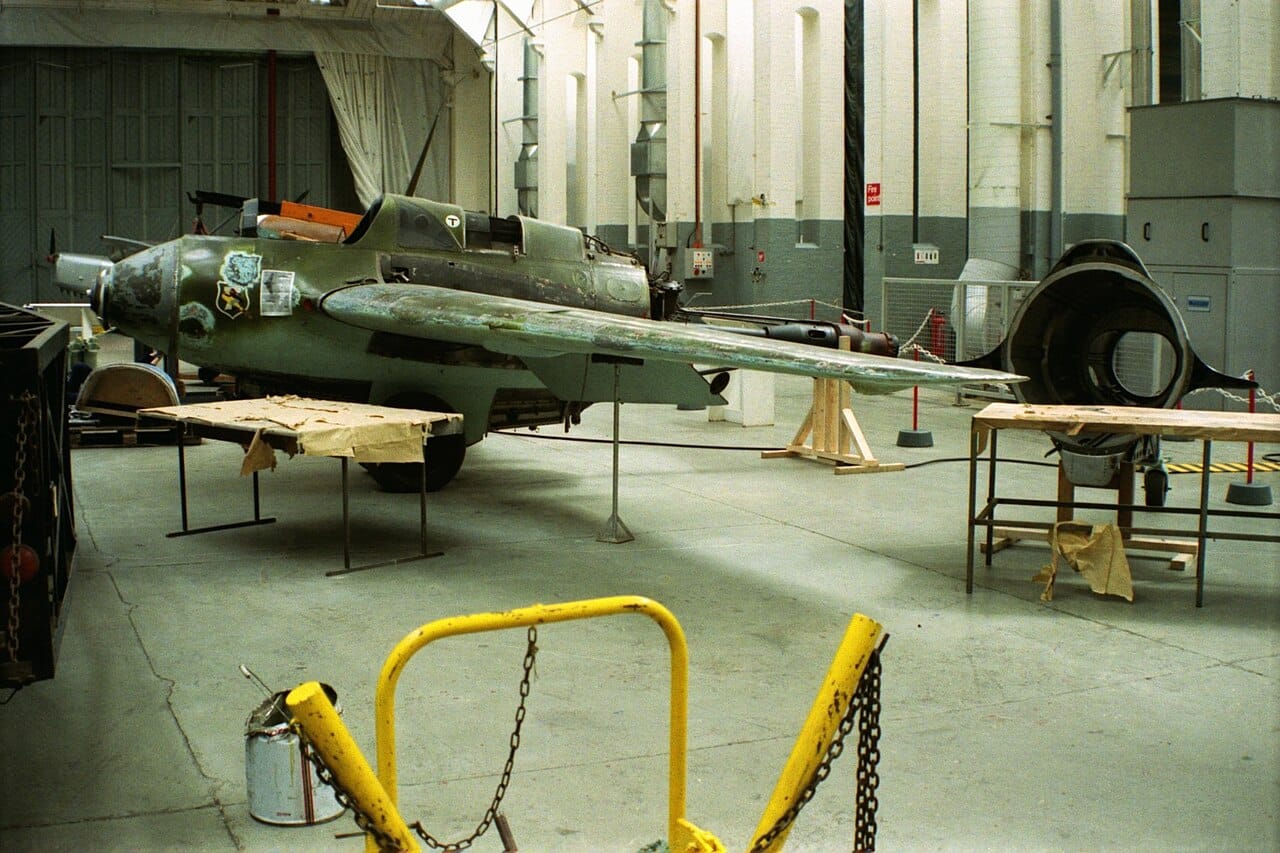
The thread running through all of it — the deltas, the flying wings, the ground-effect vehicles — was a single conviction: that the conventional wing-and-fuselage layout was a habit, not a law. The Aerodyne was the most extreme expression of that conviction. It asked what happened if you removed the wing altogether.
Lift and thrust from one fan
The principle was elegant in a way only a lifelong aerodynamicist would find obvious. A conventional aircraft separates its functions: a wing makes lift, an engine and propeller (or jet) make thrust, and the two are designed independently. A helicopter blends them — the rotor lifts and, when tilted, pulls the machine forward — but pays for it with mechanical complexity. Lippisch proposed something cleaner still.
Inside the Aerodyne sat a single large ducted fan, driven by an MTU 6022 A-3 turboshaft of 370 shaft horsepower (280 kW). The fan accelerated a column of air rearward through a duct. At the back of that duct were movable flaps. Deflect the airflow straight down and you got lift; let it stream rearward and you got thrust; set the flaps anywhere in between and you got a controllable mixture of the two. One flow channel, one fan, the whole flight envelope — from a stationary hover to full forward flight — governed by how the exhaust was steered.
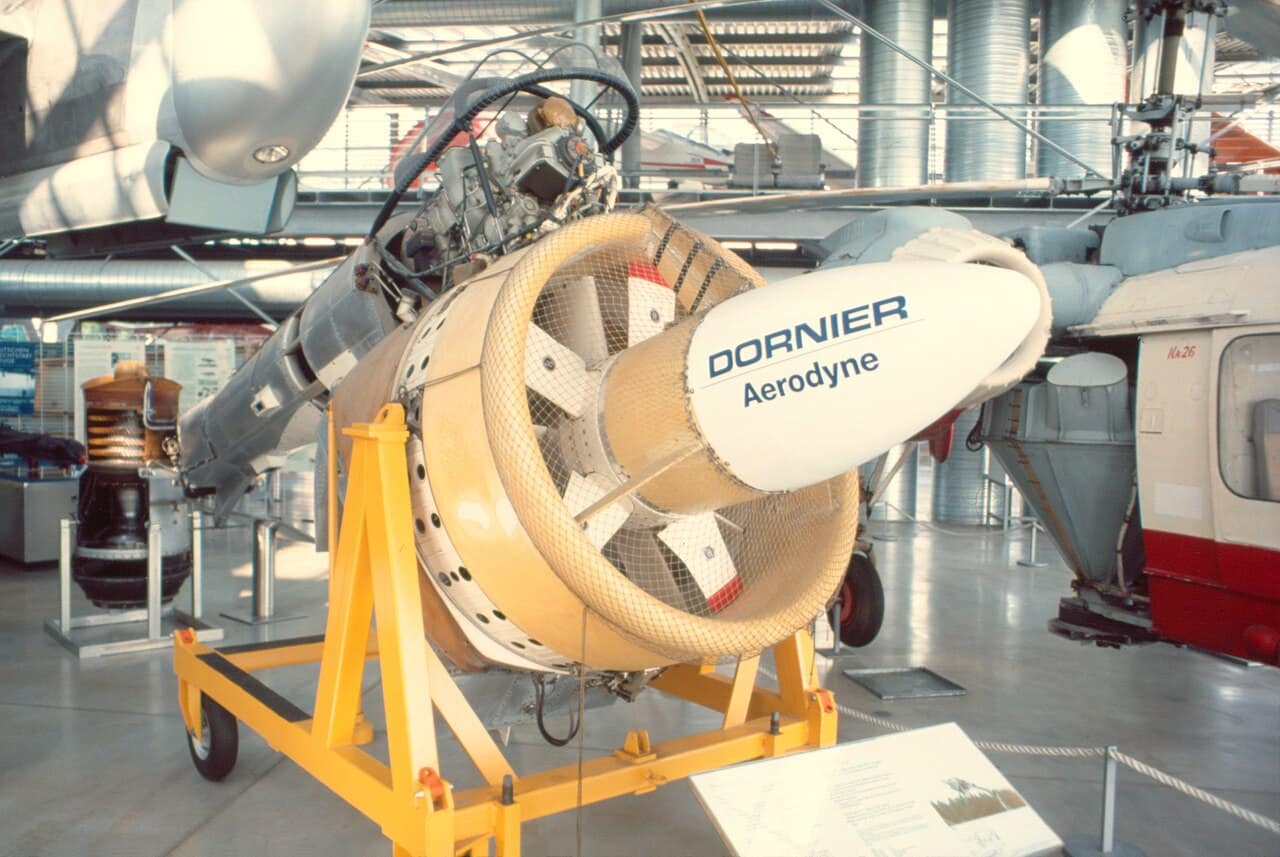
For forward flight the craft carried a small conventional tail unit at the rear, giving it pitch and yaw control once it was moving fast enough for the surfaces to bite. The whole vehicle was modest in size: 5.5 metres (18 ft) long, 1.9 metres (6 ft 3 in) wide, with a 1.1-metre (3 ft 7 in) fan and an empty weight of just 435 kg (959 lb). And crucially, it carried no one. The Aerodyne was flown unmanned, by remote control — a deliberate choice that pointed straight at its intended job.
The short film above walks through how the wingless, pilotless Aerodyne was meant to work, with footage of the prototype itself.
A drone before the world wanted drones
The Aerodyne was conceived as a reconnaissance drone — a small, expendable, unmanned platform that could be launched from land or from a ship, hover or dash to where it was needed, and carry sensors over the battlefield without risking a pilot. In the early 1970s that was a genuinely forward-looking idea. The vertical-takeoff capability meant it needed no runway; the wingless layout meant it could, in principle, be stored compactly aboard a vessel.
Dornier built a single flight-capable prototype, the Aerodyne E1, with Lippisch himself part of the team. It first flew on 18 September 1972 and went through a campaign of hovering trials that, by the accounts that survive, were successful: the machine lifted off, held a stable hover and demonstrated the attitude control the concept promised. Then, on 30 November 1972, the programme stopped.
Period newsreel coverage of the wingless-aircraft idea, capturing the era in which Lippisch was pitching the concept.
Why it went nowhere
The Aerodyne did not fail technically — it flew, and it did what it was asked to do in the hover. It failed for the most ordinary reason in defence engineering: nobody who could pay for it wanted it. The Bundeswehr showed little interest in an unmanned reconnaissance platform, reportedly preferring manned helicopters for that role. Without an operational requirement pulling it forward, there was no case for the expensive next steps — proving the full transition to forward flight, building sensors, hardening it for service.
So the single prototype became a curiosity. It is tempting, with the benefit of half a century, to call the Aerodyne a drone born too early: the small, runway-free, unmanned reconnaissance vehicle it imagined is now an entire industry. But the resemblance should not be overstated. Today’s reconnaissance drones are overwhelmingly conventional winged or rotary aircraft; the specific ducted-fan, wingless, lift-and-thrust-in-one-channel architecture that made the Aerodyne so strange never became mainstream. It is better understood not as a missed blueprint but as a dead-end branch — a brilliant one — on the family tree of flight.
That, in the end, is what makes it worth remembering. The Aerodyne is the rare machine that proved an outlandish idea could actually work, and was then quietly set aside anyway. Lippisch died in Cedar Rapids in February 1976, a few years after watching his wingless craft hover. His prototype outlived him: since 2000 the only Aerodyne ever built has sat in the Deutsches Museum’s Flugwerft Schleissheim, a fat steel cylinder on a cradle, still refusing to look like an aircraft at all.
Sources: Deutsches Museum (Flugwerft collection); Wikipedia; AeroTime; Britannica; Smithsonian National Air and Space Museum.
Related Questions
What was the Dornier Aerodyne?
The Dornier Aerodyne was a wingless, unmanned VTOL experimental aircraft conceived by German aerodynamicist Alexander Lippisch and built by Dornier for the West German Ministry of Defence. A single ducted fan produced both lift and thrust. The sole prototype, the Aerodyne E1, first flew on 18 September 1972 and is now preserved at the Deutsches Museum.
How did the Aerodyne fly without wings?
Instead of wings, the Aerodyne used one large ducted fan to generate a high-speed airflow. Adjustable flaps at the rear of the duct deflected that flow downward for lift or rearward for thrust, or any blend of the two. By varying the deflection, the craft could transition between vertical hover and forward flight without any conventional lifting surface.
Who was Alexander Lippisch?
Alexander Lippisch (1894–1976) was a German aeronautical engineer and pioneer of tailless aircraft, delta wings and ground-effect craft. His best-known design was the rocket-powered Messerschmitt Me 163 Komet interceptor. After the war he worked in the United States and later founded his own research firm, where he developed the Aerodyne concept.
Did the Dornier Aerodyne ever actually fly?
Yes. The Aerodyne E1 made its first flight on 18 September 1972 and completed successful tethered and free hovering trials. Testing ended on 30 November 1972. It demonstrated stable hover and attitude control but was never developed into a forward-flying operational vehicle.
Why was the Aerodyne programme cancelled?
The Aerodyne was intended as a land- or ship-based reconnaissance drone, but the Bundeswehr showed little interest, reportedly preferring manned helicopters for its aerial reconnaissance needs at the time. With no operational requirement behind it, funding stopped after the 1972 hover trials and the single prototype became a museum piece.
Where can you see the Dornier Aerodyne today?
The only Aerodyne ever built has been part of the Deutsches Museum collection since 2000 and is displayed at the museum’s Flugwerft Schleissheim aviation branch near Munich, mounted on its transport cradle.
0 Comments