
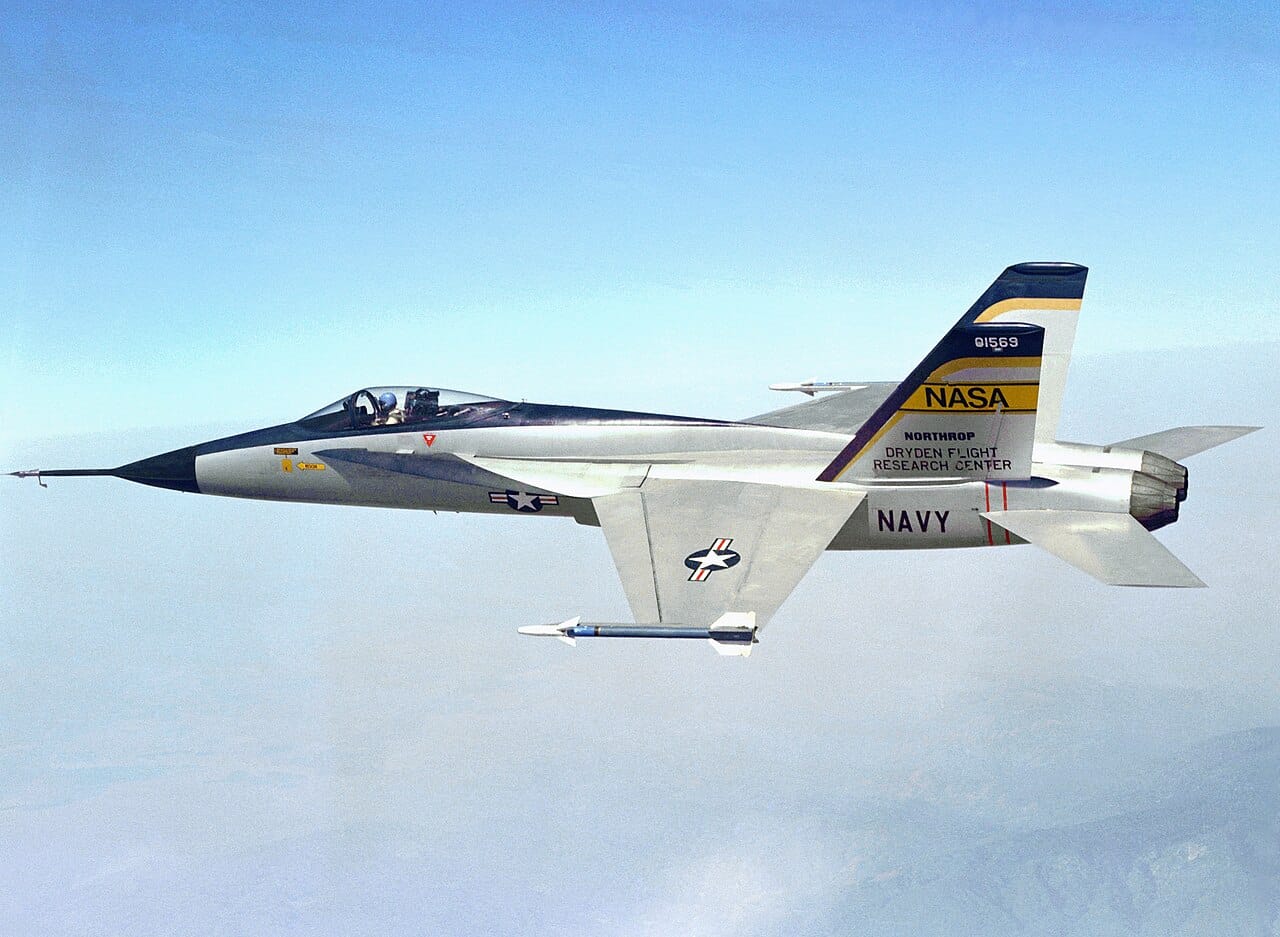
In the history of fighter aircraft, almost nobody remembers the runner-up. The jet that loses the competition gets a museum plaque, if it is lucky, and the winner gets the production line. The Northrop YF-17 Cobra is the great exception. It lost — and then went on to become one of the most successful naval fighters ever built.
The Lightweight Fighter fly-off
In the early 1970s the US Air Force wanted to test an idea: a small, cheap, ultra-agile dogfighter, a deliberate reaction to the big and expensive machines of the day. Two companies were funded to build prototypes for the Lightweight Fighter (LWF) programme. General Dynamics offered the single-engined YF-16. Northrop offered the twin-engined YF-17 Cobra.
The Cobra first flew on 9 June 1974, with Northrop test pilot Hank Chouteau at the controls. Two prototypes were built. Powered by a pair of General Electric YJ101 engines, the little fighter reached Mach 1.95, pulled up to 9.4 g and climbed past 50,000 feet. It introduced the aggressive wing-root extensions — those blended forebody strakes — that let it stay controllable at extreme angles of attack, a feature that would define fighters for decades.
Losing the contest
In January 1975 the Air Force announced its winner: the YF-16. It was slightly faster, a little cheaper, and it shared its F100 engine with the F-15, which simplified logistics. The F-16 Fighting Falcon went on to become the most widely produced Western fighter of the jet age. The YF-17, by every conventional measure, had lost.
The Navy's second chance
But there was another customer watching. The US Navy needed a new fighter of its own, and it did not like sending single-engined jets out over hundreds of miles of open ocean — two engines meant a far better chance of getting home if one failed. When the Navy launched its own fighter programme, it looked at the Air Force's rejected Cobra and saw exactly what it wanted.
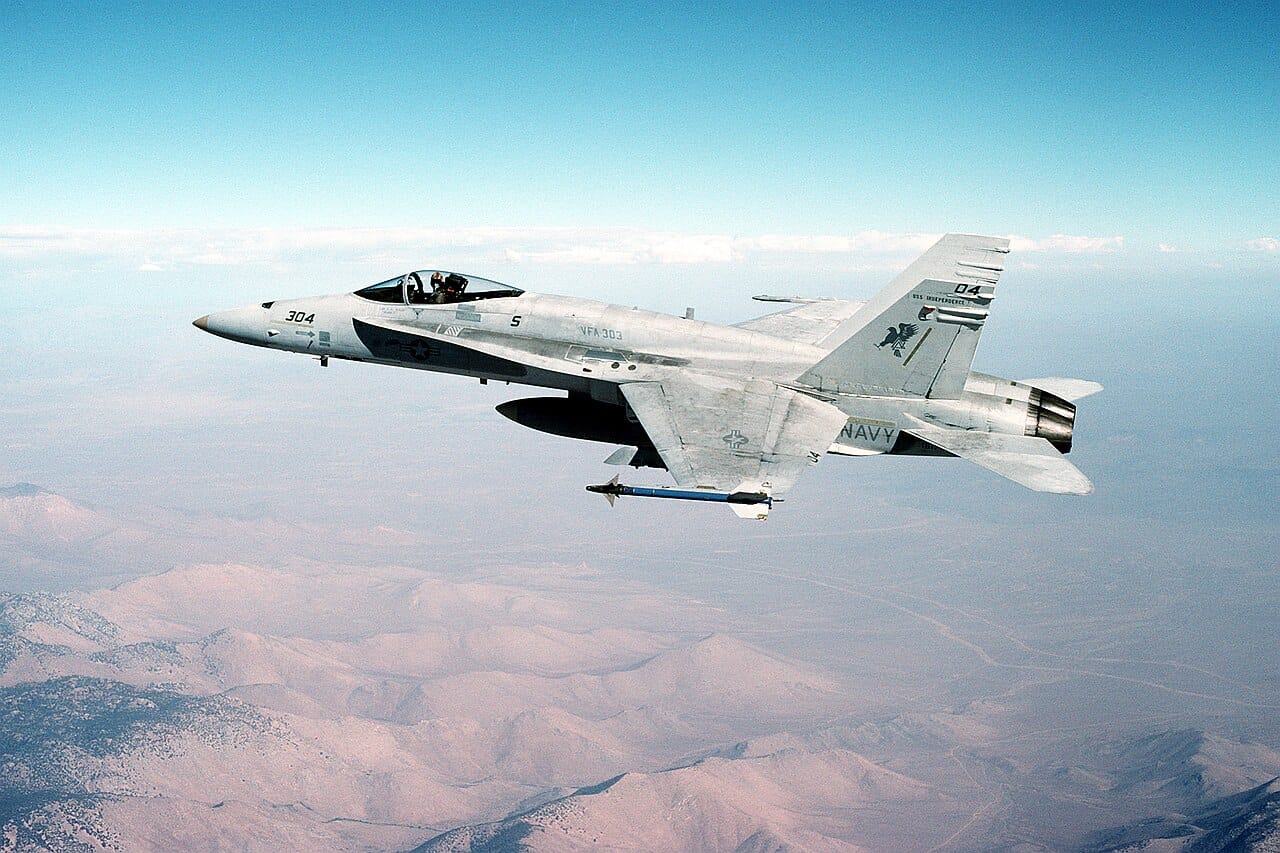
The YF-17 was handed to McDonnell Douglas, teamed with Northrop, and comprehensively enlarged and navalised — beefed-up structure, folding wings, an arrestor hook, more fuel, more capable radar and avionics. The result, first flown in 1978 and in service from 1983, was the F/A-18 Hornet.
The loser that won
The Hornet and its bigger brother, the Super Hornet, went on to fly from the decks of American carriers for over four decades, to serve half a dozen other air forces, and to become the mount of the Blue Angels display team. The YJ101 engines matured into the superb General Electric F404 family. The "cheap little dogfighter" that the Air Force turned down quietly became the backbone of US naval aviation.
It is one of aviation's best reminders that losing a competition is not the same as being wrong. The YF-17 Cobra was rejected, reworked, renamed — and outlived the very contest it had lost.
Related Questions
What was the Northrop YF-17 Cobra?
The Northrop YF-17 Cobra was a twin-engined prototype fighter built for the US Air Force's Lightweight Fighter programme in the early 1970s. It first flew on 9 June 1974 with test pilot Hank Chouteau. Although it lost the contest to the YF-16, its design was later enlarged and navalised into the F/A-18 Hornet, one of the most successful naval fighters ever built.
Did the YF-17 or the YF-16 win the Lightweight Fighter competition?
The YF-16 won. In January 1975 the US Air Force chose the single-engined General Dynamics YF-16 over Northrop's twin-engined YF-17, because it was slightly faster, a little cheaper, and shared its F100 engine with the F-15 to simplify logistics. The YF-16 became the F-16 Fighting Falcon, the most widely produced Western fighter of the jet age — one of many fighter competitions that shaped American air power.
How did the YF-17 become the F/A-18 Hornet?
After losing the Air Force contest, the YF-17 was handed to McDonnell Douglas, teamed with Northrop, and comprehensively enlarged and navalised for the US Navy — with a beefed-up structure, folding wings, an arrestor hook, more fuel and better radar. First flown in 1978 and in service from 1983, the result was the F/A-18 Hornet.
Why did the US Navy want a twin-engined fighter?
The US Navy preferred two engines because its jets fly hundreds of miles over open ocean, and a second engine greatly improves the chance of returning home if one fails. That requirement made the twin-engined YF-17 far more attractive to the Navy than the single-engined YF-16, and led directly to the F/A-18 Hornet.
What engine powered the YF-17?
The YF-17 was powered by two General Electric YJ101 engines, which let it reach Mach 1.95, pull up to 9.4 g and climb past 50,000 feet. The YJ101 later matured into the superb General Electric F404 family that powers the F/A-18 Hornet.
What are leading-edge strakes on a fighter jet?
Leading-edge strakes, or wing-root extensions, are blended forebody surfaces ahead of the wing that generate controllable airflow at high angles of attack. The YF-17 introduced these aggressive strakes, letting it stay controllable in extreme manoeuvres — a design idea that, alongside advances like fly-by-wire flight control, has defined fighters for decades.
Is the F/A-18 still in service?
Yes. The F/A-18 Hornet and its larger derivative, the Super Hornet, have flown from American aircraft carrier decks for over four decades and serve several other air forces. The Hornet is also the aircraft flown by the US Navy's Blue Angels display team, and it remains a backbone of US naval aviation.

0 Comments