
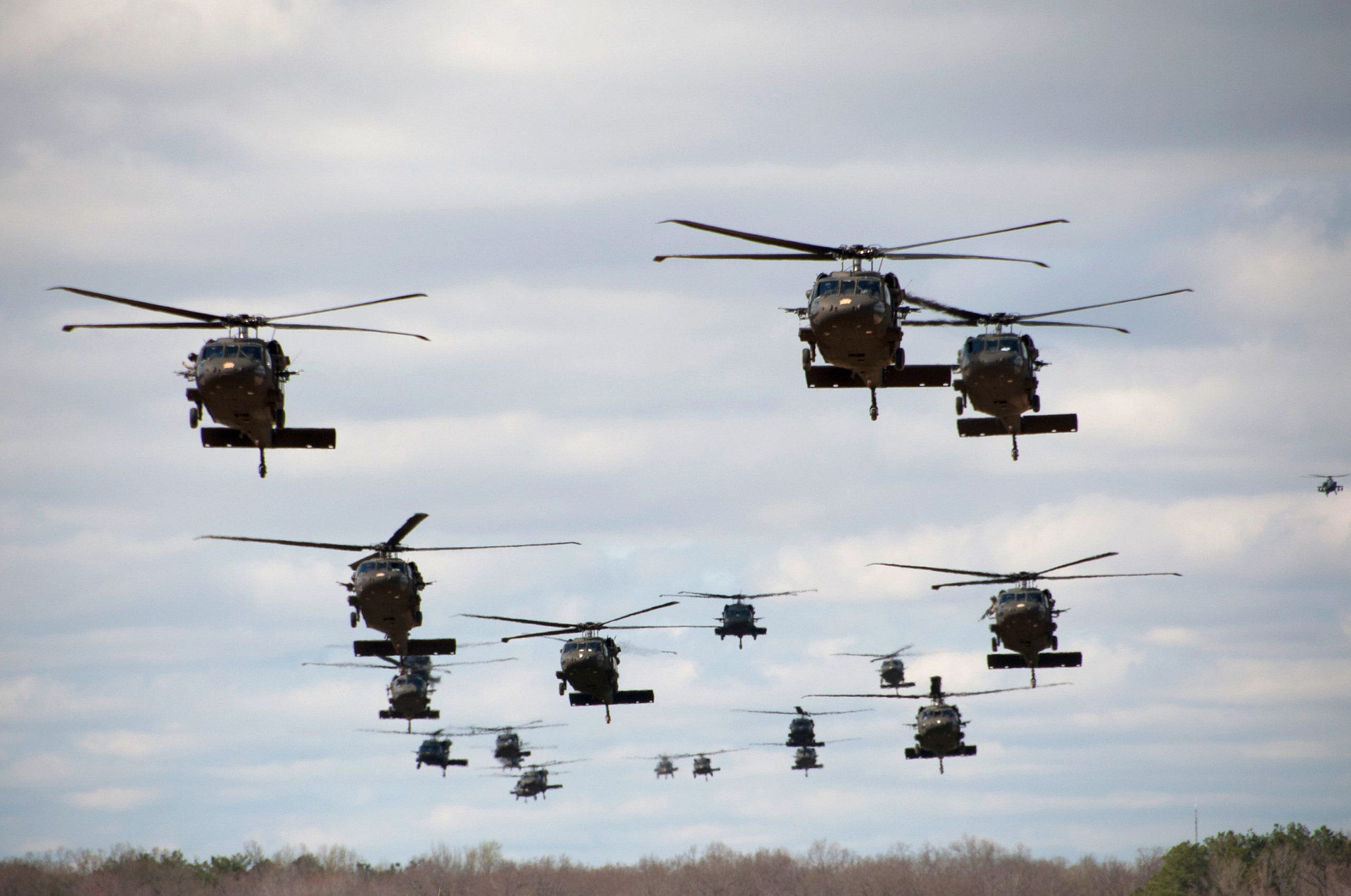
Sikorsky UH-60 Black Hawk
“The U.S. Army’s workhorse”
The definitive Western utility helicopter: a twin-turbine, four-blade machine built to carry an 11-soldier squad into battle and survive being shot down — blooded from Grenada and Mogadishu to Iraq and Afghanistan, spun into a vast family of rescue, special-operations and naval variants, and flown today by around 30 nations.
The UH-60 Black Hawk: how the U.S. Army replaced the Huey
The Black Hawk was the U.S. Army’s answer to a hard question posed by Vietnam: how do you carry a squad of soldiers into a hot landing zone and give them a real chance of coming home? The Bell UH-1 Huey had defined the air-assault era, but it was vulnerable, and its single engine and skid gear had limits. In 1972 the Army launched the Utility Tactical Transport Aircraft System (UTTAS) competition for a tougher, twin-engine successor.
Sikorsky’s entry, the YUH-60A, first flew on 17 October 1974. In December 1976 the Army chose it over the Boeing-Vertol YUH-61A, and the UH-60A Black Hawk entered service in 1979. The design was built around survivability: two General Electric T700 turboshafts, a four-blade rotor, a crashworthy airframe with energy-absorbing seats and landing gear, and a wide cabin sized for an 11-soldier squad.
What followed was one of the most successful helicopter programmes in history. The basic airframe spawned an enormous family — the improved UH-60L and UH-60M, the MH-60 special-operations variants, the HH-60 rescue helicopters, the navalised MH-60 Seahawk, the VH-60 that carries the U.S. President, and the civilian Firehawk firefighter. More than 5,000 H-60s have been built, and the type serves with roughly 30 nations.
01Why the UH-60 Black Hawk exists: the UTTAS competition and the lessons of Vietnam
Helicopter losses in Vietnam drove the Army to want a transport that was harder to kill. The UTTAS requirement asked for two engines (so one hit need not be fatal), a crashworthy structure able to absorb a hard vertical impact, self-sealing fuel tanks, and a rotor and drivetrain that could keep turning after damage.
Sikorsky’s S-70 design beat the Boeing-Vertol YUH-61A in a 1976 fly-off. The winning formula — twin T700 turboshafts, a low-slung four-blade rotor, a wheeled undercarriage and a boxy, protected cabin — became the template for Western utility helicopters for the next half-century.
02The UH-60 Black Hawk’s name and markings: the Army’s Native American naming tradition
Following the U.S. Army’s long-standing convention of naming helicopters after Native American peoples and leaders (Huey/Iroquois, Chinook, Kiowa, Apache), the UH-60 is named “Black Hawk” after the Sauk leader Black Hawk. Sikorsky’s own company designation is the S-70; export and civil versions are usually sold under that name.
How the UH-60 Black Hawk works: engines, survivability and the cabin
Two T700 turboshafts and a four-blade rotor
Two General Electric T700 engines drive a four-blade main rotor with a distinctive canted tail rotor. The twin-engine layout means a single hit or failure need not bring the helicopter down, and gives the power to lift a full squad or an under-slung load in demanding conditions.
Built to survive the crash
Survivability was the founding requirement. The Black Hawk has a crashworthy structure, energy-absorbing crew seats and landing gear, self-sealing and crash-resistant fuel tanks, redundant flight controls and armour around the cockpit — all designed so the crew can walk away from a hard landing that would destroy an older helicopter.
A cabin for the squad
The wide, low cabin was sized to carry an 11-soldier squad with their equipment, or be reconfigured for medical litters, cargo or specialist mission kit. Wide doors on both sides speed loading and unloading in a hot landing zone, and the aircraft can also carry loads on an external hook.
03The UH-60 Black Hawk’s cabin and lift: troops, litters and slung loads
In the assault role the Black Hawk typically carries an 11-soldier infantry squad; in the MEDEVAC role it is fitted for stretchers and a hoist. It can also lift external loads on a cargo hook — commonly quoted at around 4,000 kg (roughly 9,000 lb) for the up-rated variants, enough to sling a light vehicle or an artillery piece, though the exact figure varies by model and conditions.
Two door-mounted machine guns (typically 7.62 mm M240s, sometimes a door-mounted minigun) give the crew chiefs suppressive fire on the way in and out. Dedicated armed and special-operations versions add far heavier weapons.
04The UH-60 Black Hawk family: MEDEVAC, special operations, Seahawk and Marine One
Few airframes have branched as widely. The HH-60 Pave Hawk and Jayhawk fly combat search-and-rescue; the MH-60 Black Hawks (and the heavily-armed Direct Action Penetrator) serve special operations; the navalised MH-60 Seahawk / Romeo & Sierra hunts submarines and ships from carriers and frigates; the VH-60 carries the U.S. President as one of the “Marine One” helicopters; and the civil Firehawk fights wildfires with a belly tank.
05From Sikorsky S-70 to Lockheed Martin: who builds the UH-60 Black Hawk
The Black Hawk is designed and built by Sikorsky Aircraft, historically of Stratford, Connecticut. Sikorsky was owned by United Technologies for decades and was acquired by Lockheed Martin in 2015; the Black Hawk remains in production for the U.S. Army and export customers, and it has also been built under licence abroad (for example in Poland, Turkey and elsewhere).
UH-60 Black Hawk specifications: dimensions, performance and cost
Baseline note: the figures below describe the UH-60M, the standard US Army production Black Hawk since 2007 and the version most operators now buy. The UH-60A of 1979 and the UH-60L of 1989 are the same airframe with less power, a weaker gearbox and analogue instruments; where they differ materially the delta is given in grey. The naval SH-60B/F Seahawk and the MH-60R/S that replaced them are a separate aircraft in everything but the dynamic system — folding rotor and tail, different fuselage, different mission — and are treated as a cross-reference here rather than folded into these numbers. Figures are drawn from the Lockheed Martin/Sikorsky UH-60M brochure, US Army programme documents and the General Electric T700-GE-701D data sheet.
Dimensions & weights
- Экипаж
- 2 pilots plus 2 crew chiefs or door gunners
- Cabin load
- 11 equipped troops, or 6 litters with a medical attendant
- Length, rotors turning
- 19.76 m (64 ft 10 in)
- Fuselage length
- 15.26 m (50 ft 1 in)
- Fuselage width
- 2.36 m (7 ft 9 in) — the deliberately narrow, low body that lets the aircraft go into a C-130 with the rotor head and tail folded
- Высота
- 5.13 m (16 ft 10 in) to the top of the rotor head; the tail pylon folds for shipboard and airlift stowage
- Main rotor diameter
- 16.36 m (53 ft 8 in)
- Disc area
- 210.0 m² (2,260 sq ft)
- Tail rotor
- 3.35 m (11 ft 0 in), four blades on a rigid crossbeam, canted 20° to port so it contributes lift as well as anti-torque
- Пустой вес
- 5,675 kg (12,511 lb)
- Максимальная взлетная масса
- 9,980 kg (22,000 lb) — UH-60A 9,185 kg (20,250 lb), UH-60L 10,660 kg (23,500 lb) at the overload alternate gross weight
- Internal payload
- 1,450 kg (3,190 lb)
- External sling load
- 4,080 kg (9,000 lb) on the single cargo hook — enough for an M119 howitzer with crew and ammunition, which is the number that mattered to the artillery
- Disc loading
- 35.1 kg/m² (7.19 lb/sq ft)
Performance
- Never-exceed speed
- 357 km/h (222 mph, 193 kt)
- Maximum level speed
- 294 km/h (183 mph, 159 kt)
- Cruising speed
- 282 km/h (175 mph, 152 kt) at maximum-range weight
- Скорость подъема
- 8.4 m/s (1,646 ft/min)
- Hover ceiling, in ground effect
- ~3,050 m (10,000 ft) at light weight; like every hover figure this collapses with weight and temperature and is quoted here only as an order of magnitude
- Hover ceiling, out of ground effect
- Sikorsky guarantees an OGE hover at 1,220 m (4,000 ft) and 35 °C at 9,070 kg (20,000 lb) — a contractual hot-and-high figure, and a far more useful one than an absolute ceiling
- Служебный потолок
- 5,790 m (19,000 ft)
- Range, internal fuel
- ~590 km (~370 mi, ~320 nmi)
- Endurance, internal fuel
- ~2 h 20 min at economical cruise; mission planning rarely assumes more than two hours
- Ferry range
- 2,220 km (1,380 mi, 1,199 nmi) with ESSS stub wings and four external tanks
- Crash survivability
- Designed to MIL-STD-1290: the structure, gear and seats together are intended to keep occupants alive in a 11.6 m/s (38 ft/s) vertical impact, roughly a fall from 7 m (23 ft), with 20 g longitudinal restraint
- First combat use
- Grenada, October 1983
Propulsion & systems
- Engines
- 2 × General Electric T700-GE-701D turboshaft — UH-60A: T700-GE-700 of 1,151 kW (1,543 shp); UH-60L: T700-GE-701C of 1,417 kW (1,900 shp)
- Power
- 1,491 kW (2,000 shp) each at the intermediate rating
- Transmission rating
- 2,535 kW (3,400 shp) dual-engine input — the gearbox, not the engines, sets what the aircraft can lift (UH-60A: 2,109 kW / 2,828 shp)
- Rotor system
- Fully articulated four-blade main rotor with elastomeric bearings and no lubrication points; blades built on a titanium spar with a Nomex honeycomb core, graphite trailing edge and a swept tip; each blade is designed to keep flying after a 23 mm hit
- Fuel
- ~1,360 litres (~360 US gal) in two crashworthy, self-sealing tanks; up to four 760-litre (200 US gal) crashworthy external tanks on the ESSS (the original 870- and 1,700-litre ferry tanks were not crashworthy and were replaced)
- Auxiliary power unit
- Honeywell T-62T-40-1 gas turbine, for engine start and ground power independent of a ground cart
- Avionics
- UH-60M glass cockpit: four multifunction displays, dual embedded GPS/inertial navigation, digital moving map, coupled flight director and an Integrated Vehicle Health Management System (the UH-60V is a UH-60L rewired to this cockpit standard; the UH-60A/L cockpit is analogue)
- Sights and sensors
- None. The transport Black Hawk carries no targeting sensor at all — no mast sight, no turret (nose FLIR and hoist are fitted to the HH-60M, HH-60W and the MH-60 special-operations marks; the MH-60M adds AN/APQ-187 Silent Knight terrain-following radar)
- Self-protection
- AN/APR-39 radar warning, AN/AAR-57 Common Missile Warning System, M130 chaff and flare dispensers, and an infrared jammer — the AN/ALQ-144 "disco ball" on older fits, laser-based CIRCM on new ones
- Seats
- Armoured, energy-absorbing crew seats that stroke vertically on impact; energy-absorbing troop seats. This, more than any single other feature, is what the Army bought
- First flight
- 17 October 1974 (YUH-60A); UH-60M first flight 17 September 2003
- Service entry
- June 1979 with the 101st Airborne Division; UH-60M from 2007
- Number built
- More than 5,000 H-60 and S-70 airframes of all marks by January 2023, and still in production at Stratford and at PZL Mielec in Poland
- Unit cost
- ~US$21 million flyaway for a US Army UH-60M in recent multi-year buys; export prices with spares, training and support routinely run two to three times that per aircraft
06UH-60 Black Hawk variants: from the UH-60A to the UH-60M, MH-60 and HH-60
UH-60A — the original production Black Hawk (service from 1979).
UH-60L — from 1989, with more powerful engines and an uprated gearbox.
UH-60M — the current standard, with new wide-chord rotor blades, more powerful T700-GE-701D engines, a digital “glass” cockpit and strengthened airframe.
MH-60 special operations, HH-60 combat rescue, MH-60 Seahawk naval, VH-60 presidential and the civil Firehawk round out the family.
07The UH-60 Black Hawk’s operating costs: what a Black Hawk costs to buy and fly
Costs vary widely with variant, contract and customer. Recent UH-60M flyaway prices are frequently reported in the region of USD 15–21 million, with full Foreign Military Sales packages (training, spares, support) running higher per aircraft.
Cost per flight hour is commonly estimated at roughly USD 4,000–8,000 or more, but published figures differ widely depending on what is counted (fuel only, or fuel plus maintenance, overhaul and support). Treat any single number as an estimate.
Armament & payload
The Black Hawk is a transport that shoots back, not a gunship, and the distinction is the whole design
A US Army UH-60M is defensively armed and nothing more: two pintle-mounted machine guns in the cabin doors, fired by the crew chiefs, with no sight, no turret and no targeting system anywhere on the aircraft. Everything heavier hangs on the External Stores Support System, a pair of stub wings bolted to the cabin roof with two pylons each, rated at up to 4,540 kg (10,000 lb) of stores and normally used for fuel rather than weapons. The ESSS can carry Hellfire, rocket pods, gun pods and mine dispensers, and Colombia’s AH-60L Arpiía and the US Army’s MH-60L Direct Action Penetrator turn that capability into a genuine gunship — but those are conversions of a transport, and they are heavy, thirsty and short-legged for it. The Army’s own experience with the ESSS is instructive: fitting four fuel tanks blanks the door gunners’ field of fire, which is why the two-tank External Tank System exists at all. Fits vary enormously by operator and by mark; almost nothing in this section is standard across the fleet, and the armed variants below are exceptions rather than the rule.
Door guns
- 2 × 7.62 mm M240H machine guns on pintle mounts in the cabin doors — the standard US Army fit, one per side, fired by the crew chiefs.
- 2 × 7.62 mm M134 miniguns, six-barrel, roughly 3,000 rounds per minute — the special-operations and armed-escort fit, and the gun most people picture.
- 2 × 12.7 mm GAU-19/A three-barrel guns on some armed and export configurations.
- None of these has a sight beyond an open ring and the gunner’s eye; they are suppression weapons for a landing zone, not precision ones.
External stores system
- ESSS: four pylons on two cabin-roof stub wings, in service since 1986, rated to about 4,540 kg (10,000 lb) of stores.
- ETS: a cut-down two-pylon version, adopted precisely because the full four-tank ESSS fit masks the door guns.
- Crashworthy External Fuel System: up to four 760-litre (200 US gal) self-sealing tanks, the normal ESSS load in Army service.
- The wings are structural add-ons, not part of the basic airframe, and they cost cruise speed and hover performance when fitted.
Guided weapons
- AGM-114 Hellfire laser-guided missile — up to four per pylon on M299 rails, so sixteen on a fully armed DAP or Arpiía; a laser designator has to come from the aircraft’s own FLIR or from the ground.
- AIM-92 Stinger air-to-air missiles, two per station, carried by some armed configurations for self-defence.
- Spike NLOS on Israeli and some export armed fits.
- The baseline UH-60M carries no guided weapon of any kind and has no way of designating for one.
Rockets, pods and mines
- 70 mm Hydra 70 rockets in seven-tube M260 or nineteen-tube M261 pods; APKWS laser guidance kits on later fits.
- Gun pods in 7.62 mm, 12.7 mm, 20 mm and the 30 mm M230 chain gun, the last being the Apache’s weapon in a podded mount.
- M139 Volcano scatterable mine dispenser — a genuine Army mission for the type, and a reminder that the ESSS was designed for engineer as much as attack work.
- No bombs of any kind are carried.
Troops, cargo and casualties
- 11 equipped infantry on energy-absorbing seats, or 6 litters and a medical attendant in the HH-60M aeromedical fit.
- 1,450 kg (3,190 lb) internal, or 4,080 kg (9,000 lb) on the single belly hook; the hook load is the more commonly used figure in the field.
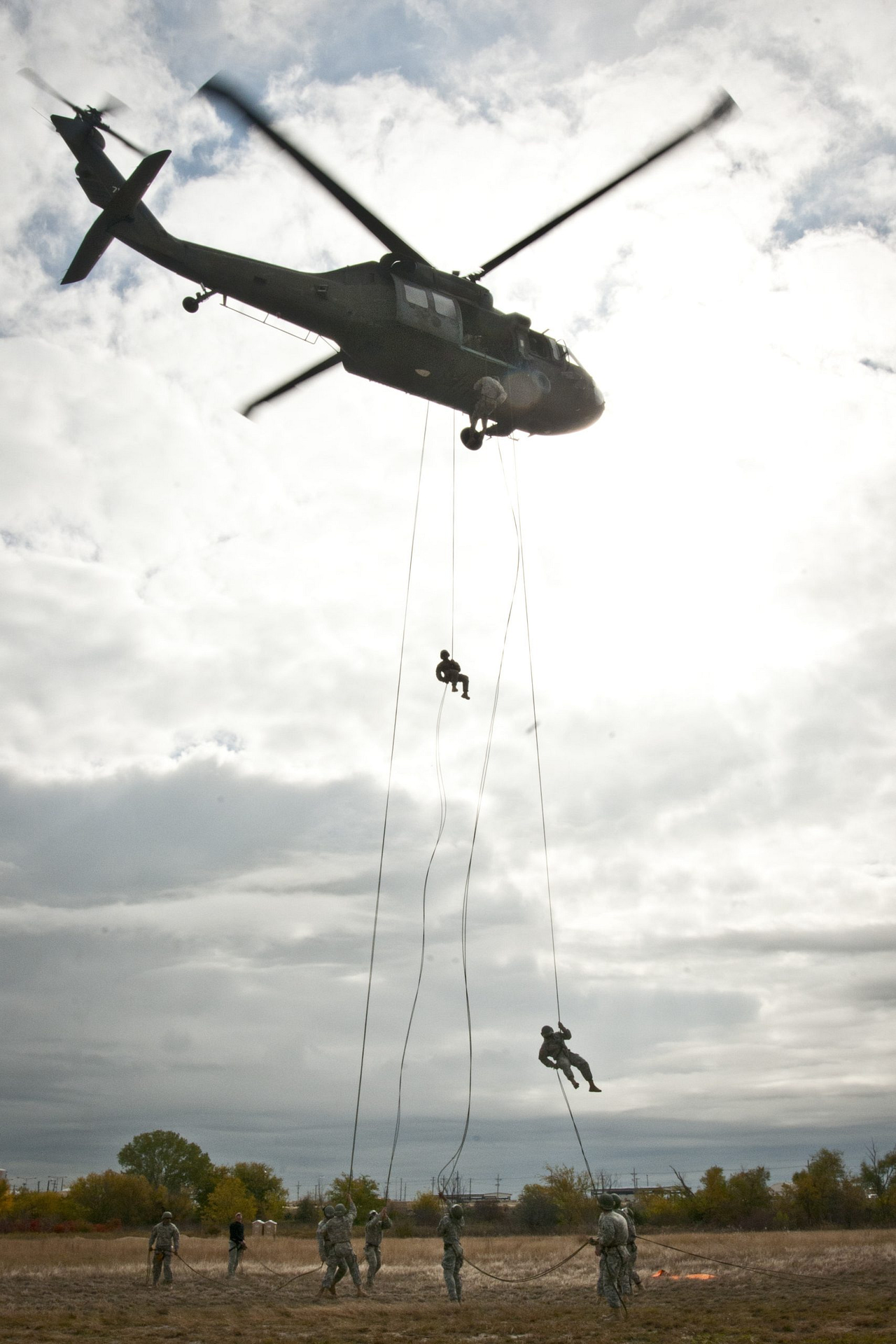
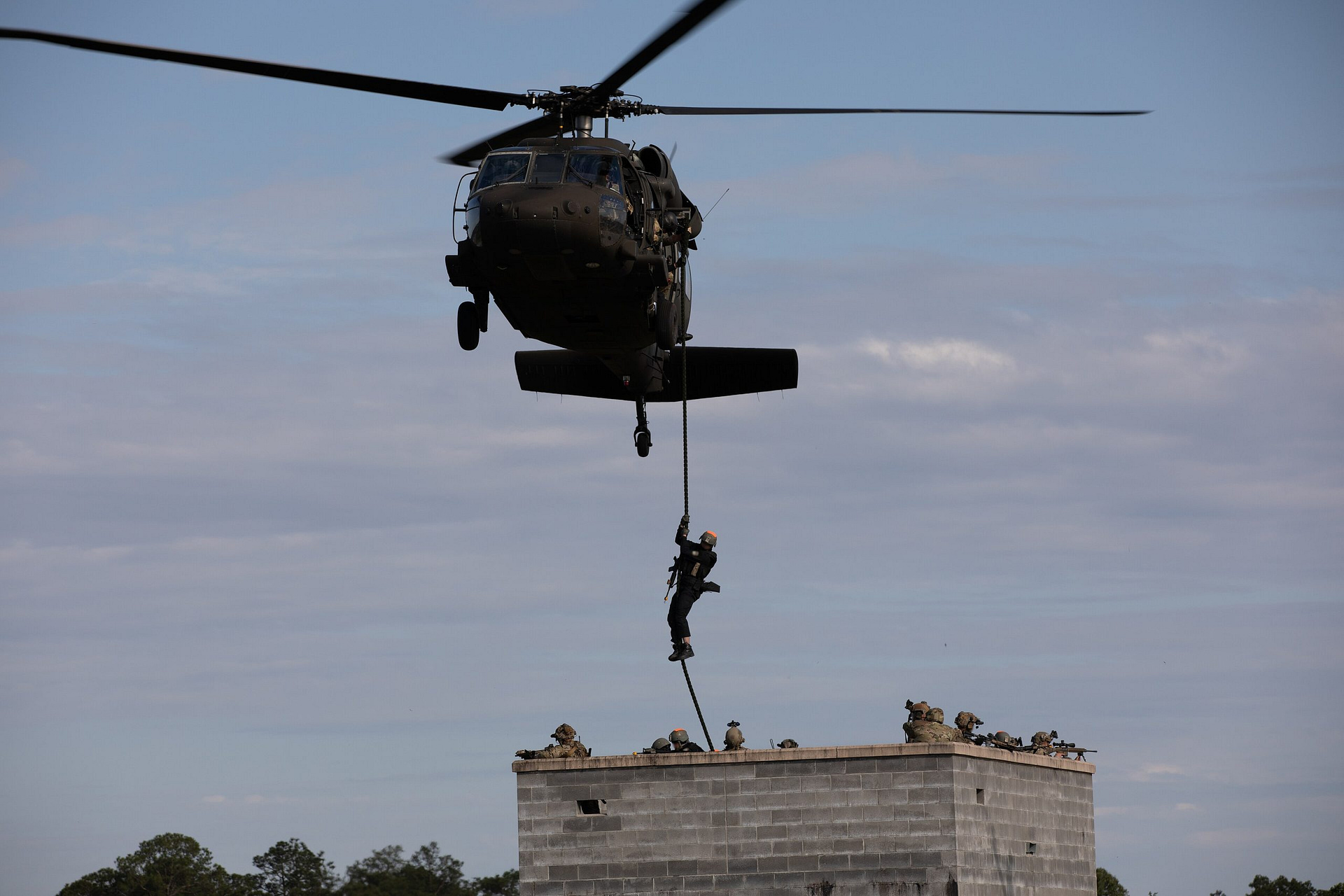
- Fast-rope insertion and extraction rigs, rescue hoist, and the Enhanced Speed Bag System for airdropping resupply from 30 m (100 ft) instead of 3 m.
- An M119 105 mm howitzer, its crew and a first load of ammunition move as one Black Hawk sling and one Black Hawk cabin, which is how US air-assault artillery is organised.
Survivability equipment
- Armoured, stroking crew seats and energy-absorbing troop seats; ballistically tolerant flight controls, hydraulics and electrics, each duplicated.
- Self-sealing crashworthy fuel cells with break-away valves — the single largest killer in Huey crashes was post-impact fire, and this is the answer to it.
- Run-dry gearboxes rated to keep turning for 30 minutes after losing all oil.
- AN/APR-39 radar warning, AN/AAR-57 missile warning, M130 chaff and flare, and infrared jamming — ALQ-144 on legacy aircraft, CIRCM on new ones.
Three typical loadouts
- Air assault, US Army UH-60M
- Eleven infantry, two M240H door guns with roughly 800 rounds each, internal fuel only, no stub wings. This is the aircraft doing the job it was designed for, and it is how the overwhelming majority of Black Hawk sorties are flown.
- Aeromedical evacuation, HH-60M
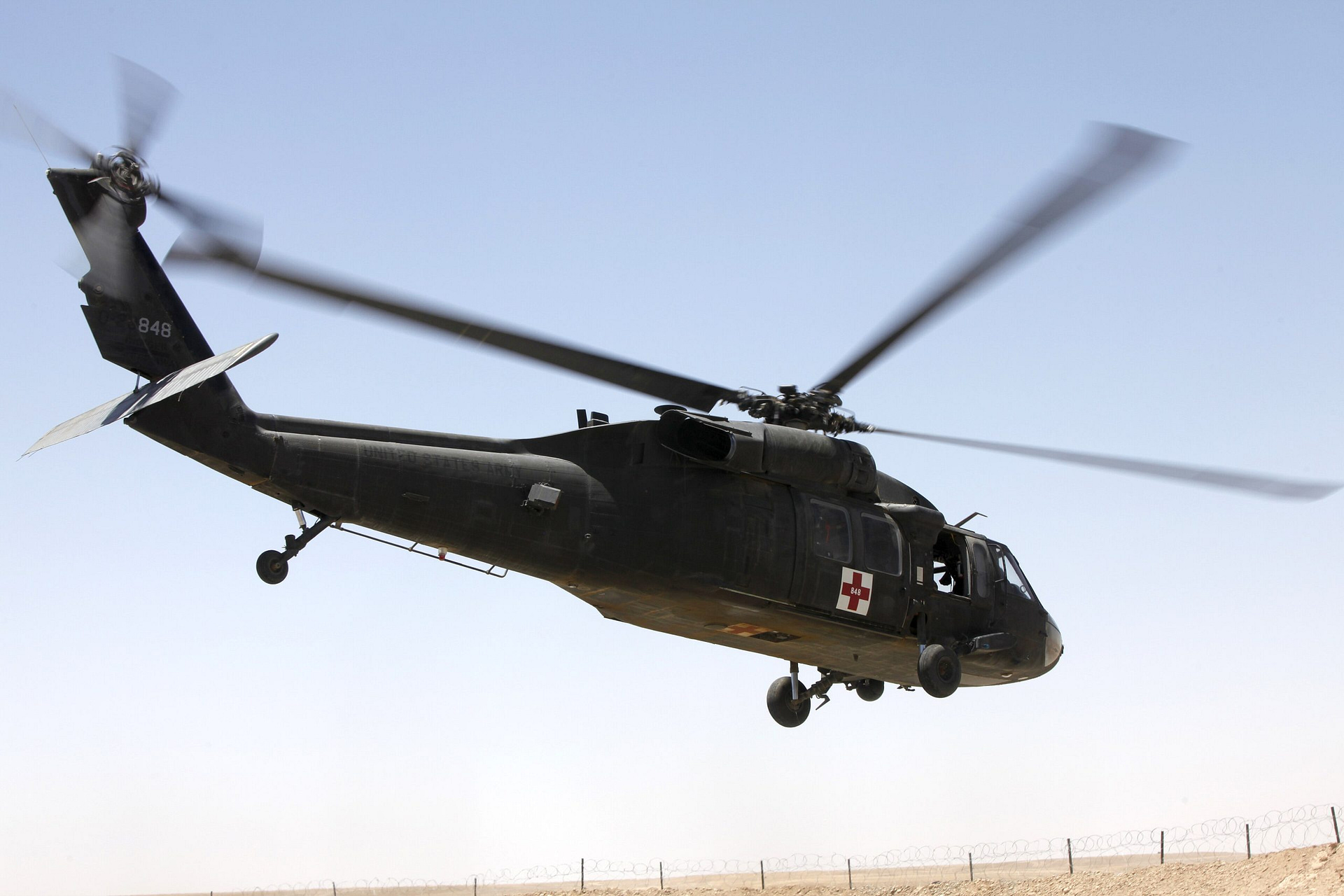
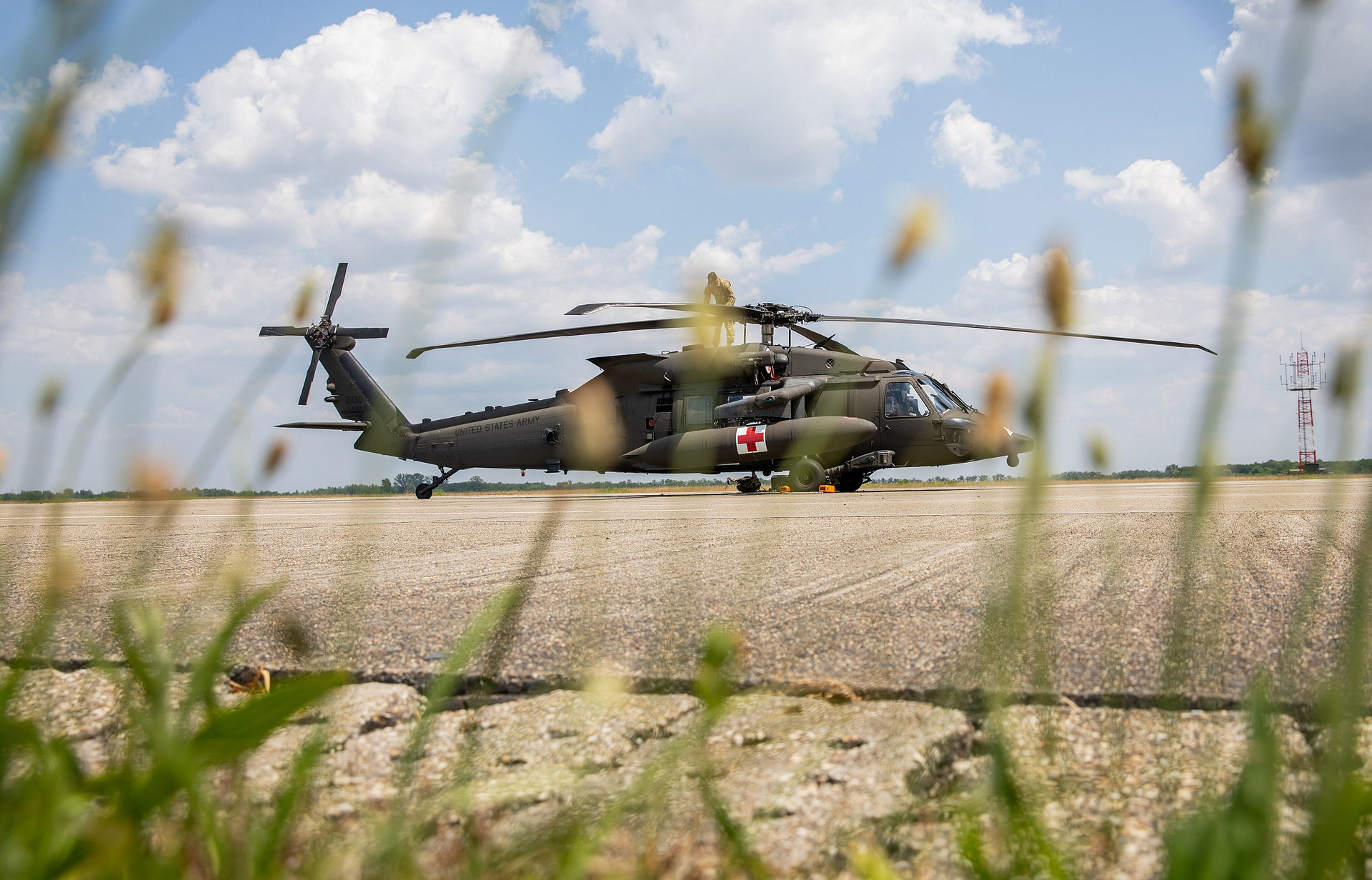
- Six litters on a powered carousel, on-board oxygen and suction, a rescue hoist, an environmental control system and a flight medic; nose FLIR for the pickup. Unarmed by convention and marked with red crosses, though crews in Afghanistan and Iraq frequently flew with the markings painted out and door guns fitted.
- Armed escort, MH-60L Direct Action Penetrator
- ESSS wings carrying up to sixteen Hellfire, or a mix of Hellfire, 70 mm rocket pods and a 30 mm M230 gun pod, plus two M134D miniguns in the doors and a FLIR turret. The cabin gives up its seats to ammunition and fuel. Endurance is the binding constraint. Operated only by the US Army’s 160th Special Operations Aviation Regiment.
Sourcing caveat: US Army technical manuals for the H-60 armament subsystems are the authority for the fits listed here, but individual operators mix and match freely, and published lists routinely conflate what the ESSS has been cleared to carry with what any given fleet actually flies. Where a weapon has been demonstrated but not fielded, it is not listed.
Variants
The UTTAS requirement asked for a helicopter that would survive being shot down, and Sikorsky built the family around that answer
The Utility Tactical Transport Aircraft System requirement was written in the shadow of Vietnam, where the Army had lost something over 5,000 helicopters and where a survivable crash was very often a fatal one. The 1972 request for proposals asked for twin engines with real hot-and-high margin, run-dry gearboxes, duplicated and ballistically tolerant hydraulics, electrics and flight controls, crashworthy self-sealing fuel, armoured stroking seats, dual-stage oleo main gear that could absorb a heavy vertical arrival, and a structure that would deform predictably rather than fold. It also required the aircraft to fit inside a C-130, which is why the Black Hawk is so wide and so low-slung and why it looks nothing like the tall, narrow Huey it replaced.
Sikorsky’s YUH-60A flew on 17 October 1974 and beat the Boeing Vertol YUH-61A in a fly-off decided in 1976. What the Army got was an aircraft that was heavier, more complex and more expensive to run than a Huey, and which carried barely more troops — eleven against a slick Huey’s dozen or so. What it also got was a machine whose crews survived accidents that would previously have killed them, and that has been the type’s defining characteristic for nearly fifty years.
The naval branch of the family — SH-60B and SH-60F Seahawk, and the MH-60R and MH-60S that replaced them — shares the engines, gearbox and rotor and almost nothing else, and is a large enough subject to be treated separately. The same is true of the Air Force’s HH-60G Pave Hawk and HH-60W Jolly Green II and the Coast Guard’s MH-60T Jayhawk.
- YUH-60A (1974–1976, 3 built)
- UTTAS prototypes; first flight 17 October 1974, competition won in December 1976.
- UH-60A Black Hawk (1979–1989, ~1,100)
- The original: T700-GE-700 engines, 2,828 shp gearbox, analogue cockpit. Grenada, Panama and the Gulf War were fought with this mark.
- UH-60L (1989–2007, ~950)
- T700-GE-701C engines and the SH-60B’s stronger gearbox, raising external lift to 9,000 lb. The workhorse of Iraq and Afghanistan.
- UH-60M (2007–present)
- Wide-chord rotor blades, T700-GE-701D engines, a strengthened airframe, glass cockpit and health monitoring. The current production standard, and the aircraft nearly every new export customer buys.
- UH-60V (2020–present)
- UH-60L airframes rewired with the UH-60M cockpit by Northrop Grumman — a cheaper way to keep the older fleet relevant without buying new aircraft.
- HH-60M and UH-60Q (medevac)
- The dedicated US Army aeromedical fit: six-litter carousel, oxygen, suction, environmental control, hoist and FLIR. The busiest single Black Hawk mission of the last twenty years.
- MH-60L, MH-60K and MH-60M (160th SOAR)
- Special-operations marks with refuelling probes, terrain-following radar, FLIR and heavy defensive suites. The MH-60L DAP is the gunship conversion.
- Low-observable MH-60 (2 built, 1 lost 2011)
- The stealth-modified Black Hawks flown into Abbottabad on 2 May 2011. One suffered a hard landing inside the compound — the walls disrupted its ground effect — and was demolished by the assault force, but the tail section survived and was photographed in daylight, revealing faceted panels, edge alignment, a shrouded multi-blade tail rotor and radar-treated glazing. It remains the only public sight of the modification.
- HH-60G Pave Hawk and HH-60W Jolly Green II (USAF)
- Combat search and rescue: refuelling probe, extra internal fuel, hoist, and in the W a much larger fuel load and cabin. Deliveries of the HH-60W began in 2020.
- S-70A and S-70i export marks, T70, UH-60J/JA, UH-60P (licence and export)
- Sikorsky’s S-70A designations cover dozens of export configurations; the S-70i and S-70M are assembled by PZL Mielec in Poland, the T70 by Turkish Aerospace under a 109-aircraft programme, the UH-60J and UH-60JA by Mitsubishi Heavy Industries in Japan, and the UH-60P by Korean Air and KAI in South Korea. Colombia’s AH-60L Arpiía, developed with Elbit, is the most heavily armed member of the family in regular service.
Closing caveat: the Black Hawk’s combat record should be read honestly. Two MH-60Ls were shot down by rocket-propelled grenades over Mogadishu on 3 October 1993, and the fight to recover their crews cost eighteen American and several hundred Somali lives; Chief Warrant Officer Michael Durant, the pilot of the second aircraft, survived the crash and eleven days of captivity, which is itself a comment on the airframe. Two more were lost to ground fire in the Gulf War on a single day in February 1991. The type is tough, not invulnerable, and the 20 g design case describes a survivable impact, not an unbreakable aircraft.
The UH-60 Black Hawk: a timeline from UTTAS to the UH-60M
UTTAS competition launched
The U.S. Army launches the UTTAS competition for a twin-engine, crashworthy successor to the UH-1 Huey.
YUH-60A first flight
Sikorsky’s YUH-60A prototype makes its first flight on 17 October 1974.
Sikorsky wins the fly-off
The Army selects the Sikorsky design over the Boeing-Vertol YUH-61A after a competitive fly-off.
UH-60A enters Army service
The UH-60A Black Hawk enters operational service with the U.S. Army.
Combat debut in Grenada
The Black Hawk sees its combat debut during the U.S. intervention in Grenada (Operation Urgent Fury).
The uprated UH-60L
The uprated UH-60L enters production with more powerful engines and a stronger gearbox.
Black Hawk Down at Mogadishu
Two MH-60 Black Hawks are shot down during the Battle of Mogadishu in Somalia — the events behind “Black Hawk Down”.
The UH-60M and beyond
The digitised UH-60M becomes the production standard; the H-60 family passes 5,000 aircraft and serves with around 30 nations.
The UH-60 Black Hawk in action: notable missions and variants
Grenada, 1983: the Black Hawk goes to war
The new helicopter’s first taste of combat came over a Caribbean island.
Read the full account
Mogadishu, 1993: the battle that named a generation
Two Black Hawks were shot down over the Somali capital in a single afternoon.
Read the full account
Designed to be crashed — and walked away from
The Black Hawk’s crashworthy design has saved many crews.
Read the full account
HH-60 Pave Hawk: coming to get you
A dedicated variant flies into danger to recover downed aircrew and casualties.
Read the full account
The Seahawk: the Black Hawk that hunts submarines
A navalised cousin flies from carriers, destroyers and frigates.
Read the full account
The White Hawk that carries the President
A specially-configured Black Hawk is one of the presidential helicopters.
Read the full account
The Firehawk: a Black Hawk against wildfires
A civil version drops water on wildfires across the American West.
Read the full account
Eleven soldiers, one landing zone
The Black Hawk’s core job is still moving the squad.
Read the full account
The most welcome sound on the battlefield
Black Hawk medical-evacuation crews have saved thousands of lives.
Read the full account
The utility helicopter the world buys
From Australia to Sweden, the Black Hawk has become a global standard.
Read the full account
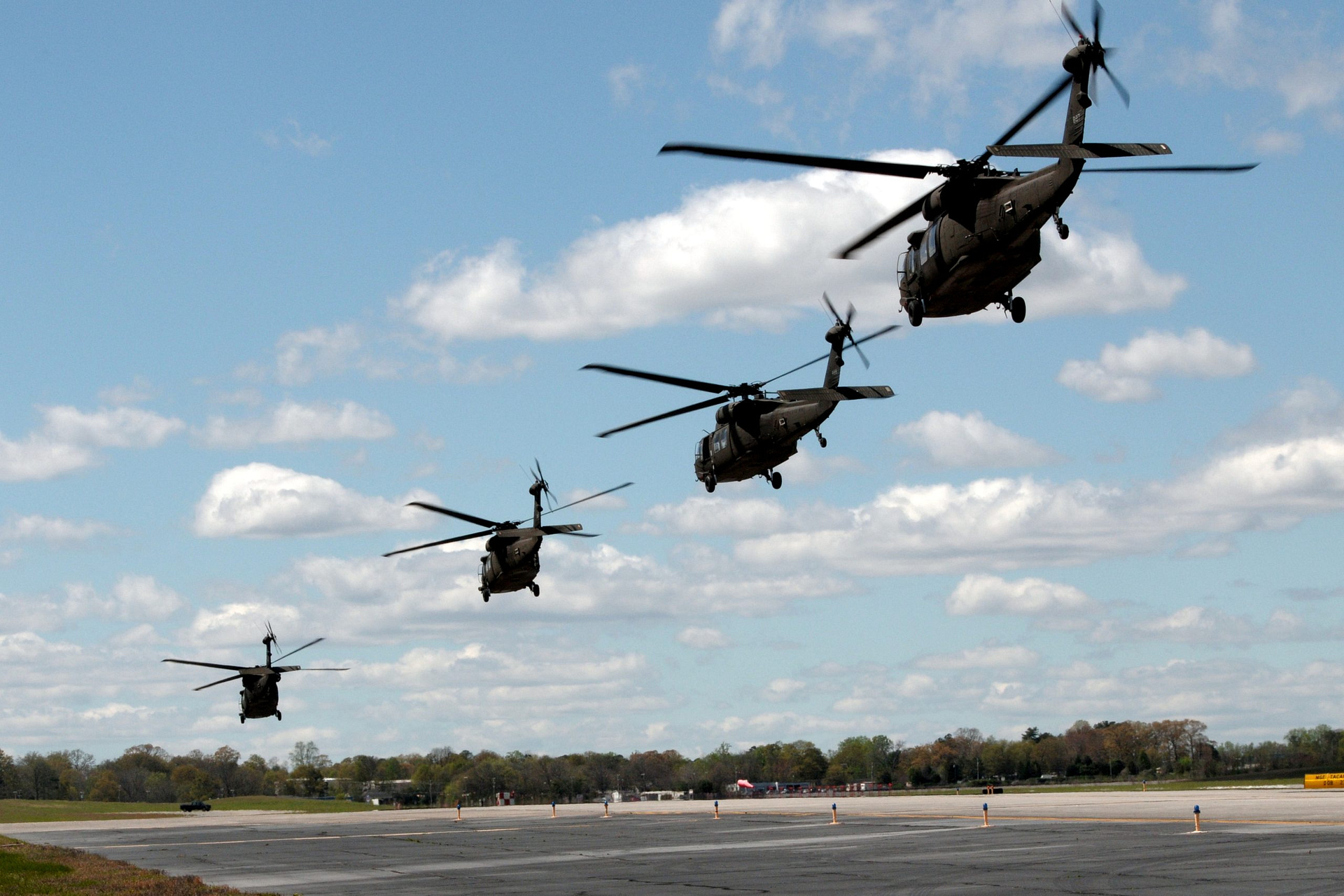
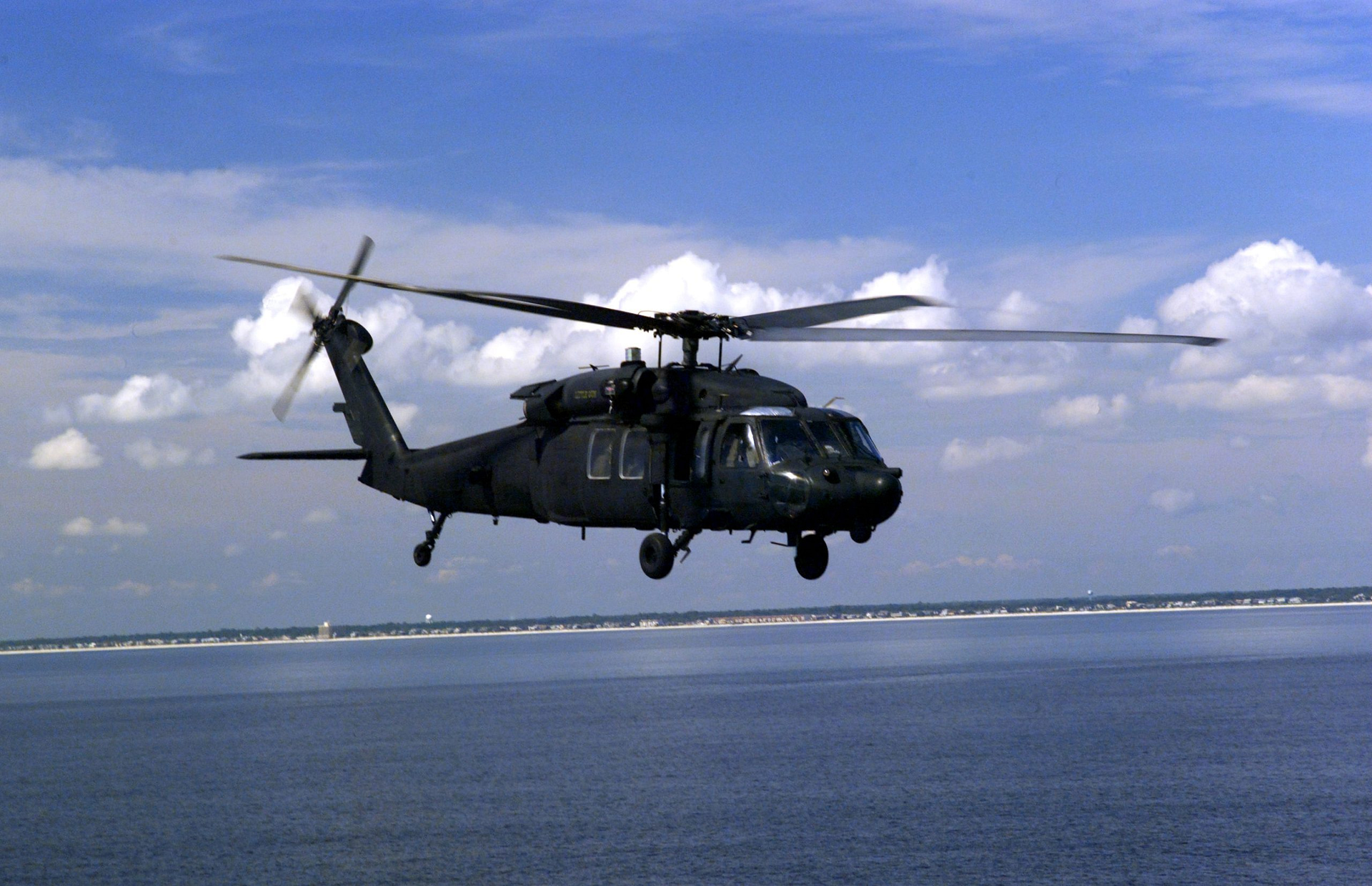
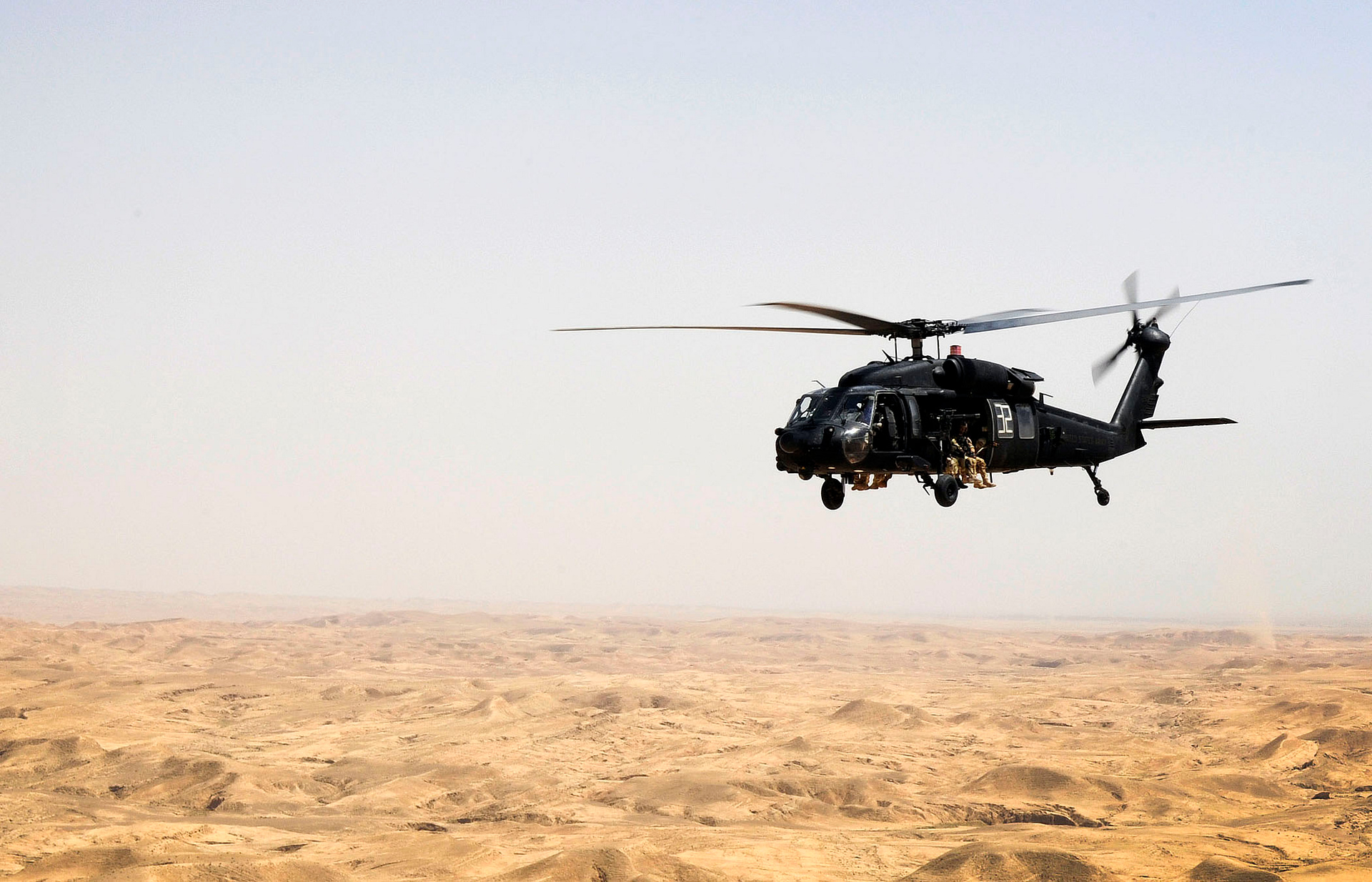
UH-60 Black Hawk photos: the utility helicopter up close
The UH-60 Black Hawk on screen: how the helicopter works
Jared Owen · “How does a Military Helicopter work? (Pave Hawk)” — a highly detailed animated breakdown of the H-60 Black Hawk family, with over 16 million views.
Where the UH-60 Black Hawk flies: origin, combat use and operators
Operators today
The Black Hawk is the most widely flown military helicopter in the Western world, and the US Army fleet dwarfs everyone else’s
The figures below count the whole military H-60 family in each country — UH-60 transports, HH-60 rescue aircraft and the naval SH-60/MH-60 derivatives together — because most operators buy across the family and separating them cleanly from open sources is not possible. The US Army alone flies more Black Hawks than every export customer combined, and no other single fleet reaches two hundred. Saudi Arabia operates a substantial H-60 force spread across four services, and the United Arab Emirates, Mexico, Brazil, Jordan, Thailand, Egypt, Chile, Austria, Sweden, Bahrain, Brunei, Croatia, Greece, Latvia, Lithuania, Slovakia, Portugal and Indonesia all fly the type in smaller numbers; none of those could be pinned to a figure firm enough to chart.
These are estimates. Many airframes counted on paper are stored, in deep overhaul, or not operational. Sources: IISS The Military Balance and FlightGlobal World Air Forces; entries that could not be corroborated are omitted. Three specific cautions. Australia’s figure combines 24 Navy MH-60R with a 40-aircraft UH-60M order that was still being delivered through 2026, so the flyable total is lower than the number shown. Turkey’s fleet is mostly 1990s S-70A-28s; the 109-aircraft T70 licence programme has delivered only a handful of aircraft and has run into repeated difficulty. Saudi Arabia is deliberately absent: its H-60 fleet is certainly large but no figure could be corroborated well enough to print.
The UH-60 Black Hawk in combat: from Grenada to today
The Black Hawk is one of the most combat-tested helicopters of the modern era, flown in every major U.S. operation since 1983 and by allied forces worldwide. It has carried and supported troops, evacuated the wounded and inserted special-operations teams — and, as at Mogadishu in 1993, it has also been shot down and fought over. Specific loss and mission figures vary between sources and should be treated as estimates.
Compare the Explore the combat record of every military aircraft. Data as of July 2026.
UH-60 Black Hawk: frequently asked questions
Can I fly in a UH-60 Black Hawk?
What is the UH-60 Black Hawk?
Who makes the UH-60 Black Hawk?
How many people can a Black Hawk carry?
What is the difference between the UH-60A, UH-60L and UH-60M?
What was “Black Hawk Down”?
How fast is a Black Hawk and how far can it fly?
What are the main Black Hawk variants and family members?
Which countries operate the UH-60 Black Hawk?
You can’t fly the UH-60 Black Hawk.
These, you can.
Some legends only live in museums — others are fuelled and waiting. MiGFlug has put civilians in real military jet cockpits since 2004.
 Fly the L-39 AlbatrosThe world’s most-flown jet trainer — aerobatics included
 Fly the F-104 Starfighter“The missile with a man in it”
 Fly the MiG-21The Cold War’s most-produced jet
 Управляйте самолетом T-33 Shooting Star.America’s first jet trainer
 Fly the DH VampireA piece of early jet history
 Fly the S.211Agile Italian jet trainer
 Fly the MB-326The classic Aermacchi jet
 Fly the MiG-15The Soviet legend of the Korean War
More from the Military Aircraft Encyclopedia
UH-60 Black Hawk: sources & further reading
- Lockheed Martin / SikorskyLockheed Martin / Sikorsky — official UH-60M Black Hawk overview and specifications.
- U.S. ArmyU.S. Army — service history, doctrine and operational use of the Black Hawk.
- Army TechnologyArmy Technology — detailed Black Hawk dimensions, powerplant, performance and variants.
- National Museum of the U.S. Air ForceNational Museum of the U.S. Air Force — HH-60 combat-rescue history and context.
- Naval History and Heritage CommandNaval History and Heritage Command — the SH-60 / MH-60 Seahawk in naval service.
- GlobalSecurity.orgGlobalSecurity.org — variant histories and program background for the UH-60.
- Smithsonian National Air and Space MuseumSmithsonian National Air and Space Museum — context on U.S. rotary-wing aviation.
- MiGFlug AfterburnerMiGFlug Afterburner — the magazine behind this encyclopedia, on military aviation and jet flights.
Hero and gallery photography: U.S. Air Force / NASA, public domain. Combat statistics as of July 2026. Spotted an error? Every page in the Aircraft Museum is fact-checked before publication — write to us and we’ll correct it.