
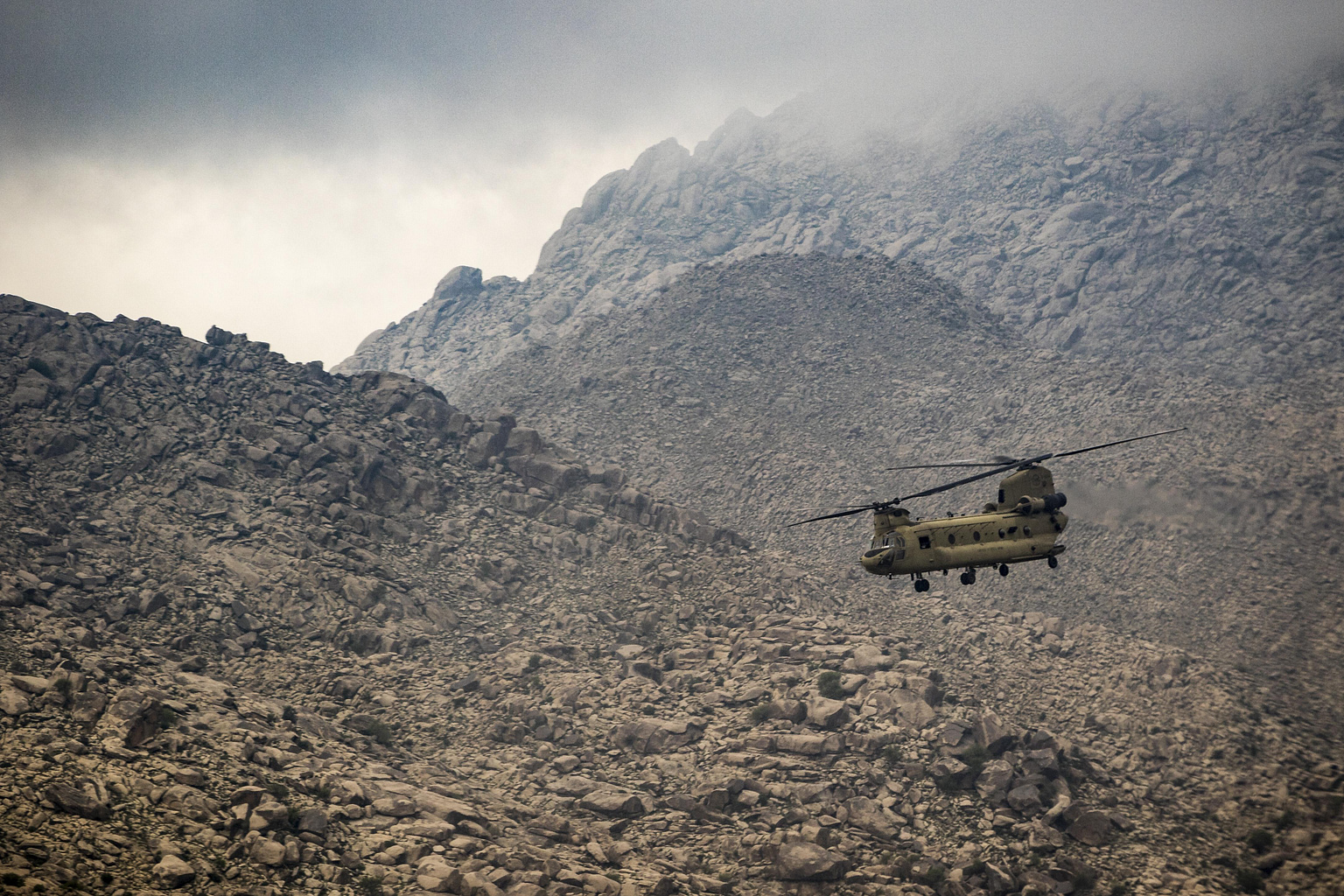
Boeing CH-47 Chinook
“The Army’s heavy lifter”
The West’s definitive heavy-lift helicopter: a tandem-rotor, twin-turbine machine with no tail rotor, built to sling artillery, vehicles and troops into places nothing else can reach — first flown in 1961, blooded in Vietnam, and still in frontline production more than 60 years later as the CH-47F and special-operations MH-47G.
The CH-47 Chinook: how the U.S. Army got its heavy lifter
By the late 1950s the U.S. Army wanted a turbine-powered transport helicopter big enough to move artillery, vehicles and troops in one lift. Frank Piasecki’s company — by then Vertol, soon Boeing Vertol — had long championed the tandem-rotor layout, with a large rotor at each end of the fuselage instead of a main-and-tail-rotor arrangement. Their Model 114 became the Army’s answer.
The prototype, the YHC-1B, first flew on 21 September 1961. Designated the CH-47A Chinook, it entered U.S. Army service in 1962 and deployed to Vietnam from 1965, where it hauled guns to mountaintop firebases and recovered thousands of downed aircraft. Two big counter-rotating rotors cancel each other’s torque, so — unlike a conventional helicopter — almost all engine power goes into lift, not into a tail rotor.
What followed is one of aviation’s great longevity stories. The Chinook was progressively re-engined and rebuilt — the CH-47C, the rebuilt CH-47D, and today’s digital CH-47F and special-operations MH-47G. More than 60 years after its first flight it remains in production, operated by around 20 nations, with Block II upgrades aimed at keeping it flying for decades more.
01Why the CH-47 Chinook exists: the U.S. Army’s search for a turbine heavy lifter
In the 1950s the Army was moving from piston to turbine power and wanted a transport helicopter that could lift a meaningful cargo — a field gun, a light vehicle, or a squad-plus of troops — in a single trip. Vertol’s tandem-rotor experience with the earlier H-21 “Flying Banana” and the Sea Knight fed directly into the Model 114.
The tandem layout was chosen deliberately: it gives a very wide usable centre-of-gravity range and puts all installed power into lift, both of which matter enormously for a heavy-load workhorse. The formula proved so sound that it has never been replaced.
02The CH-47 Chinook’s name: the U.S. Army’s Native American naming tradition
Following the Army’s long-standing convention of naming helicopters after Native American peoples (Iroquois/Huey, Apache, Kiowa, Black Hawk), the CH-47 is named “Chinook” after the Chinookan peoples of the Pacific Northwest. Boeing’s own model designations run from the Model 114 through the modern CH-47F.
How the CH-47 Chinook works: tandem rotors, engines and the cargo cabin
Two counter-rotating rotors, no tail rotor
The Chinook’s defining feature is its tandem-rotor layout: two large three-blade rotors, one at each end, turning in opposite directions. Their torques cancel, so no power is wasted on a tail rotor and almost all of it becomes lift. The layout also gives a wide centre-of-gravity range for heavy, awkward loads.
Two T55 turboshafts and enormous power
Two Lycoming / Honeywell T55 turboshafts, mounted on the rear pylon, drive both rotors through interconnecting shafts — so a single engine failure still leaves the aircraft flying. In the CH-47F each engine produces around 4,700 shaft horsepower, giving the Chinook the muscle to lift heavy loads in hot, high conditions.
A rear ramp, a cabin and a triple hook
A full-width rear loading ramp lets the Chinook swallow vehicles, pallets and troops; the cabin carries 33–55 troops or cargo. Underneath, triple external cargo hooks sling loads too big to fit inside — guns, containers, even other helicopters — and place them precisely.
03The CH-47 Chinook’s lift: troops, internal cargo and underslung loads
Inside, the Chinook typically carries around 33–55 troops, or roughly 24 litters in the medical role, or pallets and vehicles rolled up the rear ramp. Its external load capacity is the headline number: modern variants can sling on the order of 10,900 kg (about 24,000 lb) beneath the fuselage, though the exact figure varies with model, fuel, altitude and temperature.
The triple-hook system (a large centre hook plus forward and aft hooks) lets the Chinook carry a single very heavy load, or spread multiple loads to keep them stable in flight — a capability used to move artillery, engineering plant and downed aircraft.
04The CH-47 Chinook family: from the CH-47A to the CH-47F and MH-47G
The CH-47A (1962) was the original. The CH-47C brought more powerful T55 engines and greater lift. The rebuilt CH-47D (1982) added uprated engines, better rotor blades and the triple-hook cargo system. The current CH-47F (2007) has a digital “glass” cockpit, a strengthened monolithic airframe and vibration reduction; the MH-47G is the special-operations version.
Civil heavy-lift versions exist too: the Boeing Model 234 and the machines flown by operators such as Columbia Helicopters for logging, construction and firefighting.
05Who builds the CH-47 Chinook: Vertol, Boeing and licence production
The Chinook was designed by Vertol, which became Boeing Vertol and today Boeing Rotorcraft Systems, historically at Ridley Park, Pennsylvania. It has also been built or assembled under licence abroad — notably by Kawasaki in Japan (CH-47J/JA) and by Elicotteri Meridionali / Agusta in Italy — and remains in production for the U.S. Army and export customers.
CH-47 Chinook specifications: dimensions, performance and cost
Baseline note: the figures below describe the CH-47F Block II, the standard the US Army began taking on 1 July 2024 and to which up to 465 of its Chinooks are to be rebuilt. Deltas for the CH-47D of 1982 and the MH-47G special-operations aircraft are in grey. One correction to sources that circulate widely: the Block II does not have new engines. It keeps the 4,777 shp T55-GA-714A, and its extra 4,000 lb of gross weight comes from a reinforced airframe, a redesigned single-cell fuel system, an improved drivetrain and a new rotor system. The 6,000 shp T55-GA-714C is a drop-in growth engine still in test, and the 6,500 shp "T55-715" quoted in some places was a 2008 proposal for a heavier Chinook that was never built.
Dimensions & weights
- Экипаж
- 3 — pilot, co-pilot and a flight engineer or loadmaster, plus up to three gunners when the door and ramp mounts are manned. The flight engineer is not a passenger: on a Chinook he runs the hooks, calls the load and is the reason a pinnacle landing works
- Capacity
- 33–55 troops, or 24 stretchers with three attendants, or 10,886 kg (24,000 lb) of payload
- Fuselage length
- 15.60 m (51 ft 2 in)
- Length, rotors turning
- 30.14 m (98 ft 10.7 in) — the discs overlap, so the aircraft is far shorter than two 60 ft rotors set end to end would be
- Rotor diameter
- 18.29 m (60 ft 0 in) each, three blades per rotor, fully articulated, counter-rotating
- Disc area
- 525.3 m² (5,655 sq ft) for both discs, which is the basis on which the Army’s 9.5 lb/sq ft disc loading is calculated
- Fuselage width
- 3.78 m (12 ft 5 in), 5.34 m (17 ft 6 in) across the sponsons
- Высота
- 5.68 m (18 ft 7.8 in) to the top of the aft pylon
- Cargo compartment
- 9.30 × 2.29 × 1.98 m (30 ft 6 in × 7 ft 6 in × 6 ft 6 in) with a full-width rear ramp. The box takes a HMMWV, pallets on standard 463L handling, or a light vehicle driven straight up the ramp; the ramp can be flown open, level or trailing
- Пустой вес
- 11,148 kg (24,578 lb)
- Maximum gross weight
- 24,494 kg (54,000 lb) on Block II, raised from 22,680 kg (50,000 lb) on Block I
- Внутреннее топливо
- ~4,088 litres (~1,080 US gal; ~899 imp gal) in the sponsons, combined into one cell per side on Block II. The MH-47E and MH-47G carry far more in enlarged sponsons and can refuel in flight from a probe, which is the whole point of them
- External load
- 11,793 kg (26,000 lb) on the centre hook; 7,711 kg (17,000 lb) on each of the forward and aft hooks. Three hooks let one aircraft carry three separate loads and set them down in three places, or carry a single long load slung fore and aft so it does not swing
- Disc loading
- 46.4 kg/m² (9.5 lb/sq ft)
Performance
- Never-exceed speed
- 315 km/h (196 mph; 170 kn) — and it is a genuine Vne, not a brochure figure; the Chinook is one of the fastest helicopters in general military service
- Крейсерская скорость
- 291 km/h (181 mph; 157 kn)
- Vertical rate of climb
- 7.7 m/s (1,522 ft/min)
- Hover ceiling, in ground effect
- 2,990 m (9,800 ft) at operational weight
- Hover ceiling, out of ground effect
- 1,675 m (5,500 ft) at operational weight. These two figures matter far more than the service ceiling and are routinely misreported. A Chinook at 54,000 lb cannot hover anywhere near 20,000 ft; the Block II requirement is stated as a hover at 4,000 ft pressure altitude and 35 °C carrying 22,000 lb, with an eventual goal of 6,000 ft, and that is the number the US Army actually cares about
- Служебный потолок
- 6,100 m (20,000 ft) — a lightly loaded, standard-day figure
- Диапазон
- 741 km (460 mi; 400 nmi)
- Боевой радиус
- ~306 km (~190 mi; ~165 nmi)
- Ferry range
- 2,252 km (1,400 mi; 1,216 nmi)
- Power-to-weight
- 0.28 hp/lb
- Hot-and-high behaviour
- The reason the type dominated Afghanistan. At altitude and in heat, where a UH-60 loses most of its useful load, a Chinook keeps enough of its own to be worth the sortie. One Chinook was reckoned to replace up to five Black Hawks in the air-assault lift role in the Afghan mountains. In Vietnam the same arithmetic ran the other way: a CH-47A was limited to a 7,000 lb payload in the mountains against 8,000 lb near the coast, and heat and humidity cost 20 per cent of maximum lift in the lowlands and 30 per cent in the hills
- Landing technique
- No tail rotor and lift that can be traded between two rotors give a very wide usable centre-of-gravity range and a set of manoeuvres nothing else can do: a pinnacle landing with only the forward wheels on a rock, or the rear ramp alone touched to a hillside with the aircraft held in a hover and the rotors turning clear of the slope. Because both rotors carry lift, adding or removing weight at either end — troops fast-roping out, a load released, men climbing up a rope — upsets a Chinook far less than it upsets a single-rotor helicopter
Propulsion & systems
- Engines
- 2 × Honeywell (Lycoming) T55-GA-714A turboshaft, 3,562 kW (4,777 shp) each, mounted on the sides of the aft pylon. CH-47A: T55-L-5 at 2,200 shp, later -L-7 and -L-7C; CH-47C "Super C": T55-L-11 at 3,750 shp, hurriedly introduced, unreliable and temporarily withdrawn; CH-47D: T55-L-712 at 3,750 shp. The 6,000 shp T55-GA-714C has been in test since November 2021
- Transmission and drive train
- Both engines feed a combining transmission that drives forward and aft rotor gearboxes through shafting, with a synchronising shaft tying the two rotors together. Two consequences follow. Either engine can drive both rotors, so an engine failure is a performance problem rather than an emergency. And the rotors cannot go out of phase and strike one another, because they are mechanically locked in relative position — the whole overlapping layout depends on that shaft
- Rotor system
- Two three-blade fully articulated counter-rotating rotors in tandem, the aft one raised on a pylon and set with more blade angle so it works in cleaner air. Counter-rotation cancels torque, so there is no tail rotor and none of the roughly 10 per cent of engine power a tail rotor consumes; the pedals work by tilting the two discs in opposite directions instead. The type has no loss of tail-rotor effectiveness in a downwind hover, because there is nothing to lose
- Flight controls
- BAE Systems Digital Advanced Flight Control System, with an Active Parallel Actuator System on Block II that splits torque precisely between the two rotors. The CH-47C was refused an FAA certificate because its hydraulic flight-boost drive had no redundancy; redesigning it for the CH-47D is what allowed the civil Model 234 to be certificated
- Avionics
- Rockwell Collins Common Avionics Architecture System glass cockpit, shared with the MH-60K/L and CH-53E/K, plus dual embedded GPS and inertial navigation and a digital moving map. The British Project Julius rebuild fitted a Thales TopDeck flight deck, a nose-mounted forward-looking infra-red sensor and uprated T55-714 engines, producing the Chinook HC.4 and HC.5
- Sights and sensors
- No weapon sight of any kind on a standard aircraft. Nose-mounted forward-looking infra-red for pilotage on later marks; the MH-47G adds multi-mode terrain-following and terrain-avoidance radar, which is what lets it fly a low-level infiltration in weather that would ground everything else
- Defensive aids
- AN/AAR-57 Common Missile Warning System, AN/APR-39 radar warning, chaff and flare dispensers and infra-red suppressors on aircraft configured for it. The MH-47G carries a comprehensive suite as standard. It is worth saying plainly that none of this saved Extortion 17
- Loading equipment
- Three external cargo hooks, an internal rescue hoist, a full-width powered rear ramp and rollers or tie-down rings across the cabin floor. Chinooks in Vietnam also served as bombers, rolling tear gas or napalm drums off the ramp onto bunkers — an improvisation rather than a fit
- First flight
- 21 September 1961 (YHC-1B first hover); CH-47F prototype 2001, first production aircraft 23 October 2006; first CH-47F Block II delivered to the US Army 1 July 2024
- Service entry
- August 1962 (CH-47A); CH-47D 1982; MH-47E from 1991; CH-47F 2007; MH-47G Block II from September 2020
- Number built
- ~1,200 airframes and still in production, including Kawasaki’s Japanese line and Agusta’s Italian one. Counting is complicated because most CH-47Ds and many CH-47Fs are rebuilds of earlier airframes rather than new aircraft — 472 of the Army’s CH-47Ds were converted A, B and C models
- Unit cost
- ~US$38 million flyaway for a recent CH-47F, considerably more for an MH-47G. The type first flew in 1961, is still being ordered in 2026, and the US Army expects to operate it beyond 2060 — a service life of a full century, which no other combat aircraft of any kind is on course to match
06CH-47 Chinook variants: from the CH-47A to the CH-47F, MH-47G and civil Model 234
CH-47A — the original production Chinook (service from 1962).
CH-47C — more powerful T55 engines and greater lift.
CH-47D — from 1982, a comprehensive rebuild with uprated engines, improved rotors and the triple-hook cargo system.
CH-47F — the current standard, with a digital cockpit, a strengthened airframe and reduced vibration; the MH-47G is the special-operations variant, and the civil Model 234 serves commercial heavy-lift roles.
07The CH-47 Chinook’s operating costs: what a Chinook costs to buy and fly
Costs vary widely with variant, contract and customer. Recent CH-47F flyaway prices are frequently reported in the region of USD 30–40 million, with full Foreign Military Sales packages (training, spares and support) running higher per aircraft.
Cost per flight hour is commonly estimated at roughly USD 4,000–10,000 or more, but published figures differ widely depending on what is counted (fuel only, or fuel plus maintenance, overhaul and support). Treat any single number as an estimate.
Armament & payload
The Chinook is a lorry, and the only weapons on a standard one are three machine guns pointed out of the windows
There is no honest way to write an armament section for a CH-47, so the six cards below describe what the aircraft actually carries: load. The standard Chinook has no gun mount fitted as delivered, no pylons, no missile, no bomb and no sight. What it has is a 30 ft cargo box, three external hooks and enough power to lift nearly eleven tonnes, and every operational reputation the type has — artillery on mountain tops in Vietnam, air assault in Afghanistan, flood relief in Uttarakhand, sea water dropped on Fukushima reactors through lead plates laid on the cabin floor — comes from that and nothing else.
The Army did try arming it. Four CH-47As were converted in 1965 into the ACH-47A "Guns A Go-Go": two 20 mm M24A1 cannon, a 40 mm grenade turret, five .50 in or 7.62 mm machine guns and two pods of 70 mm rockets or miniguns. Three were lost, one of them when a retention pin worked loose on a 20 mm cannon and the aircraft shot off its own forward rotor blades. The programme stopped because transport demand was more urgent than gunship experiments, which was the correct answer then and remains the correct answer now.
What the Chinook has always been is a target rather than a shooter, and the record is blunt about it. Of the roughly 750 Chinooks in US and South Vietnamese hands, about 200 were lost to combat or wartime accidents. The two worst single days for American forces in Afghanistan were both Chinook shootdowns: sixteen special-operations men in Kunar in June 2005, and 38 aboard Extortion 17 near Kabul on 6 August 2011, brought down by a rocket-propelled grenade. A large slow helicopter full of people is the most valuable target on any battlefield, and no amount of defensive equipment changes that arithmetic. Fits vary sharply: US Army and RAF aircraft routinely fly with two door guns and a ramp gun in theatre, several European operators fly without any gun mount at all, and the MH-47G carries a permanent armed and defensive fit that no standard aircraft has.
Payload & lift
- 10,886 kg (24,000 lb) of payload at a 24,494 kg (54,000 lb) gross weight, with Block II adding 4,000 lb of that gross weight over Block I
- The Block II design point is not a maximum figure but a hot-and-high one: hover with 22,000 lb at 4,000 ft pressure altitude and 35 °C, growing to 6,000 ft, which is what is needed to lift a Joint Light Tactical Vehicle out of an Afghan valley
- In Vietnam the same aircraft was limited to 7,000 lb in the mountains and 8,000 lb near the coast, and the CH-47A’s transmission could not take both engines at full power. The whole B and C development programme was chasing that one problem
- Nothing is carried on pylons because there are none. Every kilogramme goes inside the box or under the hooks
Cargo bay & vehicles
- 9.30 × 2.29 × 1.98 m (30 ft 6 in × 7 ft 6 in × 6 ft 6 in) with a full-width powered rear ramp and a flat floor on rollers and tie-down rings
- A HMMWV drives straight up the ramp; so do quad bikes, light guns and pallets on standard 463L handling equipment. The ramp can be flown open, which is how paratroops and stores leave
- Because lift is shared between two rotors, the usable centre-of-gravity range is enormous. A load can be put almost anywhere in the cabin and the aircraft will still trim — a freedom no single-rotor helicopter has, and the single most underrated feature of the layout
- The best-value work the type ever did was recovery: under Project Pipe Smoke, Chinooks lifted roughly 12,000 downed aircraft worth more than US$3.6 billion out of Vietnam
External loads & the triple hook
- Centre hook: 11,793 kg (26,000 lb) — enough for a 40 ft ISO container, an M198 or M777 howitzer, a light vehicle or a bulk fuel bladder
- Forward and aft hooks: 7,711 kg (17,000 lb) each, usable independently for three separate loads dropped at three separate places on one sortie, or together in tandem for a single long load that will not oscillate
- Tandem slinging is the reason the Chinook can carry things that would set a single-hook helicopter swinging uncontrollably. It is also why the type flies bridge sections, boats and recovered airframes
- The signature Vietnam mission was artillery: placing a battery on a mountain top reachable by nothing else, then keeping it fed with ammunition. The Chinook was so valuable at this that it was rarely risked as an assault troop carrier at all
Troops, casualties & airdrop
- 33 to 55 troops depending on seating and load, which is a rifle platoon and then some — the reason a Chinook can put a coherent fighting unit on the ground in one lift rather than four
- 24 stretchers and three attendants. The Chinook has been the British forces’ casualty-evacuation aircraft of choice in every recent campaign, and in Vietnam it was used for the job whenever nothing else could take the numbers
- Fast-rope insertion and extraction from the ramp and doors, and parachute despatch off the open ramp
- Disaster relief is a real role rather than a public-relations one: Hurricane Andrew in 1992, the 2004 Indian Ocean tsunami, the 2005 Kashmir earthquake, Fukushima in 2011 and Indian flood relief in 2025
Defensive armament
- Up to three pintle-mounted 7.62 mm machine guns — one at each forward shoulder window and one on the rear ramp. Normally M240 или FN MAG; the M134 Minigun is fitted in place of an M240 where weight of fire matters more than ammunition
- Crews in Vietnam invented the fit themselves, hanging an M60 in each forward door and sometimes an M2 .50 in on the ramp, with mechanical stops added so a gunner could not fire into his own rotor discs
- None is fitted as standard on a factory aircraft. Where the guns are carried, they are for suppressing a landing zone during the seconds the aircraft is stationary and vulnerable, and they cover nothing forward of the beam
- The one armed Chinook was the ACH-47A of 1965: 20 mm cannon, a 40 mm grenade turret, five heavy machine guns and rocket pods. Four converted, three lost, programme closed by 1968
MH-47G special-operations fit
- Air-to-air refuelling probe and enlarged sponson fuel tanks, giving the range for a single-sortie infiltration far beyond any standard Chinook
- Multi-mode terrain-following and terrain-avoidance radar and forward-looking infra-red, flown with night-vision goggles at very low level in weather
- A comprehensive defensive aids suite and a permanent armament of two 7.62 mm M134 Miniguns and two M240 machine guns — the only Chinook variant whose guns are part of the design rather than a theatre fit
- Fast-rope and rappelling systems, the Rockwell Collins CAAS cockpit and all the Block II structural changes. Twenty-four Block II aircraft ordered from September 2020 against a stated requirement of 69
- The United States does not export the model. The nearest thing is the RAF’s H-47(ER), 14 aircraft contracted in March 2024 with extended range and in-flight refuelling, and the ill-fated Chinook HC3 of 1995 — a cut-price MH-47E whose bespoke avionics were never certificated, which cost an estimated £500 million and had to be reverted to HC2 standard before it could fly operationally
Three typical loadouts
- Artillery air movement
- One 155 mm M777 or M198 howitzer under the centre hook, about 30 rounds of ammunition and the eleven-man gun crew inside. The mission the Chinook was bought for, flown first onto Vietnamese mountain tops and most recently into Afghan valleys, and the one nothing else in Western service can do in a single lift.
- Air assault lift
- 33 to 44 troops with weapons and combat load, doors and ramp manned with two M240s and an M134, defensive aids live, escorted by AH-64s. Where a UH-60 would need five sorties in the mountains, the Chinook needs one — and carries the whole platoon as one unit rather than as five fragments.
- Special-operations infiltration
- MH-47G with full sponson fuel, in-flight refuelling probe, terrain-following radar, two Miniguns and two M240s, fast ropes rigged. Flown at night at very low level, hundreds of miles, in weather that grounds everything else. This is the Chinook doing the job the type is least suited to and does anyway, and it is the mission profile in which the type has taken its worst losses.
Sourcing caveat: hook capacities, cabin dimensions and payload figures are Boeing and US Army publications for the CH-47F and describe permissible limits at particular weights and temperatures, not what a given aircraft will lift on a given day — on a Chinook the operator’s manual chart, not a single number, is the answer. Gun fits are theatre-dependent rather than fixed, and several operators fly the type entirely unarmed.
Variants
Boeing has kept one 1961 airframe in continuous production by rebuilding it roughly every twenty years
The Chinook exists because the US Army could not decide how big its new turbine transport should be. One faction wanted a light tactical helicopter carrying a squad; another wanted something that could lift artillery and the Pershing missile system. The Army eventually took both: Vertol’s smaller Model 107 became the Marine CH-46 Sea Knight, the Huey was enlarged to carry the squad, and Vertol was told to scale the 107 up into the Model 114. That aircraft first hovered on 21 September 1961 and has never been out of production since.
Development has run in two streams. The mainstream A, B, C, D, F and F Block II line is mostly about power, gross weight and cockpit, and most aircraft in any given fleet are rebuilds rather than new-builds — 472 of the Army’s CH-47Ds were converted A, B and C airframes. The special-operations stream, from the MH-47D of the 1980s to the MH-47G Block II of today, adds range, refuelling, radar and defensive equipment, and it has always been small, expensive and export-restricted.
- YHC-1B / CH-47A (1961–1967, 354 built)
- Lycoming T55-L-5 at 2,200 shp, later -L-7 and -L-7C, 33,000 lb gross weight and about 10,000 lb of payload. Deliveries from August 1962. Its transmission could not absorb both engines at full power, which is the problem the next two marks were built to fix.
- CH-47B and CH-47C (1967–1980, 108 and 233 built)
- The power fix, in two steps. The B was an interim aircraft with 2,850 shp T55-L-7C engines, a blunted aft pylon, asymmetric blades and strakes along the ramp and fuselage to clean up the airflow, and it introduced the M24 door and M41 ramp gun mounts. The C brought stronger transmissions and, as the "Super C", 3,750 shp T55-L-11 engines at a 46,000 lb gross weight — an engine rushed in to buy payload, unreliable enough to be temporarily swapped back for the older -L-7C. The C was widely exported and licence-built by Agusta in Italy. Four CH-47As had meanwhile been converted in 1965 into the armed ACH-47A described above; three were lost and the idea was abandoned by 1968.
- CH-47D (1979–2002, 472 converted plus new-build)
- The transformation: T55-L-712 and later T55-GA-714A engines, composite rotor blades, redesigned cockpit, redundant electrics, an advanced flight control system, GPS and the triple-hook cargo system with 26,000 lb on the centre point. Almost every US CH-47D was a rebuilt A, B or C.
- MH-47D and MH-47E (1980s–1990s, 12 and 26 built)
- Special-operations conversions for the 160th Special Operations Aviation Regiment, with in-flight refuelling, fast-rope systems and, on the E, greatly enlarged fuel capacity and terrain-following radar. All later rebuilt to MH-47G.
- CH-47F (2001–present)
- A monolithic milled airframe with far fewer joints, which cuts vibration, inspection and crack repair and extends fatigue life; T55-GA-714A engines, the Rockwell Collins CAAS cockpit and the BAE digital flight control system. Boeing had delivered 48 by August 2008 and then took a US$4.8 billion contract for 191 more.
- CH-47F Block II (from 2024)
- Reinforced airframe, single-cell fuel system saving 90 kg and adding capacity, improved drivetrain, three 60 kVA generators, 54,000 lb gross weight. First delivered 1 July 2024. The Advanced Chinook Rotor Blades derived from the cancelled RAH-66 Comanche were dropped after persistent vibration and an aft-blade stall problem — a rare public admission that a promised upgrade did not work.
- MH-47G (2004–present, Block II from 2020)
- The current special-operations aircraft: CAAS cockpit, all the CH-47F structural work, refuelling probe, terrain-following radar, a full defensive suite and two Miniguns and two M240s. The last first-generation MH-47G was handed over in February 2011; Block II deliveries began 1 September 2020 against a requirement of 69.
- CH-47J and CH-47JA (1986–present, licence-built by Kawasaki)
- Japanese aircraft for the Ground and Air Self-Defense Forces, differing in engine, rotor brake and avionics; the JA of 1993 added enlarged tanks, an AAQ-16 infra-red turret and a partial glass cockpit. Kawasaki had built 61 by April 2001 and more than 110 by the early 2000s. Three flew the sea-water drops over Fukushima in March 2011.
- UK Chinook HC.1 to HC.6A (1980–present)
- The largest fleet outside the United States. HC.1 based on the CH-47C, HC.2 and HC.2A rebuilt to CH-47D standard from 1993, HC.4 and HC.5 produced by the Project Julius avionics rebuild, and HC.6 and HC.6A based on the CH-47F. The HC.3, eight cut-price MH-47Es ordered in 1995 and delivered in 2001, never became operational and had to be reverted. Bravo November survived the sinking of the Atlantic Conveyor in 1982 and once lifted 81 troops in a single Falklands sortie.
- Model 234, CH-47SD and other exports (1980–present)
- The civil Model 234LR and 234UT, whose type certificate Columbia Helicopters bought in 2006 and which still fly logging and firefighting work; the Model 414 export CH-47D; the CH-47SD "Super D" with extra fuel for Singapore, Greece and Taiwan; the CH-47DG for Greece; and the HH-47D search-and-rescue variant for South Korea.
Closing caveat: production totals for the Chinook are unusually soft because the great majority of D and F aircraft are rebuilds, so the same airframe can appear in three different production figures. Roughly 1,200 airframes is the most defensible single number, and it excludes the separate Kawasaki and Agusta licence runs from some counts and includes them in others.
The CH-47 Chinook: a timeline from the Model 114 to the CH-47F
Vertol designs the Model 114
Vertol begins design of the tandem-rotor Model 114 to meet a U.S. Army medium-transport requirement.
YHC-1B first flight
The prototype YHC-1B (Boeing Vertol Model 114) makes its first flight on 21 September 1961.
CH-47A enters service
The type is designated CH-47A Chinook and enters U.S. Army service.
Chinook goes to Vietnam
The Chinook deploys to Vietnam, lifting artillery to firebases and recovering downed aircraft.
The uprated CH-47C
Up-engined variants follow; the CH-47C brings more powerful T55 engines and greater lift.
The rebuilt CH-47D
The rebuilt CH-47D enters service with uprated engines, better rotors and a triple-hook cargo system.
The digital CH-47F
The new-build, digital CH-47F enters U.S. Army service with a strengthened airframe.
60+ years and counting
The CH-47F and special-operations MH-47G remain in production after 60+ years, with Block II upgrades extending the design toward mid-century.
The CH-47 Chinook in action: notable missions and variants
Vietnam, 1965: the Chinook goes to war
The heavy lifter proved itself hauling guns and rescuing aircraft.
Read the full account
1982: “Bravo November”, the Chinook that survived
A single RAF Chinook did the work of many after disaster at sea.
Read the full account
Why the Chinook has two rotors and no tail rotor
The twin-rotor layout turns all engine power into lift.
Read the full account
The triple hook: slinging vehicles, guns and even aircraft
The Chinook can carry loads too big to fit inside.
Read the full account
The MH-47: flying special forces into the dark
A heavily modified Chinook is a special-operations workhorse.
Read the full account
Afghanistan: the helicopter that owns the high country
Twin rotors and huge power make the Chinook a high-altitude champion.
Read the full account
From earthquakes to floods: the Chinook as lifesaver
The same lift that moves armies moves aid.
Read the full account
The Boeing 234 and Columbia: Chinooks in civilian colours
A handful of Chinooks work for a living outside the military.
Read the full account
The 60-year helicopter
Few combat aircraft stay in production this long.
Read the full account
The heavy lifter the world buys
Around 20 nations fly the Chinook.
Read the full account
CH-47 Chinook photos: the heavy-lift helicopter up close


The CH-47 Chinook on screen: how the tandem-rotor helicopter works
Learn from the Base · “How does a Cargo Helicopter work? (CH-47 Chinook)” — an animated technical breakdown of how the Chinook’s twin tandem rotors, transmission and heavy-lift systems actually work.
Where the CH-47 Chinook flies: origin, combat use and operators
Operators today
Twenty air arms fly the Chinook, and the US Army owns roughly two-thirds of every one ever kept in service
Sixty-five years after the first hover, the Chinook is still in production and its operator list is still growing. The pattern is distinctive: unlike most American combat aircraft, the export Chinook fleet is concentrated in close allies who operate the type exactly as the US Army does, and several of them build or rebuild their own — Kawasaki in Japan, Agusta in Italy. The largest new order on the books is European: Germany chose the CH-47F Block II in June 2022 to replace its CH-53Gs, and none of those 60 aircraft has yet been delivered.
These are estimates of delivered aircraft on charge. The US figure combines 465 CH-47F with the US Army, Army National Guard and Army Reserve as of January 2025 with roughly 69 MH-47G of the 160th Special Operations Aviation Regiment, and the Block II rebuild programme covers up to 465 of them. Japan’s number is 47 CH-47J and JA with the Ground Self-Defense Force and 15 with the Air Self-Defense Force as of March 2022, all Kawasaki-built; a Japanese equipment return gives 66, and the difference has not been reconciled. The British total was 60 in February 2022 and 54 in active inventory in 2025, with further temporary reduction announced ahead of 14 new H-47(ER) contracted in March 2024 — treat 54 as a ceiling rather than a current flying figure. South Korea’s is Republic of Korea Army CH-47D plus air force HH-47D and is the shakiest entry here; 18 CH-47F have been approved to supplement them. The Dutch 20 are 14 new-build CH-47F and six earlier aircraft brought to the same standard, all CH-47Ds having gone by 2023. Singapore’s figure includes twelve CH-47SD "Super D" and dates from 2011, with CH-47F replacement under way. Spain has 13 CH-47D upgraded to F standard plus four new-build. Ordered but not delivered and therefore not charted: Germany, 60 CH-47F Block II. Omitted because no current figure could be corroborated: Greece, Turkey, the United Arab Emirates, Egypt, Morocco, Saudi Arabia, Taiwan and Libya. Iran is a special case — it bought about 90 Agusta-built CH-47Cs before 1979, has kept them flying under embargo with locally rebuilt airframes, and estimates of what is operational have ranged from 20 to 45. Sources: IISS The Military Balance, FlightGlobal World Air Forces, US Army and national inventory returns and manufacturer announcements; entries that could not be corroborated are omitted.
The CH-47 Chinook in combat: from Vietnam to today
The Chinook is one of the most combat-tested helicopters ever built, in continuous frontline use since Vietnam. It has hauled troops, guns and supplies, recovered downed aircraft, and inserted special-operations teams from Southeast Asia to the Falklands, Iraq and Afghanistan. Specific loss and mission figures vary between sources and should be treated as estimates.
Compare the Explore the combat record of every military aircraft. Data as of July 2026.
CH-47 Chinook: frequently asked questions
Can I fly in a CH-47 Chinook?
What is the CH-47 Chinook?
Who makes the CH-47 Chinook?
Why does the Chinook have two rotors and no tail rotor?
How much can a CH-47 Chinook lift?
What is the difference between the CH-47D, CH-47F and MH-47G?
How fast is a Chinook and how far can it fly?
Has the CH-47 Chinook been used in combat?
Which countries operate the CH-47 Chinook?
You can’t fly the CH-47 Chinook.
These, you can.
Some legends only live in museums — others are fuelled and waiting. MiGFlug has put civilians in real military jet cockpits since 2004.
 Fly the L-39 AlbatrosThe world’s most-flown jet trainer — aerobatics included
 Fly the F-104 Starfighter“The missile with a man in it”
 Fly the MiG-21The Cold War’s most-produced jet
 Управляйте самолетом T-33 Shooting Star.America’s first jet trainer
 Fly the DH VampireA piece of early jet history
 Fly the S.211Agile Italian jet trainer
 Fly the MB-326The classic Aermacchi jet
 Fly the MiG-15The Soviet legend of the Korean War
More from the Military Aircraft Encyclopedia
CH-47 Chinook: sources & further reading
- BoeingBoeing — official CH-47 Chinook overview, variants and specifications.
- U.S. ArmyU.S. Army — service history, doctrine and operational use of the Chinook.
- Army TechnologyArmy Technology — detailed Chinook dimensions, powerplant, performance and variants.
- Королевские военно-воздушные силыRoyal Air Force — the Chinook in British service, including “Bravo November”.
- GlobalSecurity.orgGlobalSecurity.org — CH-47 variant histories and programme background.
- National Museum of the United States ArmyNational Museum of the United States Army — Army aviation history and the Chinook.
- Smithsonian National Air and Space MuseumSmithsonian National Air and Space Museum — context on rotary-wing aviation.
- MiGFlug AfterburnerMiGFlug Afterburner — the magazine behind this encyclopedia, on military aviation and jet flights.
Hero and gallery photography: U.S. Air Force / NASA, public domain. Combat statistics as of July 2026. Spotted an error? Every page in the Aircraft Museum is fact-checked before publication — write to us and we’ll correct it.