
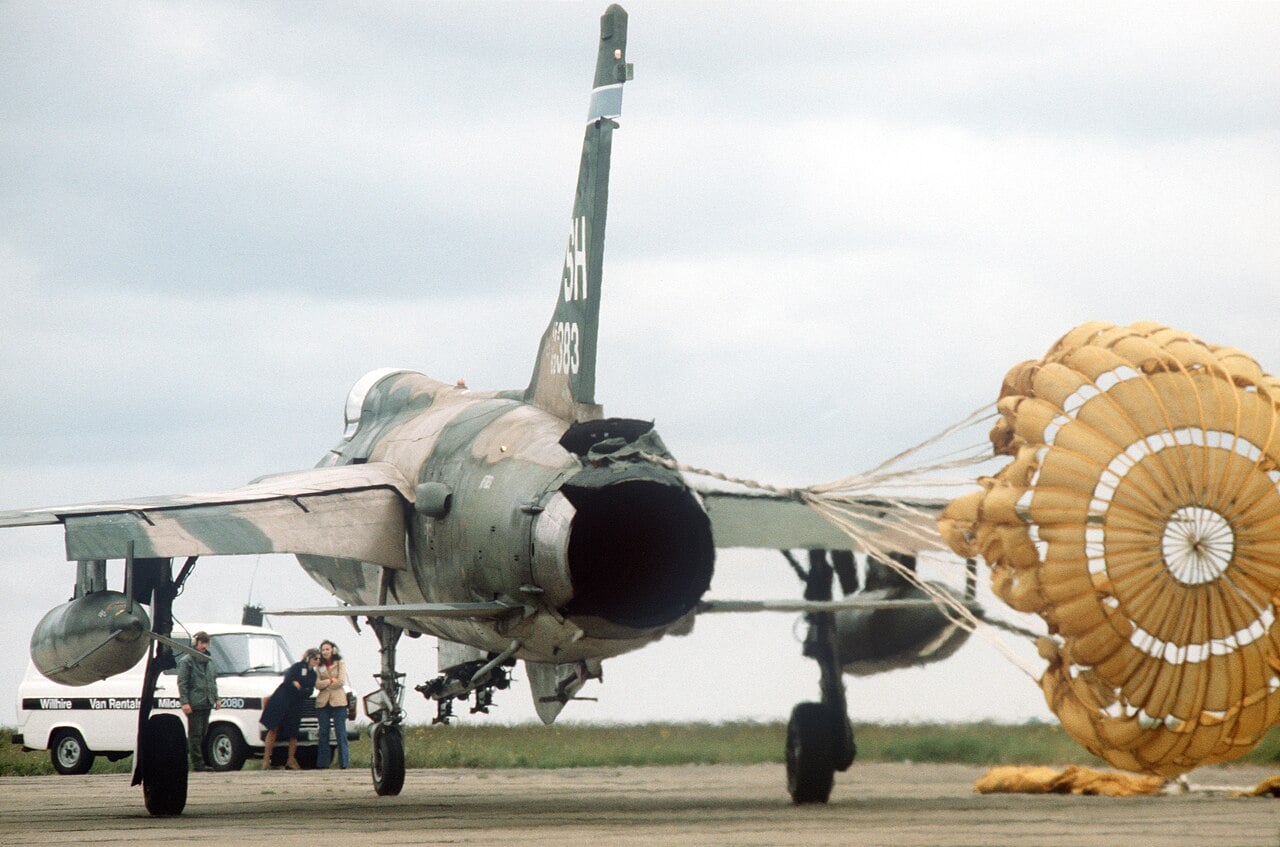
A Lockheed F-104 Starfighter came down final approach at 175 knots with full flaps, and that was the basic number. The pilot then added five knots for every 1,000 pounds of fuel still in the tanks above the first thousand. On a typical recovery that put the approach at 180 knots or more — 333 km/h, gear down, flaps down, on short final.
An airliner crosses the threshold at around 140 knots. A Dassault Rafale comes down final at under 120. The Starfighter approached faster than a 747 takes off.
Fighter takeoff and landing numbers are like that throughout: they scatter across a range no airliner comes close to, they change completely depending on whether the afterburner is lit, and — the part that surprises most people — almost nobody officially publishes them.
Kurzinfo
Afterburner vs dry, same aircraft, same weight: F-4J at 46,833 lb — 4,410 ft (1,344 m) on military thrust, 2,490 ft (759 m) in afterburner
Shortest fighter ground run in this piece: AV-8B short takeoff, clean, 21,201 lb — 260 ft (79 m) in calm air, 110 ft (34 m) with 25 kt wind over deck
Längste: F-104C long-range escort, 25,276 lb, military thrust — 7,200 ft (2,195 m)
Highest approach speed: F-104G, 175 kt full flaps plus 5 kt per 1,000 lb of fuel
Lowest approach speed: Rafale, under 120 kt (Dassault)
Best documented drag-chute saving: F-105D at 29,927 lb — 4,225 ft (1,288 m) on brakes alone, 2,455 ft (748 m) with the chute
Thrust reverser: only two fighters ever used one operationally — Saab 37 Viggen and Panavia Tornado
Carrier arrested rollout: around 320 to 350 ft (98 to 107 m); Mk 7 Mod 3 specified pendant runout 344 ft (105 m)
The numbers nobody publishes
Before any of the figures below, one finding is worth stating plainly, because it shapes everything else. Almost no air force publishes fighter runway performance.
The USAF fact sheets for the F-16 und die F-15, the RAF page for the Eurofighter Typhoon, the Eurofighter GmbH product material and Lockheed Martin's own F-35B product cards contain no takeoff distance, no landing distance and no approach speed between them. Eurofighter GmbH publishes exactly one performance claim on the subject: under eight seconds to take off from standstill.
The figures that do exist come almost entirely from one source family: the declassified USAF and NAVAIR Standard Aircraft Characteristics sheets, produced from flight test data in the 1950s, 60s, 70s and 80s. They are dry, tabular, unglamorous, and they are the only place where you can put two numbers side by side and know they were measured the same way.
Everything below is anchored to documents like those. Where a number could not be verified, this article says so instead of printing it. The English Electric Lightning, for example, appears nowhere in what follows: its operating data manuals sit behind paywalls, and every takeoff-roll figure circulating online traces back to a wiki.
What the afterburner actually buys
The cleanest evidence comes from the NAVAIR sheet for the F-4J Phantom II, which prints military and maximum thrust as a pair in the same row, at the same weight, with the same stores.
At 46,833 pounds with four AIM-7E Sparrows, the Phantom's ground run was 4,410 ft (1,344 m) on military thrust and 2,490 ft (759 m) in afterburner. The dry roll is 1,920 ft (585 m) longer — 77 percent longer. Lighting the burners removes almost 44 percent of the takeoff roll. Load a 600-gallon tank and the pair becomes 5,600 ft (1,707 m) dry against 3,070 ft (936 m) wet.
The F-16A sheet gives the same experiment on a modern fighter. Two mission columns carry identical weight, identical fuel, identical stores — 29,253 lb with two AIM-9Js and two 370-gallon tanks — and differ only in the power setting. Intermediate power: 3,725 ft (1,135 m). Maximum power: 2,380 ft (725 m). Afterburner cuts 36 percent off the roll.
Which raises the obvious question of when a fighter pilot is required to use it. That one is written down.
The same threshold appears in the F-15 manual, restricted to single-ship departures: if the computed military-power takeoff distance exceeds half the available runway, take off in afterburner. The wording has survived essentially unchanged from 1999 to the current editions.
Not every fast jet works this way. The German Air Force states that unlike the Tornado, the Eurofighter takes off without afterburner in normal flight operations, which reduces noise around Luftwaffe airfields. And the MiG-21 could not do a static afterburner takeoff at all: the USAF team that flew a captured Fishbed at Groom Lake in 1968 under the HAVE DOUGHNUT programme recorded that the brakes would not hold the aircraft in afterburner, and that the afterburner would not light until military thrust had already been reached.
The extremes, top and bottom
Once you have comparable sheets, the spread is enormous.
At the short end of conventional runways sits the F-15C. Configured for air superiority with four AIM-7Fs at 45,713 lb, the sheet gives a ground run of 1,250 ft (381 m) and 2,350 ft (716 m) to clear 50 feet. Loaded for close air support with sixteen Mk 82s at 54,333 lb it needs 1,800 ft (549 m). One honest caveat: the circled power-setting footnote beside those rows is below the resolution of the available scan, so whether they are military or maximum thrust cannot be confirmed. A 1,250 ft roll at that weight looks like afterburner, but that is inference, not evidence.
At the long end sits the Starfighter, and this is where its reputation comes from. On military thrust the F-104C needed 5,320 ft (1,621 m) of ground run in the basic mission at 22,140 lb, 5,900 ft (1,798 m) in the air superiority fit, and 7,200 ft (2,195 m) configured for long-range escort at 25,276 lb. The sheet prints no afterburner takeoff figures at all.
Then there is the aircraft that ignores the question. The NAVAIR sheet for the AV-8B Harrier II gives short-takeoff runs in pairs, calm air and 25 knots of wind over the deck. Clean at 21,201 lb: 260 ft (79 m) calm, 110 ft (34 m) with wind. Loaded with six Mk 82s at 26,525 lb: 730 ft (223 m) and 425 ft (130 m). A Harrier in its lightest useful configuration gets airborne in less distance than an F-15 uses to accelerate through walking pace.
Coming back down is the harder half
Fighters are built to go fast, which makes them bad at going slow, and landing is where that bill arrives.
The Starfighter's tiny, razor-thin wing is the extreme case. Rolf Stünkel, who flew the F-104G with the German Navy's Marinefliegergeschwader 1 at Schleswig-Jagel and logged over a thousand hours on type, has described the approach schedule in detail: basic approach 175 knots with full flaps, plus five knots for every 1,000 lb of fuel above the first thousand. If a restriction or a strong crosswind forced a takeoff-flap landing instead, the basic number went up to 195 knots. Touchdown was at 150 knots minimum, and power could not be pulled below 82 percent until the wheels were down, because the Starfighter's boundary layer control blew engine bleed air over the flaps — lose the air, lose the lift.
For comparison, the F-16A sheet lists approach speeds of 127 to 134 knots across its landing weights, and the F-15C 140 to 144 knots. Dassault publishes an approach speed for the Rafale of less than 120 knots, the lowest verified figure in this whole set. The Swedish Air Force describes a JAS 39 Gripen touching down at just under 300 km/h, about 162 knots.
The drag chute, and what it is actually worth
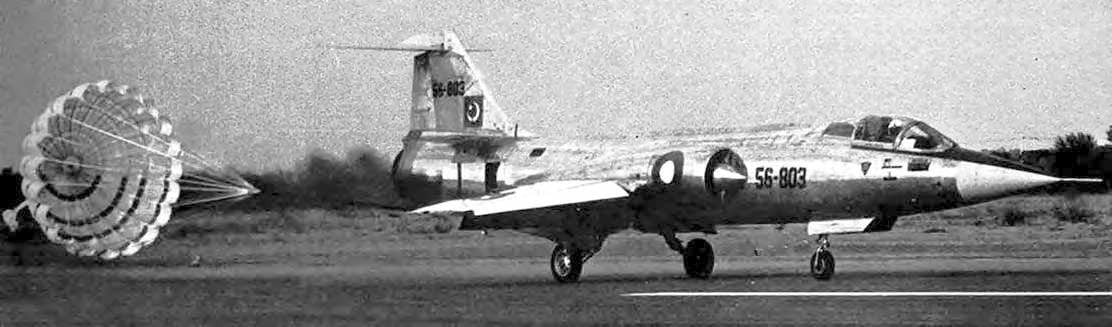
The definitive fitment list is not a fighter manual but a parachute one: the USAF's Recovery Systems Design Guide, AFFDL-TR-78-151, whose Table 1.14 lists every American deceleration parachute assembly of the era. The F-104 carried the MB-7 — a 16-foot ringslot canopy with 20 gores and a design deployment velocity of 200 knots. The F-105 carried a 20-foot ribbon chute good to 225 knots, the F-5 a 15-foot ringslot to 180 knots.
What it saves depends enormously on the aeroplane. Three SAC sheets print ground roll with and without the chute at identical weight:
The F-104C at 15,000 lb went from 3,350 ft (1,021 m) on brakes to 2,870 ft (875 m) with the chute — a saving of 480 ft, about 14 percent. The F-105D at 29,927 lb went from 4,225 ft (1,288 m) to 2,455 ft (748 m) — 1,770 ft saved, nearly 42 percent. The F-106A at 27,121 lb went from 4,110 ft to 2,760 ft, though its footnote credits the chute plus speed brakes, so that one is not the chute alone.
The mechanics are less exotic than people assume. There is no ballistic ejection: the compartment door opens, a pilot chute is thrown into the airstream, a bridle drags the deployment bag out and the canopy blossoms. Brakes go on at roughly 80 knots. At the end of the roll the pilot keeps the chute inflated and off the runway, taxis to a designated drop-off point and jettisons it there. A single chute is good for 25 to 50 cycles, and the design guide records examples used more than 150 times.
Who carries one is less obvious than it looks. USAF F-16s do not. Norwegian and Dutch F-16s do — the USAF's own 1978 design guide lists a 23-foot F-16 ribbon chute explicitly footnoted “Norwegian version”. The same three countries, Norway, the Netherlands and Denmark, later developed and funded the bolt-on drag-chute pod for the F-35, the first modification to the F-35 design to arrive after the main development phase ended. It sits between the vertical tails, and one switch on the upper left instrument panel opens the pod, releases a Kevlar canopy and, pushed the other way, jettisons it.
USAF F-15s do not use a chute either. Their manual instead prescribes aerobraking: hold the nose up after touchdown with the flaps still down so the airframe itself does the work, then let the nose fall normally.
Sweden put the engine in reverse instead
Only two fighters have ever used a thrust reverser operationally. NASA Langley named them in 1985: the Saab 37 Viggen and the Panavia Tornado. On the Tornado, bucket-type reversers swing in behind the nozzle about two seconds after touchdown and splay the flow sideways to keep it out of the intakes and off the fin.
The Viggen's was designed in from the start, integral to a Pratt & Whitney ejector-nozzle layout. Saab raised the idea in February 1962; P&W had never seriously studied one, so development went to Saab, which contracted Rohr in the United States for the detail design. The result, on figures compiled by the Arboga Elektronikhistoriska Förening from Swedish defence-procurement documents, was a landing run of around 500 m (1,640 ft) for the AJ 37 and under 500 m for the JA 37.
Those same compiled figures contain the single most dramatic afterburner comparison in this article. An AJ 37 at its normal takeoff weight of 14,876 kg needed 1,000 m (3,281 ft) without afterburner and 400 m (1,312 ft) with Zone III reheat. At maximum takeoff weight, 1,300 m against under 600 m. Two and a half times the runway, for the same aeroplane at the same weight, decided by one throttle position. These come from a specialist historical association rather than a government publisher, and are worth reading as such — but they are internally consistent and they match what the Viggen was designed to do.
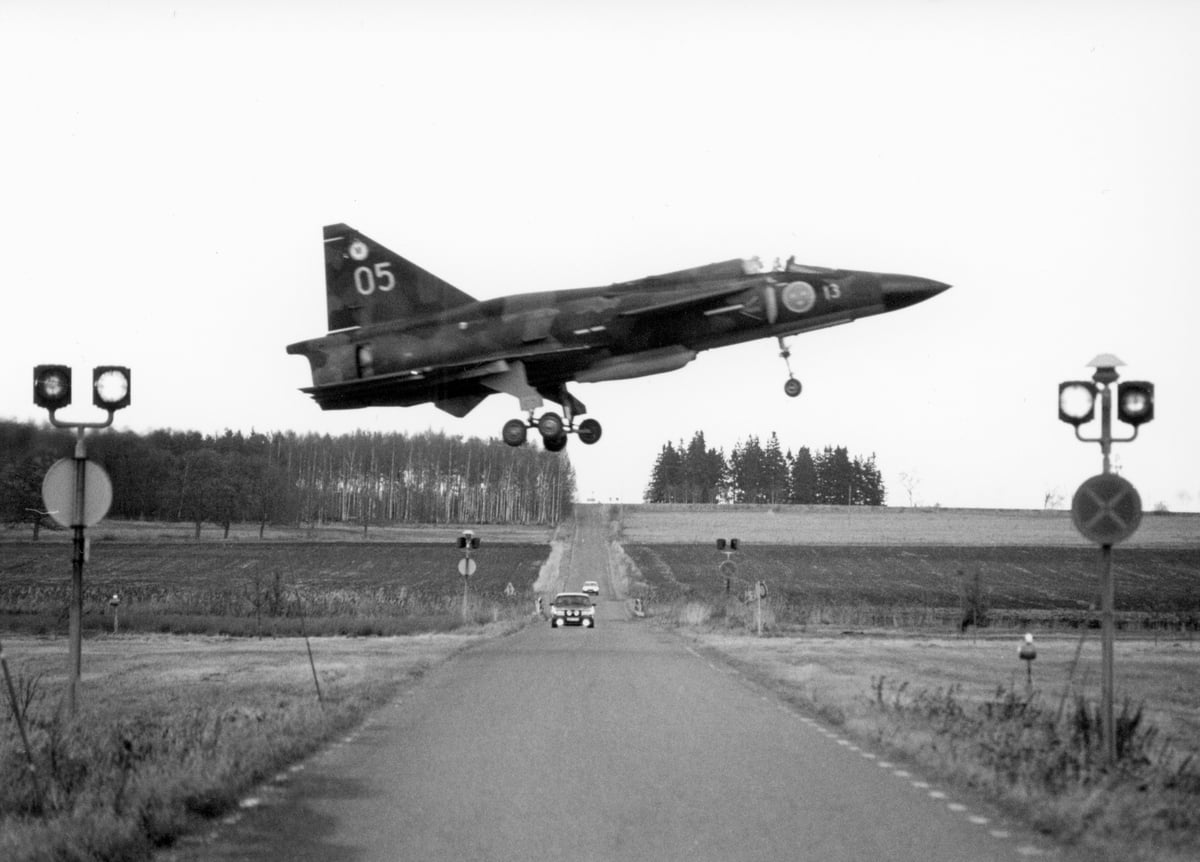
One correction is worth making here, because it is repeated everywhere. The famous “800 metre” Viggen figure is not a Viggen figure. It comes from the Swedish fortifications agency's definition of a runway class: kortbana, short runway, minimum 800 by 17 metres plus 200 metre run-off strips. That is an infrastructure standard the aircraft had to fit, not a measured aircraft performance. The actual requirement written into the programme was runways of around 500 metres.
Gripen threw away both
Saab's answer on the Viggen's replacement was to delete the reverser, the brake chute and the arrestor hook, and get the stopping distance from aerodynamics and brakes alone.
Take Saab's own published figures with care, though, because Saab has issued three different sets. The 2016 Gripen C In Brief fact sheet gives a minimum takeoff of 400 m and a landing of 500 m. A 2019 Saab article on road operations says 800 m by 16 m for both. The 2020 Gripen E material says takeoff from 500 by 16 m and landing on 600 m. None of the three states a weight, a load, a temperature or a surface. They should not be reconciled, and anyone quoting a single one of them as the Gripen number is quoting a press release, not a performance chart.
What the Swedish Air Force does describe is the technique. Landing a JAS 39C/D on the Hagshult short strip during Exercise Aurora, Lieutenant Colonel Robin Ohlsson of 171st Fighter Squadron explained that braking begins the instant the wheels touch, and that wind, altitude, temperature, surface condition and weapons load are all weighed before the approach.
A short excursion to sea
Everything above assumes a runway. Take it away and the problem is solved by brute force at both ends. This is a summary rather than the full story — we have covered EMALS and the Advanced Arresting Gear separately, and a fuller piece on carrier operations is coming.
The steam catapult that launched US Navy aircraft for six decades is the C-13 family, and its dimensions are published in the Navy's own training manual. The C-13-0 has a power stroke of 249 ft 10 in; the C-13-1 stretches that to 309 ft 8¾ in; the C-13-2 runs 306 ft 9 in through a 21-inch bore instead of 18. What the Navy does not publish is end speed, because there is no such thing as the end speed. A capacity selector valve varies the catapult's energy output for aircraft of different types and weights, and the actual settings live in aircraft launching bulletins that are not public. Any single figure you see quoted for “the” catapult is someone's guess.
EMALS, on the Ford class, is documented rather better. A rear admiral testifying to the House Armed Services Committee put it at 70 million foot-pounds to a 150-knot end speed in a 360-foot power stroke; the engineering description from NAWCAD Lakehurst gives a 103 m launch motor built from 298 stator segments, an energy capability of 90 million foot-pounds, an end speed range of 55 to 200 knots and a cycle time of 45 seconds.
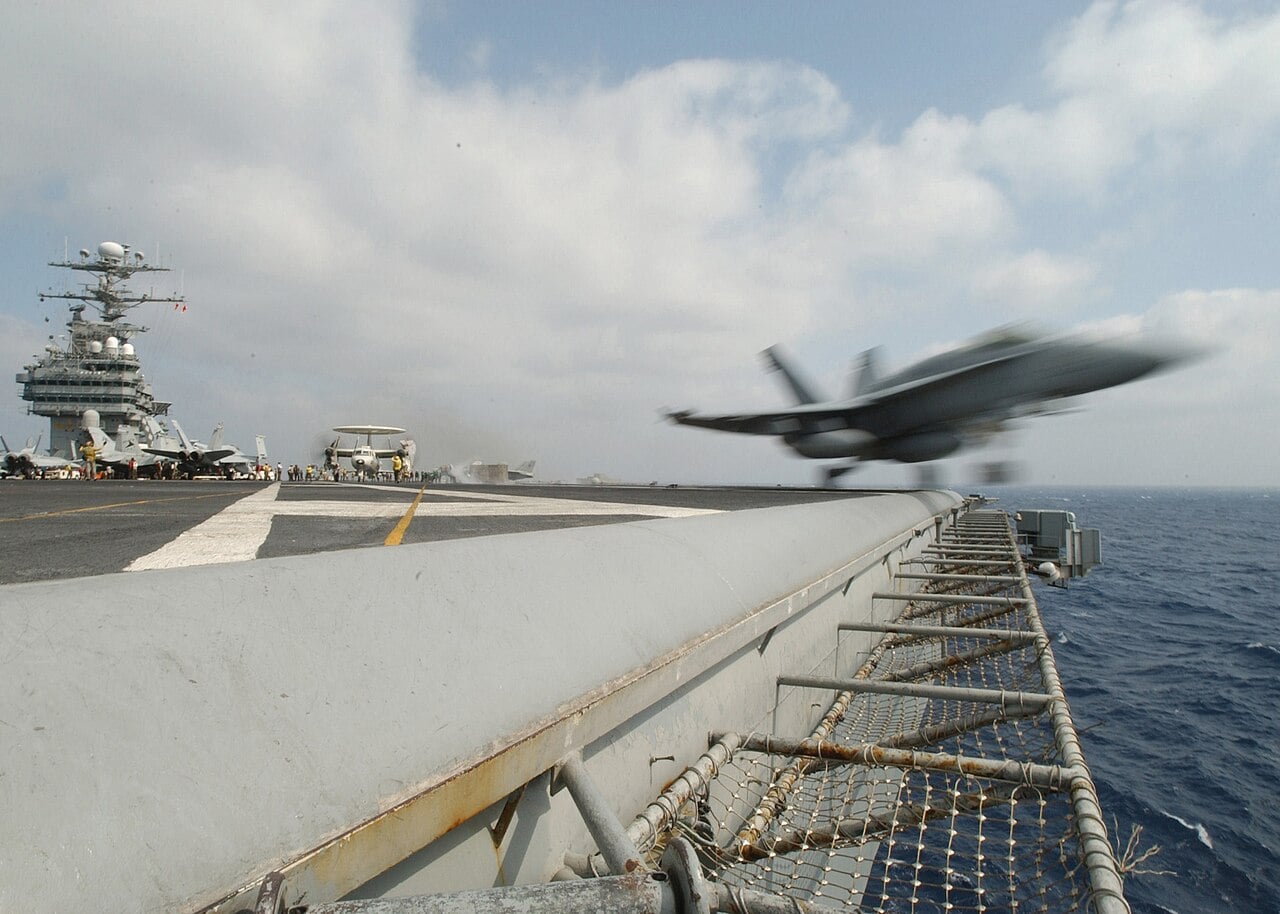
The most interesting EMALS number is not the energy but the smoothness. Steam catapults run a peak-to-mean acceleration profile nominally around 1.25, with excursions as high as 2.0. EMALS is required to stay within 1.05, which the Navy credits with a 31 percent extension in airframe fatigue life. The aircraft is not launched harder. It is launched more evenly.
At the other end, the wires. A common belief is that the Ford class dropped from the Nimitz class's four arresting wires to three — but the Navy had already moved to three on the last two Nimitz ships, USS Ronald Reagan and USS George H.W. Bush. On a four-wire deck the target is the three wire, chosen as the balance between clearing the round-down at the stern and not floating past every cable. On the three-wire ships the target is the two.
The arrested rollout is short and the official figures cluster tightly: the Mk 7 Mod 3 specification gives a deck pendant runout of 344 ft (105 m), NAVAIR says less than 350 ft for a 50,000 lb aircraft and elsewhere 320 ft. The engaging speed is quoted by the Navy as 150 knots in one publication and 150 miles per hour in another, which cannot both be right and has never been reconciled.
Which brings us to the bolter — defined identically in two Navy training publications as a touchdown on the carrier in which the arresting hook does not engage the wires. It is why a pilot slams the throttles to military rated thrust at the instant the wheels touch, flying the approach exactly as a touch-and-go and never anticipating a trap. The power stays up until the aircraft has stopped and a yellow shirt signals for it to come back. The reason is not, as often repeated, in case a cable snaps. It is so that if the hook misses, the aircraft is already accelerating off the far end rather than trying to.
The ramp
Ski jumps get talked about vaguely. The best-documented figure comes from a US Marine Corps evaluation aboard the Spanish carrier Príncipe de Asturias in December 1988, written up by Major Art Nalls, then the AV-8B assistant programme manager at NAVAIR.
An AV-8B at 29,000 lb, carrying twelve Mk 82s and a full load of 25 mm ammunition, launched off a 12-degree ramp with a 300 ft (91 m) deck run in 35 knots of wind over deck. The same aircraft on a flat American amphibious deck needed the entire 750 ft (229 m) available. At 31,000 lb the Harrier went off the ramp in 400 ft — a weight that could not be launched from any US flat deck at all, even using all 750 feet. Aircraft leaving a ramp transitioned to wing-borne flight 150 to 200 ft above the water; off a flat deck they left initially level at 60 ft.
For the Queen Elizabeth class the ramp angle is usually given as 12.5 degrees, a figure that traces to a Royal Aeronautical Society journal paper on optimising the CVF ramp profile for the F-35B and appears on no Royal Navy, MoD or BAE Systems page. What is officially confirmed is the geometry: a 64 m ramp section, 13 m wide, 300 tonnes, rising 6 m above a flight deck that is 280 m by 70 m.
And the F-35B itself? The Pentagon's acquisition reporting sets the requirement as a 600-foot short takeoff from an LHA, LHD or carrier at sea level on a tropical day with ten knots of wind over deck, carrying two 1,000-pound JDAMs and two internal AMRAAMs, and records a 2012 estimate of 544 ft. The widely quoted “550 feet” appears in no primary document at all. Which is a fitting note to end on: in a field this measured, the number everybody repeats is usually the one nobody wrote down.
Häufig gestellte Fragen
How much runway does a fighter jet need to take off?
How much shorter is a takeoff with afterburner?
When are fighter pilots required to use afterburner on takeoff?
What was the F-104 Starfighter’s approach speed?
How much does a drag chute shorten the landing roll?
Which fighters have a brake parachute and which do not?
Which fighter jets use thrust reversers?
Is it true the Viggen could operate from 800 metre runways?
How far does an aircraft roll after catching an arrestor wire?
Why do carrier pilots go to full power the moment they touch down?
How much does a ski-jump ramp help?
Sources: USAF Standard Aircraft Characteristics sheets for the F-104C (8 December 1958), F-105D (16 July 1959), F-106A (November 1964), F-16A Block 1-10 and Block 15 (March 1984) and F-15C (February 1992); NAVAIR Standard Aircraft Characteristics, F-4J (NAVAIR 00-110AF4-3, August 1973) and AV-8B Harrier II (NAVAIR 00-110AV8-4, October 1986); AFMAN 11-2F-16 Volume 3 and AFMAN 11-2F-15 Volume 3; AFFDL-TR-78-151, Recovery Systems Design Guide, December 1978; USAF FTD, Project HAVE DOUGHNUT; Rolf Stünkel interview, Hush-Kit, 30 April 2022; Dassault Aviation, Rafale specifications and performance data; Försvarsmakten and Saab AB published Gripen material; Arboga Elektronikhistoriska Förening, compiled from FMV and Flygvapnet documents; Fortifikationsverket Rapport 2007:1; NASA TP-2519 and TP-2834; NAVEDTRA 14310, Aviation Boatswain’s Mate E; CNATRA P-816 and P-1211; NAWCAD Lakehurst EMALS engineering description; House Armed Services Committee, Oversight of EMALS; US DoD Selected Acquisition Report, F-35, 31 December 2023; Maj. Art Nalls USMC, “Why Don’t We Have Any Ski Jumps?”, US Naval Institute Proceedings, November 1990; Aircraft Carrier Alliance and Royal Navy published figures.

0 Comments