

On Sunday afternoon, 18 October 2026, families waved from Portsmouth's Round Tower as HMS Prince of Wales slipped out to sea for the second phase of Operation Firecrest. She sails to take charge of the UK Carrier Strike Group in the North Atlantic and the High North, alongside NATO allies.
The carrier gets the headlines, but she never goes to war alone. A flight deck full of jets is a huge, valuable target, and almost everything around her exists to keep it alive and moving: destroyers that watch the sky, frigates and submarines that hunt underwater, and tankers that keep the whole group fuelled.
So what exactly sails with an aircraft carrier? Here is how a carrier strike group is put together in the United States, the United Kingdom and France, and what each ship actually does.
Datos rápidos
- US CSG: One carrier, an air wing of up to nine squadrons, cruiser and destroyers, up to two attack submarines, a supply ship
- US personnel: Roughly 7,500 across the whole strike group
- US air wing: 65 to 70 aircraft in a typical carrier strike group
- US strike groups: 11, per Wikipedia (as of March 2023)
- Typical UK CSG: Queen Elizabeth-class carrier, Type 45 destroyer, Type 23 frigate, submarine, fleet tanker
- UK jets: F-35B Lightning from 617 Squadron RAF and 809 Naval Air Squadron
- French CSG: Charles de Gaulle, three frigate escorts, a fleet oiler and an attack submarine on Clemenceau 25
- Name change: US carrier groups became carrier strike groups on 1 October 2004
What a Carrier Strike Group Is
In US Navy terms, a carrier strike group (CSG) is an operational formation of roughly 7,500 people: usually an aircraft carrier, at least one cruiser, a destroyer squadron of at least two destroyers or frigates, and a carrier air wing of 65 to 70 aircraft. Submarines, logistics ships and a supply ship are often attached.
The name is relatively new. Until 2004 the Navy spoke of carrier battle groups, a term other navies still use. On 1 October 2004 carrier groups were redesignated carrier strike groups, reflecting a growing emphasis on projecting air power ashore rather than fighting Midway-style fleet battles.
The division of labour is simple in principle. The carrier and its air wing provide the main offensive firepower, while the other ships provide defence and support. In practice the roles overlap: escorts can fire Tomahawk cruise missiles at land targets, and the air wing defends the group with combat air patrols and airborne anti-submarine sweeps.
The US Model: Carrier and Air Wing
The centrepiece is the nuclear-powered supercarrier, which is also the flagship for the strike group commander, usually a rear admiral. The US Navy's own fact file lists a Nimitz-class carrier at approximately 60-plus aircraft, with a ship's company of 3,000 to 3,200 plus about 1,500 in the air wing. The newer Gerald R. Ford class carries 75-plus aircraft.
The air wing, or CVW, is where the punch comes from. According to Wikipedia's carrier air wing article, today's wing has four strike fighter squadrons, flying the F/A-18E/F Super Hornet or, in one squadron, the F-35C Lightning II. Some of those F-35C squadrons can come from United States Marine Corps Aviation.
Around the fighters sit the specialists: an electronic attack squadron of seven EA-18G Growlers, an airborne command and control squadron of E-2 Hawkeyes, two MH-60 Seahawk helicopter squadrons, and a logistics detachment that is moving from the C-2 Greyhound to the CMV-22B Osprey. Several of the MH-60R helicopters live on the escorts rather than on the carrier.

The Escorts: Air Defence and Submarine Hunting
A US strike group typically includes one or two Aegis guided-missile cruisers of the Ticonderoga class and a destroyer squadron of two to three Arleigh Burke-class destroyers, according to Wikipedia. The destroyers are used mainly for anti-air and anti-submarine warfare, and both types carry Tomahawk missiles for long-range strike.
That cruiser slot is changing. The Navy asked in 2022 to retire all 17 remaining Ticonderoga cruisers by the end of fiscal year 2027, and Wikipedia records just five still active as of September 2026. Their place in the strike group is passing to the latest Flight III Arleigh Burke destroyers, with the future DDG(X) programme planned to follow in the 2030s.
Beneath the surface, up to two nuclear attack submarines screen the group against hostile ships and submarines. Their positions are rarely publicised. The surface escorts do not always stay close either: Wikipedia notes that ships often disaggregate from the carrier, performing missions hundreds or even thousands of miles away.
Grid 88 explains how the ships and aircraft of a US carrier strike group work together.
Logistics: The Ships Nobody Photographs
A strike group burns fuel and munitions at a ferocious rate. The US model includes a combined ammunition, oiler and supply ship, usually of the Supply class, to replenish the group at sea. The nuclear carrier needs no fuel for itself, but its jets and its conventionally powered escorts do.
The Royal Navy depends on the same kind of support. Its Tide-class tankers were designed specifically to refuel the Queen Elizabeth-class carriers, and RFA Fort Victoria is the only ship able to resupply them with dry stores until new fleet solid support ships arrive, the first planned for 2031.
The British Version: Smaller, Allied, F-35B
The UK Carrier Strike Group is built around one of the two Queen Elizabeth-class carriers, HMS Queen Elizabeth or HMS Prince of Wales. A typical group, as described on Wikipedia, has two surface escorts, a Type 45 destroyer for air defence and a Type 23 frigate for anti-submarine warfare, plus a submarine and a fleet tanker.
The jets are F-35B Lightnings flown by the joint UK force. On the 2025 Indo-Pacific deployment, Operation Highmast, Prince of Wales embarked F-35Bs from 617 Squadron of the Royal Air Force, and the Royal Navy credits 809 Naval Air Squadron of the Fleet Air Arm with the jets for the first phase of Firecrest. Merlin and Wildcat helicopters handle submarine hunting and other tasks.
In the first phase of Firecrest, the group included the Type 45 destroyer HMS Duncan and the tanker RFA Tidespring, with the frigate HMS Somerset and a French destroyer joining for Exercise Neptune Strike, the Royal Navy said. Naval News reported eight F-35Bs, three Merlin Mk2s, two Wildcats and Malloy T-150B drones aboard the carrier.
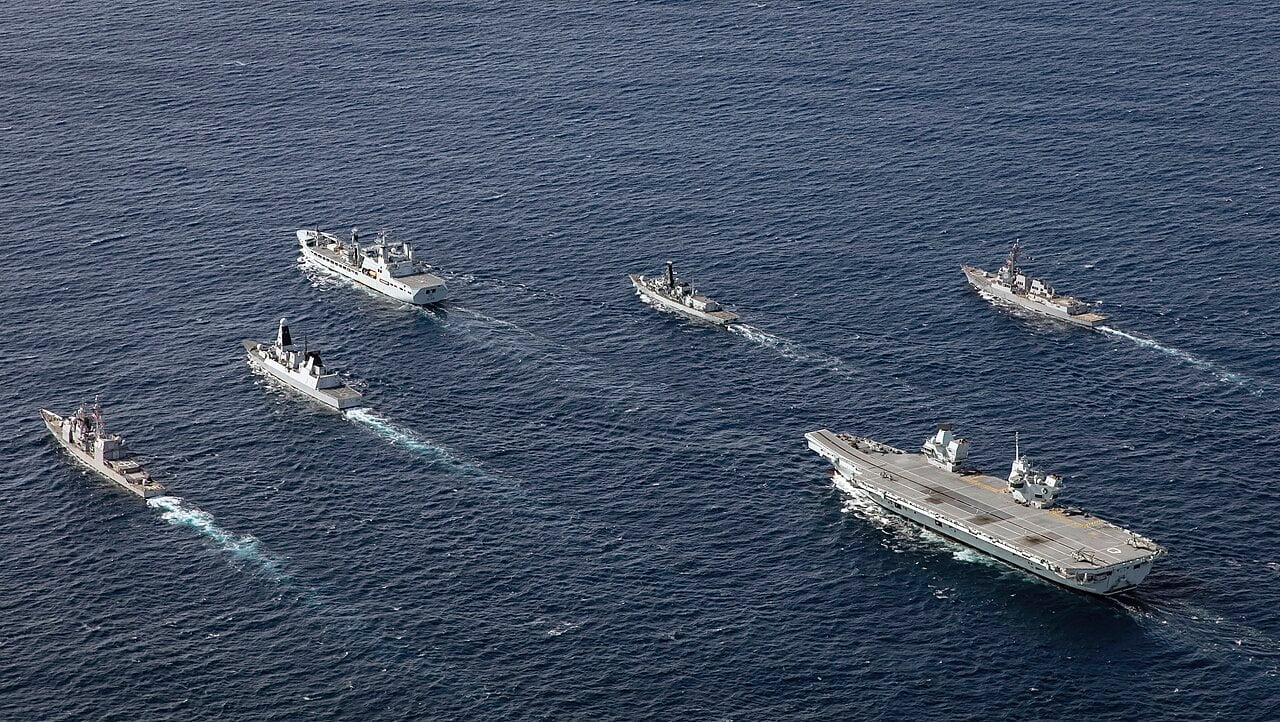
Allies are part of the British model by design. Wikipedia notes that personnel shortages and ageing ships have left the Royal Navy increasingly reliant on allied escorts. On the 2021 deployment, the US destroyer USS The Sullivans and the Dutch frigate HNLMS Evertsen sailed in the group.
BFBS Forces News looks at the ships and aircraft of the UK's Carrier Strike Group 2025.
France: One Carrier, One Group
France has a single nuclear-powered carrier, Charles de Gaulle, so its carrier strike group is a national centrepiece. Its embarked air group flies the Rafale M and E-2C Hawkeye with French Naval Aviation, plus helicopters for search and rescue.
For the Clemenceau 25 deployment to the Indo-Pacific, USNI News reported that the group included three frigate escorts, a fleet oiler and a nuclear-powered attack submarine. The named ships included the air-defence frigate Forbin and the oiler Jacques Chevallier, and an Italian frigate was integrated during the deployment.
It is the same recipe in miniature: a carrier for striking power, escorts for air and submarine defence, a submarine below and a tanker behind.
How Big Is a Strike Group, Really?
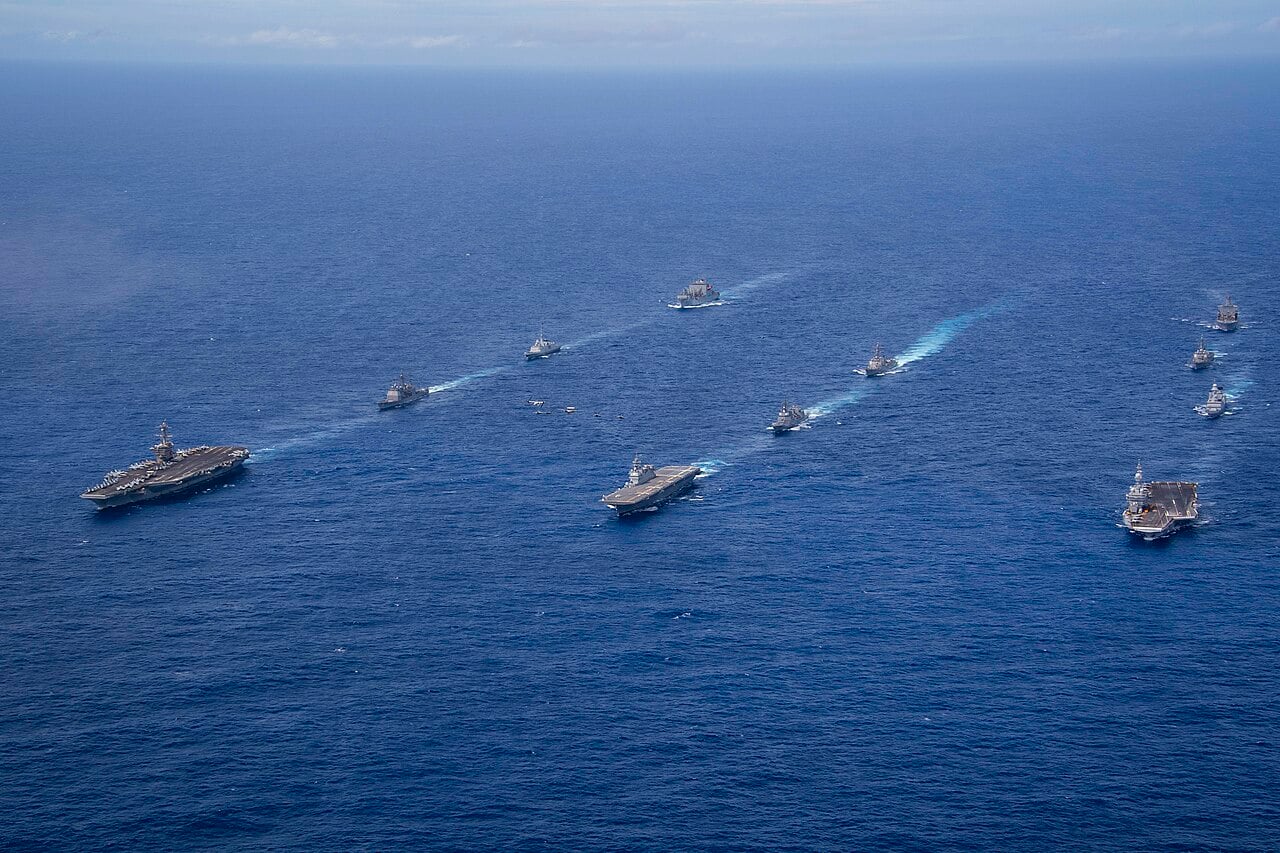
Numbers vary with the mission, but the order of magnitude is clear. A US carrier strike group puts roughly 7,500 people and 65 to 70 aircraft to sea. The US Navy maintains 11 carrier strike groups, according to Wikipedia, and its Fleet Response Plan calls for six to be deployed or ready to deploy within 30 days at any time.
The British and French groups are smaller, typically one carrier and a handful of escorts. The Queen Elizabeth class is designed to carry around 40 aircraft. What they share with the Americans is the logic: a carrier is only as good as the ships that keep submarines, missiles and empty fuel tanks away from it.
Navy Lookout footage of jets launching from HMS Prince of Wales during the NATO Arctic mission of Operation Firecrest.
When Prince of Wales heads north this autumn, watch the ships around her as well as the jets on her deck. They are the reason the carrier can be there at all.
Sources: US Navy (Aircraft Carriers fact file), Royal Navy, Naval News, USNI News, The News Portsmouth, Wikipedia (Carrier strike group; Carrier Air Wing; Ticonderoga-class cruiser; UK Carrier Strike Group; HMS Prince of Wales; French aircraft carrier Charles de Gaulle)
0 Comments