
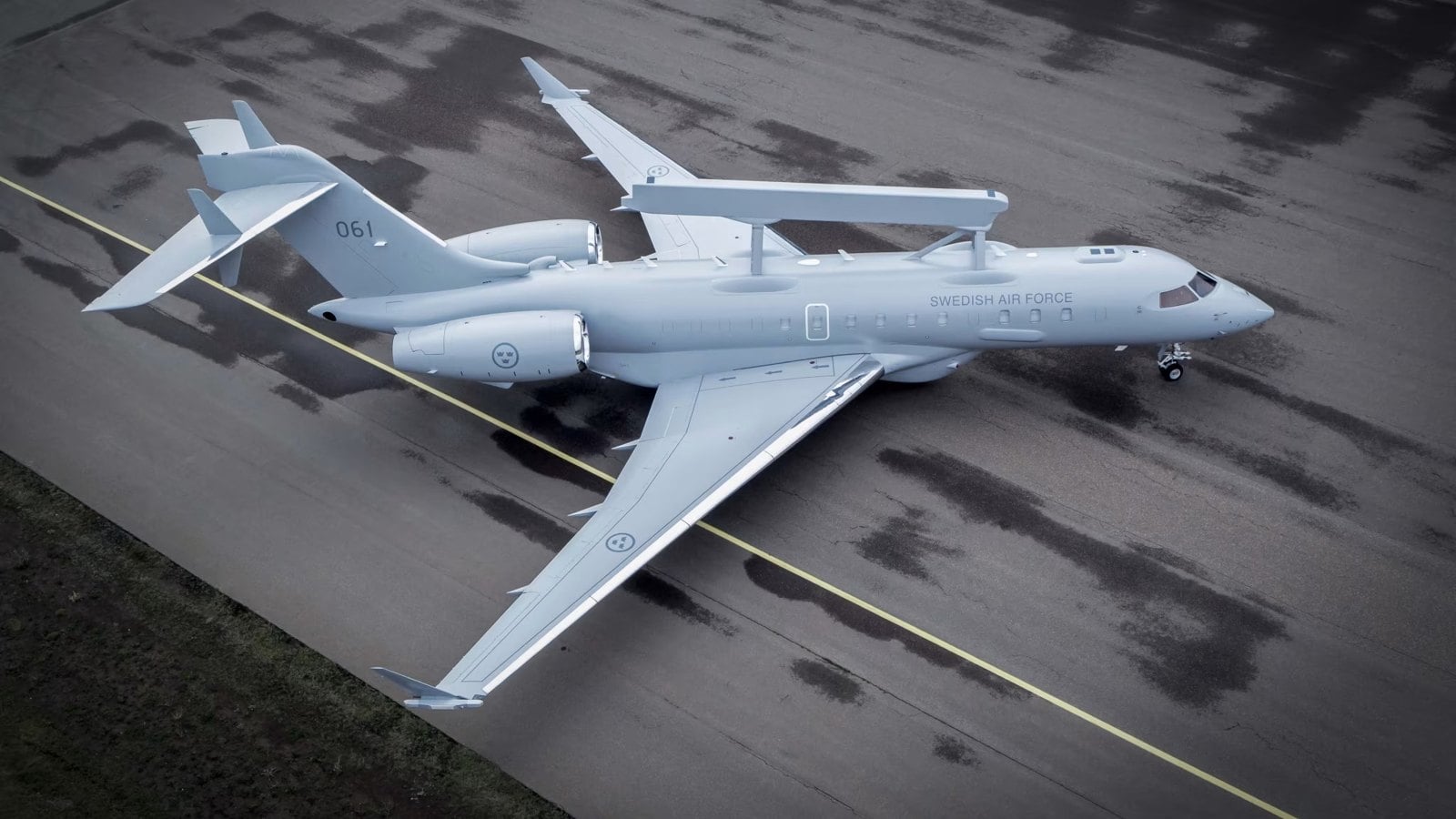
Ever since it gave its radar planes to Ukraine, Sweden has defended its airspace without an airborne early warning aircraft of its own. That gap is now closing. On 15 October 2026, Saab presented the first GlobalEye built for the Swedish Air Force, a grey business jet with a long radar “plank” on its back and the serial 061 on its tail.
Sweden calls the aircraft the S 106. It is not finished yet: testing and verification come first, then its first flight, and only then delivery to FMV, the Swedish Defence Materiel Administration. Deliveries are due to start in 2027.
Datos rápidos
- Aeronave: Saab GlobalEye airborne early warning and control (AEW&C) jet
- Swedish designation: S 106
- Presented: 15 October 2026, by Saab
- Swedish order: Three aircraft (two in June 2022, a third in June 2024), with an option for a fourth
- Third aircraft value: About SEK 2.6 billion
- Entregas: From 2027
- Base: Ärna Air Base near Uppsala
- Plataforma: Bombardier Global 6000 with Saab’s Erieye ER radar
- Radar range (Saab figure): About 550 km at 35,000 ft
- Resistencia: More than 11 hours
Why Sweden Needs It Now
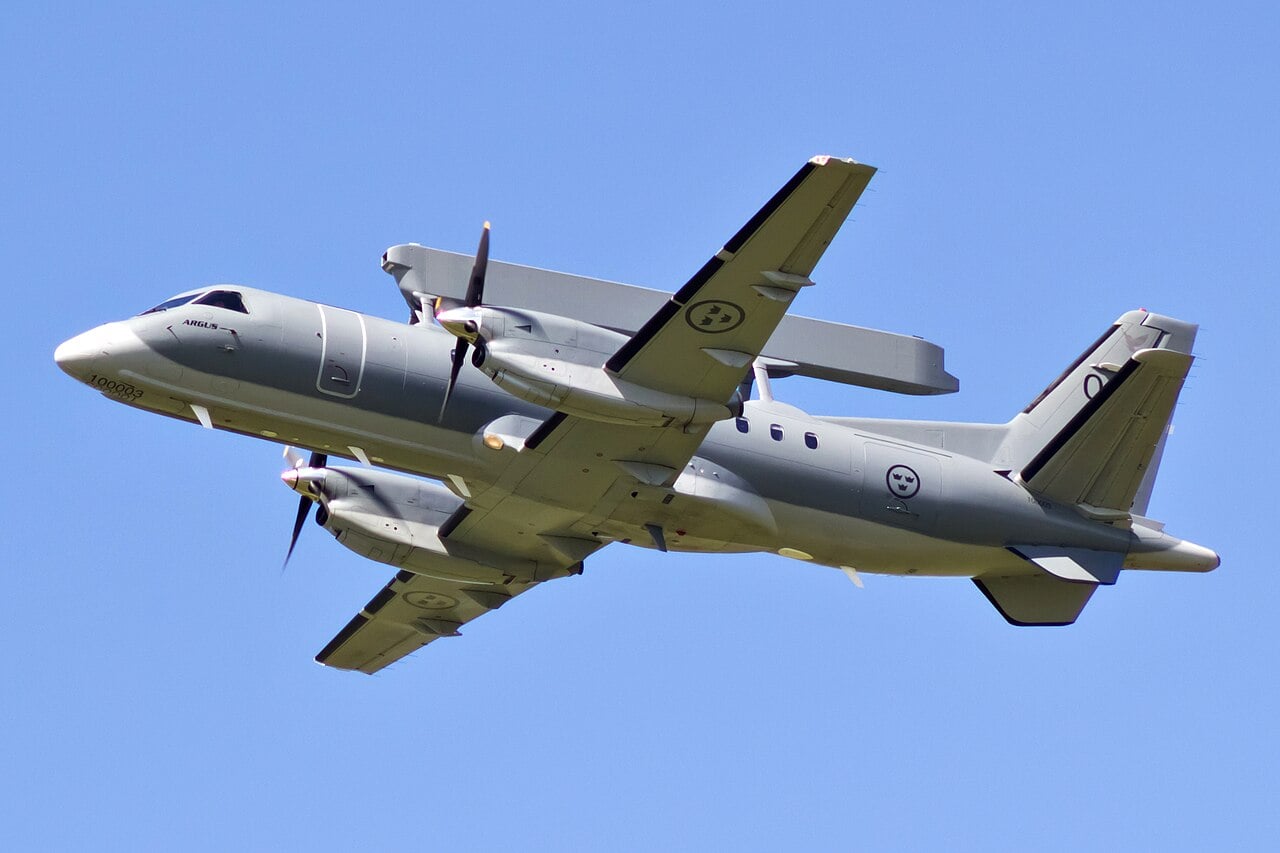
Sweden used to fly its airborne radar on two Saab 340-based aircraft, the ASC 890. In May 2024 the government decided to give both of them to Ukraine, where they help track Russian aircraft and missiles. They were the Swedish Air Force’s only airborne radar planes at the time, so Sweden accepted a gap in its own coverage until the GlobalEyes arrive.
FMV ordered the first two GlobalEyes in June 2022 with an option for more. In June 2024 it exercised that option for a third aircraft, worth about 2.6 billion Swedish kronor, and it still holds an option for a fourth. The Swedish GlobalEyes will be based at Ärna Air Base near Uppsala.
A Business Jet With a 550 km Eye
GlobalEye is built on Bombardier’s Global 6000 business jet. Saab mounts its Erieye ER radar in a fairing of roughly 10 metres on top of the fuselage. According to Saab, the radar can detect targets about 550 km away when the aircraft flies at 35,000 feet, and the jet can stay airborne for more than 11 hours.
That combination matters for a country like Sweden. A long-range radar flying high above the Baltic can see low-flying aircraft, cruise missiles and drones far beyond the horizon of ground radars. It can then pass that picture to Gripen fighters and to air defence units on the ground.
Europe’s Radar Jet of Choice
Sweden is not the only customer. The United Arab Emirates already flies the GlobalEye, and NATO, the Netherlands and Canada have all moved towards the type in 2026, as Afterburner has reported. For Saab, delivering to its home air force is a milestone of a different kind.
Before that, aircraft 061 has to fly. Saab has not given a date for its first flight. Once it does, and once the flight test campaign is complete, Sweden will finally have its own eye in the sky again.
An overview of the Saab GlobalEye and its Erieye ER radar by Matsimus.
Sources: Saab; Defence Blog; FlightGlobal; Swedish Defence Materiel Administration (FMV). Featured image: Saab
0 Comments