
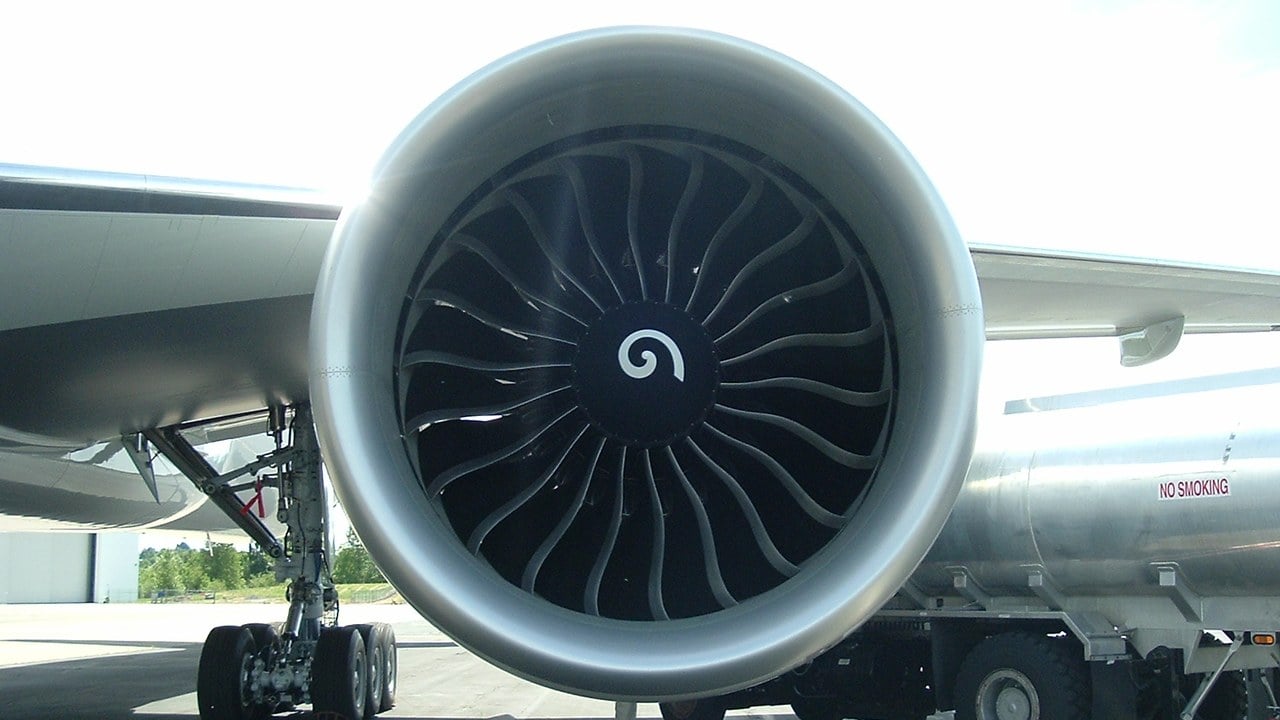
Walk along the apron of a busy airport and you pass three very different-looking machines. A regional airliner with two big propellers. A widebody whose engine intakes are so wide you could almost stand up inside them. And, if you are lucky, a slim two-seat jet trainer with a hot, narrow tailpipe and no visible fan at all.
Underneath, all three run on the same basic machine: a gas turbine. Air is squeezed, burned with kerosene and expanded through a turbine that keeps the whole thing spinning. What makes a turbojet, a turbofan, a turboprop and a turboshaft so different is not how they make energy. It is how they spend it.
That single decision, how much of the core’s power is turned into a fast, hot jet and how much is handed to a fan, a propeller or a rotor, shapes everything from fuel bills to engine noise to whether an aircraft can go supersonic. Here is turbojet vs turbofan vs turboprop, explained, and why every aircraft ends up where it does.
Datos rápidos
- Common core: Compressor, combustor and turbine (the gas generator)
- Turbojet: All air passes through the core; bypass ratio zero. Example: GE J79 (F-4 Phantom II)
- Low-bypass turbofan: Fighter engines; Eurojet EJ200 (Eurofighter Typhoon) 0.4:1
- Medium-bypass turbofan: Ivchenko AI-25TL (Aero L-39 Albatros) 2:1
- High-bypass turbofan: Airliners; GE9X about 10:1, PW1000G 12.5:1
- Turboprop: Propeller gives about 90% of thrust; rarely flown above Mach 0.6 to 0.7
- Turboshaft: All power to a shaft; GE T700 in the UH-60 Black Hawk
- Key idea: Moving a lot of air a little beats moving a little air a lot
One core, four ways to spend it
Every one of these engines is built around a gas generator: compressor, combustor and turbine, the “suck, squeeze, bang, blow” sequence covered in our explainer ¿Cómo funciona un motor a reacción? The turbine takes just enough energy from the hot gas to drive the compressor. What remains is the engine’s budget.
A turbojet spends the whole budget on one thing: blasting its exhaust out of the nozzle as fast as possible. A turboventilador adds extra turbine stages to drive a ducted fan at the front, and part of the air goes around the core instead of through it. A turboprop pushes the idea much further, extracting almost all the remaining energy through a gearbox to turn a propeller. A turboshaft goes all the way and sends its power down a shaft, usually to a helicopter rotor.
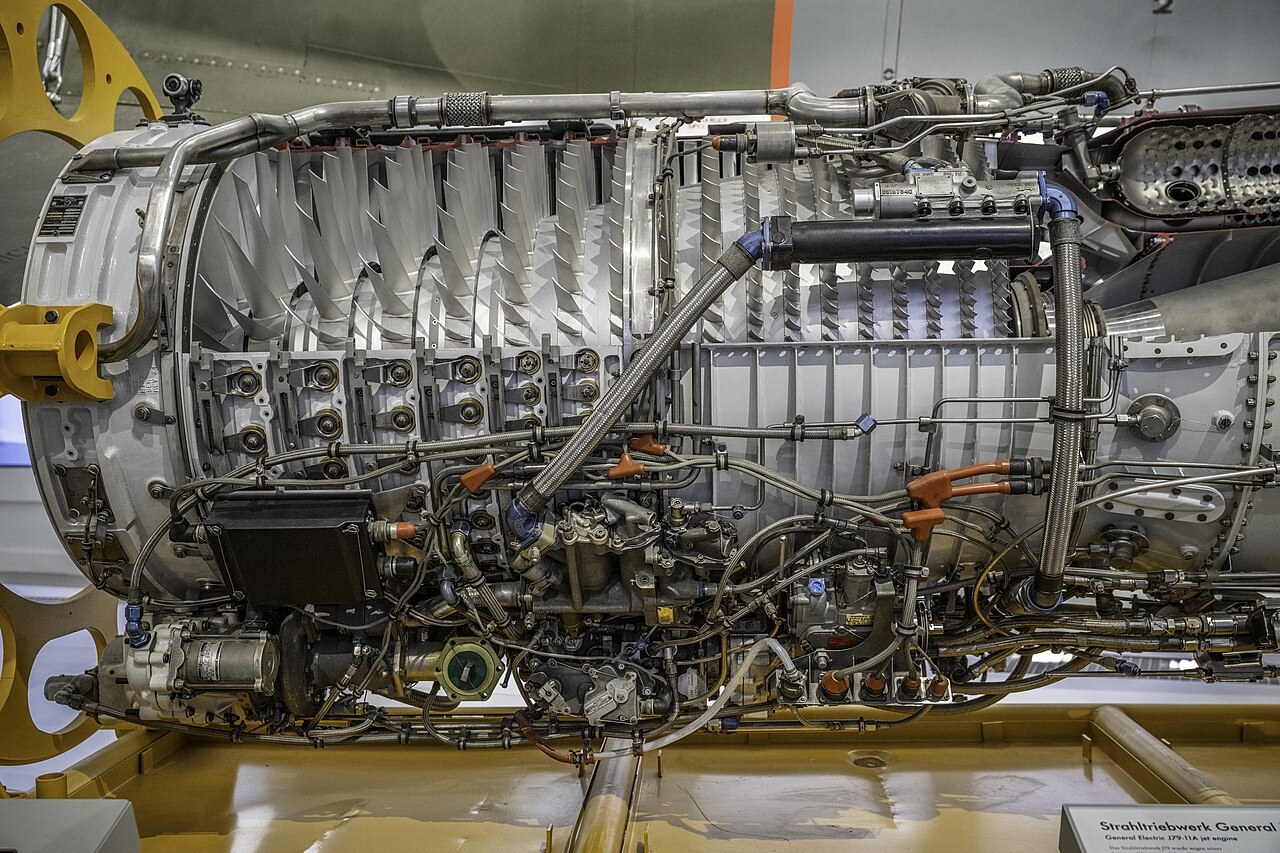
The turbojet came first. The General Electric J79, the engine that powered the F-4 Phantom II y el B-58 Hustler, is a classic example: every gram of air that enters the intake passes through the combustor and leaves through the nozzle at enormous speed. It is simple, compact and very good at high supersonic speed. At ordinary airliner speeds, it wastes a startling amount of fuel.
The aha: why fast exhaust is wasteful
A jet engine makes thrust by speeding air up. But any air that leaves the nozzle faster than the aircraft is flying also leaves behind a wake of wasted kinetic energy. The faster the jet relative to the aircraft, the more energy goes into that wake rather than into pushing the aeroplane along.
Engineers call this propulsive efficiency, and the classic Froude formula makes it brutally simple: efficiency equals 2 divided by (1 plus jet speed over flight speed). If the exhaust leaves at twice the aircraft’s speed, propulsive efficiency is about 67 percent. If it leaves at three times the speed, it falls to 50 percent. Make the jet barely faster than the aircraft and efficiency approaches 100 percent, although you then need a huge mass of air to make useful thrust.
That is the whole secret of the turbofan, and of the propeller before it. Accelerating a large mass of air a little is more efficient than accelerating a small mass of air a lot. Frank Whittle saw it early: his March 1936 British patent already described the principle of what we now call a turbofan, for aircraft flying at around 500 mph.
Animagraffs’ animated cutaway shows how air flows through the fan, core and bypass duct of a modern turbofan.
Bypass ratio: from 0.3 to more than 12
The number that describes how far an engine leans towards the “lots of air, gently” side is the bypass ratio: the mass of air that goes around the core divided by the mass that goes through it. A bypass ratio of 6 means six kilograms of air flow through the fan duct for every kilogram that is burned in the core.
The first production turbofan, the Rolls-Royce Conway, had a bypass ratio of only about 0.3. Airliner engines of the 1960s such as the Pratt & Whitney JT8D and the Rolls-Royce Spey were closer to 1. Then came the high-bypass revolution: the General Electric TF39, built for the Galaxia C-5, became the first production high-bypass turbofan, and big fans spread quickly to widebody airliners.
Today’s numbers are striking. GE quotes an approximate 10:1 bypass ratio for the GE9X on the Boeing 777X, with a fan more than 11 feet (134.5 inches) across, wider than the fuselage of a Boeing 737. The geared Pratt & Whitney PW1000G, in service since 2016, reaches 12.5:1. On these engines the fan produces the vast majority of the thrust, and the core’s main job is simply to drive it.
There is a bonus. Jet noise comes mostly from fast exhaust tearing into still air, so slower bypass air makes a high-bypass turbofan far quieter than a turbojet of the same thrust. Bigger is not automatically better, though: a larger fan adds weight and drag and has to fit under the wing with enough ground clearance.
GE Aerospace footage of the GE9X’s first flight on 13 March 2018, under the wing of GE’s Boeing 747 flying testbed at Victorville, California.
Why fighters stay skinny
If big fans are so efficient, why do fighters not use them? Because a fighter needs something an airliner does not: lots of thrust from a small frontal area, and the ability to keep pushing at supersonic speed. A high-bypass engine’s thrust falls away as speed rises, while its fat nacelle would add drag the fighter cannot afford.
Most modern fighter engines are therefore low-bypass turbofans. The Eurojet EJ200 in the Eurofighter Typhoon has a bypass ratio of 0.4:1 and produces about 13,500 lbf dry and 20,000 lbf with afterburner, according to partner MTU Aero Engines. Its bypass and core flows mix before the afterburner, where extra fuel is burned for take-off and combat. Fighter fans also have several stages, and some engines, such as the GE F404, use variable inlet guide vanes to protect against the compressor stall.
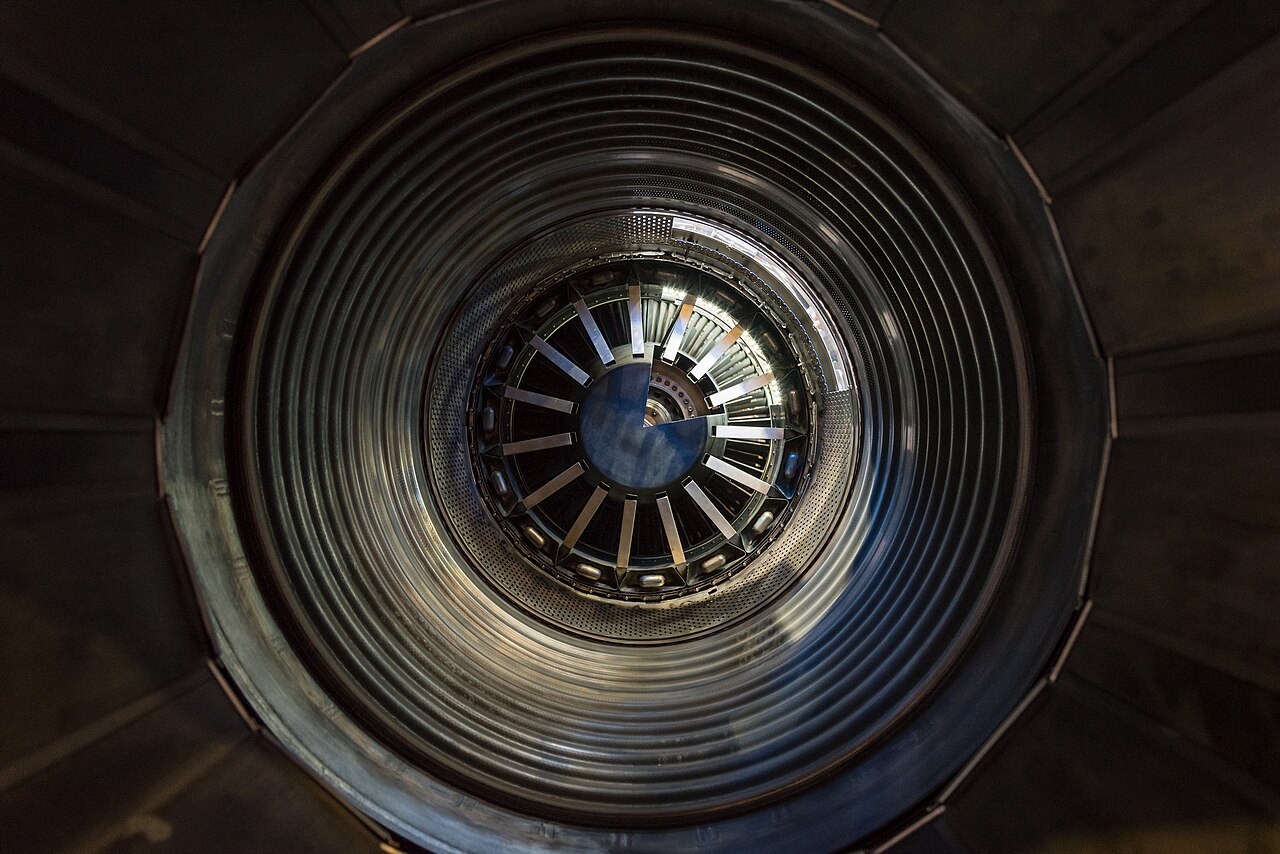
The small bypass still pays its way. The cooler bypass air makes cruise more economical than a pure turbojet and helps keep the afterburner section cool. On a modern engine, a FADEC computer juggles fuel flow, nozzle area and guide vanes so the pilot can slam the throttle without worrying about any of it.
The L-39: a turbofan in a trainer
Between those two extremes sits an engine that thousands of pilots learned on. When the Aero L-39 Albatros made its first flight on 4 November 1968, it became the first trainer aircraft in the world to be powered by a turbofan. Its engine, the Ivchenko AI-25TL, is a medium-bypass turbofan with a bypass ratio of 2:1 and a rated thrust of 16.87 kN (3,790 lb).
The AI-25 family was originally designed for the Yakovlev Yak-40 tri-jet airliner, and the uprated AI-25TL was developed for the L-39. For a trainer, the choice made sense. A turbofan is more economical than a turbojet at the subsonic speeds where a trainer spends its life, and the engine helped make the L-39 an economical jet for the many air forces that bought it.
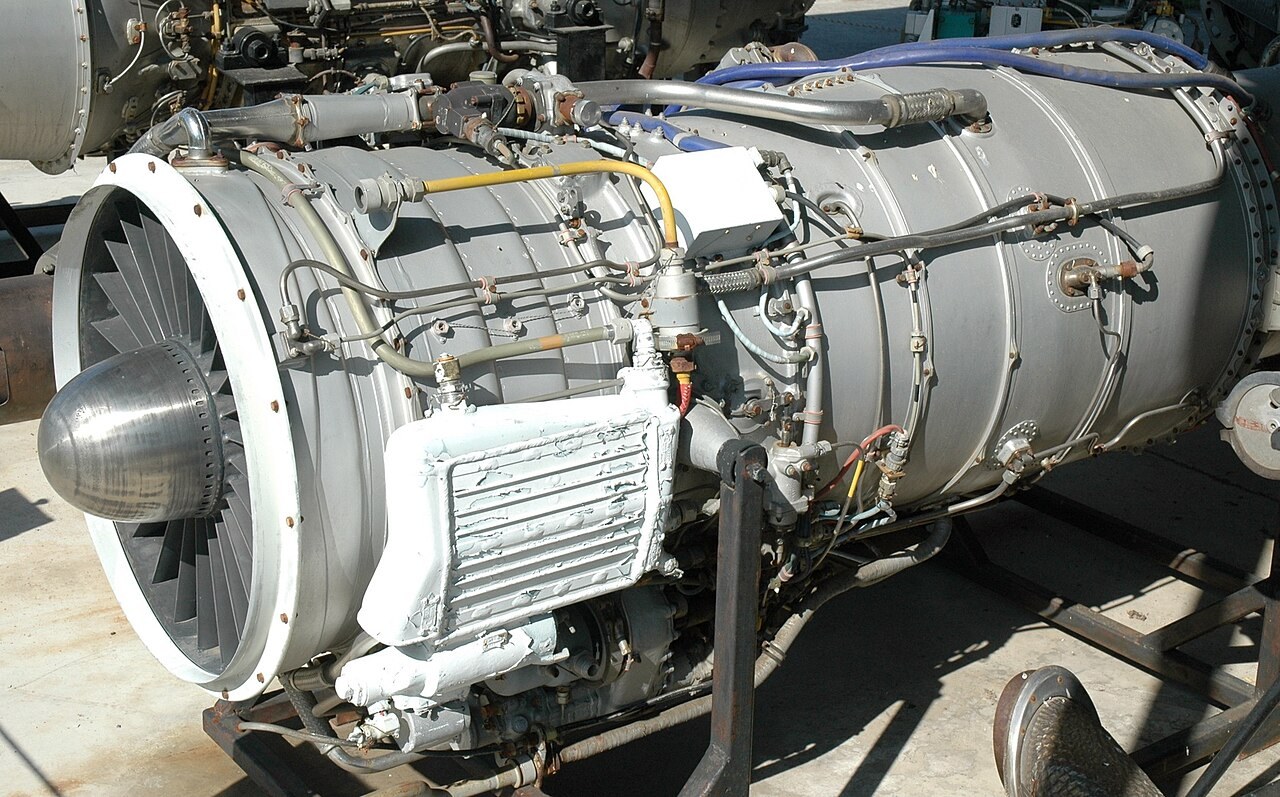
With no afterburner and a modest bypass flow, the L-39 sounds nothing like a fighter at full reheat. The test run below shows a turbofan for the L-39 running on its own, outside the airframe.
A turbofan engine for the L-39 Albatros on a test run, filmed by the engine-overhaul channel AgentJayZ.
Turboprops: the short-haul champions
A propeller is, in effect, a huge, unducted fan. Turboprops are often described as having bypass ratios of around 50 to 100, and only about 10 percent of a turboprop’s thrust comes from its exhaust. Almost everything the core produces goes through a reduction gearbox to turn the propeller at a much lower speed than the turbine.
That gives superb efficiency at low speed, which is why turboprops dominate short regional routes, where a jet’s higher cruising speed saves only a few minutes. Their weakness is the propeller tip. As flight speed rises, the blade tips approach the speed of sound and efficiency collapses, so turboprops rarely fly faster than about Mach 0.6 to 0.7. The Tu-95 Bear with its contra-rotating propellers is the famous exception.
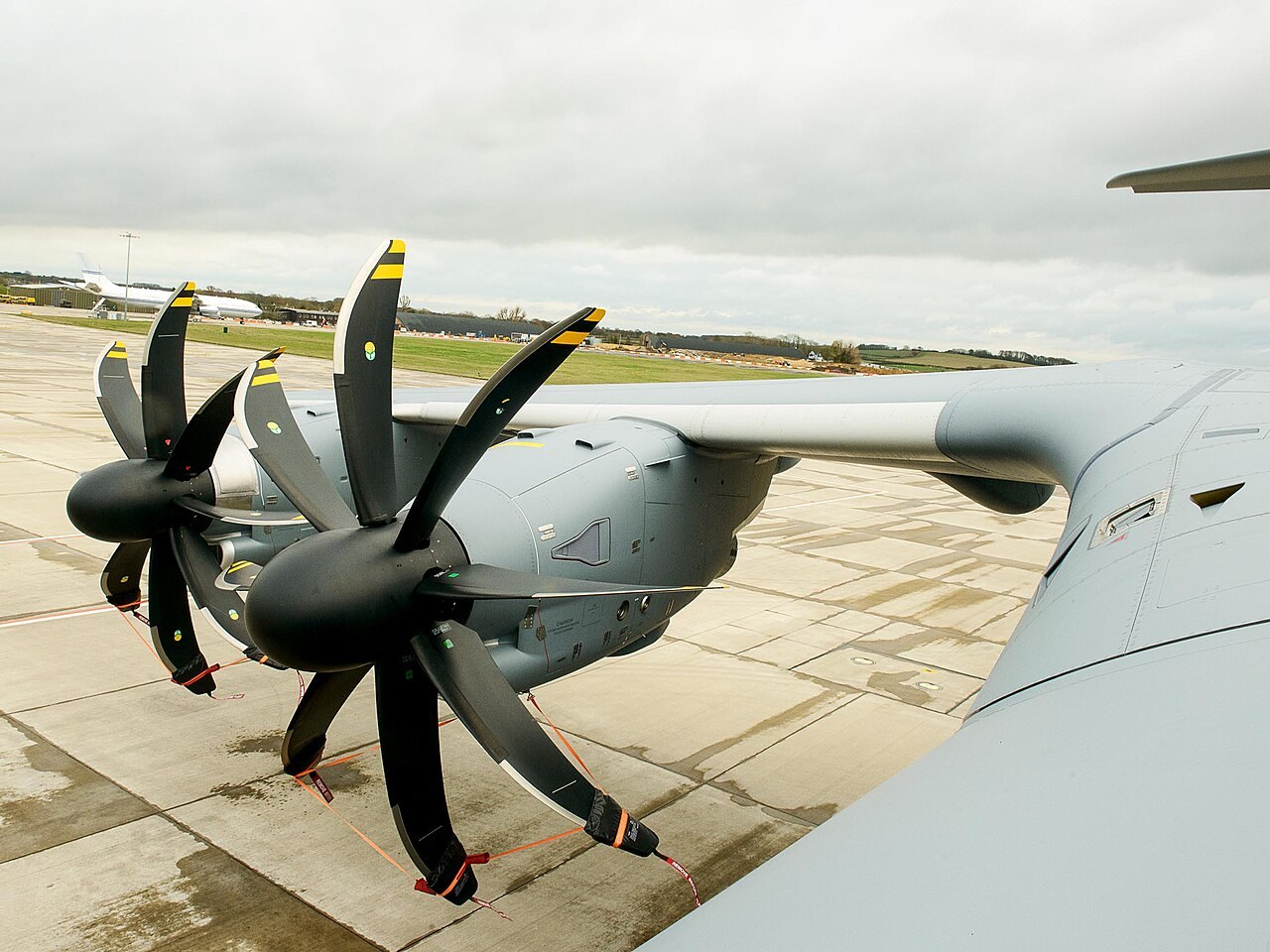
At the big end of the scale sits the Europrop TP400 on the Airbus A400M Atlas, rated at about 11,000 shaft horsepower and the most powerful turboprop in service with a single propeller. The Royal Air Force flies the type as the Atlas; the photo above shows its first example at RAF Brize Norton.
Turboshafts: all shaft, no thrust
Remove the propeller, keep the gearbox and power turbine, and you have a turboshaft. The exhaust provides essentially no useful thrust. All the work goes down a shaft, which in a helicopter drives the main and tail rotors. The UH-60 Black Hawk uses two General Electric T700 turboshafts. The same core architecture runs auxiliary power units, ships and even the M1 Abrams tank.
The families are closer than they look. The first experimental high-bypass turbofan, the Avco Lycoming PLF1A-2 of 1962, was derived from a T55 helicopter turboshaft. And the F135 in the F-35B switches partly into turboshaft mode in hover, sending about 29,000 horsepower forward through a shaft to drive its lift fan.
So the next time you board, look at the engine. A propeller means a short hop and a thrifty operator. A giant fan means the engine is quietly moving ten times more air around its core than through it. And a narrow, glowing tailpipe means someone chose speed over economy. It is the same gas turbine every time. Only the budget changes.
Sources: NASA Glenn Research Center (Beginner’s Guide to Aeronautics), GE Aerospace, GE Reports, MTU Aero Engines, LeteckeMotory.cz, MiGFlug, Wikipedia (Turbofan; Turboprop; Turboshaft; Propulsive efficiency; Ivchenko AI-25; Aero L-39 Albatros)


0 Comments