
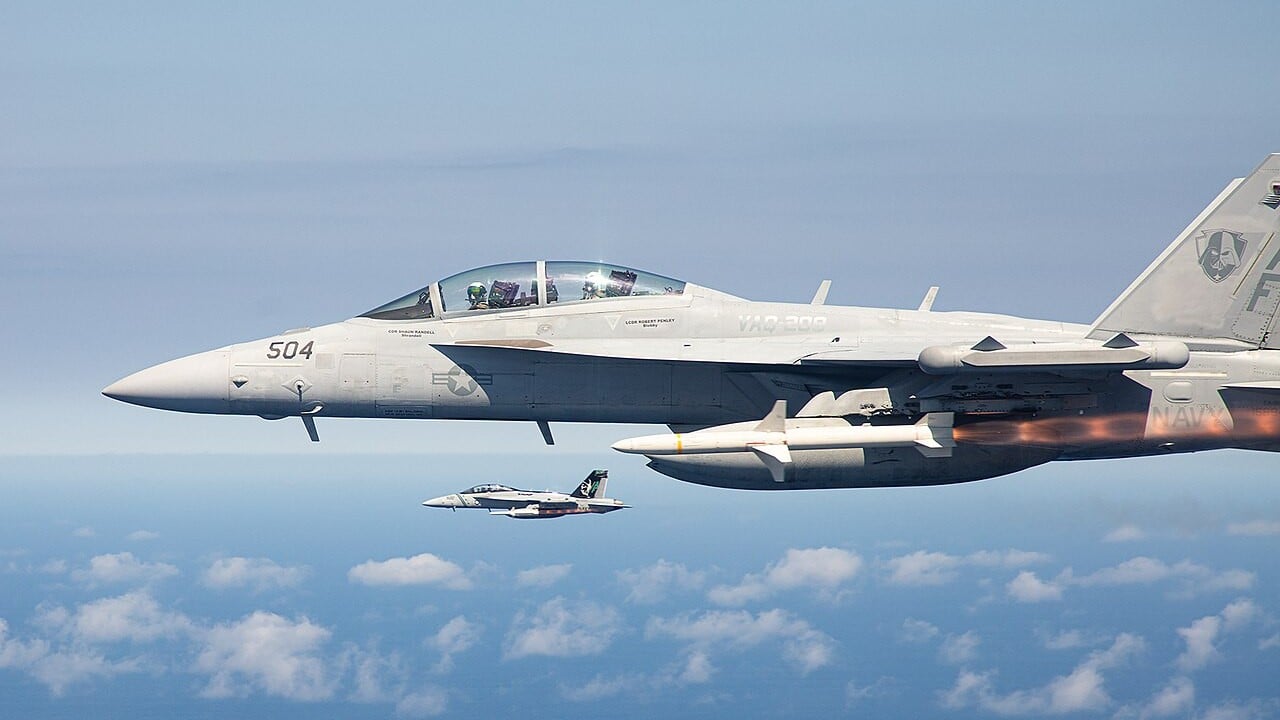
Over Iraq in the 1990s, American pilots learned that a single word on the radio could switch off an enemy radar. The word was “Magnum”, the brevity call for the launch of an AGM-88 HARM. Iraqi operators listened to coalition frequencies and knew what it meant, and pilots recalled that a bogus Magnum call was often enough to make a surface-to-air missile site shut down.
That trick only works because of what a HARM is: an anti-radiation missile, a weapon that hunts radars by flying down their own beam. It is the sharpest tool in the suppression of enemy air defences (SEAD) mission, and it has been shaping how air wars are fought since Vietnam. Here is how an anti-radiation missile works, why radar operators fear it, and why switching the radar off is no longer the escape it used to be.
Informations clés
- Qu'est-ce que c'est : A missile that homes on an enemy radio emission source, usually an air defence radar
- Main mission: Suppression of enemy air defences (SEAD), the Wild Weasel role
- Seeker: Passive receiver: it listens, it does not transmit
- First US type: AGM-45 Shrike, in US Navy service from 1965
- Main Western type: AGM-88 HARM, full production approved March 1983
- HARM range: More than 48 km (30 miles), per the USAF fact sheet
- Counter to shutdown: Inertial memory (HARM), parachute loiter (ALARM), millimetre-wave radar (AARGM)
- Newest: AGM-88G AARGM-ER, internal carriage on the F-35A and F-35C
What is an anti-radiation missile?
An anti-radiation missile, or ARM, is a missile designed to detect and home in on an enemy radio emission source. In practice that usually means a radar: the search and tracking radars that feed surface-to-air missile batteries. The same principle also works against jammers, and even against radios used for communications.
The “radiation” in the name has nothing to do with nuclear weapons. It means electromagnetic radiation, the radio-frequency energy a radar sends out to find aircraft. A radar has to transmit to see, and every pulse it sends is also a signpost pointing back at the antenna. An anti-radiation missile is built to read that signpost.
That gives the weapon a neat asymmetry. A surface-to-air missile system needs its radar on to engage, and the moment it lights up, it becomes a target. Unlike a radar, though, the missile’s passive receiver does not measure range. It knows the direction of the emitter very well and the distance only roughly, which is why later designs added navigation systems and second sensors.
How the seeker finds a radar
In the nose of an ARM sits a passive receiver with antennas tuned to the frequency bands that air defence radars use. It does not transmit anything. Instead it measures the direction from which the radar’s energy arrives, and the guidance system steers the missile to keep that direction centred, using proportional navigation, the same steering law used by many air-to-air missiles.
Early seekers were simple. The Shrike, America’s first dedicated air-to-surface ARM, had a seeker tuned to a fixed frequency range and a fixed, narrow field of view. If North Vietnam introduced a radar on a different band, a new Shrike seeker had to be built, and the result was a long line of sub-variants, each tuned to a different radar. Mission planners had to know in advance which radars they would meet.
Modern seekers cover a broad slice of the spectrum, can be reprogrammed with new threat libraries, and can classify emitters by their signal characteristics. That lets the missile pick the most dangerous radar out of a crowded electronic picture instead of homing on the first signal it hears.
From Shrike to Standard ARM: lessons from Vietnam
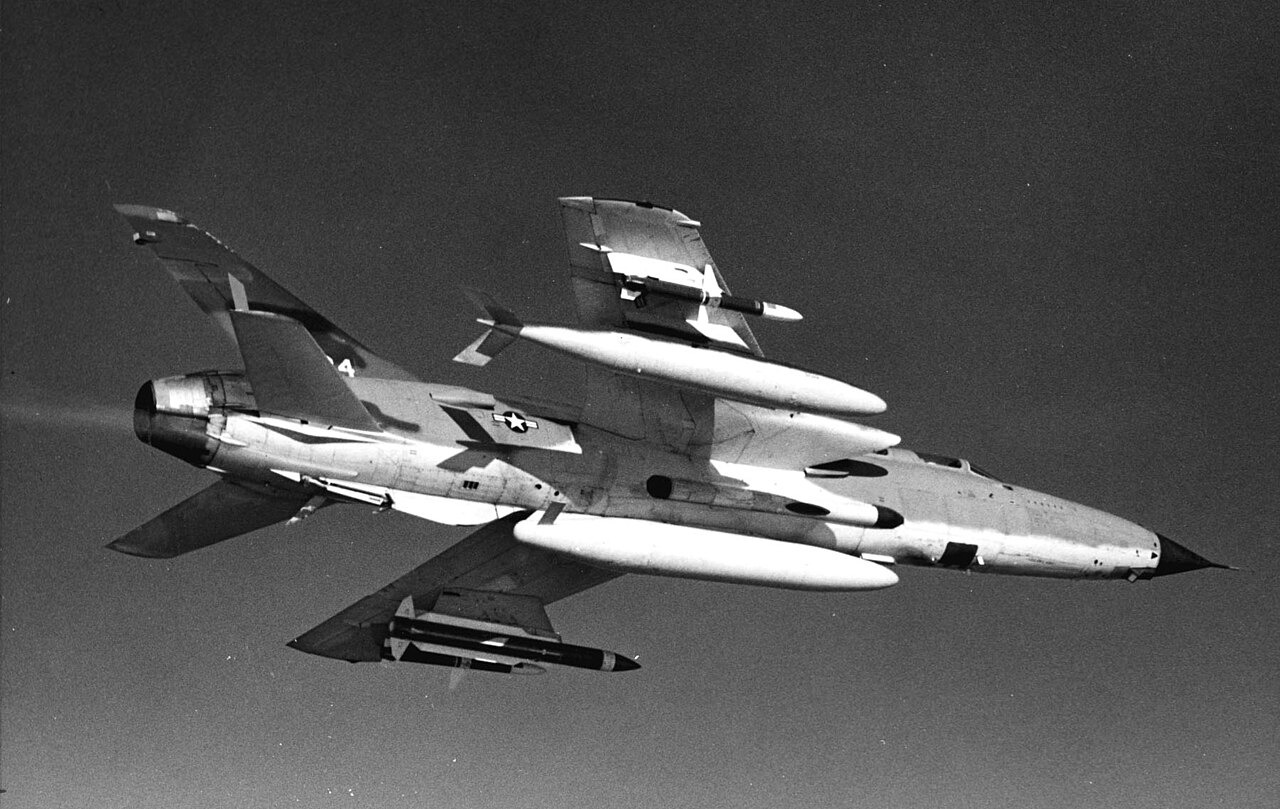
The Shrike grew out of the Naval Weapons Center at China Lake. It used the airframe of the AIM-7 Sparrow air-to-air missile with a bigger warhead and a smaller rocket motor, and it was designed to counter the Soviet SA-2 Guideline by homing on its “Fan Song” guidance radar. It entered US Navy service in 1965 and flew from A-4 Skyhawks, A-6s, A-7s, F-4 Phantoms and the US Air Force’s F-105 Wild Weasels.
It had serious limits. The missile had to be pointed almost perfectly at the emitter, its warhead was small, and it had no target memory. When a SAM site switched its radar off, any Shrikes in the air lost lock and went ballistic. The Weasels’ story, told in Afterburner’s Belettes sauvages : Premiers arrivés, derniers sortis, is in large part the story of working around those flaws.
The answer was the much bigger AGM-78 Standard ARM, built on the airframe of the US Navy’s RIM-66 Standard surface-to-air missile and in service from 1968. It could attack radars from far greater range. It was also much more expensive than the Shrike, so the cheaper missile stayed in service alongside it, and F-105G crews often carried both.
Ryan McBeth explains what a HARM high-speed anti-radiation missile is and how it is used against air defence radars.
HARM: the high-speed answer
The AGM-88 HARM, for High-speed Anti-Radiation Missile, replaced both. It was approved for full production in March 1983, first reached the fleet on the A-7E Corsair II, and the US Air Force first paired it with the F-4G Wild Weasel and its APR-47 radar attack and warning system. Today it is a joint Air Force and Navy weapon carried by the F-16, F/A-18 Hornet, EA-18G Growler et Tornado among others.
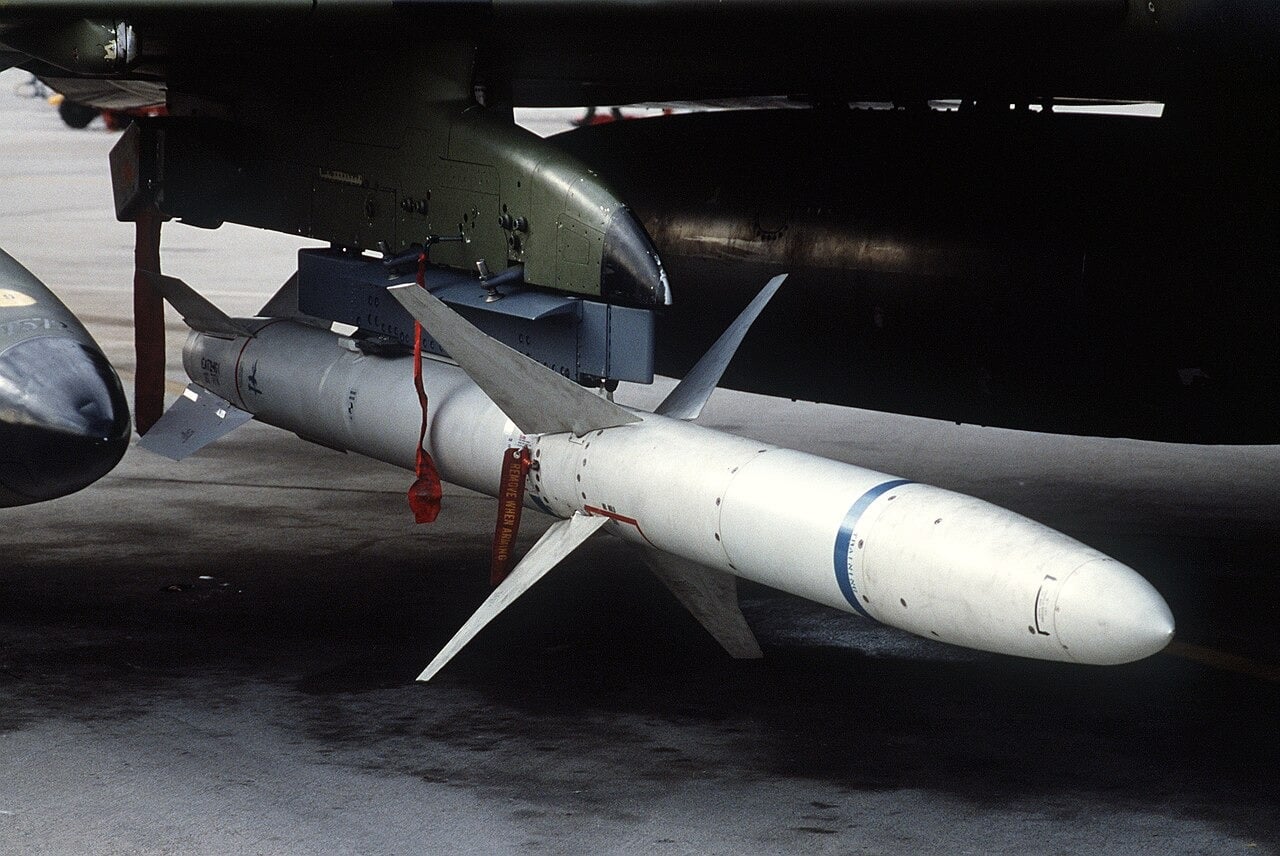
The US Air Force fact sheet describes a missile about 4.1 metres long and 360 kg at launch, with a dual-thrust solid rocket motor, a fixed seeker in the nose and a range of more than 48 km. Speed is the point. A missile that reaches the radar faster gives the operator less time to notice it, decide, and switch off.
HARM also has a small piece of cleverness that the Shrike lacked: an inertial navigation system. Once the seeker has fixed the radar’s position, the missile can remember where it was and keep flying there even if the radar goes quiet. The longer the radar stays off, the more error builds up, but an operator who shuts down a few seconds too late can still lose the antenna.
Three ways to fire a HARM
HARM has three main operating modes. In Pre-Briefed mode it is fired at long range at a known or suspected radar location, and the seeker switches on to search as it approaches. In Target of Opportunity mode the missile’s own seeker detects an emitter while still on the aircraft and the pilot launches at it. In Self-Protect mode it is fired quickly at a radar that is threatening the launching aircraft itself.
US Air Force F-16CJs add a dedicated HARM Targeting System pod, which locates radars and hands precise targeting data to the missile, so it does not have to rely on its own seeker alone. Many HARMs in wartime are also “pre-emptive” shots, fired at areas where a radar might come up, to make sure no operator dares to turn one on while a strike package passes.
That is the hidden strength of the weapon. During NATO’s 78-day air campaign over Serbia in 1999, more than 700 HARMs were reportedly fired, yet according to post-war analyses only a handful of the targeted SA-6 batteries were confirmed destroyed, because Serbian crews learned to keep their radars off or switch them on only for seconds. The radars survived, but a SAM fired without radar guidance is far less dangerous to the aircraft overhead.
Beating the radar that switches off
The British answer to the shutdown problem was ALARM, the Air Launched Anti-Radiation Missile carried by RAF Tornados. In its loiter mode it climbed high above the target area, deployed a parachute and hung there, listening. When a radar lit up, the missile dropped its chute, fired a second rocket motor and dived on the emitter. The RAF used ALARM in the 1991 Gulf War, over Kosovo and in Iraq in 2003 before retiring it at the end of 2013.
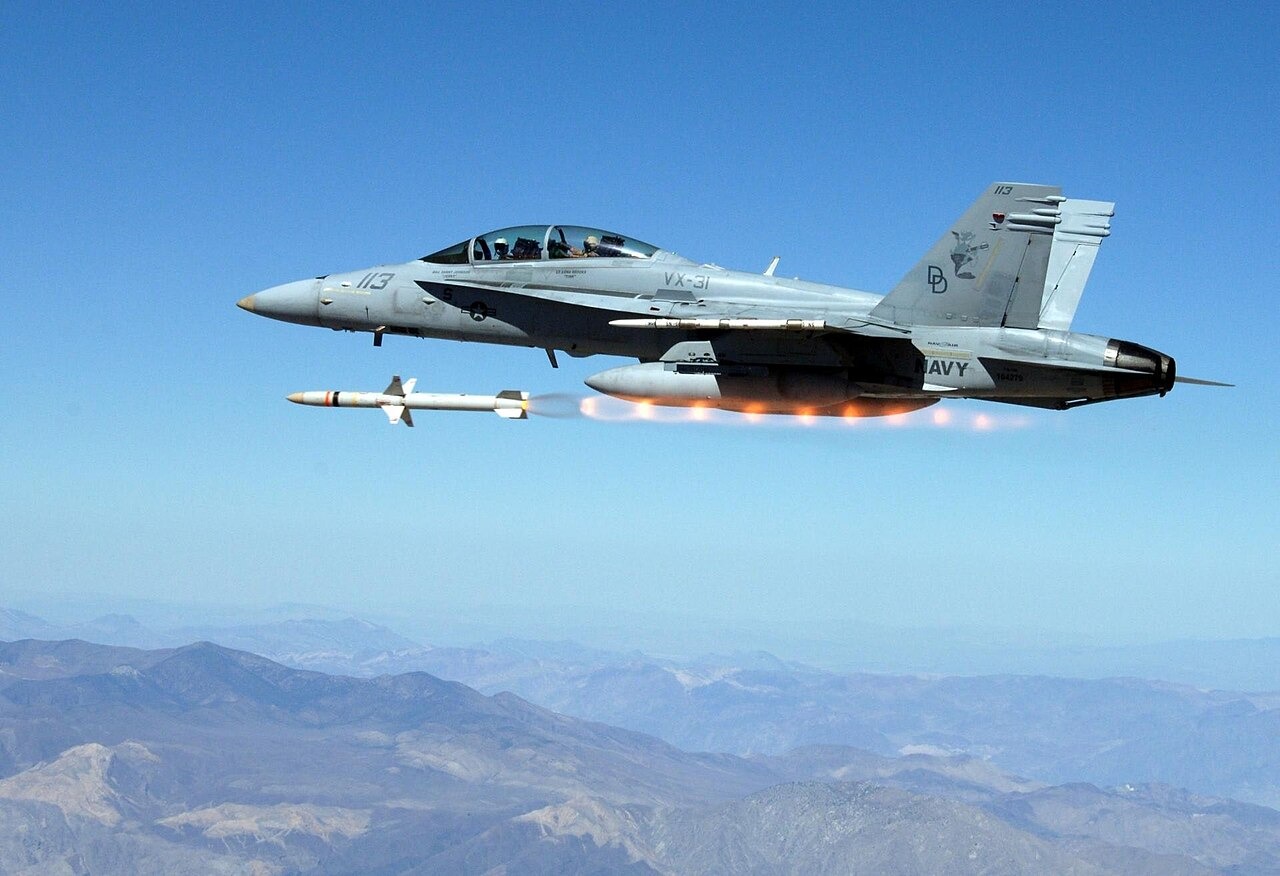
The American answer was to give the missile a second pair of eyes. The AGM-88E AARGM (Advanced Anti-Radiation Guided Missile), developed by Orbital ATK and now Northrop Grumman with Italy as a partner, keeps the HARM’s motor and warhead but adds a new seeker, satellite and inertial navigation, and a millimetre-wave radar for terminal guidance. Even if the target radar goes silent, the missile can see the site itself in the final seconds. It can also send back an image of the target just before impact.
The newest version, the AGM-88G AARGM-ER, uses a new airframe and rocket motor for roughly twice the range and is designed to fit inside the weapons bays of the F-35A and F-35C. Finland, the Netherlands, Australia and Norway are among the countries buying it.
HARMs on Soviet jets: the Ukrainian improvisation
The most unexpected chapter of the anti-radiation missile story began in 2022. The United States supplied AGM-88 HARMs to Ukraine, whose Soviet-built MiG-29 et Su-27 were never designed to carry Western weapons. Within a couple of months, contractors had wired the missiles onto them, and in late August 2022 the Ukrainian Air Force released cockpit footage of a MiG-29 launching one.
Without the full integration that an F-16 has, the Ukrainian jets cannot use every mode the missile offers. But, as the commander of US Air Forces in Europe pointed out at the time, the missile does its job even when it hits nothing: Russian crews forced to switch off their radars leave a window in which Ukrainian aircraft can operate.
NAVAIR footage of an AARGM live-fire test, the anti-radiation missile that adds a millimetre-wave radar for the final seconds of its flight.
Why the anti-radiation missile still matters
An anti-radiation missile is not a perfect radar killer, and it was never meant to be. It is a threat that changes behaviour. It forces an air defence crew to choose between seeing and surviving, and every second its radar is dark is a second in which strike aircraft can get through.
From the Shrike over North Vietnam to the AARGM-ER inside an F-35, the principle has not changed: a radar must transmit to see, and anything that transmits can be found. The engineering has simply caught up with the one defence that used to work, switching off. Over Iraq, a single word on the radio was enough. Today the missile itself is better at not taking no for an answer.
Sources: US Air Force (AGM-88 HARM fact sheet), Designation-Systems.net (AGM-45 Shrike), Air Power Australia (ALARM), Breaking Defense, Naval News (Northrop Grumman release), Air & Space magazine, Ukrainian Air Force, Wikipedia (Anti-radiation missile; AGM-88 HARM; AGM-45 Shrike; ALARM)
Header photo: US Navy photo by Cmdr. Cameron Dekker / public domain



0 Comments