
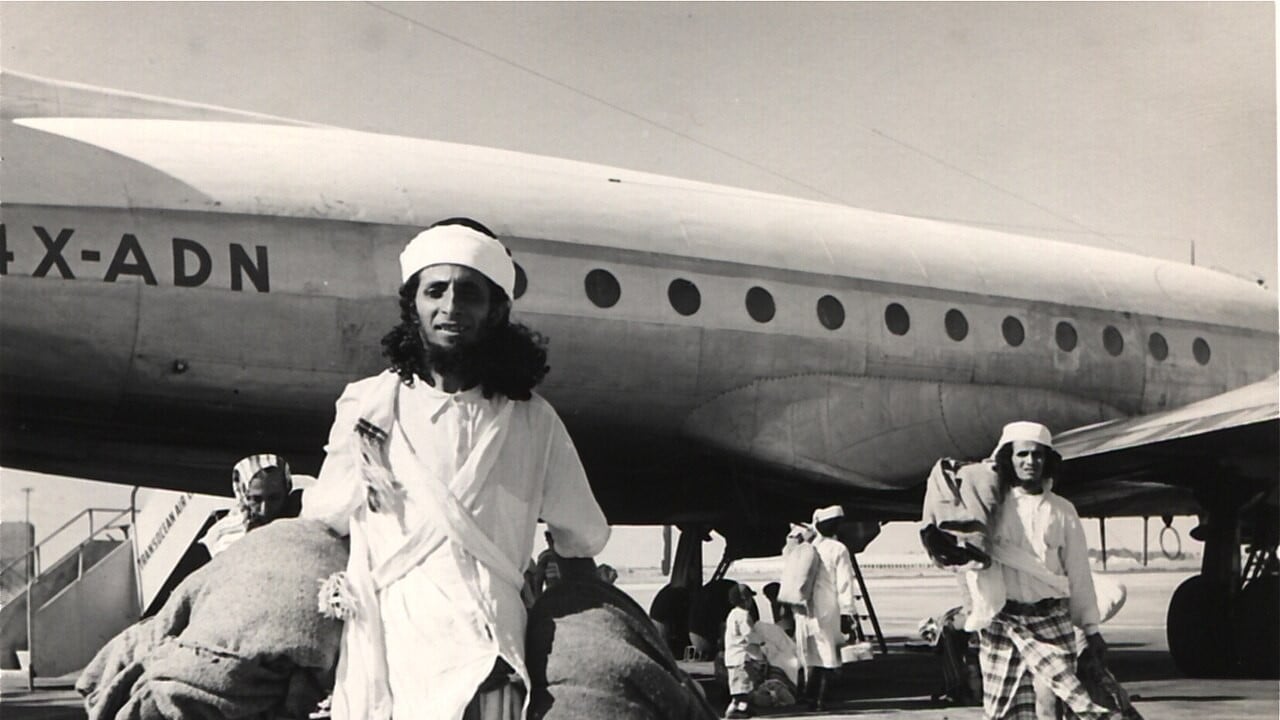
The passengers had never seen an aeroplane up close. Many walked out of the desert to reach the British colony of Aden with everything they owned on their backs. And when a big four-engined Douglas finally stood on the apron waiting for them, some hesitated at the steps, not out of fear, but because it was the Sabbath.
Between December 1948 and September 1950, an improvised fleet of war-surplus transports flew around 49,000 Yemenite Jews from Aden to the new state of Israel. Officially it was Operation On Wings of Eagles. The world came to know it as Operation Magic Carpet, and some of the key people who made it happen came from an unlikely place: a small airline based in Anchorage, Alaska.
Informations clés
- Opération: On Wings of Eagles, better known as Operation Magic Carpet
- Dates : 16 December 1948 to 24 September 1950
- People flown: About 49,000 Yemenite Jews
- Itinéraire: Aden to Israel, about 1,760 miles and roughly eight hours
- Aéronef: War-surplus Douglas DC-4s and Curtiss C-46s; the first flight was a DC-3
- Opérateurs : Alaska Airlines, then Near East Air Transport, under contract to the JDC
- Échelle: About 430 flights, more than 1.3 million miles
An airline from Alaska, a crisis in Aden
In 1949, Alaska Airlines was led by James Wooten, a former trucking man who had launched the first scheduled air freight service at American Airlines in 1944 and became Alaska’s president in June 1947. Wooten had turned the small Anchorage carrier into a busy charter operator, buying up surplus military transports, including Douglas DC-4s, the civilian version of the C-54 Skymaster, et Curtiss C-46 Commandos. Alaska aircraft had already flown in the Berlin Airlift.
Thousands of miles away, a humanitarian crisis was building. Jews leaving Yemen had gathered in Aden, then a British colony, where the American Jewish Joint Distribution Committee ran a transit camp called Hashed. With sea passage through the Suez Canal closed to ships bound for Israel, the JDC turned to the air, and chartered American aircraft to fly the refugees out.

The first flight left Aden on 16 December 1948, a Douglas DC-3 carrying 50 orphans. In the first stage, to spring 1949, roughly 7,000 people were flown out, with groups trucked almost daily to Aden airport under armed guard. That was only the beginning.
Flying by the stars over hostile ground
The route from Aden to Israel ran the length of the Red Sea, about 1,760 miles and roughly eight hours of flying. The aircraft crossed Yemen but had to skirt Saudi Arabia, Egypt and Transjordan, and they were fired on from the ground seven times; one aircraft took a hit in the tail. A support base was set up at Asmara in Eritrea.
There was no radar coverage and no GPS. Alaska Airlines navigator Elgen Long, then in his early twenties, worked out the aircraft’s position by celestial navigation with a sextant and a chronometer. Unable to find a proper marine chronometer in France on the way out, he bought a Rolex wristwatch, a certified chronometer, to keep time. According to Alaska Airlines, it was still ticking on his wrist decades later.
An excerpt from “A Day of Deliverance”, the JDC’s 1949 film from Aden (JDC Archives).
When Long’s crew reached Aden, they found that the “group” awaiting transport was thousands strong, with nowhere to shelter or feed them. The British asked how many people the DC-4 could carry. In its airline layout, the answer was only around 50.
Ripping out the seats
The crew worked the numbers and concluded the DC-4 could lift far more weight than its cabin allowed, so they took the seats out. Later aircraft were fitted with wooden benches instead of upholstered seats, and carried between 125 and 145 passengers a flight instead of the usual 56. Many of the refugees were badly underweight after the trek to Aden, which helped make the arithmetic work.

Long remembered that the very first passengers hesitated at the steps of the aircraft. It was the Sabbath, and they were deeply observant.
According to Long, his crew flew back and forth between Aden and Israel for seven days straight, taking turns to sleep while the other crew members flew. Wooten himself piloted some of the flights.
Regulators, a new airline and a secret wave
Alaska Airlines’ worldwide charter business had grown far beyond its modest scheduled network, and in August 1949 the US Civil Aeronautics Board and Civil Aeronautics Administration cracked down, with severe fines that included one against Wooten personally. Rather than abandon the airlift, Wooten and pilot Robert Maguire formed a new carrier, Near East Air Transport, to keep the flights going.
Navigator Elgen Long recalls the On Wings of Eagles flights (wysinfo).
The biggest wave came in the second stage, from July to November 1949, when some 30,000 people were flown out, with the peak in September. It was deliberately kept out of the news: the Israeli censor and the press cooperated out of concern for the refugees still waiting in Aden. The JDC only announced the airlift publicly on 7 November 1949.
The journey was not a fairy tale for everyone. Many people died on the way to Aden or in the camps, and a monument was later raised in the Jewish cemetery in Aden to about 700 refugees who died there. Historians have since criticised parts of how the wider operation was organised.
The last flight, and the legacy
The final stage ran through 1950. On 24 September 1950, the last two aircraft landed at Lydda with 177 passengers. In all, the operation comprised some 430 flights covering more than 1.3 million miles, at a transport cost of more than US$4 million.
Wooten and Near East Air Transport went straight on to an even larger airlift, Operation Ezra and Nehemiah from Iraq in 1950 and 1951. Together the two airlifts carried at least 160,000 people. Wooten, a lifelong Baptist, received a commendation from Israeli Prime Minister David Ben-Gurion. Long went on to fly solo around the world over both poles in 1971 and later spent decades researching the disappearance of Amelia Earhart.
The North-American Aerospace Museum on Elgen Long, the Magic Carpet navigator who later flew solo around the world over both poles.
For years the airline’s role was barely known outside the families it flew. In 2013 the Alaska Jewish Museum in Anchorage opened an exhibition on it, and Alaska Airlines now tells the story as part of its own history. The name the passengers gave it came from scripture: the promise of being carried home “on eagles’ wings”. They just did not expect the eagles to be ex-military Douglas transports from Alaska.
Sources: Alaska Airlines (“On Eagles’ Wings”, 2017), American Jewish Joint Distribution Committee Archives
Header photo: Fritz Cohen / Wikimedia Commons, public domain

0 Comments