
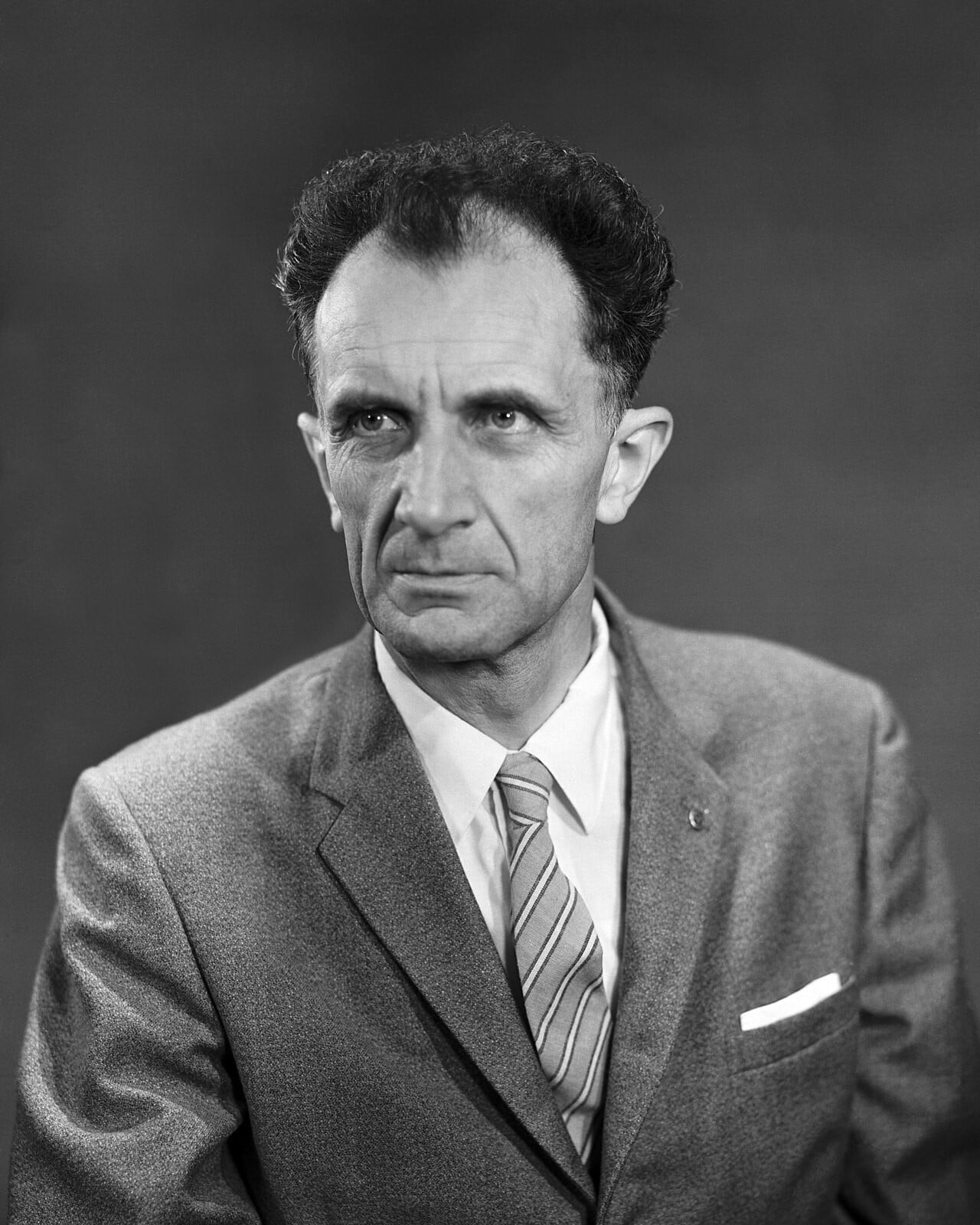
In the autumn of 1935, some of the greatest aerodynamicists alive gathered in Rome for the Volta Congress, an international meeting on “High Velocities in Aviation”. Ludwig Prandtl was there, and Theodore von Kármán, and G. I. Taylor. A young German named Adolf Busemann stood up and explained why a wing angled back from the fuselage should behave better at very high speed.
At dinner afterwards, the host, General Arturo Crocco, jokingly sketched “Busemann’s airplane of the future” on the back of a menu: a fighter with swept wings and a swept tail. It looked remarkably like a jet of the 1950s. No aircraft of the day could fly anywhere near the speeds where it would matter, and most of the room promptly forgot the idea.
Ten years later it changed every fast aircraft on Earth. Look at a modern airliner, a business jet or a fighter and the wings are swept back. Here is swept wings explained: what sweep actually does, why it works, what it costs, and why airliners settle on roughly 25 to 35 degrees.
Informazioni rapide
- What sweep does: Delays shock waves and the drag rise near Mach 1 by raising the critical Mach number
- The rule: The wing mainly feels the airflow component normal to its leading edge: flight speed times the cosine of the sweep angle
- Idea first presented: Adolf Busemann, Volta Congress, Rome, 1935
- Independent US work: Robert T. Jones, NACA Langley, 1945
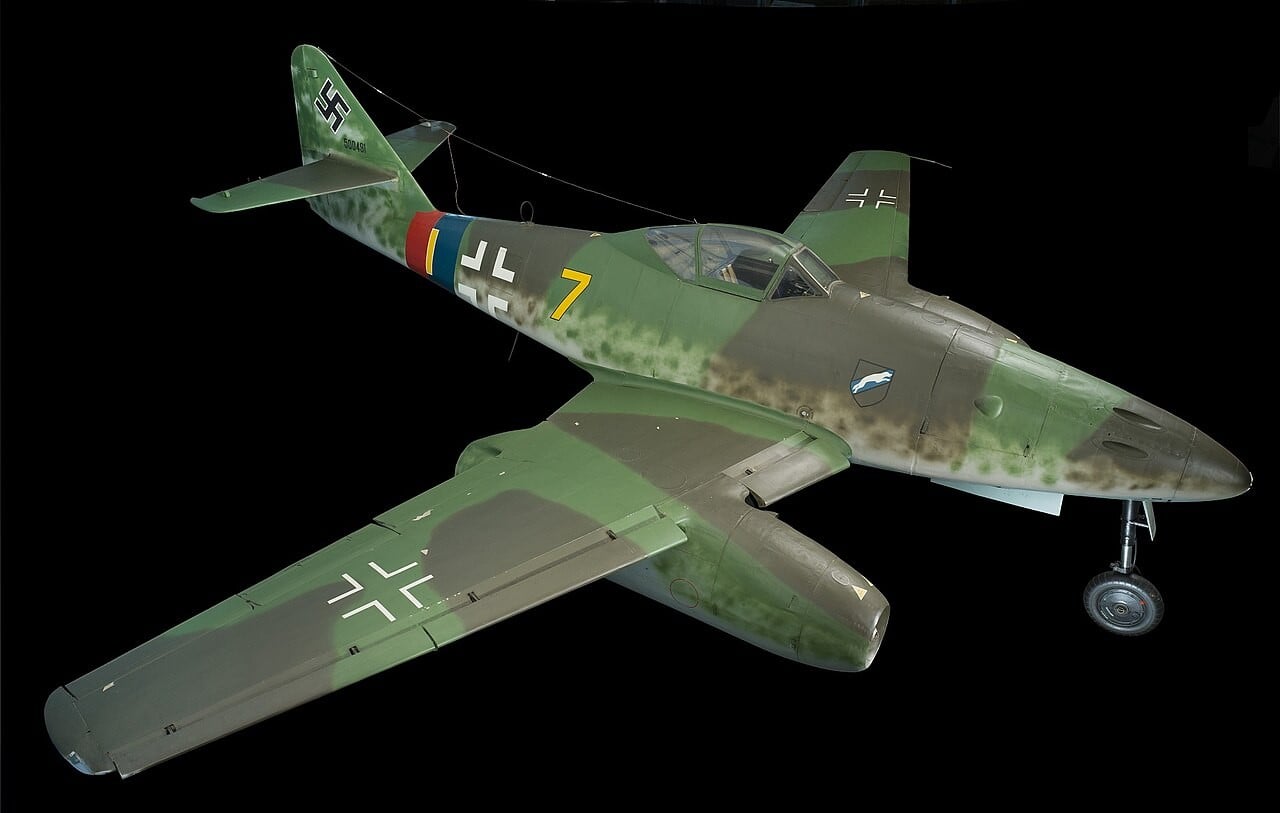
- Me 262: Outer wings swept only about 18.5 degrees, mainly for balance
- MiG-15 and F-86: Both 35-degree swept wings; met over Korea from 1950
- Downsides: Tip stall, pitch-up, less low-speed lift, more structural weight
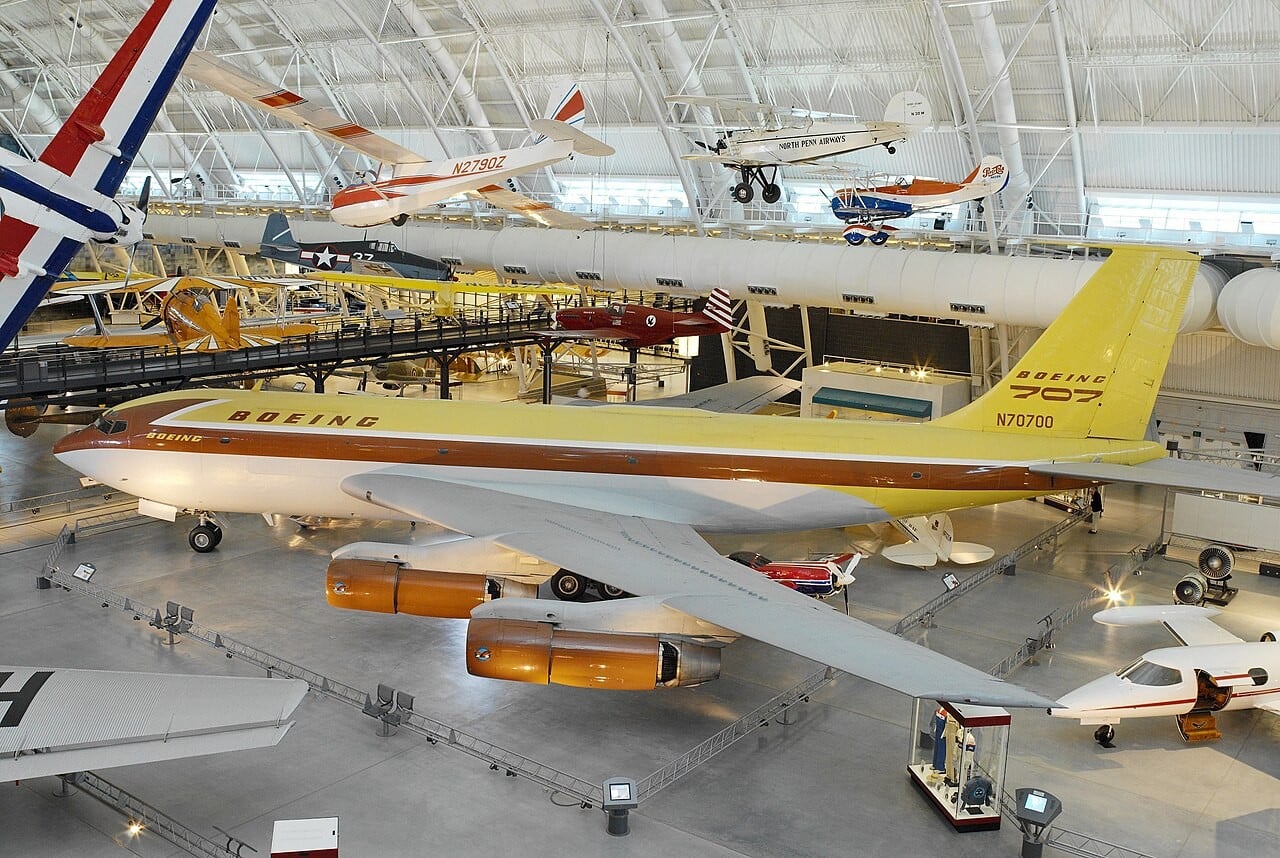
- Airliners: A320 25 deg, 777 31.6 deg, 707 35 deg, 747 37.5 deg
The wall before the sound barrier
An aircraft does not have to reach Mach 1 to run into the sound barrier. Air speeds up as it flows over the curved upper surface of a wing, so parts of that flow reach the speed of sound while the aircraft itself is still well below it. The FAA’s Airplane Flying Handbook defines the flight Mach number at which some portion of the airflow over the wing first reaches Mach 1 as the critical Mach number.
Beyond it, a shock wave forms where the supersonic pocket of air slows back down. Shocks cost energy, so drag rises steeply. As speed increases, the shock grows stronger and moves aft, the airflow behind it can separate, and the aircraft may buffet or start to tuck its nose down, the effect we covered in Mach Tuck: la picchiata che quasi uccise i primi piloti di jet..
The thicker the wing, the earlier this happens. The critical Mach number of the fairly thick wing of the P-38 Lightning was about 0.69, while the much thinner wing of the Supermarine Spitfire reached about 0.89. Thin wings help. Sweep helps far more.
The cosine trick
Here is the aha. On a long swept wing, the air flowing along the span, parallel to the leading edge, does very little. What matters for the pressure pattern, and for the shock wave, is the component of the airflow that crosses the wing at right angles to the leading edge.
That component equals the flight speed multiplied by the cosine of the sweep angle. Sweep a wing back 35 degrees and the airflow it “feels” is only about 82 percent of the aircraft’s speed. At 45 degrees, it is about 71 percent. In idealised theory, a wing that would hit trouble at Mach 0.7 when straight could fly correspondingly faster before the same shock appears.
Real wings, with roots, tips and a fuselage in the middle, never get the whole ideal benefit, but the gain is large. NACA engineer Robert T. Jones, who worked out the same principle independently in 1945, put it neatly: a shock on a swept wing would itself have to be swept, and such an oblique shock cannot form until the velocity component normal to it becomes supersonic.
Real Engineering explains why airliner wings are angled backwards and how sweep delays the formation of shock waves.
Germany gets there first
Busemann’s 1935 paper dealt only with supersonic lift, but by the end of that year he had shown similar benefits at transonic speeds, and the topic was classified. In 1939 Hubert Ludwieg at the AVA in Göttingen ran the first wind-tunnel tests of the idea, comparing a straight wing with one swept at 45 degrees at Mach 0.7 and 0.9. Sweep cut drag at transonic speed exactly as predicted, and the results were passed to Willy Messerschmitt in December 1939.
IL Messerschmitt Me 262, the first operational jet fighter, is often described as a swept-wing jet, but its sweep was almost accidental. When its engines turned out heavier than planned, the outer wings were swept back by just 18.5 degrees to move the wing’s centre of lift into the right place. Busemann proposed a 35-degree wing for it in 1941, but it was never adopted.
German designers did push further before the war ended. The Messerschmitt P.1101 was built to explore which sweep angle to use and was captured almost complete; in the United States it became the basis of the Bell X-5, the subject of our story on variable sweep. Junkers even flew a bomber with its wings swept forward, the Ju 287.
1945: the idea crosses the Atlantic
In the United States, Jones reached the same conclusion in early 1945 while studying highly swept delta and V-shaped wings at NACA Langley. Some colleagues did not believe him; Theodore Theodorsen reportedly dismissed it as “hocus-pocus”. Free-flight model tests under Robert Gilruth backed Jones up, and his report went out in June 1945.
That same May, a US technical team including von Kármán and Boeing’s George Schairer reached Busemann’s laboratory at Braunschweig and found a mass of swept-wing data. When they asked what it was, Busemann reminded them that they had heard it from him a decade earlier in Rome.
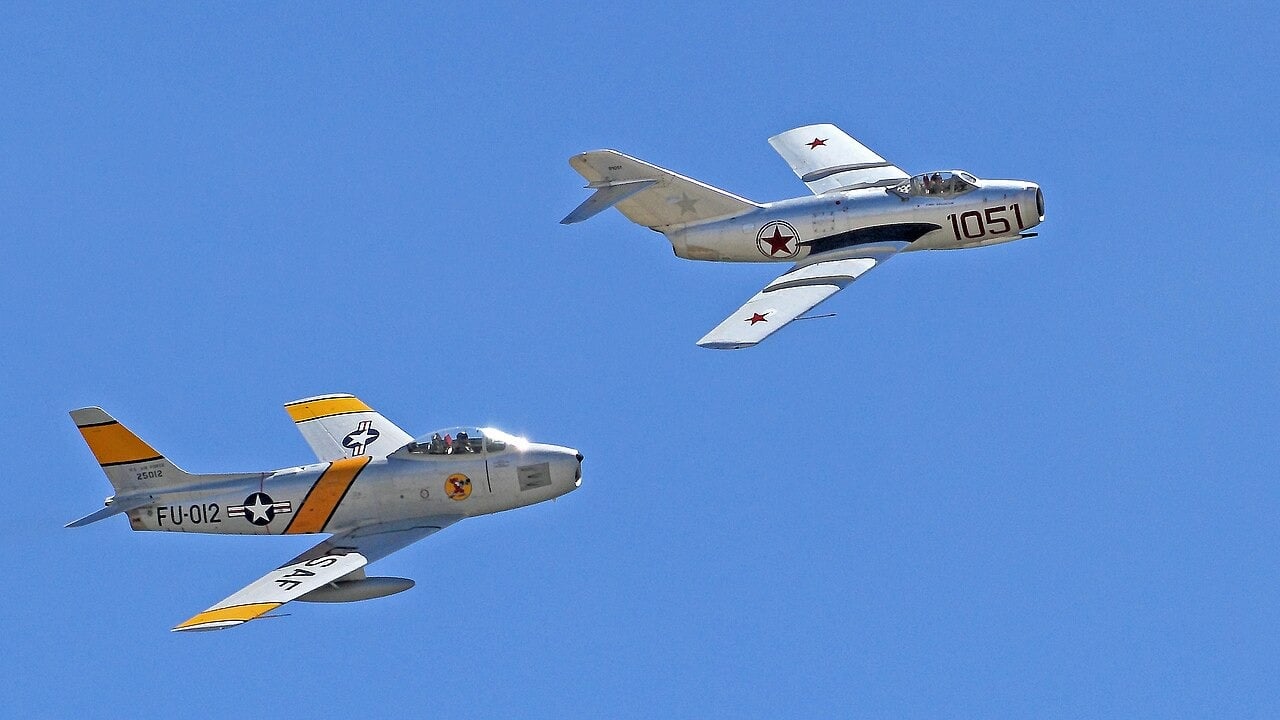
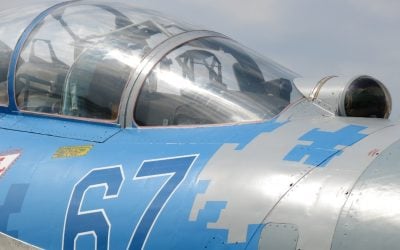
Schairer immediately wrote home. Boeing reworked its straight-winged bomber design into the B-47 Stratojet with wings swept at 35 degrees, and North American redesigned its new fighter, which became the F-86 Sabre, with a 35-degree swept wing. In the Soviet Union, Mikoyan-Gurevich combined German swept-wing research with a Rolls-Royce Nene engine and produced the MiG-15, also with a 35-degree wing.
Over Korea from late 1950, the two met in the first jet-versus-jet air war. Straight-winged American jets such as the F-80 and F-84 were outclassed by the MiG-15 and pushed into ground attack, and the swept-wing Sabre became the fighter that could take it on.
The Air Zoo, a Smithsonian-affiliated museum in Kalamazoo, Michigan, compares the swept-wing rivals of Korea, the MiG-15 and the F-86 Sabre.
The price of sweep
Sweep is not free. A swept wing of a given span has longer spars, is harder to make stiff against twisting and is therefore heavier. More importantly, it is worse at low speed, because the lift it makes depends on the same reduced airflow component that delays the shock.
At low speed and high angle of attack, air on a swept-back wing also drifts sideways along the span towards the tips. The boundary layer thickens, and the tips, which sit furthest aft, tend to stall first. Lose lift at the tips and the centre of lift moves forward, pitching the nose up, which stalls more of the wing. This pitch-up plagued early swept-wing jets; on the F-100 Super Sabre it was nicknamed the “Sabre dance”. Our explainer on angle of attack and the stall covers the basics.
Engineers fought back with hardware. The MiG-15 carries wing fences, flat plates on top of the wing that stop the sideways flow. The F-86 used leading-edge slats that extend at low speed to add lift. Others used dogtooth notches, wing twist and, later, big slats and flaps. Swept wings also tend to suffer Dutch roll, which is why airliners carry yaw dampers.
Why airliners settle at 25 to 35 degrees
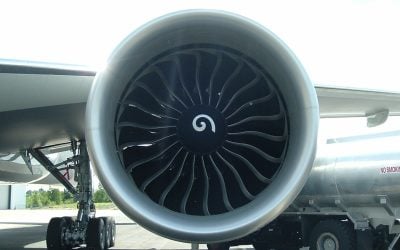
An airliner designer is always trading cruise speed against everything else. More sweep allows a higher cruise Mach number, but costs weight, low-speed lift and runway performance. The Airbus A320 family uses 25 degrees of sweep. The Boeing 777’s wing is swept 31.6 degrees for cruise at about Mach 0.83. The faster Boeing 747 uses 37.5 degrees, and the original 707 used 35.
Modern supercritical airfoils, flatter on top so that the shock that forms is much weaker, have raised the critical Mach number further. That lets designers use thicker, lighter wings, or less sweep, for the same cruise speed. Why airliners stopped chasing ever higher speeds is told in Da Mach 2 a Mach 0,85: perché gli aerei di linea hanno rallentato.
Boldmethod’s crash course on how wing sweep increases an aircraft’s critical Mach number.
Forward sweep and swing wings
Sweeping a wing forward delays the shock just as well, and the tips stall last, which keeps the ailerons working. The catch is structural. Under load, a forward-swept wing twists so that its tips bite harder into the air, adding lift and more twist, and the wing can bend itself to destruction. It took fly-by-wire flight controls to make demonstrators like the Grumman X-29 E Su-47 Berkut practical. No highly forward-swept design has entered production.
The other escape is to change the sweep in flight: wings spread for take-off and landing, swept back for speed. That idea, from the X-5 to the F-111, F-14 Tomcat, Tornado E MiG-23, delivered both, at the price of heavy, complex pivots.
Most fast aircraft never needed it. A simple angle, borrowed from a 1935 lecture and a sketch on a dinner menu, was enough to push the shock wave much closer to Mach 1. Every time you board a jet and see the wing sweep away towards the tip, you are looking at Busemann’s airplane of the future.
Sources: FAA Airplane Flying Handbook (FAA-H-8083-3C), National Academy of Engineering Memorial Tributes (Robert T. Jones on Adolf Busemann), Invention & Technology, NASA Langley, Smithsonian National Air and Space Museum, MiGFlug, Wikipedia (Swept wing; Critical Mach number; Adolf Busemann; Volta Congress; Pitch-up; Messerschmitt Me 262; MiG-15; F-86 Sabre)
0 Comments