
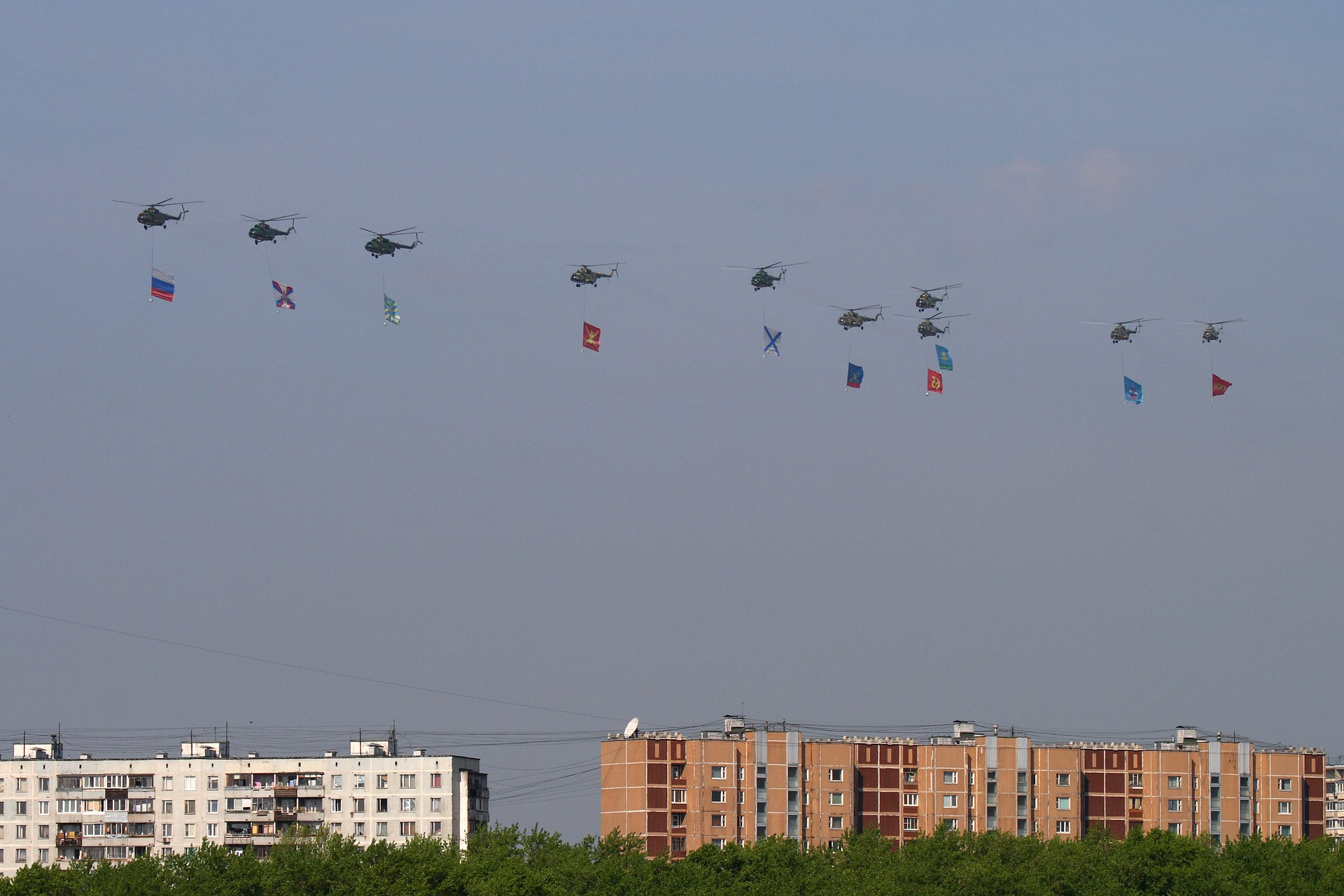
Mil Mi-8 / Mi-17 Hip
“The world’s helicopter”
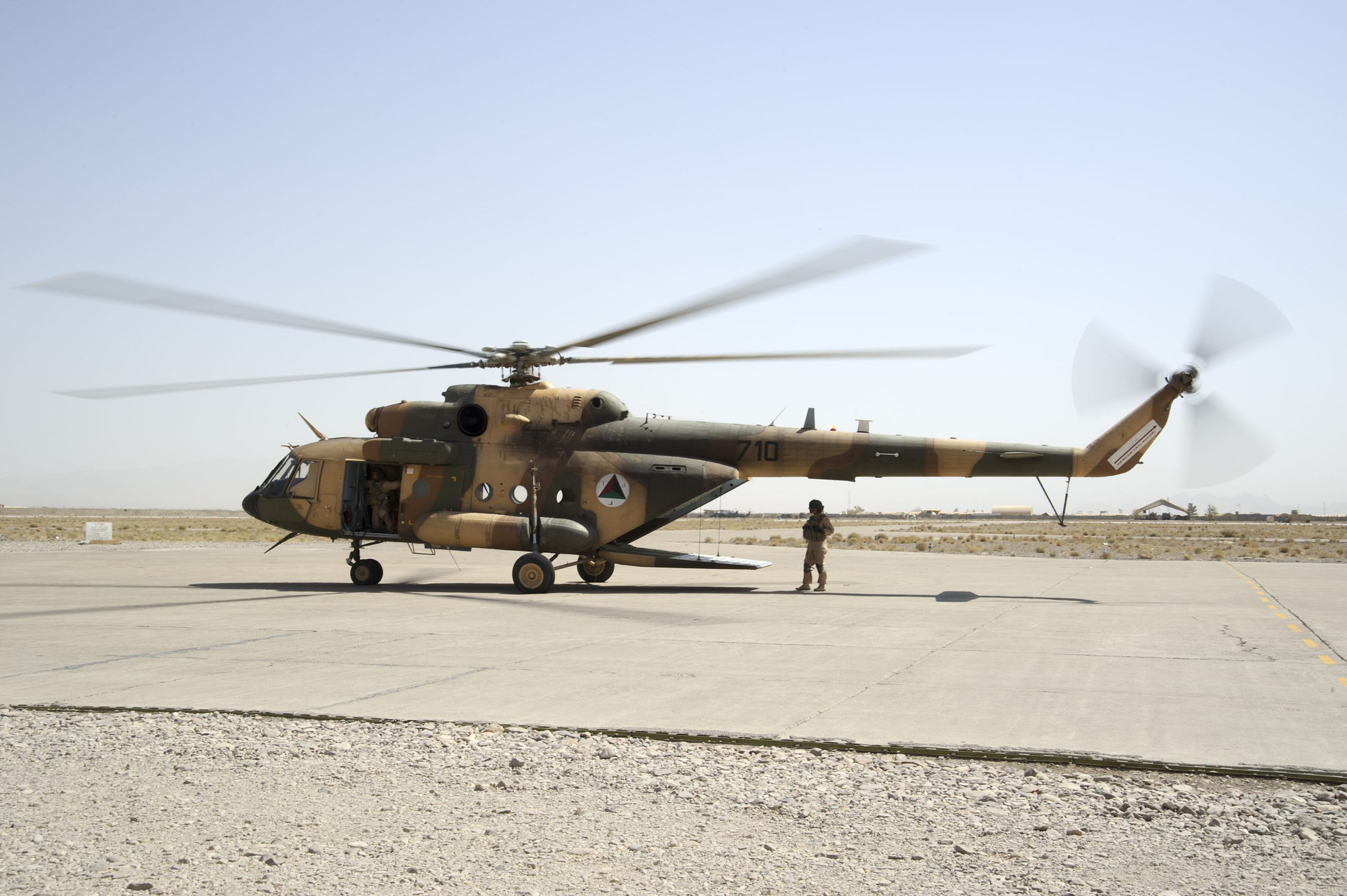
The Soviet Union’s definitive medium helicopter and the most-produced helicopter in history: a twin-turbine, five-blade machine with a cavernous cabin and clamshell rear doors, built to carry troops, cargo, VIPs and weapons alike — first flown in 1961, and still in production and frontline service more than 60 years later as the Mi-17 and Mi-171.
The Mil Mi-8 Hip: how the Soviet Union built the world’s helicopter
At the end of the 1950s the Mil Design Bureau, founded by Mikhail Mil, set out to give the Soviet Union a modern turbine-powered medium helicopter to replace the piston-engined Mi-4. The design, the V-8, first flew on 24 June 1961 with a single turboshaft; a definitive twin-engine version followed in 1962. That two-engine layout — safer, more powerful, and endlessly adaptable — became the production Mi-8.
What Mil created was less a single aircraft than a platform. The Mi-8 pairs a big, square, uninterrupted cabin ו clamshell rear doors with a five-blade main rotor and two turboshafts mounted above the cabin. The same airframe could be a troop transport, a flying ambulance, a VIP “Salon”, an electronic-warfare platform, a search-and-rescue machine, a firefighter — or, with weapons on stub pylons, a gunship.
Built in enormous numbers at Kazan ו Ulan-Ude, the Mi-8 and its upgraded, export designation the Mi-17 became the most-produced helicopter ever made — commonly cited at more than 17,000 aircraft — and one of the most widely exported, serving with over 100 nations. More than sixty years after its first flight it remains in production as the Mi-17 and Mi-171 family.
01Why the Mil Mi-8 Hip exists: replacing the Mi-4 with turbine power
By the late 1950s the Soviet Army needed a helicopter that could do what the piston-engined Mi-4 could not: lift more, fly faster and operate more reliably using the new generation of turboshaft engines. Mikhail Mil’s bureau answered with the V-8, whose second prototype introduced the pair of engines that defined the type.
Twin turboshafts gave two crucial advantages — far more installed power, and the ability to keep flying on one engine if the other failed. Combined with a roomy cabin sized for a squad or a light vehicle, the formula was so sound that it has been refined rather than replaced for six decades.
02The Mil Mi-8 Hip’s NATO name and the Mi-8/Mi-17 designations
NATO assigned the type the reporting name “Hip”. In Soviet and Russian service the baseline transport is the Mi-8 (early versions with Klimov TV2-117 engines); the re-engined, more powerful version with TV3-117 engines is the Mi-8MT, and its export designation is the Mi-17. Modern commercial and military variants are marketed as the Mi-171 ו Mi-172. Different names, one closely related family.
How the Mil Mi-8 Hip works: engines, rotor and that enormous cabin
Two Klimov turboshafts above the cabin
The Mi-8 is powered by two Klimov turboshafts mounted side by side on top of the fuselage — TV2-117 engines on early Mi-8T aircraft, uprated TV3-117 engines on the Mi-8MT/Mi-17. Two engines mean redundancy and the power to lift heavy loads from hot, high or rough strips where a single-engine helicopter would struggle.
A five-blade rotor and a rugged airframe
A large five-blade main rotor roughly 21 m across, driven through a central gearbox, gives the Hip its lift; a three-blade tail rotor counters torque. The airframe is deliberately simple and rugged, built to be maintained in the field with basic tooling — a key reason the type spread to so many air forces and operators.
A cavernous cabin and clamshell doors
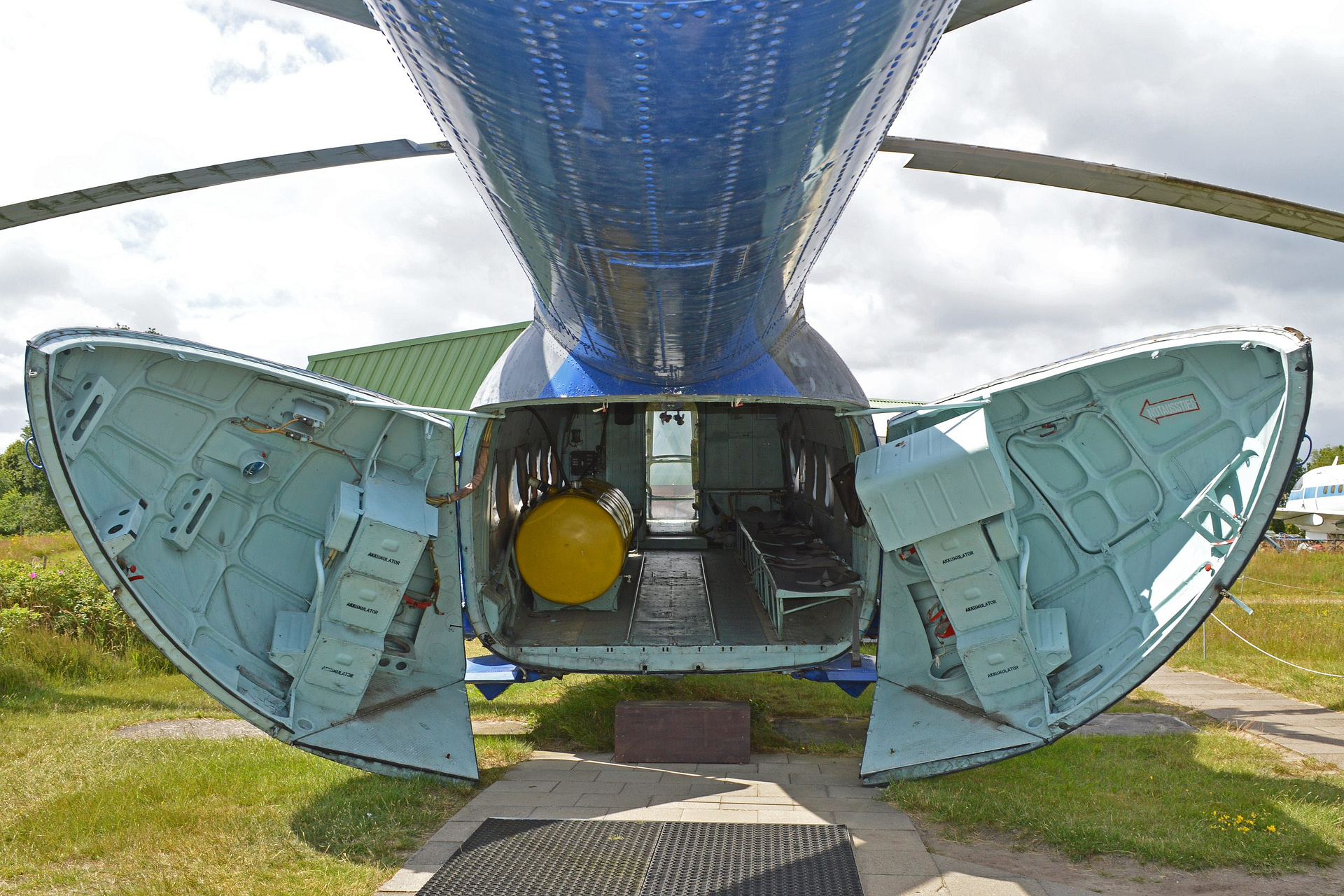
The Hip’s signature is its big square cabin with clamshell rear loading doors and a large sliding side door. It swallows 24–28 troops, 12 stretchers, cargo, or a light vehicle, and can sling loads underneath. On armed versions, stub pylons carry rocket pods, bombs and gun pods.
03The Mil Mi-8 Hip’s cabin: troops, cargo, casualties and underslung loads
Inside, the Mi-8 typically carries around 24–28 troops, or about 12 stretchers plus attendants in the medical role, or cargo and light vehicles loaded through the rear clamshell doors. Internal payload is on the order of 4,000 kg, with roughly 3,000 kg carried as an external sling load; exact figures vary with variant, fuel, altitude and temperature.
That flexible cabin is the whole point of the design. The same aircraft can be reconfigured for passengers, freight, casualty evacuation, VIP transport, electronic warfare or firefighting, which is why the Mi-8/Mi-17 became a universal workhorse across civil and military operators alike.
04The Mil Mi-8 Hip family: from the Mi-8T to the Mi-17, Mi-8AMTSh and Mi-171
The early Mi-8T transport used TV2-117 engines. The Mi-8MT / Mi-17 introduced more powerful TV3-117 engines and a tail rotor moved to the port side, greatly improving hot-and-high performance. Armed versions include the Mi-8TV and the modern Mi-8AMTSh “Terminator”, while civil and modernised military machines are sold as the Mi-171 ו Mi-172.
Specialised sub-variants have filled almost every helicopter role: airborne command posts, electronic-warfare and jamming platforms (Mi-8PP/SMV), search-and-rescue and polar versions, and VIP “Salon” interiors.
05Who builds the Mil Mi-8 Hip: Mil, Kazan, Ulan-Ude and Russian Helicopters
The Hip was designed by the Mil Moscow Helicopter Plant and built in vast numbers at two factories: Kazan Helicopters וה- Ulan-Ude Aviation Plant. Both are today part of Russian Helicopters, the state rotorcraft holding, which continues to build and modernise Mi-8/Mi-17/Mi-171 aircraft for domestic and export customers.
Mil Mi-8 / Mi-17 Hip specifications: dimensions, performance and cost
Baseline note: the figures below describe the Mi-8MTV-5, exported as the Mi-17V-5 (NATO: Hip-H) — the second-generation, TV3-117VM-engined, rear-ramp standard that is the most widely delivered military Hip of the last thirty years and the version still coming off the lines at Kazan and Ulan-Ude. The original Mi-8T (Hip-C) of 1967 is a materially different aeroplane: TV2-117 engines of barely two-thirds the power, a starboard pusher tail rotor, clamshell rear doors instead of a ramp, and a hover ceiling low enough to matter in the mountains. The Mi-8AMTSh (Mi-171Sh, marketed as the "Terminator") is the Ulan-Ude-built armed assault version with armour, an electro-optical turret and guided missiles. Deltas for those marks are in grey. Published Hip figures vary widely because the family spans sixty years and dozens of sub-marks; where Jane’s and the manufacturer disagree the better-attested value is given and the alternative noted.
Dimensions & weights
- צוות
- 3 — pilot, co-pilot and flight engineer (the engineer doubles as door gunner and load master on armed and assault fits)
- Cabin
- 24 equipped troops on tip-up seats; up to 36 in the high-density fit on the MTV-5 (the Mi-8T seated 24, and 28 at a squeeze)
- Main rotor diameter
- 21.29 m (69 ft 10 in), five all-metal blades, fully articulated
- Disc area
- 356 m² (3,832 sq ft)
- Tail rotor
- 3.91 m (12 ft 10 in), three blades — moved from starboard to port and reversed to a tractor on the second-generation Mi-8MT, which bought a useful margin of yaw authority in the hover
- Fuselage length
- 18.42 m (60 ft 5 in)
- Length, rotors turning
- 25.35 m (83 ft 2 in)
- גוֹבַה
- 5.65 m (18 ft 6 in) to the top of the rotor head
- Cabin dimensions
- 5.34 × 2.34 × 1.80 m (17 ft 6 in × 7 ft 8 in × 5 ft 11 in) — a genuinely square box, which is why the type carries so much awkward freight
- משקל ריק
- ~7,200 kg (15,870 lb) — equipment fit moves this by several hundred kilogrammes; the Mi-171A2 is quoted at 7,489 kg (16,510 lb)
- Normal take-off weight
- 11,100 kg (24,470 lb)
- משקל המראה מקסימלי
- 13,000 kg (28,660 lb); 13,500 kg (29,760 lb) with an under-slung load on the Mi-171A2
- Internal payload
- 4,000 kg (8,820 lb) through the rear ramp and the port cargo door
- External sling load
- 4,000 kg (8,820 lb); 5,000 kg (11,020 lb) on the Mi-171A2
- Disc loading
- 36.5 kg/m² (7.5 lb/sq ft) at maximum weight — low, which is a large part of why the Hip lifts well, lands on soft ground and autorotates forgivingly
Performance
- Never-exceed speed
- 250 km/h (155 mph, 135 kt)
- Maximum cruise
- 230 km/h (143 mph, 124 kt)
- Economical cruise
- 205 km/h (127 mph, 111 kt)
- Maximum speed, slung load
- 200 km/h (124 mph, 108 kt)
- קצב הטיפוס
- 8 m/s (1,575 ft/min)
- תקרת השירות
- 6,000 m (19,685 ft); the Mi-8T managed 4,500 m (14,760 ft)
- Hover ceiling, out of ground effect
- 3,980 m (13,060 ft) — against roughly 800 m (2,625 ft) for the Mi-8T. This single number is what the TV3-117 bought, and it is the difference between being able to land on an Afghan or Kashmiri ridgeline and not
- Range, standard internal fuel
- 495 km (308 mi) on Jane’s figures for the Mi-8MT; the manufacturer quotes 800 km (497 mi) for the Mi-171A2 on a fuller tank
- Ferry range
- 960 km (595 mi) with auxiliary cabin tanks
- Endurance
- ~3 h on internal fuel; longer with cabin tanks, at the direct cost of payload
- Operating temperature
- −50 to +50 °C (−58 to +122 °F) cleared on the Mi-171E — the Hip’s least glamorous and most valuable quality
Propulsion & systems
- Engines
- 2 × Klimov TV3-117VM free-turbine turboshafts (the Mi-8T had 2 × Klimov TV2-117A; late-build and re-engined aircraft have the Klimov VK-2500)
- Power
- 1,640 kW (2,200 shp) each at take-off — against 1,103 kW (1,480 shp) each for the TV2-117A on the Mi-8T, 1,454 kW (1,950 shp) for the TV3-117MT on the Mi-8MT, and 1,790 kW (2,400 shp) rising to 2,010 kW (2,700 shp) emergency for the VK-2500
- Transmission
- VR-14 main gearbox — deliberately rated below the combined engine output, so the aircraft keeps power in hand for one-engine-inoperative work and for hot-and-high hovering rather than for speed
- Rotor system
- Five-blade fully articulated main rotor, NACA 23012 section, with a three-blade tail rotor; blades are all-metal with a steel spar and honeycomb-filled trailing sections
- Auxiliary power unit
- AI-9V, giving self-contained engine starting and ground electrical power — a large part of why the type works from unprepared strips with no support
- Fuel
- ~3,700 L (977 US gal, 814 imp gal) in two conformal external side tanks plus a service tank; one or two auxiliary cabin tanks optional
- Radar & navigation
- Nose-radome weather and mapping radar from the Mi-8MTV-1 onward; DISS Doppler navigation set under the tail boom; satellite navigation and a partial glass cockpit on the Mi-171A2 and Mi-8MTV-5-1
- Sights & sensors
- PKV collimating sight for unguided stores; the Mi-8MTKO, Mi-8AMTSh and Mi-171Sh add a GOES-series gyrostabilised electro-optical turret with thermal imaging and a laser designator, and night-vision-compatible cockpit lighting
- Self-protection
- ASO-2V flare dispensers, EVU exhaust infrared suppressors and the L-166V1A "Ispanka" infrared jammer; late Russian aircraft carry the President-S directional infrared countermeasures suite. Armed marks add titanium and steel plate around the cockpit and engine bays
- First flight
- June 1961 — the single-engine V-8 prototype (some sources give 7 July 1961, the date of its Tushino appearance); the twin-engine V-8A flew on 2 August 1962, the first Soviet helicopter with purpose-designed turboshafts
- Service entry
- 1967, with the Soviet Air Force, as the Mi-8T
- Number built
- Over 17,000 across the Mi-8, Mi-17 and Mi-171 family and still in production at Kazan and Ulan-Ude — the most-produced helicopter in history by a very wide margin, and one of the most-produced aircraft of any kind. Exact totals are unpublished and the figure is an accumulation of plant records rather than an audited count
06Mil Mi-8 / Mi-17 variants: from the Mi-8T to the Mi-17, Mi-8AMTSh and Mi-171
Mi-8T — the baseline transport with TV2-117 engines.
Mi-8TV / TVK — armed versions with stub pylons for rockets, bombs and gun pods.
Mi-8MT / Mi-17 — re-engined with more powerful TV3-117 turboshafts and much improved hot-and-high performance; the Mi-17 is the export designation.
Mi-8AMTSh “Terminator” — a modern armed assault version; Mi-171 / Mi-172 are the current commercial and military build standards.
07The Mil Mi-8 / Mi-17’s operating costs: what a Hip costs to buy and fly
Costs vary widely with variant, contract and customer. Export Mi-17 prices are frequently reported in the region of USD 10–25 million depending on configuration, with full packages (training, spares and support) running higher per aircraft.
Cost per flight hour is commonly estimated at roughly USD 2,000–4,000 or more, but published figures differ widely depending on what is counted (fuel only, or fuel plus maintenance, overhaul and support) and on the operator. Treat any single number as an estimate.
Armament & payload
The Hip can be armed heavily, but its real payload is twenty-four soldiers and four tonnes of freight
Armed Mi-8s carry a genuinely serious load — six pylons, up to 1,500 kg of stores in practice, rocket pods, gun pods, bombs and on the Mi-8AMTSh guided anti-tank missiles. Crews in Afghanistan and Chechnya used all of it. But it is worth being blunt about what this is: a fifteen-tonne transport helicopter with weapons bolted to the sides. It is large, it is not agile, its sight is a simple collimating reticle on most marks, and it cannot manoeuvre or absorb damage the way a purpose-built gunship can. Against an unsuppressed heavy machine gun it is a big target; against a MANPADS it is a very big one. The Mi-24 exists precisely because the Soviet Army tried the armed Mi-8 first and found it wanting. What the armed Hip does well is escort and support its own transports on a mission it was already flying — suppressing a landing zone, working over a treeline, covering an extraction — and doing so with the same airframe, the same crews and the same spares as the transports.
The transport numbers are the ones that decided wars. Twenty-four troops, or twelve stretchers with an attendant, or four tonnes in the cabin, or four tonnes under the belly hook. Clamshell rear doors on the first generation, a proper hydraulic loading ramp on the Mi-8MTV-5 and Mi-171Sh, and a cargo box square enough to swallow a light vehicle or a howitzer trail. Almost every Hip ever built has spent most of its life doing that rather than shooting at anything. Fits vary enormously by mark and operator; an Mi-8T with two rocket pods and an Mi-171Sh with a turret, Ataka missiles and armour are separated by forty years and are barely the same weapons system.
Door & ramp guns
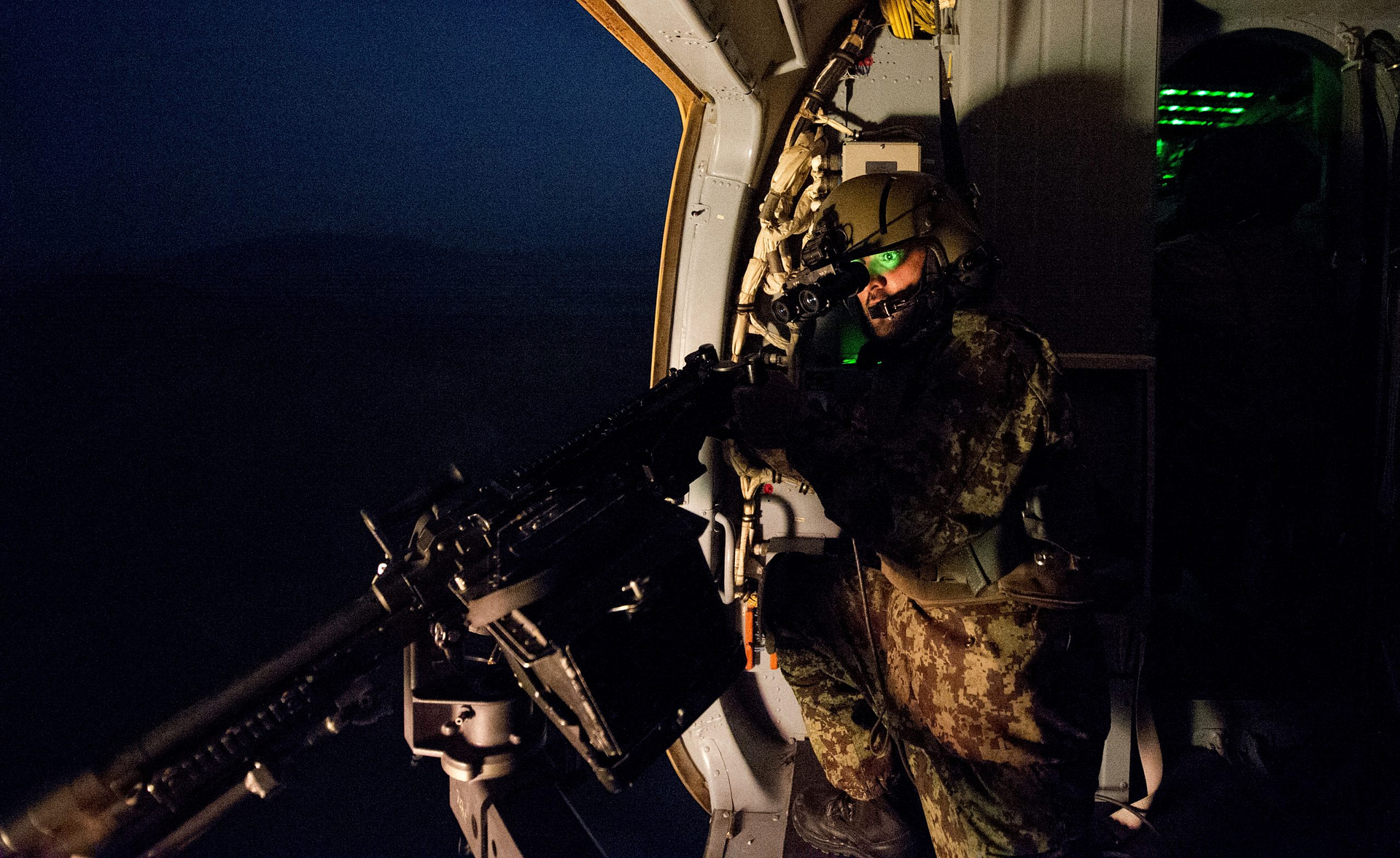
- 7.62 mm PKT machine guns on pintles in the port cargo doorway and the starboard forward window — the near-universal fit, usually manned by the flight engineer.
- 12.7 mm A-12.7 or NSVT machine gun in a bow mounting on armed marks: the Mi-8TV, Mi-8TB and the armed second-generation aircraft. Aimed by the pilot with the whole airframe.
- Ramp-mounted PKT or 12.7 mm gun on ramp-equipped Mi-8MTV-5 and Mi-171Sh airframes, covering the rear quarter that no other station can.
- Field fits are endemic: Ukrainian, Afghan and African crews have mounted DShK and PKM guns wherever a frame member would take the load.
Rockets & gun pods
- 57 mm S-5 rockets in UB-16-57 (16 rounds) or UB-32 (32 rounds) pods — the classic first-generation fit, up to six pods.
- 80 mm S-8 rockets in B-8V20A pods (20 rounds) — the standard on the Mi-8MTV and later, with high-explosive, fragmentation, thermobaric and flechette heads.
- UPK-23-250 gun pod: a 23 mm GSh-23L twin-barrel cannon with 250 rounds. Two of these give the Hip more strafing weight than most gunships carry internally, at the cost of drag and a fixed aiming line.
- GUV-8700 universal weapon pod, containing either a 12.7 mm four-barrel YakB gatling with two 7.62 mm GShG guns, or an AGS-17 30 mm automatic grenade launcher.
Guided missiles
- 9M17 Falanga-M (AT-2 Swatter) — four radio-command anti-tank missiles on the Mi-8TV (Hip-F). Slow, manually flown and close to useless under fire.
- 9M114 Shturm-V (AT-6 Spiral) — cleared on some second-generation armed Mi-8MTV airframes, in the same tube launchers the Mi-24V used.
- 9M120 Ataka-V (AT-9 Spiral-2) — the Mi-8AMTSh and Mi-171Sh weapon, up to eight rounds, with tandem-shaped-charge, thermobaric and fragmentation warheads. This, not the Shturm, is the missile fitted to production "Terminator" aircraft.
- 9K38 Igla-V infrared air-to-air missiles for self-defence on late Russian marks — cleared, carried, and essentially never used in anger.
Bombs & dispensers
- FAB-100, FAB-250 and FAB-500 general-purpose bombs on the inboard pylons — unusual for a transport helicopter, and used routinely in Afghanistan.
- OFAB fragmentation and ZAB incendiary bombs; ODAB thermobaric bombs against caves and fortified compounds.
- KMGU-2 submunition and mine dispensers, used to seed the approaches to firebases and to close mountain tracks.
- RBK cluster bombs and, on some Soviet-era aircraft, chemical smoke-laying and decontamination equipment.
Troops, cargo & slung loads
- 24 equipped troops on folding side benches; up to 36 in the high-density Mi-8MTV-5 fit. This is the Hip’s actual weapon.
- 4,000 kg (8,820 lb) internally through the rear ramp or clamshell doors and the port cargo door.
- 4,000 kg (8,820 lb) on the belly hook — 5,000 kg (11,020 lb) on the Mi-171A2. Slung artillery pieces, fuel bladders, drilling equipment, transformers and generators are all routine.
- A cabin 5.34 m long, 2.34 m wide and 1.80 m high, with a floor stressed for vehicles — and, on ramp aircraft, the ability to drive them in.
Medevac, rescue & mission fits
- 12 stretchers plus a seat for a medical attendant; the Mi-17-1VA flying-hospital version carried an operating table and intensive-care equipment.
- LPG-150M or SLG-300 rescue hoist over the starboard door, with 150–300 kg capacity.
- Firefighting: Bambi-type buckets and belly tanks of up to 4,000 litres, plus a spot-fire nozzle. Russian, Chinese and Malaysian civil operators do most of their flying this way.
- Mission-specific conversions run to airborne command posts (Mi-19), electronic-warfare jammers (Mi-8MTPR-1 with Rychag-AV), signals intelligence, aerial survey, geophysical work and VIP interiors.
Three typical loadouts
- Air assault, Mi-8MTV-5
- 24 troops with weapons and ammunition, cabin auxiliary fuel deleted, two B-8V20A rocket pods on the inboard pylons for landing-zone suppression, PKT guns in both forward windows and on the ramp, ASO-2V flares armed. The pods are there so the aircraft can cover its own approach without waiting for an escort.
- Armed escort, Mi-8AMTSh
- Four 9M120 Ataka-V missiles on the outboard rails, two B-8V20A rocket pods inboard, one UPK-23-250 gun pod, electro-optical turret working, half a troop load in the cabin. In practice the missiles stay for hard point targets and the rockets and gun do the work.
- Casualty evacuation and resupply
- Pylons stripped, 12 stretcher fittings rigged, medical attendant aboard, auxiliary cabin tank fitted for radius, door gun retained. The mission the Hip has flown more than any other, in about sixty countries, for close to sixty years.
Sourcing caveat: Russian and export brochure loads differ from what units actually fly, and few operators publish their standard fits. Pylon counts vary by mark — four on the Mi-8T and Mi-8MTV-3, six on most other armed marks — and several second-generation aircraft in Ukrainian, Georgian and African service carry locally integrated stores that appear in no manufacturer’s document.
Variants
Two generations of Hip, one designation, and an export nameplate that confuses almost everyone
The Mi-8 splits cleanly in two. The first generation — Mi-8T, Mi-8P and their relatives — runs on TV2-117 engines, has a starboard pusher tail rotor and clamshell rear doors, and dates from the mid-1960s. The second generation, from the Mi-8MT of 1975, has TV3-117 engines, a port-side tractor tail rotor, oval exhausts with infrared suppressors, engine intake dust filters and considerably more armour. Everything since is a development of that.
The naming is the part that trips people up. Mi-17 is not a different helicopter: it is the export designation for the second-generation Mi-8M series, adopted because "Mi-8" had come to mean the older aircraft in foreign eyes. The same airframe from Kazan is an Mi-8MTV at home and an Mi-17V-5 abroad; from Ulan-Ude it is an Mi-8AMT at home and an Mi-171 abroad. Most of the world’s "Mi-8" fleets are in fact Mi-17s or Mi-171s, and a great many published operator tables silently mix the three.
- V-8 / V-8A (1961–64, 5 prototypes)
- Single-engine V-8 flew first; the twin-engine V-8A of August 1962 was the first Soviet helicopter with purpose-built turboshafts. The fourth prototype swapped the four-blade rotor for five to cure vibration.
- Mi-8T (Hip-C, 1965–90s, several thousand)
- The original military transport: TV2-117 engines, clamshell doors, round windows, 24 troops, and provision for four pylons. The aircraft most people picture when they hear "Mi-8".
- Mi-8P / Mi-8PS (1965–, civil)
- Civil passenger version with large square cabin windows and 28 airline seats; the PS is the VIP fit. Aeroflot took hundreds and flew them on scheduled routes into places with no runway.
- Mi-8TV / Mi-8TB (Hip-E/F, 1970s)
- The first properly armed Hip — six pylons, a 12.7 mm bow gun and four 9M17 Falanga missiles. Heavily armed, and the experiment that convinced the Soviet Army it needed the purpose-built Mi-24 instead.
- Mi-8MT / Mi-17 (Hip-H, 1975–)
- The second generation. TV3-117MT engines, port tractor tail rotor, dust filters, infrared suppressors. Exported as the Mi-17 from 1981 and the basis of everything that followed.
- Mi-8MTV / Mi-17-1V (1980s–)
- The hot-and-high mark, with high-altitude TV3-117VM engines that lifted the service ceiling to 6,000 m and the out-of-ground-effect hover to nearly 4,000 m. Developed with Afghanistan directly in mind.
- Mi-8MTV-5 / Mi-17V-5 (1996–, several hundred)
- The current Kazan military standard and the baseline here: rear loading ramp in place of clamshell doors, a bulged "dolphin" nose for extra avionics and freight, an extra port door, night-vision-compatible lighting. India took 151, Russia over 130.
- Mi-8AMT / Mi-171 (1991–, Ulan-Ude)
- Ulan-Ude’s parallel line, sold heavily on the civil market. The Mi-171E is cleared from −50 to +50 °C; the certificated Mi-171A2 and offshore Mi-171A3 are the modern civil offering.
- Mi-8AMTSh / Mi-171Sh (2002–, "Terminator")
- The armed assault version: armour, an electro-optical turret, 9M120 Ataka missiles, President-S countermeasures. Bought by Russia, China, Algeria, Peru, Czechia, Croatia, Ghana and Bangladesh. The Mi-8AMTSh-VN "Sapsan" is the special-forces fire-support development.
- Mi-8MTPR-1 (2014–, ~18 for Russia)
- Electronic-warfare conversion of the Mi-8MTV-5-1 carrying the Rychag-AV jammer against air-defence and airborne radars. One of the more genuinely useful modern Hip derivatives, and one Ukraine has hunted deliberately.
- Mi-14 (Haze, 1973–86, ~270)
- Not an Mi-8 variant but a direct derivative: an amphibious anti-submarine helicopter with a boat hull and sponsons, built on Mi-8MT dynamics. Worth listing because it is where a good deal of second-generation engineering was proved.
Closing caveat: this list is a fraction of the whole. Russian and export sub-marks run into the hundreds — at least a dozen distinct electronic-warfare fits alone, plus command posts, signals-intelligence aircraft, minelayers, flying hospitals, aerial-survey and geophysical conversions, and licence-adjacent Chinese assembly of the Mi-171 at Sichuan Lantian. Production totals for individual marks are unpublished; the figures above are best estimates from plant statements and delivery reporting rather than audited numbers.
The Mil Mi-8 Hip: a timeline from the V-8 prototype to the Mi-171
Mil begins the V-8
The Mil Design Bureau begins work on the V-8, a turbine-powered medium helicopter to replace the piston-engined Mi-4.
V-8 prototype first flight
The single-engine V-8 prototype makes its first flight on 24 June 1961.
The twin-engine V-8A
The definitive twin-engine V-8A (with two TV2-117 turboshafts) first flies, setting the pattern for the production Mi-8.
Mi-8 enters production
The Mi-8 is shown publicly and enters series production at Kazan.
Mi-8 in service and export
The Mi-8 enters Soviet military and civil service and begins its huge export career.
Workhorse over Afghanistan
The Mi-8 becomes the workhorse and improvised gunship of the Soviet war in Afghanistan.
The Mi-8MT / Mi-17
The re-engined Mi-8MT (exported as the Mi-17), with more powerful TV3-117 engines, enters production.
60+ years and 17,000+ built
As the Mi-17, Mi-171 and Mi-8AMTSh, the Hip remains in production — the most-produced helicopter ever, flown by 100+ nations.
The Mil Mi-8 Hip in action: notable roles, wars and variants
Afghanistan, 1979–89: the Hip goes to war
The Mi-8 became the Soviet Army’s indispensable workhorse and improvised gunship.
Read the full account
The most-produced helicopter in history
More than 17,000 Mi-8/Mi-17 aircraft have reportedly been built.
Read the full account
The Swiss-army-knife helicopter
Troop carrier, ambulance, gunship, VIP jet, firefighter — all the same aircraft.
Read the full account
Rockets, bombs and gun pods: the armed Hip
Stub pylons turn the transport into a gunship.
Read the full account
Why two Klimov turboshafts changed everything
Twin engines gave the Hip power and survivability.
Read the full account
The helicopter of the Eastern Bloc — and far beyond
The Mi-8 became the standard helicopter of a hundred nations.
Read the full account
Oilfields, mountains and the Arctic
The Mi-8 does hard civilian work where roads end.
Read the full account
The Hip as a flying fire engine
Water buckets and belly tanks make the Mi-8 a firefighter.
Read the full account
From the Middle East to Africa and Asia
The Mi-8 has seen combat on nearly every continent.
Read the full account
The 60-year helicopter still in production
Few helicopters have stayed in production this long.
Read the full account
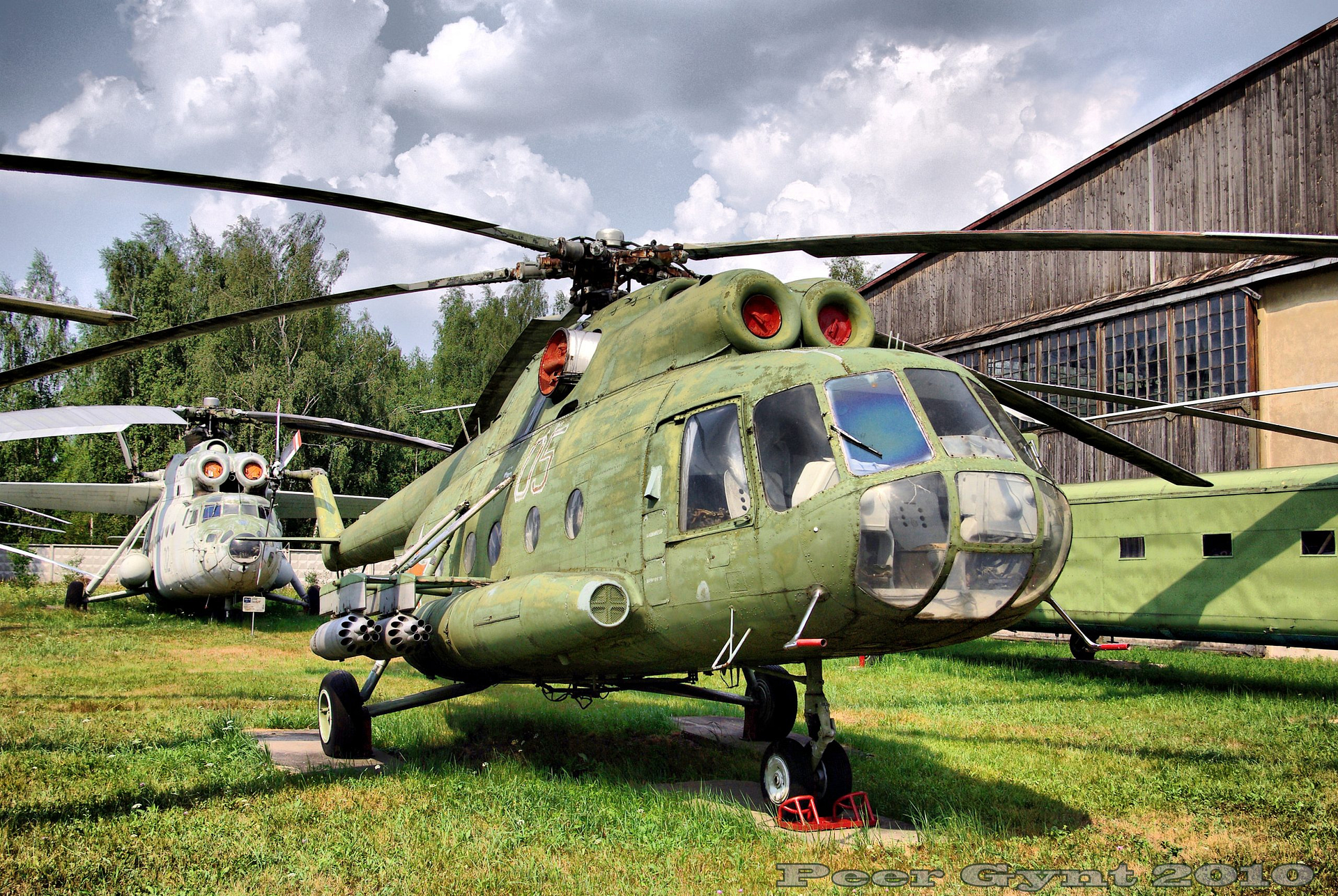
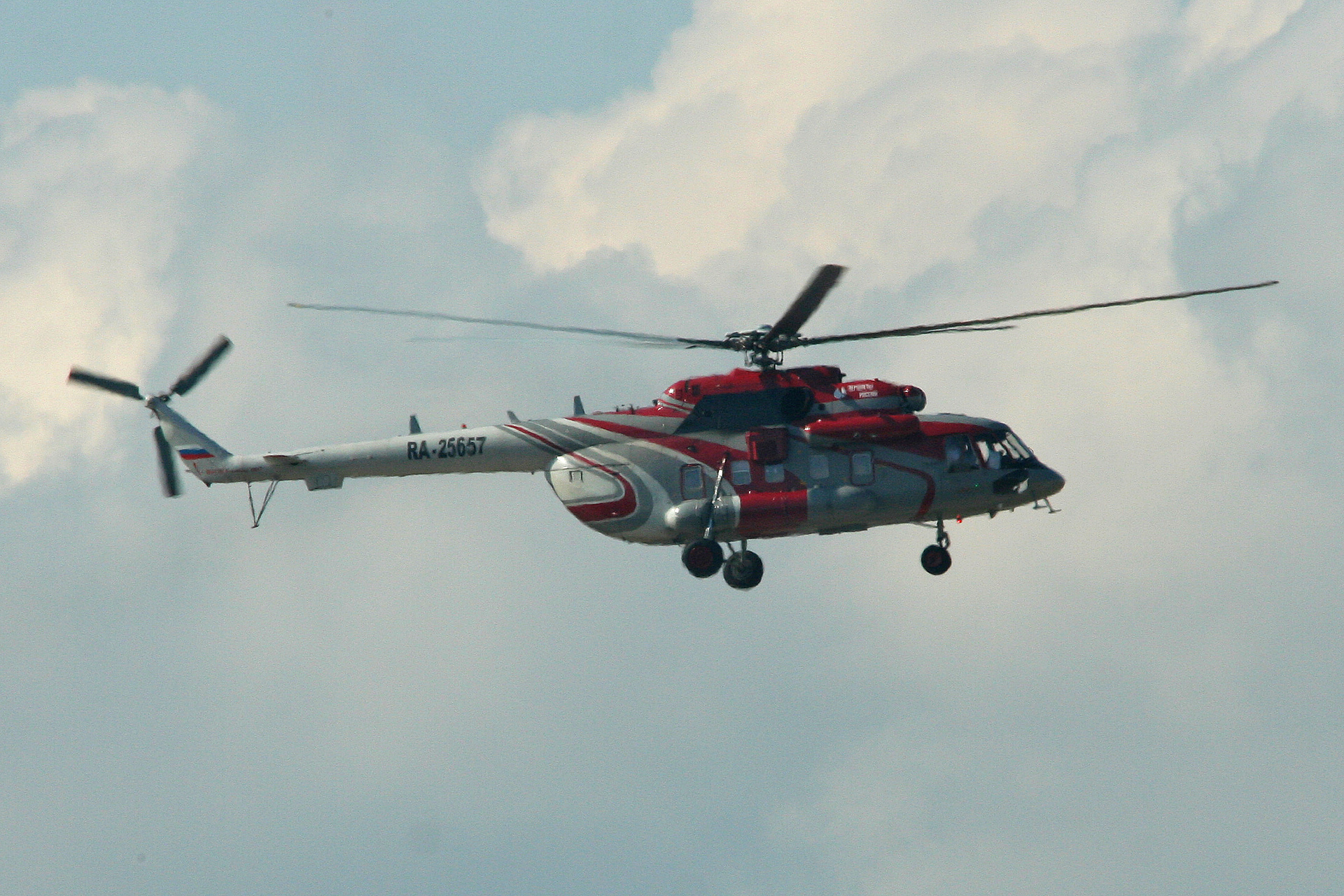
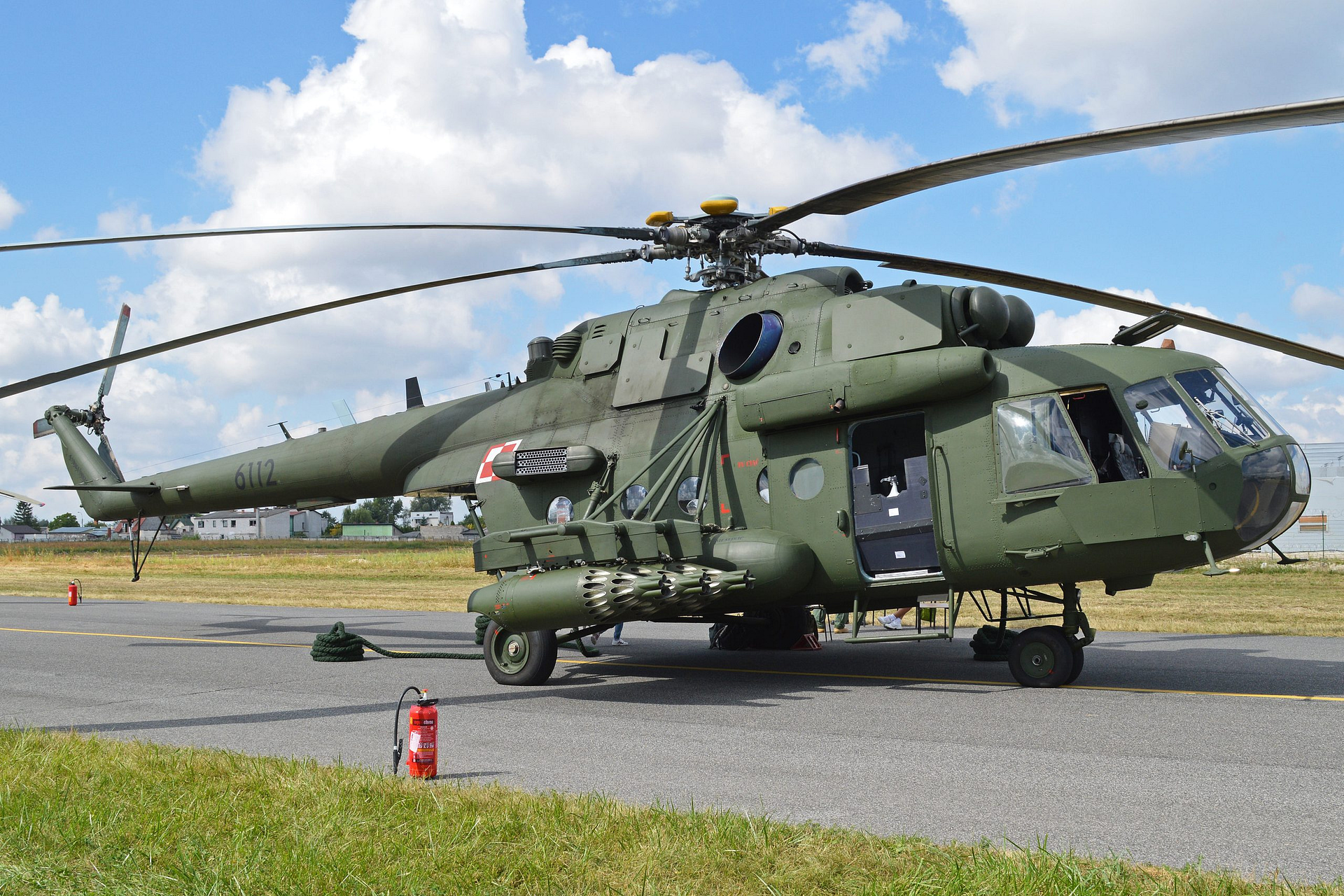
Mil Mi-8 / Mi-17 Hip photos: the world’s helicopter up close
The Mil Mi-8 Hip on screen: the most-produced helicopter in history
Matsimus · “Why is there hate for the Mi-8 / Mi-17 Helicopter?” — an established military-aviation channel walks through the Mi-8/Mi-17’s design, versatility and reputation as the most-produced helicopter in history (170k+ views).
Where the Mil Mi-8 Hip flies: origin, combat use and operators
Operators today
The Hip serves with more air forces than any other helicopter, and no two of them count it the same way
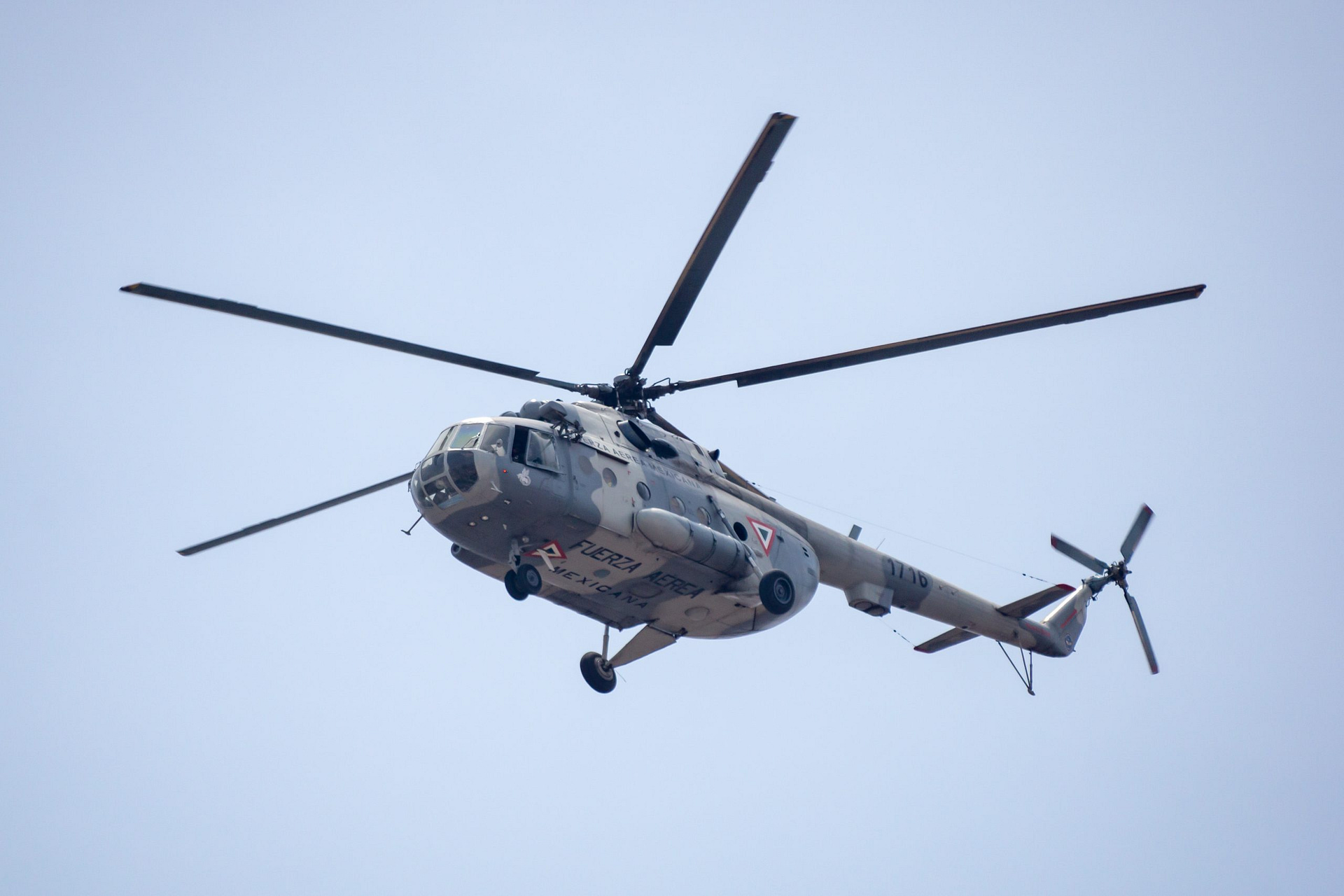
Somewhere well over fifty air forces fly the Mi-8/Mi-17 family today, plus paramilitary services, police forces, disaster agencies and a large civil fleet; earlier tallies of around eighty countries include historical operators. Counting it is genuinely hard. Most foreign "Mi-8" fleets are actually Mi-17 or Mi-171 export variants; national inventories mix first- and second-generation airframes under one line; and a Hip that has not flown in five years still appears on paper. The figures below are rounded estimates for the largest military fleets, and only where two independent sources agreed.
These are estimates and should be read as orders of magnitude, not inventories. Russia’s figure is the widest: analysts working from procurement records put roughly 300 Mi-8s with the Aerospace Forces proper, while counts that include naval aviation, the FSB Border Service, the National Guard and other ministries run past 500. China’s figure is the People’s Liberation Army Ground Force Aviation total alone; India’s rests on 151 Mi-17V-5 delivered by 2016 plus surviving earlier Mi-17 and Mi-17-1V. Other substantial fleets — Kazakhstan, Peru, Venezuela, Poland, Mexico, Colombia, Belarus, Indonesia, Vietnam, Nigeria and around forty more — are omitted only because published counts for them could not be corroborated from two sources, not because they are small. Afghanistan’s status is unresolved: the Taliban inherited a substantial Mi-17 fleet in 2021, but how much of it is airworthy is unknown. Sources: IISS The Military Balance and FlightGlobal World Air Forces; entries that could not be corroborated are omitted.
The Mil Mi-8 Hip in combat: from Afghanistan to today
The Mi-8/Mi-17 is one of the most combat-used helicopters ever built, in continuous frontline service since the 1960s. It has flown as troop transport, supply ship, casualty-evacuation aircraft and, in its armed versions, as a gunship — from the Soviet war in Afghanistan through conflicts across Africa, the Middle East, Asia and, most recently, Ukraine. Specific loss and production figures vary between sources and should be treated as estimates.
Compare the Explore the combat record of every military aircraft. Data as of July 2026.
Mil Mi-8 / Mi-17 Hip: frequently asked questions
Can I fly in a Mil Mi-8?
What is the Mil Mi-8 Hip?
What is the difference between the Mi-8 and the Mi-17?
Who makes the Mil Mi-8 / Mi-17?
How many Mi-8 / Mi-17 helicopters have been built?
How fast is the Mi-8 and how far can it fly?
What engines does the Mi-8 use?
Has the Mil Mi-8 been used in combat?
Which countries operate the Mi-8 / Mi-17?
You can’t fly the Mi-8 Hip.
These, you can.
Some legends only live in museums — others are fuelled and waiting. MiGFlug has put civilians in real military jet cockpits since 2004.
 Fly the L-39 AlbatrosThe world’s most-flown jet trainer — aerobatics included
 Fly the F-104 Starfighter“The missile with a man in it”
 Fly the MiG-21The Cold War’s most-produced jet
 טסו על ה-T-33 Shooting StarAmerica’s first jet trainer
 Fly the DH VampireA piece of early jet history
 Fly the S.211Agile Italian jet trainer
 Fly the MB-326The classic Aermacchi jet
 Fly the MiG-15The Soviet legend of the Korean War
More from the Military Aircraft Encyclopedia
Mil Mi-8 / Mi-17 Hip: sources & further reading
- Russian HelicoptersRussian Helicopters — official manufacturer of the Mi-8/Mi-17/Mi-171 family, overviews and specifications.
- Russian Ministry of DefenceRussian Ministry of Defence — service context for the Mi-8/Mi-17 in Russian military use.
- Airforce TechnologyAirforce Technology — detailed Mi-17 Hip dimensions, powerplant, performance and variants.
- BAE / industry referencesBAE / industry references — general context on rotary-wing avionics and upgrades.
- GlobalSecurity.orgGlobalSecurity.org — Mi-8/Mi-17 variant histories and programme background.
- Imperial War MuseumImperial War Museum — context on Cold War and Soviet military aviation.
- Smithsonian National Air and Space MuseumSmithsonian National Air and Space Museum — context on rotary-wing aviation.
- MiGFlug AfterburnerMiGFlug Afterburner — the magazine behind this encyclopedia, on military aviation and jet flights.
Hero and gallery photography: U.S. Air Force / NASA, public domain. Combat statistics as of July 2026. Spotted an error? Every page in the Aircraft Museum is fact-checked before publication — write to us and we’ll correct it.