
Hawker Sea Hawk
“Britain’s naval jet”
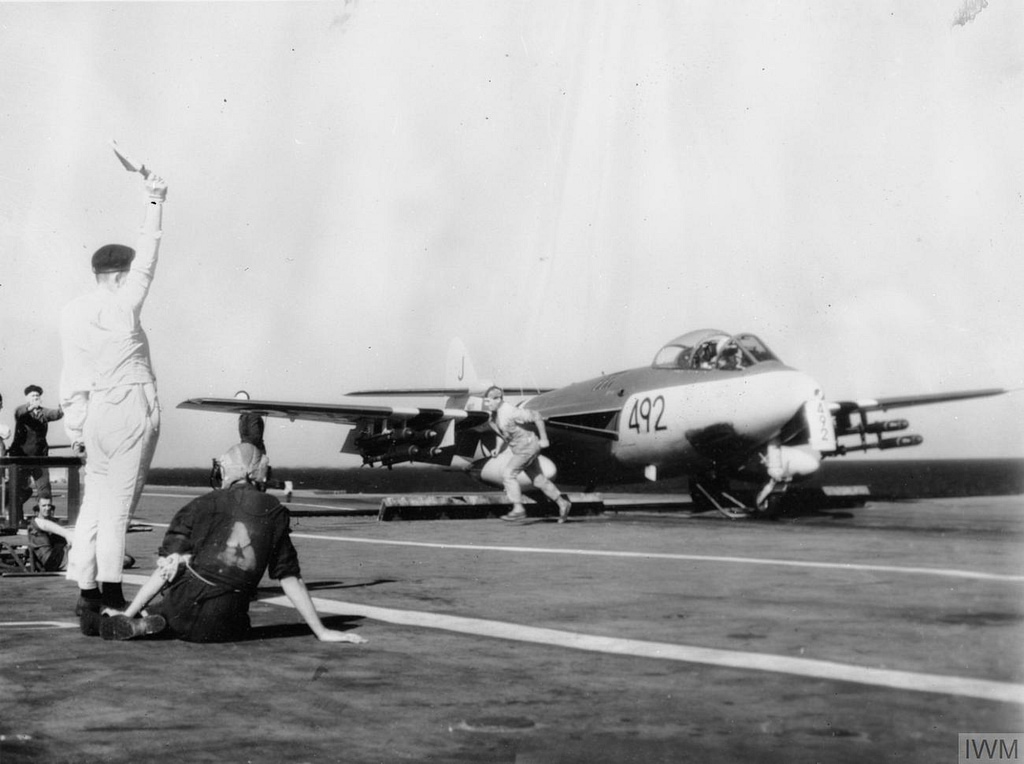
An elegant straight-wing carrier fighter-bomber — Hawker’s first jet, built largely by Armstrong Whitworth, with a clever split exhaust that vented at the wing roots. It flew ground-attack over Suez in 1956 and fought its last war from an Indian carrier in 1971.
Hawker’s first jet, and the navy’s workhorse
In the last months of the Second World War, Hawker Aircraft — the firm behind the Hurricane and the Sea Fury — began sketching its first jet. Under the direction of the legendary designer Sir Sydney Camm, the private-venture P.1040 set out to solve a stubborn problem of early jet layout: a single turbojet buried in a slim fuselage needed a long tailpipe, and that pipe ate into the very fuselage volume a naval aircraft wanted for fuel.
Hawker’s answer became the aircraft’s signature. Instead of one long exhaust, the Rolls-Royce Nene fed a bifurcated (divided) jetpipe whose two outlets vented at the wing-root trailing edges. The short, low-loss ducting freed the entire rear fuselage as a fuel tank, giving the type unusually good range for a first-generation jet. Air came in through clean wing-root leading-edge intakes, and the wing itself was deliberately straight — chosen for docile, forgiving handling rather than outright speed.
The P.1040 prototype first flew on 2 September 1947. The RAF showed little interest in a straight-wing jet fighter, so Hawker turned to the naval requirement. A navalised prototype with folding wings, catapult spools and an arrester hook flew in 1948, and the Royal Navy adopted the design. There was a catch: Hawker’s factories were saturated with development of the swept-wing Hunter, so under the Korean-War “Super-Priority” scheme, Sea Hawk production was handed to sister company Armstrong Whitworth at Coventry. Hawker built only the first three dozen; Armstrong Whitworth built the overwhelming majority of the roughly 542 aircraft.
The Sea Hawk entered Royal Navy front-line service in 1953 and evolved quickly through fighter, fighter-bomber and ground-attack marks, ending with the definitive FGA.6. Its combat debut came at Suez in 1956, flying intensive ground-attack sorties from three carriers. Front-line British service was short — swept-wing jets were already arriving — but the rugged, well-liked Hawk found a long second life abroad, serving the Netherlands, West Germany and, above all, India, whose Sea Hawks fought in the 1971 war and flew on until about 1983.
01The Hawker Sea Hawk’s lineage: from the P.1040 to the swept-wing Hunter
The Sea Hawk sits at a fork in Hawker’s history. Its straight-winged P.1040 airframe was the starting point for a family of experiments: the P.1052, which fitted swept wings to a Sea Hawk-type fuselage and flew in 1948, and the P.1081, which added a straight-through jetpipe and flew in 1950 before being lost in a 1951 crash. Those research aircraft pointed the way to Hawker’s transonic masterpiece, the Hunter.
So the docile naval Hawk was, in effect, the first rung on a ladder that ended with one of the most admired jets ever built. It also explains why Armstrong Whitworth built most Sea Hawks: Hawker’s own lines were busy turning that swept-wing research into the Hunter, leaving the straight-wing naval fighter to be produced by a sister firm within the Hawker Siddeley Group.
What makes it special
The bifurcated jet exhaust
The Sea Hawk’s defining trick was to split the single Rolls-Royce Nene’s thrust into a divided jetpipe that exhausted at the wing-root trailing edges, one outlet on each side. Short, low-loss ducting replaced a long central tailpipe — freeing the entire rear fuselage to be used as a fuel tank. The result was exceptional range and endurance for a first-generation jet, and an elegant packaging solution still admired by engineers.
A carrier fighter built to be forgiving
The wing was deliberately kept straight (unswept) for gentle, predictable low-speed handling — ideal for carrier approaches. Add hydraulically folding wings for below-deck stowage, a wide-track undercarriage and rock-steady gun and rocket aiming, and the Sea Hawk became a stable, popular deck aircraft and an outstanding strike platform. It traded top speed for the qualities that matter most flying off a pitching flight deck.
The Rolls-Royce Nene and its famous copy
Power came from a single Rolls-Royce Nene, a robust centrifugal-flow turbojet breathing through clean wing-root intakes. Simple and durable, it gave dependable service in British, Indian, Dutch and German hands. The Nene has a twist of history too: it was licensed to the Soviet Union in 1946–47 and copied as the engine that powered the מיג-15 — so the same basic turbojet flew in a British naval fighter and in the Cold War’s most famous adversary.
02The Hawker Sea Hawk’s split exhaust: why the fuselage could be filled with fuel
Early jet fighters wasted a surprising amount of internal volume on plumbing. A single engine mounted amidships had to route its hot exhaust all the way to the tail through a long jetpipe, and that pipe — plus the cooling and structure around it — consumed fuselage space that could otherwise hold fuel. For a naval aircraft, where range and endurance decide whether you can find your carrier again, that was a real penalty.
Hawker’s bifurcated arrangement solved it neatly. The Nene sat forward, and its efflux divided into two short pipes venting just behind the wing roots. With no long tailpipe running aft, the whole rear fuselage became a fuel bay. It is one reason the Sea Hawk earned a reputation for good legs, and why the design is remembered as one of the tidier engineering ideas of the early jet age.
03The Hawker Sea Hawk’s variants: from F.1 fighter to FGA.6 and the export marks
The Sea Hawk matured through a clear progression. The F.1 was the initial fighter; the F.2 added power-boosted ailerons; the FB.3 strengthened the wing for underwing stores; and the FGA.4 became a dedicated ground-attack machine with four pylons. The FB.5 and definitive FGA.6 re-engined the type with the more powerful Nene 103, and many earlier airframes were converted up to that standard.
Exports carried their own designations. The Netherlands bought Mk 50s; West Germany received all-weather Mk 100s and radar-equipped Mk 101s; and India operated aircraft broadly equivalent to the FGA.6, along with reconditioned airframes, making it the type’s largest and longest-serving export operator.
Full specifications
Figures below are for the definitive Sea Hawk FB.5 / FGA.6 with the Rolls-Royce Nene 103. Period sources vary with variant and loading, so values are given as commonly cited figures.
Airframe & Performance
- צוות
- 1 (pilot)
- מֶשֶׁך
- ~12.09 m (39 ft 8 in)
- מוּטַת כְּנָפַים
- ~11.89 m (39 ft 0 in); folding wings
- גוֹבַה
- ~2.64 m (8 ft 8 in)
- משקל ריק
- ~4,208 kg (~9,280 lb)
- Max takeoff weight
- ~7,350 kg (~16,200 lb)
- Max speed
- ~965 km/h (~600 mph, ~Mach 0.79) at sea level
- תקרת השירות
- ~13,560 m (~44,500 ft)
- לָנוּעַ
- ~770 km (~480 mi) internal; more with drop tanks
Propulsion, Armament & Cost
- מָנוֹעַ
- 1 × Rolls-Royce Nene 103 centrifugal turbojet
- Thrust
- ~23 kN (~5,200 lbf); earlier marks ~5,000 lbf
- Guns
- 4 × 20 mm Hispano Mk V cannon in the nose
- External stores
- Up to ~2,000 lb: bombs, rockets & drop tanks
- First flight
- 2 September 1947 (P.1040)
- Built
- ~542 total (Hawker + Armstrong Whitworth)
- Unit / programme cost
- No reliable modern flyaway figure published
- Cost per flight hour
- No reliable public figure
04The Hawker Sea Hawk’s cost: what a 1950s carrier fighter was worth
The Sea Hawk was a British government procurement of the early 1950s, produced in quantity under a wartime-style priority scheme, and no precise modern-style flyaway price is published for it. Because it was a straightforward, single-engined design built on established production lines, it was relatively economical compared with the more advanced swept-wing jets that followed. Any single figure quoted for the type should be read as an order-of-magnitude estimate rather than a sourced flyaway cost.
No reliable public cost-per-flight-hour number exists for the Sea Hawk either. As with most first-generation Cold War jets, operating-cost data was never released in a form comparable to modern figures, so any precise dollar-per-hour claim is effectively guesswork.
From private venture to Indian carrier jet
First flight
Hawker’s private-venture P.1040 prototype makes its maiden flight on 2 September 1947, with the signature bifurcated wing-root exhaust.
Navalised prototype
A carrier-capable prototype with folding wings, arrester hook and catapult spools flies, and the Royal Navy adopts the design.
Production moves to Coventry
Under the Korean-War “Super-Priority” scheme, Sea Hawk production is transferred to Armstrong Whitworth, which builds most of the fleet.
Enters Royal Navy service
The Sea Hawk F.1 enters front-line Fleet Air Arm service, beginning with 806 Naval Air Squadron.
Combat at Suez
Six Sea Hawk squadrons fly intensive ground-attack sorties over Egypt from HMS Eagle, Albion and Bulwark during Operation Musketeer.
Withdrawn from RN front line
Swept-wing Scimitars and Sea Vixens replace the Sea Hawk in front-line Royal Navy service; second-line use continues into the 1960s.
War from INS Vikrant
Indian Navy Sea Hawks of INAS 300 fly around 300 strike sorties against East Pakistan, helping blockade its ports in the 1971 war.
Last operator retires
India retires its Sea Hawks around 1983, replaced by the Sea Harrier — ending three decades of front-line service.
Twelve Hawker Sea Hawk stories
The hawk that went to sea
Hawker’s raptor tradition met salt air in a folding-wing naval fighter.
Read the full story
Two tailpipes, one engine
The split exhaust hid a fuselage full of fuel — the Sea Hawk’s cleverest idea.
Read the full story
Why Hawker built so few
Most Sea Hawks wore an Armstrong Whitworth builder’s plate, not a Hawker one.
Read the full story
Musketeer’s sharpshooters
Six squadrons, three carriers, day after day over Egypt.
Read the full story
The Indian carrier’s war
Sea Hawks off INS Vikrant helped strangle East Pakistan in 1971.
Read the full story
The engine that flew for both sides
A Sea Hawk and a MiG-15 shared the same basic heart.
Read the full story
Wings that bowed
A fighter that shrank to fit below a crowded carrier deck.
Read the full story
The German and Dutch Sea Hawks
Britain was not the only navy to fly the straight-winged Hawk.
Read the full story
The straight wing that led to a legend
The Sea Hawk’s airframe was the first step toward Hawker’s finest jet.
Read the full story
Obsolete on arrival, loved anyway
Straight wings in a swept-wing world — and still it flew for thirty years.
Read the full story
Where to meet a Sea Hawk today
Preserved Hawks still show their split exhaust and folded wings in museums.
Read the full story
Why the Hawk was grounded
It was overtaken by Mach, not by failure.
Read the full story
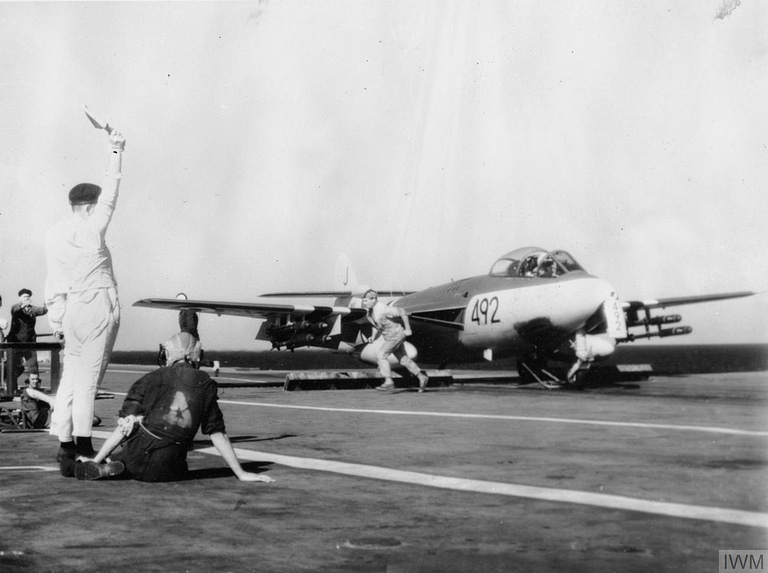
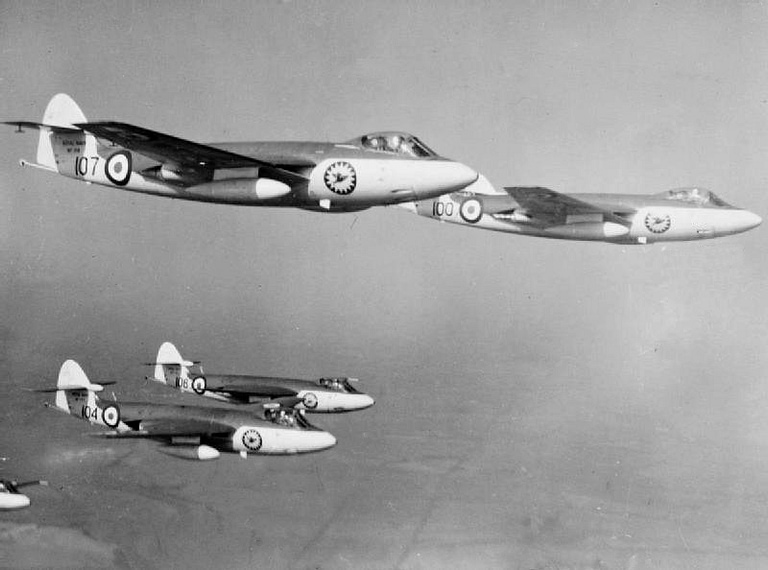
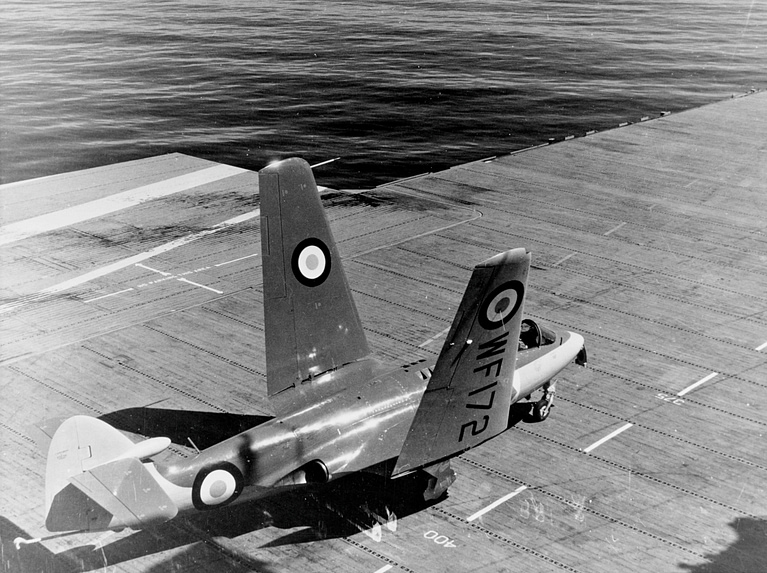
The Sea Hawk in pictures
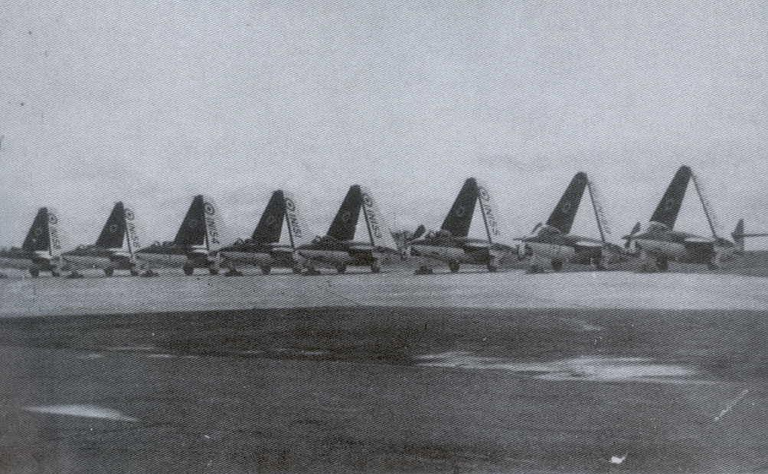
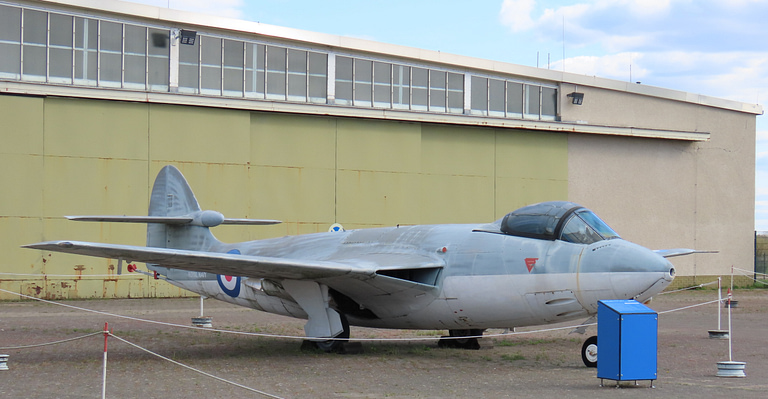
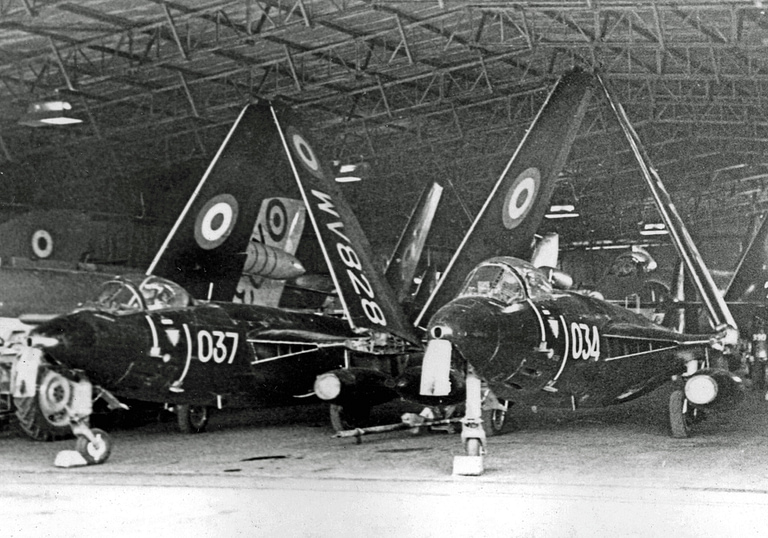
The Sea Hawk in motion
A curated video feature for the Hawker Sea Hawk is coming soon. In the meantime, explore the photo gallery above and the operator map below.
Where the Sea Hawk served
Where the record stands
The Sea Hawk fought two very different wars. In 1956 it was the Fleet Air Arm’s principal day strike fighter over Suez, flying cannon, bomb and rocket attacks on Egyptian airfields and ground targets from three carriers, for the loss of two aircraft to ground fire. Fifteen years later it went to war again in Indian hands: from INS Vikrant in the 1971 war, its Sea Hawks flew some 300 strike sorties against East Pakistan, sinking shipping and helping blockade the ports. Between and after those campaigns its value was steady, reliable naval air power in British, Indian, Dutch and German service.
Compare the combat record of every military aircraft. Figures as of July 2026.
Everything people ask about the Sea Hawk
Can I fly in a Sea Hawk?
Who built the Sea Hawk — Hawker or Armstrong Whitworth?
Did the Sea Hawk see combat?
What was the Sea Hawk armed with?
What engine did it use, and what was special about it?
Who operated the Sea Hawk and when was it retired?
You can’t fly the Sea Hawk.
These, you can.
Some legends only live in museums — others are fuelled and waiting. MiGFlug has put civilians in real military jet cockpits since 2004.
 Fly the L-39 AlbatrosThe world’s most-flown jet trainer — aerobatics included
 Fly the F-104 Starfighter“The missile with a man in it”
 Fly the MiG-21The Cold War’s most-produced jet
 טסו על ה-T-33 Shooting StarAmerica’s first jet trainer
 Fly the DH VampireA piece of early jet history
 Fly the S.211Agile Italian jet trainer
 Fly the MB-326The classic Aermacchi jet
 Fly the MiG-15The Soviet legend of the Korean War
Continue the tour
Every fact, checked
- Thunder & Lightnings — Sea Hawk historyDevelopment, variants, the Suez squadrons and service history.
- HistoryOfWar — Hawker Sea HawkVariants, the P.1052/P.1081 lineage, production numbers and Suez.
- HistoryOfWar — Hawker P.1040Prototype origins, the bifurcated exhaust and early specifications.
- Plane Crazy — Hawker Sea HawkOperators and retirement dates for the RN, Netherlands, Germany and India.
- Imperial War Museums — Sea Hawk FB.5Museum airframe history, Suez service and design notes.
- Paul Ooi Model Works — Sea Hawk at SuezSuez squadrons, carriers, weapons and losses to ground fire.
- Sanjha Morcha — INS Vikrant & Sea Hawks, 1971First-hand Indian account of the 1971 carrier strikes.
- Afterburner — 2 September 1947 first flightDating the maiden flight, prototype serials and Camm’s design credit.