
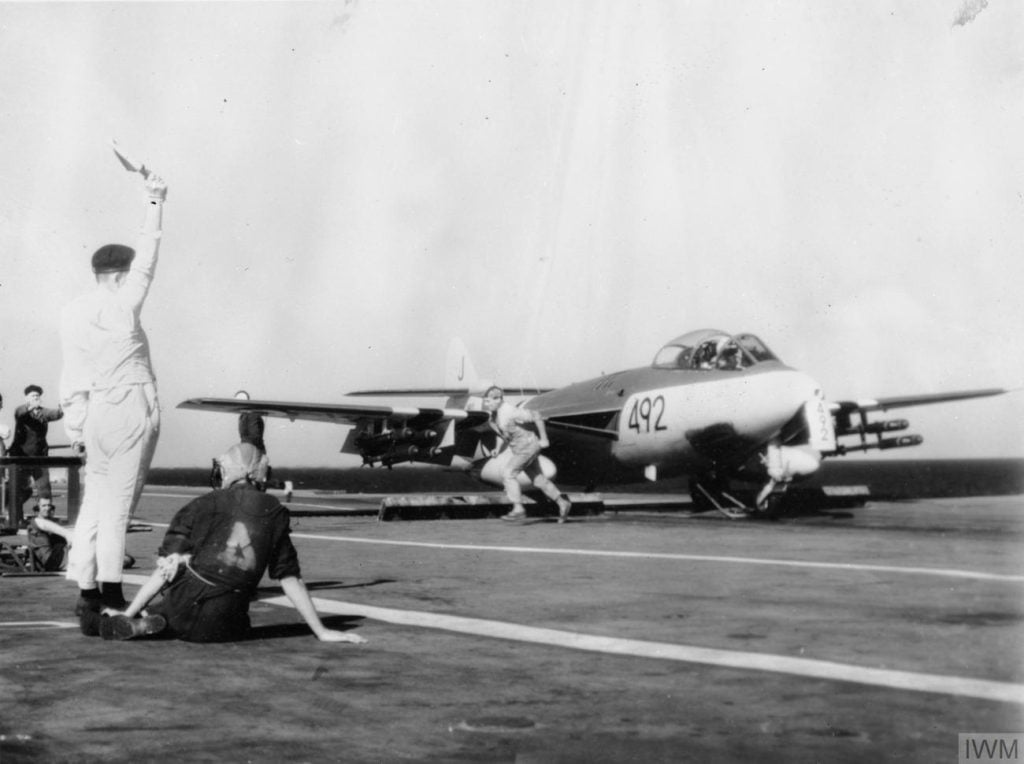
Hawker Sea Hawk
“Britain’s naval jet”
An elegant straight-wing carrier fighter-bomber — Hawker’s first jet, built largely by Armstrong Whitworth, with a clever split exhaust that vented at the wing roots. It flew ground-attack over Suez in 1956 and fought its last war from an Indian carrier in 1971.
Hawker’s first jet, and the navy’s workhorse
In the last months of the Second World War, Hawker Aircraft — the firm behind the Hurricane and the Sea Fury — began sketching its first jet. Under the direction of the legendary designer Sir Sydney Camm, the private-venture P.1040 set out to solve a stubborn problem of early jet layout: a single turbojet buried in a slim fuselage needed a long tailpipe, and that pipe ate into the very fuselage volume a naval aircraft wanted for fuel.
Hawker’s answer became the aircraft’s signature. Instead of one long exhaust, the Rolls-Royce Nene fed a bifurcated (divided) jetpipe whose two outlets vented at the wing-root trailing edges. The short, low-loss ducting freed the entire rear fuselage as a fuel tank, giving the type unusually good range for a first-generation jet. Air came in through clean wing-root leading-edge intakes, and the wing itself was deliberately straight — chosen for docile, forgiving handling rather than outright speed.
The P.1040 prototype first flew on 2 September 1947. The RAF showed little interest in a straight-wing jet fighter, so Hawker turned to the naval requirement. A navalised prototype with folding wings, catapult spools and an arrester hook flew in 1948, and the Royal Navy adopted the design. There was a catch: Hawker’s factories were saturated with development of the swept-wing Hunter, so under the Korean-War “Super-Priority” scheme, Sea Hawk production was handed to sister company Armstrong Whitworth at Coventry. Hawker built only the first three dozen; Armstrong Whitworth built the overwhelming majority of the roughly 542 aircraft.
The Sea Hawk entered Royal Navy front-line service in 1953 and evolved quickly through fighter, fighter-bomber and ground-attack marks, ending with the definitive FGA.6. Its combat debut came at Suez in 1956, flying intensive ground-attack sorties from three carriers. Front-line British service was short — swept-wing jets were already arriving — but the rugged, well-liked Hawk found a long second life abroad, serving the Netherlands, West Germany and, above all, India, whose Sea Hawks fought in the 1971 war and flew on until about 1983.
01The Hawker Sea Hawk’s lineage: from the P.1040 to the swept-wing Hunter
The Sea Hawk sits at a fork in Hawker’s history. Its straight-winged P.1040 airframe was the starting point for a family of experiments: the P.1052, which fitted swept wings to a Sea Hawk-type fuselage and flew in 1948, and the P.1081, which added a straight-through jetpipe and flew in 1950 before being lost in a 1951 crash. Those research aircraft pointed the way to Hawker’s transonic masterpiece, the Hunter.
So the docile naval Hawk was, in effect, the first rung on a ladder that ended with one of the most admired jets ever built. It also explains why Armstrong Whitworth built most Sea Hawks: Hawker’s own lines were busy turning that swept-wing research into the Hunter, leaving the straight-wing naval fighter to be produced by a sister firm within the Hawker Siddeley Group.
What makes it special
The bifurcated jet exhaust
The Sea Hawk’s defining trick was to split the single Rolls-Royce Nene’s thrust into a divided jetpipe that exhausted at the wing-root trailing edges, one outlet on each side. Short, low-loss ducting replaced a long central tailpipe — freeing the entire rear fuselage to be used as a fuel tank. The result was exceptional range and endurance for a first-generation jet, and an elegant packaging solution still admired by engineers.
A carrier fighter built to be forgiving
The wing was deliberately kept straight (unswept) for gentle, predictable low-speed handling — ideal for carrier approaches. Add hydraulically folding wings for below-deck stowage, a wide-track undercarriage and rock-steady gun and rocket aiming, and the Sea Hawk became a stable, popular deck aircraft and an outstanding strike platform. It traded top speed for the qualities that matter most flying off a pitching flight deck.
The Rolls-Royce Nene and its famous copy
Power came from a single Rolls-Royce Nene, a robust centrifugal-flow turbojet breathing through clean wing-root intakes. Simple and durable, it gave dependable service in British, Indian, Dutch and German hands. The Nene has a twist of history too: it was licensed to the Soviet Union in 1946–47 and copied as the engine that powered the MiG-15 — so the same basic turbojet flew in a British naval fighter and in the Cold War’s most famous adversary.
02The Hawker Sea Hawk’s split exhaust: why the fuselage could be filled with fuel
Early jet fighters wasted a surprising amount of internal volume on plumbing. A single engine mounted amidships had to route its hot exhaust all the way to the tail through a long jetpipe, and that pipe — plus the cooling and structure around it — consumed fuselage space that could otherwise hold fuel. For a naval aircraft, where range and endurance decide whether you can find your carrier again, that was a real penalty.
Hawker’s bifurcated arrangement solved it neatly. The Nene sat forward, and its efflux divided into two short pipes venting just behind the wing roots. With no long tailpipe running aft, the whole rear fuselage became a fuel bay. It is one reason the Sea Hawk earned a reputation for good legs, and why the design is remembered as one of the tidier engineering ideas of the early jet age.
03The Hawker Sea Hawk’s variants: from F.1 fighter to FGA.6 and the export marks
The Sea Hawk matured through a clear progression. The F.1 was the initial fighter; the F.2 added power-boosted ailerons; the FB.3 strengthened the wing for underwing stores; and the FGA.4 became a dedicated ground-attack machine with four pylons. The FB.5 and definitive FGA.6 re-engined the type with the more powerful Nene 103, and many earlier airframes were converted up to that standard.
Exports carried their own designations. The Netherlands bought Mk 50s; West Germany received all-weather Mk 100s and radar-equipped Mk 101s; and India operated aircraft broadly equivalent to the FGA.6, along with reconditioned airframes, making it the type’s largest and longest-serving export operator.
Full specifications
Figures below are for the definitive Sea Hawk FB.5 / FGA.6 with the Rolls-Royce Nene 103. Period sources vary with variant and loading, so values are given as commonly cited figures.
Baseline note: the figures below describe the Sea Hawk FGA.6, the final Royal Navy standard — a Rolls-Royce Nene 103 of 5,200 lbf in an airframe cleared for bombs, rockets and drop tanks. It is the right baseline because it is the mark that fought at Suez in the hands of most squadrons, the mark India bought and rebuilt, and the mark that almost every survivor represents. Deltas for the F.1, F.2, FB.3 and FGA.4, for the FB.5 conversions, and for the export Mk 50, Mk 100, Mk 101 and Indian aircraft are in grey. Three things to understand before the numbers, all of them consequences of one decision. First, the exhaust. Hawker split the Nene’s jet pipe into two short ducts — the works called them "trouser legs" — that exit through nozzles in the wing-root trailing edge rather than running a single long pipe to the tail. That is why the rear fuselage of a Sea Hawk is not a hot tube but a plain monocoque box, and Hawker filled it with fuel. Tanks sit fore and aft of the engine, so the centre of gravity barely moves as they empty, the wing needs no fuel in it and can therefore be thin, clean and easy to fold, and the aeroplane ended up with a range of 770 km on internal fuel at a time when first-generation jets were routinely embarrassing their operators by running out of it. The price was paid in thrust: the split ducts lose more than a well-faired single pipe, the Nene was rated at 5,000 lbf in the early installation, and the wing root around the nozzles is a hot, congested piece of structure that engine fitters disliked. Second, the production total. 542 is the usually quoted figure and is used here, but 524 also appears in reputable places, and mark-by-mark totals do not reconcile cleanly with either because 50 FB.5s and part of the FGA.6 run were conversions of existing airframes rather than new machines. Third, Indian aircraft. India’s Sea Hawks are commonly called "Mk 6", but the fleet was three things at once: new-build and refurbished British FGA.6s, plus 28 ex-Bundesmarine Mk 100 and Mk 101 airframes bought second-hand in 1966, so an Indian Sea Hawk may be a German aeroplane with a German fin.
Dimensions & weights
- Crew
- 1 — every Sea Hawk of every mark was a single-seater. No two-seat trainer version was ever built, so navies converted pilots straight on to the type from piston fighters and from the Meteor and Vampire trainers, which is one reason early Fleet Air Arm accident rates on the type were unflattering
- Length
- 12.09 m (39 ft 8 in) — unchanged across the marks. Nothing was ever stretched, because there was nothing to stretch for: no radar in the nose, no second seat, no afterburner in the tail
- Wingspan
- 11.89 m (39 ft 0 in). This is 30 in more than the first naval prototype VP413 carried. Deck trials in HMS Illustrious in 1949 showed the low-speed handling was not good enough for carrier approaches, and the cure was simply more wing
- Height
- 2.64 m (8 ft 8 in). The German Mk 101 is the exception in the family: its underwing search radar pod demanded a taller vertical tail to restore directional stability, and the enlarged fin is the quickest way to identify a Bundesmarine airframe — including the ones India later flew
- Wing area
- 25.83 m² (278 sq ft), straight-tapered and unswept. The Sea Hawk was designed around the compressibility limits of 1946, and Hawker’s own swept-wing derivatives, the P.1052 and P.1081, were flying while the Sea Hawk was still being ordered
- Aspect ratio
- 5.47 — high for a jet fighter of the period, and a direct dividend of putting no fuel in the wing. A thin, high-aspect wing with nothing inside it but structure, guns aside, is what gave the type its unusually docile approach
- Wing folding
- Hydraulic, outer panels folding upward — fitted from the second prototype VP413 of August 1948 onward and standard on all production aircraft. The fold line sits outboard of the stores stations, so a folded Sea Hawk still has its pylons and rocket rails exposed on the horizontal inner wing
- Empty weight
- 4,208 kg (9,278 lb). Light by later standards and light even for its own generation; the Supermarine Attacker, its direct Fleet Air Arm rival, was heavier and had a tailwheel
- Gross weight
- 5,996 kg (13,220 lb) — the clean fighter figure, four cannon and full internal fuel, no external stores
- Maximum take-off weight
- 7,326 kg (16,150 lb) with a full external load. The 1,330 kg between gross and maximum is the whole of the Sea Hawk’s war load, and it is not much: two 500 lb bombs and rockets, or bombs and tanks, but rarely everything at once from a light fleet carrier
- Wing loading
- 232 kg/m² (48 lb/sq ft) at gross weight — low, forgiving, and the reason pilots almost universally described the aeroplane as easy to bring aboard. At maximum take-off weight it rises to 284 kg/m² (58 lb/sq ft), which is where the deck-launch margins started to matter
- Internal fuel
- Fuselage tanks fore and aft of the engine — deliberately straddling the centre of gravity so that trim change with fuel burn is small. Published capacity figures for the Sea Hawk are inconsistent and none is well enough corroborated to print here as fact; what is not in dispute is that the fuselage volume freed by the bifurcated jet pipe gave the type more internal fuel, and more endurance, than the Attacker or the Vampire
- External fuel
- 2 × 90 imp gal drop tanks (409 L each) on the inboard stations. German Mk 100 and Mk 101 aircraft were fitted for four underwing tanks in the ferry and patrol role, which is the largest fuel fit any Sea Hawk carried
- Undercarriage
- Retractable tricycle, wide track — the first Hawker aeroplane with a nosewheel. Against the Attacker’s tailwheel this was transformative for deck work: a level attitude on approach, a clear view of the batsman and later the mirror, and no risk of the tail dropping into the round-down
Performance
- Maximum speed
- 969 km/h (600 mph, 522 kn) at sea level. Like most straight-wing jets the Sea Hawk was fastest low down, where the air is dense and the Nene is happiest; it did not gain speed with height the way a swept-wing aeroplane does
- Speed at altitude
- Falls away steadily above about 6,000 m — the combination of a fixed-geometry centrifugal engine and an unswept wing meant the Sea Hawk was slower at height than the MiG-15 it might have met, and everyone involved knew it. Against Egyptian Vampires and Meteors in 1956 this did not matter; against the MiG-15bis that Egypt was already receiving, it would have
- Limiting Mach number
- About Mach 0.83 as a normal handling limit. Beyond it the straight wing ran into compressibility, with the nose-down trim change and aileron heaviness familiar from every first-generation jet. No Sea Hawk was ever supersonic, in a dive or otherwise
- Rate of climb
- 29 m/s (5,700 ft/min) at sea level, clean. Respectable for 1953 and thoroughly ordinary by 1956; the Hunter, entering RAF service in the same period, climbed at nearly twice the rate
- Service ceiling
- 13,560 m (44,500 ft). High enough for the fighter role the F.1 and F.2 were bought for, and entirely irrelevant to the ground-attack role the FB.3, FGA.4 and FGA.6 actually flew
- Range
- 770 km (480 miles, 420 nautical miles) on internal fuel. This is the number the bifurcated jet pipe bought, and it is the single figure that explains why the Admiralty took the type on after the RAF turned it down — endurance is worth more to a carrier air group than top speed, because a deck cycle is measured in minutes of fuel
- Range with drop tanks
- Substantially greater with 2 × 90 imp gal tanks — but the tanks occupy the inboard stations, which are also the bomb stations, so the Sea Hawk faced the standard first-generation trade: reach or war load, seldom both
- Combat radius
- ~370 km (200 nautical miles) with a useful strike load, as a working figure derived from range rather than a published one. Indian Sea Hawks launched against Cox’s Bazar on 4 December 1971 from a reported 85 nautical miles, well inside this, though the Vikrant account in some sources gives 230 nautical miles for the same strike
- Endurance
- Long for the generation — contemporary pilots consistently rated the Sea Hawk as the type that could stay airborne while the Attacker and early Sea Venoms were calling for the deck. No single authoritative endurance figure is published; the comparative judgement is better attested than any number
- Thrust-to-weight
- 0.39 at gross weight (5,200 lbf against 13,220 lb). Some compilations print 0.38 for the same aircraft; the difference is a rounding convention, not a disagreement about the aeroplane
- Launch and recovery
- Catapult spools, arrester hook and RATOG provision — the Sea Hawk could be catapulted or, with rocket-assisted take-off gear, flown off a short deck in low wind. That last capability was not academic: INS Vikrant went to war in 1971 with reported boiler defects limiting her speed, which cuts wind over the deck and squeezes launch margins directly
- Handling
- Benign, and famously so — light controls after power ailerons arrived on the F.2, a stable approach, no vices at the stall, and a reputation among Fleet Air Arm pilots as one of the pleasantest aeroplanes any of them flew. It is the quality that kept the type in Indian service for twenty-three years
Propulsion & systems
- Engine
- 1 × Rolls-Royce Nene 103 centrifugal-flow turbojet — the F.1, F.2, FB.3 and FGA.4 used the Nene 101; the FB.5 and FGA.6 the Nene 103. That is the whole of the Sea Hawk’s engine development over six marks and five years, and it is a small step: about 4 per cent
- Rated thrust
- 23.1 kN (5,200 lbf) for the Nene 103; 22.2 kN (5,000 lbf) for the Nene 101. The improvement was felt most on take-off and at low speed, which is exactly where a carrier aeroplane with a growing external load needs it
- Engine architecture
- Single-stage double-sided centrifugal compressor, nine combustion chambers, single-stage turbine — 1.26 m (49.5 in) in diameter and 726 kg (1,600 lb) dry, passing about 36 kg/s of air. The double-sided impeller is why the Sea Hawk is fat in the middle and why it needed two intakes: this is a wide engine, and the airframe is wrapped around it
- Jet pipe
- Bifurcated, exhausting through nozzles in the wing-root trailing edge — the defining feature of the design and the reason the type exists in this shape. Two short ducts instead of one long one lose less total pressure, and more importantly they leave the entire rear fuselage empty. Hawker filled it with fuel
- Why that mattered
- Fuel in the fuselage, not the wing — three consequences follow. The tanks straddle the centre of gravity, so trim scarcely changes as fuel burns. The wing carries no fuel, so it can be thin, structurally simple and fold cleanly without wet joints across the hinge. And the aeroplane has more fuel than its contemporaries, which converts directly into deck-cycle endurance and into the 770 km range that persuaded a sceptical Admiralty. The costs are real too: duct losses, a hot and crowded wing-root structure, and awkward access for engine changes
- Air intakes
- Wing-root leading-edge intakes, one each side — short ducts to a mid-fuselage engine, keeping the nose free for the gun bay and the cockpit well forward for the view over the deck
- Structure
- All-metal stressed-skin, conventional and conservative — no wood, no novel materials, no marginal weight-saving. The Sea Hawk was designed to be repaired in a hangar at sea by ratings with hand tools, and it was
- Flight controls
- Manual on the F.1; power-assisted ailerons from the F.2 (first flight 24 February 1954). Elevator and rudder remained manual throughout. The aileron change is the single largest improvement in the type’s handling and the reason F.1s were quickly relegated
- Hydraulics
- Undercarriage, flaps, air brakes, wing fold and arrester hook — a single conventional system, with the wing fold operable by the pilot, which mattered on a crowded deck park
- Escape system
- Martin-Baker ejection seat from the outset — the Sea Hawk never went through the phase, endured by early Vampire and Venom fighter-bomber pilots, of having no seat at all. For a carrier aeroplane spending its life over water, that was not a luxury
- Avionics and radar
- None airborne in Royal Navy or Indian service — radio, IFF and a gyro gunsight, and that is the extent of it. The one exception in the whole family is the German Mk 101, which carried an EKCO search radar in an underwing pod for maritime reconnaissance and needed the enlarged fin to live with it. The Dutch Mk 50 added Philips-built UHF radio and, from 1959, a Sidewinder capability no other Sea Hawk ever had
- Naval fit
- Arrester hook, catapult spools, folding wings, RATOG points and deck lashing rings — specified from Naval Specification N.7/46, which the Admiralty issued in May 1946 for three prototypes after the RAF had declined the land-based P.1040 as offering too little over the Meteor and Vampire
04The Hawker Sea Hawk’s cost: what a 1950s carrier fighter was worth
The Sea Hawk was a British government procurement of the early 1950s, produced in quantity under a wartime-style priority scheme, and no precise modern-style flyaway price is published for it. Because it was a straightforward, single-engined design built on established production lines, it was relatively economical compared with the more advanced swept-wing jets that followed. Any single figure quoted for the type should be read as an order-of-magnitude estimate rather than a sourced flyaway cost.
No reliable public cost-per-flight-hour number exists for the Sea Hawk either. As with most first-generation Cold War jets, operating-cost data was never released in a form comparable to modern figures, so any precise dollar-per-hour claim is effectively guesswork.
Armament & payload
The Sea Hawk fought two wars with four Hispano cannon and stores that went where the pilot pointed them
The Sea Hawk’s armament is the least original thing about it: four 20 mm Hispano Mk V cannon in the nose, 200 rounds each, plus iron bombs, RP-3 rockets and drop tanks on underwing stations that the FB.3 introduced and the FGA.4 made properly usable. Nothing guided was ever carried by a British or Indian Sea Hawk, air-to-air or air-to-surface, and nothing needed to be: against Egyptian airfields in 1956 and against Pakistani gunboats and coasters in the Bay of Bengal in 1971, cannon and rockets were precisely the right currency, and the aeroplane’s steadiness in the dive was worth more than any electronics it might have carried. The interesting armament story in this family belongs not to the Royal Navy but to the Royal Netherlands Navy, which from 1959 hung a pair of AIM-9B Sidewinders on its Mk 50s and thereby produced the only missile-armed Sea Hawks ever to fly. Fits varied sharply by mark and operator: the F.1 and F.2 were gun-only fighters with no stores clearance worth the name, the FB.3 introduced a strengthened wing and four stations, the German Mk 100 and Mk 101 were plumbed for four underwing tanks, and published rocket and bomb loads for the FGA.6 disagree with each other in ways noted below.
Gun
- Four 20 mm Hispano Mk V cannon in the lower nose, grouped under the cockpit floor — the standard British naval battery of the period, shared with the Sea Fury, Attacker and Sea Venom
- 200 rounds per gun, 800 rounds total — a generous magazine by contemporary standards and enough for repeated strafing passes, which is how the type spent most of its combat life
- The battery was unchanged from the F.1 of 1951 to the last Indian aircraft flying in the 1980s. No Sea Hawk of any mark carried a different gun, a gun pack, or fewer than four cannon
- Muzzle blast troughs are cut into the nose skinning; the cannon fire below and outboard of the pilot’s feet, which kept smoke and flash out of the windscreen far better than the Vampire family managed
- Against Egyptian aircraft caught on the ground at Dekheila, Abu Sueir, Fayid, Kabrit and Kasfareet in November 1956, the cannon did most of the damage; rockets and bombs were used against harder targets
Air-to-air
- Guns only, on every Royal Navy Sea Hawk of every mark. No Fleet Air Arm Sea Hawk ever carried an air-to-air missile, and none was ever cleared for one
- Royal Netherlands Navy Mk 50s are the exception: from 1959 they carried two AIM-9B Sidewinder infrared missiles, the only guided air-to-air weapon ever fitted to the type
- Indian Sea Hawks remained gun-armed for air-to-air work throughout their twenty-three years, including both Indo-Pakistani wars
- German Mk 100 and Mk 101 aircraft carried no missiles; the Mk 101’s radar was a search set for finding ships, not a fire-control radar for finding aircraft
- The honest assessment is that by 1956 the Sea Hawk was already a marginal air-to-air aeroplane — fast enough low down, out-climbed and out-run at height by anything swept-wing, and dependent entirely on a gyro gunsight and the pilot’s eyes
Air-to-surface guided
- None. No Sea Hawk of any mark, in any air arm, ever carried a guided air-to-surface weapon — the card is kept because its emptiness is the point
- The type predates practical Western air-to-surface guided weapons in naval service by roughly a decade; the Royal Navy’s first were carried by the Buccaneer and Sea Vixen generation that replaced it
- Indian Sea Hawks sank or crippled something close to a dozen Pakistani gunboats, coasters and cargo vessels in December 1971 entirely with cannon, rockets and 500 lb bombs
- The nearest thing to a precision weapon on a Sea Hawk was a steady aeroplane in a 30-degree dive, and by every contemporary account it was very steady indeed
Bombs
- 500 lb bombs on the inboard stations — the standard British naval store of the period and the Sea Hawk’s principal hard-target weapon at Suez and over Chittagong
- Published maxima disagree: the widely reproduced FGA.6 table gives four 500 lb bombs, while operational accounts and other compilations describe two, with the outboard stations given over to rockets. Two 500 lb bombs plus rockets is the load most often described in service
- 1,000 lb bombs appear in some listings for the fighter-bomber marks; the figure is poorly corroborated and should be treated with caution
- Napalm tanks and mines were among the stores cleared for the FB.3 when the strengthened wing was introduced in 1954
- Practice bomb carriers were standard for the training and second-line units, which is what most surviving airframes spent their last flying years doing
Rockets
- RP-3 rockets on underwing rails — the 3-inch British rocket projectile, fired with 60 lb high-explosive or 25 lb armour-piercing heads, unchanged in essentials since 1943
- Up to 20 rockets is the figure given in the most-reproduced specification; 16 appears just as often, and the difference probably reflects different rail fits rather than a real disagreement about the aeroplane
- A widely copied table also lists "16 × .5 in rockets", which is almost certainly a corrupted rendering of a 5-inch rocket — it is repeated uncritically across the internet and should not be trusted
- Rockets were the weapon of choice against soft and semi-hard targets: vehicle parks and gun positions at Suez, and gunboats and small merchant shipping off Cox’s Bazar and Chittagong in 1971
- Eight Indian Sea Hawks opened the 1971 naval air campaign on 4 December armed with guns and rockets, striking the airfield and harbour at Cox’s Bazar before turning to Chittagong
Pods & other stores
- 2 × 90 imp gal drop tanks (409 L each) on the inboard stations — the standard ferry and long-range fit, and the direct competitor to the bomb load for those two stations
- German Mk 100 and Mk 101 aircraft were configured for four underwing tanks, the heaviest fuel fit in the family, reflecting the Bundesmarine’s long over-water patrol task in the Baltic
- EKCO-built search radar in an underwing pod on the Mk 101 alone — the only sensor pod any Sea Hawk carried, and the reason those aircraft have a noticeably larger fin
- Reconnaissance camera installations were among the stores the FB.3 was cleared to carry when its wing was strengthened in 1954
- RATOG — rocket-assisted take-off gear — was provided for, and was the difference between launching and not launching from a light fleet carrier in poor wind
Three typical loadouts
- Airfield strike, Egypt, 1 November 1956
- Four Hispano Mk V with 800 rounds, two 500 lb bombs inboard, rockets outboard. This is the Operation Musketeer profile flown by 897 and 899 Naval Air Squadrons from HMS Eagle, 800 and 802 from HMS Albion, and 804, 810 and 895 from HMS Bulwark against Dekheila, Abu Sueir, Fayid, Kabrit and Kasfareet. 897 alone flew 169 sorties between 1 and 6 November, and the three carriers together flew close to 1,300 offensive sorties in the first five days.
- Anti-shipping and harbour strike, Bay of Bengal, December 1971
- Four cannon with full ammunition and a full rocket load, no bombs, for maximum passes per sortie against gunboats and coasters. Eight INAS 300 Sea Hawks flew this profile from INS Vikrant against Cox’s Bazar and Chittagong at 0800 on 4 December 1971; ten went with two Alizés against Mongla, Chalna and the Pussur river on 6 December. The heavier variation, with 500 lb bombs added, was flown on 12 December when 28 Sea Hawk sorties went against Chittagong airfield.
- Fleet combat air patrol, Mediterranean, 1955
- Four cannon, no offensive stores, two 90 imp gal drop tanks on the inboard stations. This was what the F.1 and F.2 were bought for and the role the Sea Hawk was steadily pushed out of after 1956; the endurance that the bifurcated jet pipe bought is what made the type good at it, and the climb and ceiling it lacked are what made the Scimitar and Sea Vixen necessary.
Sourcing caveat. Sea Hawk weapon tables in general circulation trace back to a small number of secondary compilations and reproduce each other’s errors, the ".5 in rockets" entry being the clearest example. Where a store is listed above without a number, it is because no figure could be corroborated across independent sources rather than because the store is doubtful. Sortie counts for Suez come from squadron records as summarised in the Naval Air Squadron histories and contemporary carrier accounts; the 1971 figures come from Indian naval retrospectives, which disagree among themselves about launch range for the 4 December strike — 85 and 230 nautical miles both appear in print for the same eight aircraft.
Variants
Sea Hawk mark numbers record two changes only: one engine, and one change of job
Six Royal Navy marks in five years sounds like restless development. It was not. The F.1 and F.2 differ by power-assisted ailerons; the FB.3 differs from the F.2 by a strengthened wing that could carry stores; the FGA.4 differs from the FB.3 by fixing the way those stores were handled; the FB.5 is an FB.3 with the more powerful Nene 103 dropped in; and the FGA.6 is an FGA.4 built with that engine from new. Everything else — airframe, cockpit, guns, undercarriage, the bifurcated jet pipe — stayed as Hawker drew it in 1946.
The reason the marks proliferate anyway is that the Sea Hawk changed job in mid-production. The Admiralty ordered a fighter and, by the time it was in squadron service in 1953, wanted a fighter-bomber, because the swept-wing aeroplanes arriving elsewhere had made a straight-wing interceptor obsolete before it had finished being delivered. Hawker built 35 of the F.1 at Kingston; everything after that was built by Armstrong Whitworth at Baginton in Coventry, which had capacity Kingston did not, and which is why almost every Sea Hawk in the world is a Coventry aeroplane.
Exports followed the same conservative pattern, with one twist. The Netherlands and West Germany bought aircraft essentially identical to the Royal Navy’s, differing in radio, radar and tank fit. India bought British aircraft, then in 1966 bought the Bundesmarine’s cast-off fleet as well — a transaction that had to be routed through an Italian intermediary because of West German export restrictions during Indo-Pakistani tension. The result is that the type’s longest and hardest service was flown partly on second-hand German airframes.
- P.1040, P.1052 and P.1072 (1947–50 / 3 + 2 + 1)
- The research line. The P.1035 of November 1944 put a Nene in a Fury with a conventional tail pipe; the December 1944 redesign into the P.1040 split that pipe into wing-root "trouser legs" and freed the rear fuselage for fuel. VP401 first flew from Boscombe Down on 2 September 1947 with Bill Humble at the controls; the navalised VP413 flew on 31 August 1948 and went to HMS Illustrious in April 1949, where about 25 deck landings and some unhappy low-speed handling produced the 30 in span increase. The P.1052 and P.1072 were swept-wing and rocket-augmented offshoots that never entered production; P.1052 VX272 survives at Yeovilton.
- Sea Hawk F.1 (1951–54 / 95)
- The initial production fighter with the Nene 101, unpowered ailerons and no meaningful stores capability. WF143 first flew on 14 November 1951; 35 were built at Kingston and 60 at Coventry. Entered Fleet Air Arm service in March 1953 with 806 Naval Air Squadron at Brawdy, later embarking in HMS Eagle. Heavy in roll and quickly superseded.
- Sea Hawk F.2 (1954 / 40)
- The F.1 with power-assisted ailerons, first flown 24 February 1954 as WF240. A small change that transformed the handling and is the reason no F.1 lasted long in a front-line squadron. Still a pure fighter with no strengthened wing.
- Sea Hawk FB.3 (1954–55 / 116)
- The first fighter-bomber, first flown 13 March 1954 as WF280, and the largest single production block. A strengthened wing with four stations cleared for rockets, bombs, napalm, mines, reconnaissance cameras, drop tanks and RATOG. 802 Naval Air Squadron took FB.3s to Suez in HMS Albion; one had the front of a drop tank shot away by ground fire and came home.
- Sea Hawk FGA.4 (1954–55 / 97)
- The fighter/ground-attack mark, first flown 26 August 1954 as WV792, addressing the stores-handling problems the FB.3 had revealed in service. Same Nene 101. 895 Naval Air Squadron embarked FGA.4s in HMS Bulwark in August 1956 and swapped them for 897’s FB.3s that October, an aircraft exchange between squadrons on the eve of a war that tells you how interchangeable the marks really were.
- Sea Hawk FB.5 (from 1955 / about 50 conversions)
- Not a new-build mark: FB.3 airframes re-engined with the Nene 103, worth about 4 per cent more thrust. The gain showed itself where it mattered on a carrier — low-speed handling and take-off performance — rather than in top speed. Most of the surviving British airframes in museums are FB.5s.
- Sea Hawk FGA.6 (1955–56 / 101, of which 86 new-build)
- The definitive Royal Navy standard and the baseline for this page: FGA.4 airframe, Nene 103, full ground-attack clearance. The remainder of the 101 were conversions from FB.3 and FGA.4 stock. This is the mark that fought at Suez with most squadrons, that India bought, and that the great majority of survivors represent.
- Sea Hawk Mk 50 (Netherlands, 1957–64 / 22 of 30 ordered)
- Royal Netherlands Navy ground-attack aircraft, NATO-funded, externally almost indistinguishable from an FGA.6 but fitted with Philips-built UHF radio. From 1959 they carried two AIM-9B Sidewinders — the only Sea Hawks ever to be missile-armed. Flew from HNLMS Karel Doorman, including during the confrontation with Indonesia over New Guinea; moved ashore in 1961 when the Dutch NATO commitment shifted to maritime patrol and anti-submarine work, and withdrawn in October 1964.
- Sea Hawk Mk 100 and Mk 101 (West Germany, 1957–65 / 68, 34 of each)
- Ordered for the Bundesmarine in 1956 and delivered between November 1957 and February 1959 to Marinefliegergeschwader 1 and 2, flying from Jagel, Schleswig, Nordholz and Eggebek. The Mk 100 was a day fighter-bomber with American electronics and provision for four underwing tanks; the Mk 101 an all-weather machine with an EKCO search radar in a wing pod and an enlarged vertical fin to cope with it. The type was already dated when it arrived; the last German Sea Hawks left in the summer of 1965 as the F-104G Starfighter came in.
- Indian Sea Hawks, commonly styled Mk 6 (1959–83 / 74 total)
- India’s fleet came in two tranches: 46 aircraft from Britain between 1960 and 1964 — new-build and refurbished ex-Fleet Air Arm FGA.6s — and 28 ex-Bundesmarine Mk 100 and Mk 101 airframes acquired in 1966, routed through an Italian intermediary to get round West German export restrictions. INAS 300 "White Tigers" commissioned in Britain on 7 July 1960; Lieutenant Commander R. H. Tahiliani made the first Sea Hawk deck landing on INS Vikrant on 18 May 1961 in IN 156, and the squadron sailed from Britain with eleven aircraft on 31 July 1961.
Closing note on numbers, service and disposition. Total production is usually given as 542 and that figure is used here, but 524 also appears in reputable sources and neither reconciles cleanly with the mark-by-mark totals, because the 50 FB.5s and part of the FGA.6 run were conversions rather than new airframes. Royal Navy front-line service was short: first squadron March 1953, last front-line unit 806 Naval Air Squadron disbanded at RNAS Brawdy on 15 December 1960 as the Scimitar and Sea Vixen came in, with second-line and Fleet Requirements flying continuing at Hurn until 1969. The Dutch finished in October 1964 and the Germans in the summer of 1965. India flew the type for twenty-three years, more than twice as long as Britain: INAS 300 took the Sea Hawk to war twice, made its last carrier disembarkation from INS Vikrant on 8 May 1978, ran the remainder ashore, and flew the last Sea Hawk sortie on 16 December 1983 — the same day the first Sea Harriers arrived at Dabolim to replace it. Of the survivors, published counts run from 36 to 37 airframes, of which roughly 30 are complete aircraft and the rest cockpit sections and fuselage fragments; every one is an original military airframe, since no Sea Hawk replica or reproduction has ever been built. None is currently airworthy. The last flying example, FGA.6 WV908, flew with the Royal Navy Historic Flight until it was grounded in 2010, went into dehumidified storage at RAF Shawbury, and was announced in June 2022 as returning to Yeovilton for restoration to flight; that work is still in progress. Static survivors cluster in three places: Britain, where WF225 guards the gate at RNAS Culdrose and examples sit at East Fortune, Duxford, Newark, Yeovilton, the Midland Air Museum and Gatwick; Germany and the Netherlands, with airframes at Berlin-Gatow, Hermeskeil, De Kooy and Soesterberg, plus one at the Malta Aviation Museum and a privately owned FB.5 in Texas; and India, which holds the largest concentration of all — a dozen or more aircraft at naval air stations, the Naval Aviation Museum at Goa, the National Defence Academy at Pune and various technical institutes, several of them ex-Bundesmarine Mk 100 and Mk 101 machines wearing Indian serials. India’s long tail is visible in the survivor list as clearly as in the service record.
From private venture to Indian carrier jet
First flight
Hawker’s private-venture P.1040 prototype makes its maiden flight on 2 September 1947, with the signature bifurcated wing-root exhaust.
Navalised prototype
A carrier-capable prototype with folding wings, arrester hook and catapult spools flies, and the Royal Navy adopts the design.
Production moves to Coventry
Under the Korean-War “Super-Priority” scheme, Sea Hawk production is transferred to Armstrong Whitworth, which builds most of the fleet.
Enters Royal Navy service
The Sea Hawk F.1 enters front-line Fleet Air Arm service, beginning with 806 Naval Air Squadron.
Combat at Suez
Six Sea Hawk squadrons fly intensive ground-attack sorties over Egypt from HMS Eagle, Albion and Bulwark during Operation Musketeer.
Withdrawn from RN front line
Swept-wing Scimitars and Sea Vixens replace the Sea Hawk in front-line Royal Navy service; second-line use continues into the 1960s.
War from INS Vikrant
Indian Navy Sea Hawks of INAS 300 fly around 300 strike sorties against East Pakistan, helping blockade its ports in the 1971 war.
Last operator retires
India retires its Sea Hawks around 1983, replaced by the Sea Harrier — ending three decades of front-line service.
Twelve Hawker Sea Hawk stories
The hawk that went to sea
Hawker’s raptor tradition met salt air in a folding-wing naval fighter.
Read the full story
Two tailpipes, one engine
The split exhaust hid a fuselage full of fuel — the Sea Hawk’s cleverest idea.
Read the full story
Why Hawker built so few
Most Sea Hawks wore an Armstrong Whitworth builder’s plate, not a Hawker one.
Read the full story
Musketeer’s sharpshooters
Six squadrons, three carriers, day after day over Egypt.
Read the full story
The Indian carrier’s war
Sea Hawks off INS Vikrant helped strangle East Pakistan in 1971.
Read the full story
The engine that flew for both sides
A Sea Hawk and a MiG-15 shared the same basic heart.
Read the full story
Wings that bowed
A fighter that shrank to fit below a crowded carrier deck.
Read the full story
The German and Dutch Sea Hawks
Britain was not the only navy to fly the straight-winged Hawk.
Read the full story
The straight wing that led to a legend
The Sea Hawk’s airframe was the first step toward Hawker’s finest jet.
Read the full story
Obsolete on arrival, loved anyway
Straight wings in a swept-wing world — and still it flew for thirty years.
Read the full story
Where to meet a Sea Hawk today
Preserved Hawks still show their split exhaust and folded wings in museums.
Read the full story
Why the Hawk was grounded
It was overtaken by Mach, not by failure.
Read the full story
The Sea Hawk in pictures
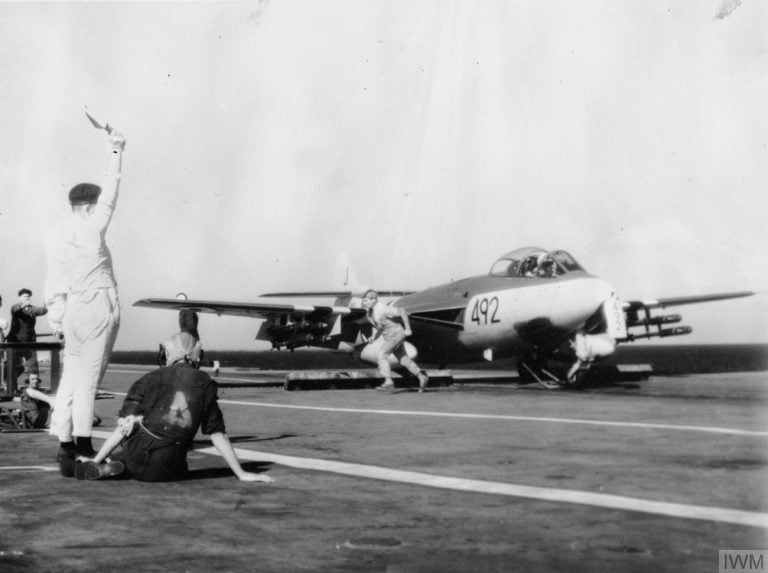
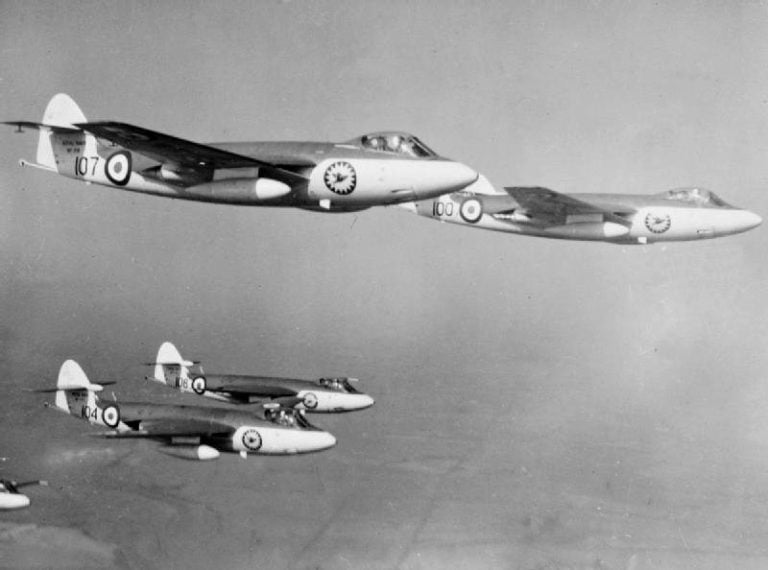
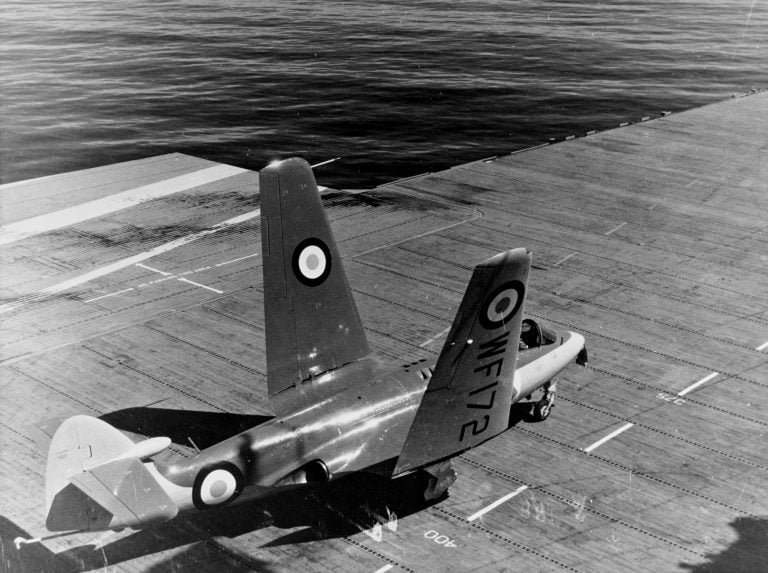
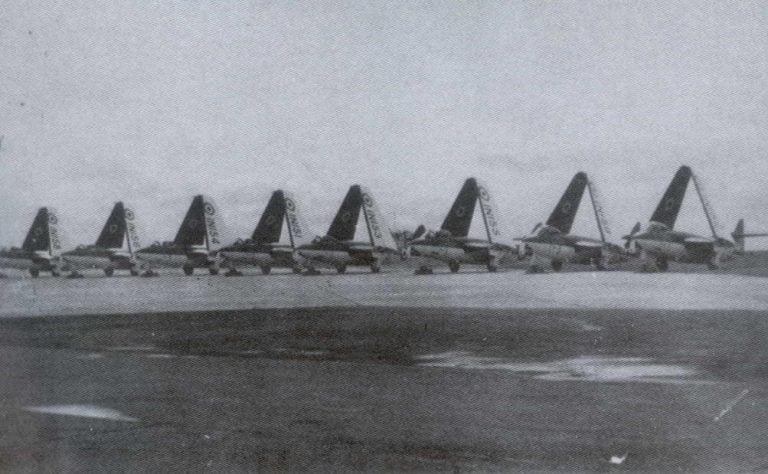
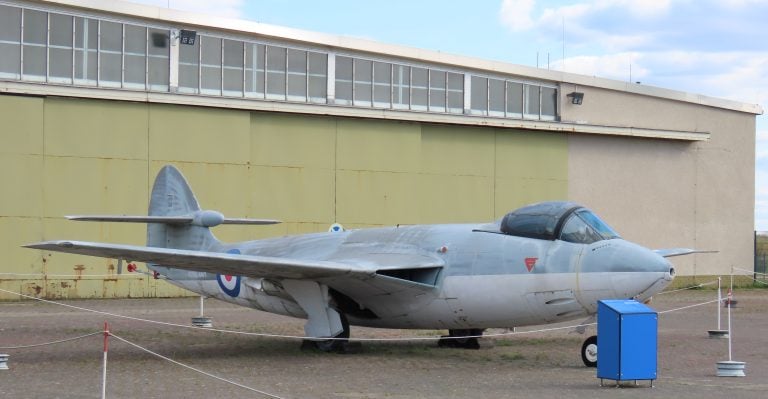
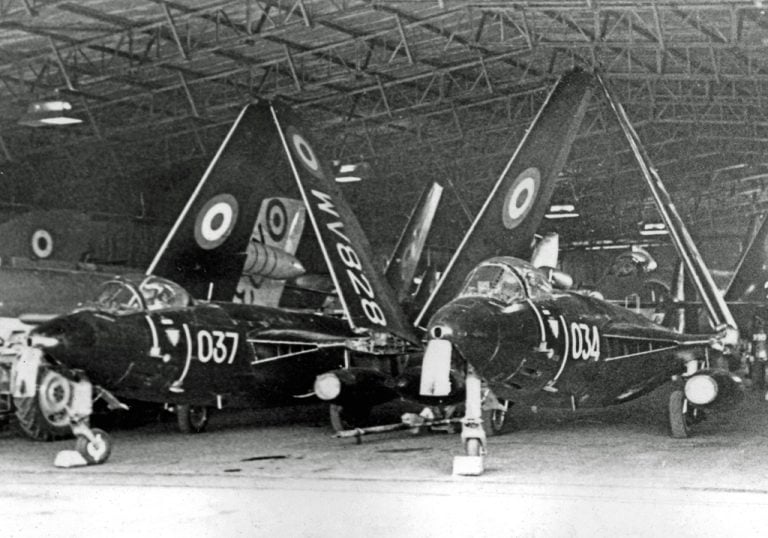
The Sea Hawk in motion
A curated video feature for the Hawker Sea Hawk is coming soon. In the meantime, explore the photo gallery above and the operator map below.
Where the Sea Hawk served
Where the record stands
The Sea Hawk fought two very different wars. In 1956 it was the Fleet Air Arm’s principal day strike fighter over Suez, flying cannon, bomb and rocket attacks on Egyptian airfields and ground targets from three carriers, for the loss of two aircraft to ground fire. Fifteen years later it went to war again in Indian hands: from INS Vikrant in the 1971 war, its Sea Hawks flew some 300 strike sorties against East Pakistan, sinking shipping and helping blockade the ports. Between and after those campaigns its value was steady, reliable naval air power in British, Indian, Dutch and German service.
Compare the combat record of every military aircraft. Figures as of July 2026.
Everything people ask about the Sea Hawk
Can I fly in a Sea Hawk?
Who built the Sea Hawk — Hawker or Armstrong Whitworth?
Did the Sea Hawk see combat?
What was the Sea Hawk armed with?
What engine did it use, and what was special about it?
Who operated the Sea Hawk and when was it retired?
You can’t fly the Sea Hawk.
These, you can.
Some legends only live in museums — others are fuelled and waiting. MiGFlug has put civilians in real military jet cockpits since 2004.
 Fly the L-39 AlbatrosThe world’s most-flown jet trainer — aerobatics included
 Fly the F-104 Starfighter“The missile with a man in it”
 Fly the MiG-21The Cold War’s most-produced jet
 Fly the T-33 Shooting StarAmerica’s first jet trainer
 Fly the DH VampireA piece of early jet history
 Fly the S.211Agile Italian jet trainer
 Fly the MB-326The classic Aermacchi jet
 Fly the MiG-15The Soviet legend of the Korean War
Continue the tour
Every fact, checked
- Thunder & Lightnings — Sea Hawk historyDevelopment, variants, the Suez squadrons and service history.
- HistoryOfWar — Hawker Sea HawkVariants, the P.1052/P.1081 lineage, production numbers and Suez.
- HistoryOfWar — Hawker P.1040Prototype origins, the bifurcated exhaust and early specifications.
- Plane Crazy — Hawker Sea HawkOperators and retirement dates for the RN, Netherlands, Germany and India.
- Imperial War Museums — Sea Hawk FB.5Museum airframe history, Suez service and design notes.
- Paul Ooi Model Works — Sea Hawk at SuezSuez squadrons, carriers, weapons and losses to ground fire.
- Sanjha Morcha — INS Vikrant & Sea Hawks, 1971First-hand Indian account of the 1971 carrier strikes.
- Afterburner — 2 September 1947 first flightDating the maiden flight, prototype serials and Camm’s design credit.