
Boeing B-47
“Stratojet”
The swept-wing, six-engine jet bomber that carried Strategic Air Command’s nuclear deterrent through the 1950s — and whose radical shape became the template for almost every jet airliner that followed.
The bomber that invented the jet age’s shape
In 1943 the U.S. Army Air Forces asked for a jet-powered bomber, and Boeing’s first answers were timid — straight-winged machines with engines buried in the fuselage, barely faster than the piston bombers they were meant to replace. The leap came from the wreckage of wartime Germany. In May 1945 Boeing aerodynamicist George Schairer, touring captured German research, grasped that sweeping a wing backwards delayed the sharp rise in drag near the speed of sound. He wrote home, and Boeing tore up its design.
What emerged was the Model 450: a thin wing swept 35 degrees, with six turbojets slung in streamlined pods beneath it rather than buried inside. The XB-47 first flew on 17 December 1947 — the 44th anniversary of the Wright brothers’ flight — and it looked like nothing else in the sky. That swept-wing, podded-engine formula would within a decade become simply what a jet was supposed to look like, carried straight into Boeing’s own B-52 וה- 707 airliner, and from there into essentially every jetliner flying today.
Entering service in 1951, the B-47 became the numerical backbone of Strategic Air Command. At its peak SAC fielded well over 1,500 Stratojets across dozens of wings, kept on alert to strike the Soviet Union with nuclear weapons. Building them took an industrial army: Boeing, Douglas and Lockheed together turned out more than 2,000 aircraft between 1947 and 1957, one of the largest bomber programmes of the postwar era.
For all that, the B-47 never dropped a bomb in anger. Its war was fought quietly, by unarmed and lightly armed RB-47 reconnaissance versions that flew electronic-intelligence sorties along — and sometimes across — Soviet frontiers, mapping radar and air defences. Several were fired on; some were lost. As intercontinental missiles and the longer-legged B-52 took over, the Stratojet left the bomber role in 1965–66, with the last special-mission aircraft flying until 1969.
01The Boeing B-47 Stratojet’s swept wing: how captured German data rewrote the jet age
Boeing’s early jet-bomber studies — the Models 424 and 432 — kept the straight wings of the piston era and performed poorly. The decisive input came in 1945, when George Schairer, serving on General Hap Arnold’s scientific mission in occupied Germany, examined German high-speed aerodynamic research showing that a swept wing delays compressibility drag as an aircraft nears the speed of sound. Schairer’s letter back to Seattle prompted Boeing to abandon the straight-wing layout. Engineer Vic Ganzer worked out an optimum sweep of about 35 degrees, and after the Air Force rejected fuselage-buried engines as a fire risk, the team hung six engines in underwing pods. The resulting Model 450 was so far ahead of its rivals that it effectively defined the shape of the jet age — a shape Boeing reused on the B-52 and the 707.
What makes it special
A swept wing and six podded engines
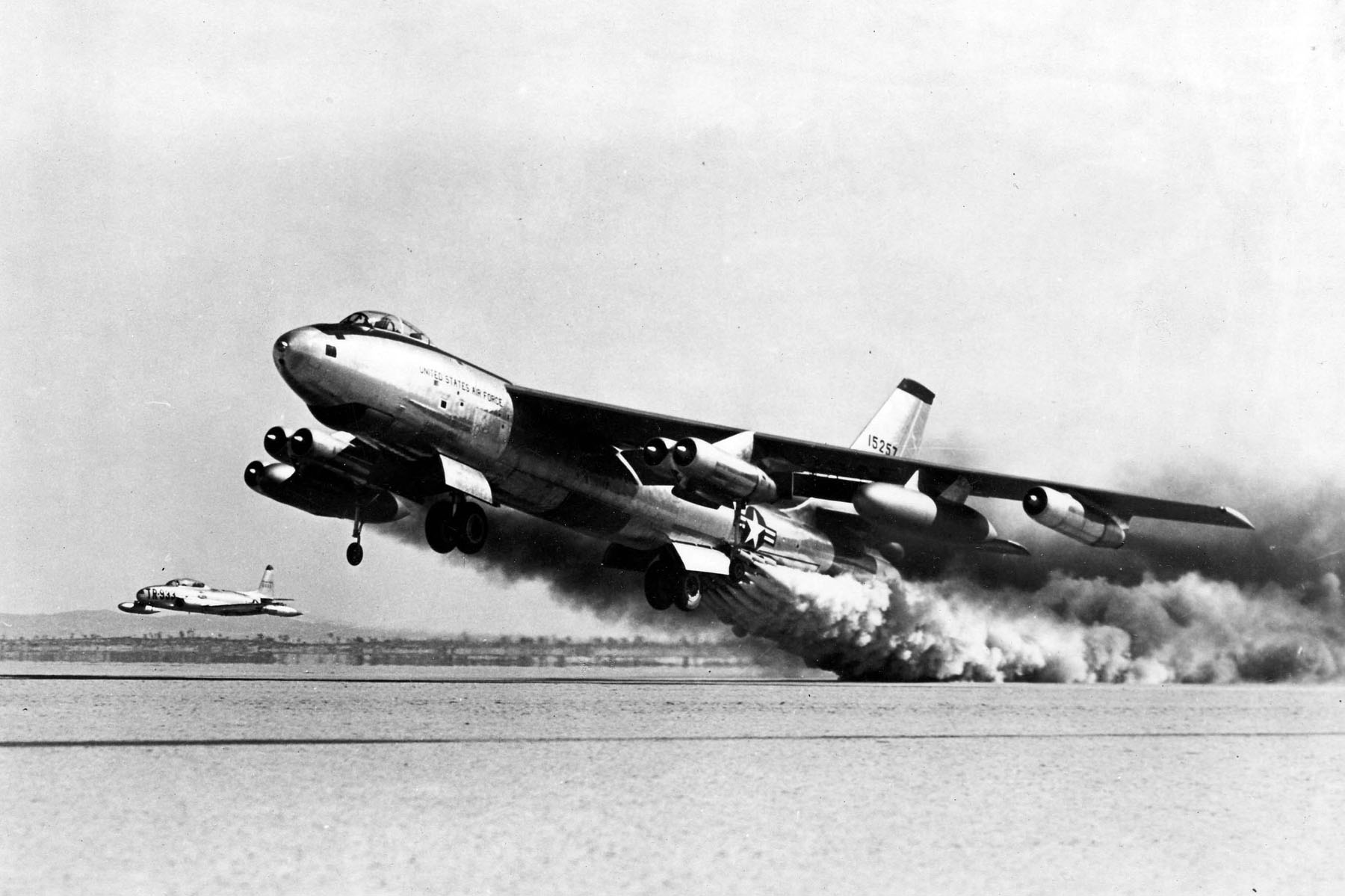
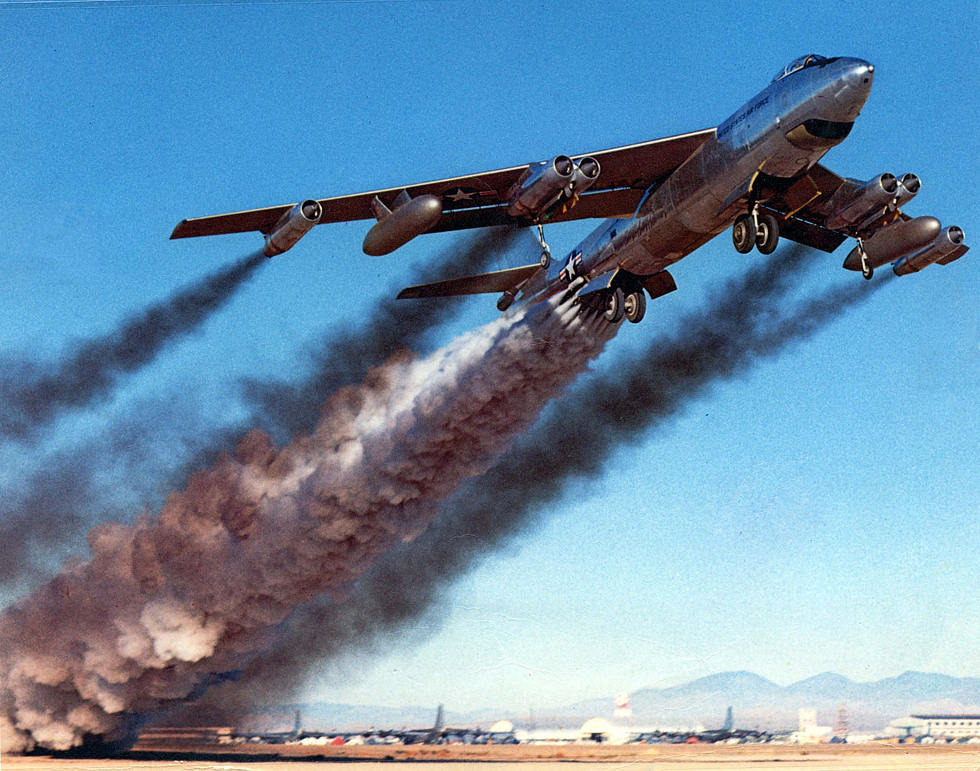
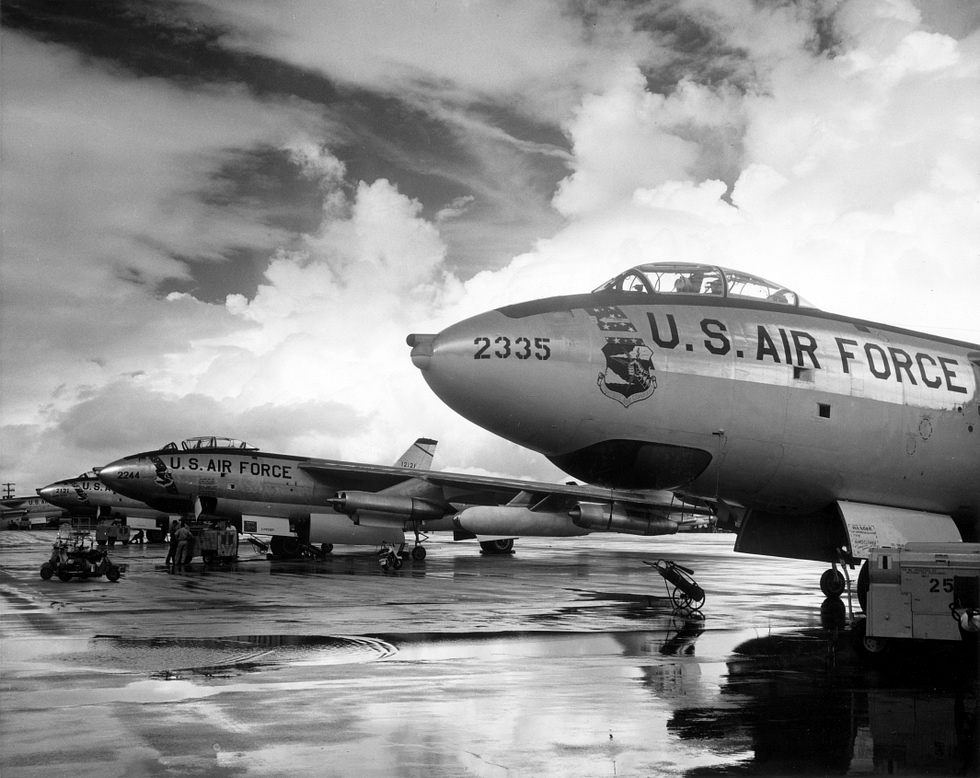
The B-47’s thin, high-aspect-ratio wing was swept 35 degrees and carried its six General Electric J47 turbojets in streamlined pods — a twin-engine nacelle inboard on each wing plus a single engine near each tip. Hanging the engines below and ahead of the structure kept fire away from the wing and eased maintenance. It became the standard layout Boeing carried into the B-52 and the 707, and thus almost every jet airliner since.
Bicycle landing gear
The wing was too thin and too flexible to house landing gear, so Boeing put the wheels in the fuselage: two twin-wheel tandem bogies fore and aft of the bomb bay, with small outrigger wheels that folded out of the inboard engine pods for balance. The jet sat nose-high and could not rotate on takeoff, and because the gear could not be de-crabbed, crews landed still angled into a crosswind.
Rocket takeoffs and toss-bombing
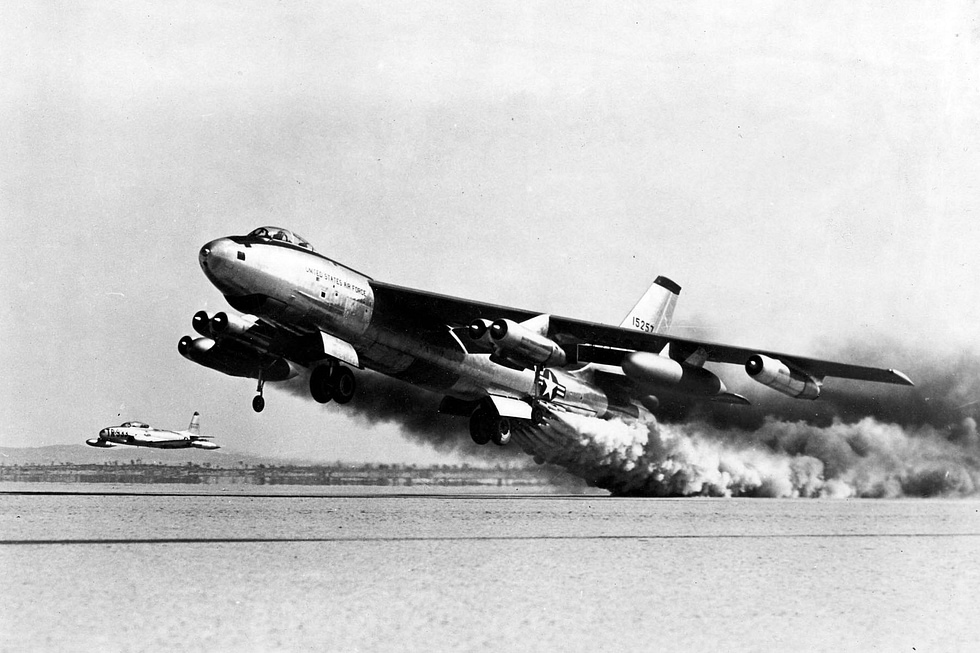
Heavy and underpowered on early turbojets, the B-47 used RATO rocket bottles — up to 33 units of around 1,000 lbf each — for its smoke-belching assisted takeoffs. To deliver a nuclear weapon and survive the blast, it flew the LABS “toss-bombing” maneuver: run in low, pull up into a half-loop that lobbed the bomb forward, then roll out and escape.
02The B-47 Stratojet’s flexible wing: the flaw that grounded the fleet
The same thin, flexible wing that made the B-47 fast also made it fragile. The wingtips could move through roughly 17 feet of total deflection between full up-bending and down-bending — and the constant flexing, worsened by punishing low-level manoeuvres, fatigued the metal where the wing met the fuselage. In 1957–58 the fleet suffered a wave of fatal in-flight break-ups. The Air Force responded with a major structural-reinforcement effort (nicknamed “Project Milk Bottle”) plus temporary groundings and speed restrictions. It was a hard lesson in metal fatigue that fed directly into later jet design.
03The B-47 Stratojet’s drag chutes: how you stop a slippery jet bomber
The clean swept wing that made the B-47 fast also made it hard to slow down. Crews used two parachutes. On final approach a small approach chute was streamed so the engines could be kept at high RPM — ready to spool up instantly for a go-around — without the aircraft accelerating. On the runway a large brake chute was deployed to haul the fast, heavy bomber to a stop in a reasonable distance. The techniques, like so much of the B-47, were later refined on Boeing’s jet airliners.
Full specifications
Airframe & Performance
- צוות
- 3 (pilot, copilot/gunner, navigator-bombardier)
- מֶשֶׁך
- ~33.5 m (109 ft 10 in)
- מוּטַת כְּנָפַים
- 35.4 m (116 ft), swept 35°
- גוֹבַה
- ~8.5 m (28 ft)
- Max takeoff weight
- ~100,000 kg (~230,000 lb)
- Max speed
- ~977 km/h · Mach ~0.84
- תקרת השירות
- ~12,300 m (~40,000 ft)
- Ferry range
- ~6,400 km (~4,000 mi)
- רדיוס לחימה
- ~3,200 km (with refuelling)
Propulsion, Systems & Cost
- Engines
- 6 × GE J47-GE-25 turbojets
- Thrust (each)
- ~32 kN (~7,200 lbf)
- Takeoff assist
- RATO/JATO rockets (up to 33)
- הְתחַמְשׁוּת
- 2 × 20 mm tail cannon; ~11,000 kg bombs (incl. nuclear)
- First flight
- 17 December 1947 (XB-47)
- Built
- ~2,032 (1947–1957)
- Unit cost
- ~$1.9 million (B-47E, 1950s)
- Cost per flight hour
- No reliable public figure
04The B-47 Stratojet’s operating costs: what the numbers really say
A B-47E is commonly cited at a flyaway cost of about $1.9 million in early-1950s dollars — a useful order-of-magnitude figure, though period accounting mixed airframe, engine and equipment costs in ways that make any single number approximate. No credible cost-per-flight-hour figure for 1950s Strategic Air Command operations exists in the open record, so any precise dollar-per-hour value attached to the type should be treated as an estimate rather than a sourced fact. What is certain is that the programme was vast: with more than 2,000 aircraft and a fleet flying constant alert, the B-47 was one of the most expensive military undertakings of its decade.
From German research to Cold-War alert
The requirement
The U.S. Army Air Forces call for a jet bomber. Boeing’s first straight-wing studies (Models 424/432) fall short.
The swept-wing letter
George Schairer, studying captured German aerodynamic data, writes home; Boeing adopts a 35° swept wing with six podded engines.
First flight
The XB-47 flies for the first time on 17 December, from Boeing Field to Moses Lake, Washington.
Enters service
The B-47 joins Strategic Air Command and begins replacing piston-engine bombers as the core of the nuclear deterrent.
The spy variant
The RB-47H electronic-reconnaissance version enters service and begins hazardous intelligence flights along Soviet borders.
The fatigue crisis
A wave of wing-fatigue break-ups forces groundings, speed limits and a major structural-reinforcement programme.
Shot down over the Barents Sea
On 1 July a Soviet MiG-19 downs an RB-47H off the Kola Peninsula; four crew die and two are captured and held in the Lubyanka.
Retirement
The bomber role ends in 1965–66 as the B-52 and ICBMs take over; the last special-mission WB-47E flies on 30 October 1969.
From the flight line: twelve Stratojet stories
A letter from the ruins of Germany
One engineer’s note pushed Boeing to sweep the wing — and changed the jet age.
Read the full story
Six engines that became the template
Every jetliner you fly copies this layout.
Read the full story
Holy smoke — RATO
Thirty-three rockets and a wall of black smoke.
Read the full story
The wing that waved
The tips flexed some 17 feet — until the metal cracked.
Read the full story
Riding a bicycle at 180 mph
No room in the wing for wheels, so the gear went in the belly.
Read the full story
Bombing over your shoulder
A four-engine bomber flying half a loop.
Read the full story
Spying on the bear
Unarmed jets flew where no one else dared.
Read the full story
Seven months in the Lubyanka
A MiG-19, the Barents Sea, and a KGB prison.
Read the full story
Chutes to slow the jet
A parachute on final, another on the runway.
Read the full story
The jet that pointed to the B-52
Fast, but short of legs.
Read the full story
Two thousand jets, three companies
An industrial army built the Stratojet.
Read the full story
The men who first tamed it
Robbins, Osler and the swept-wing unknown.
Read the full story
The Stratojet in pictures
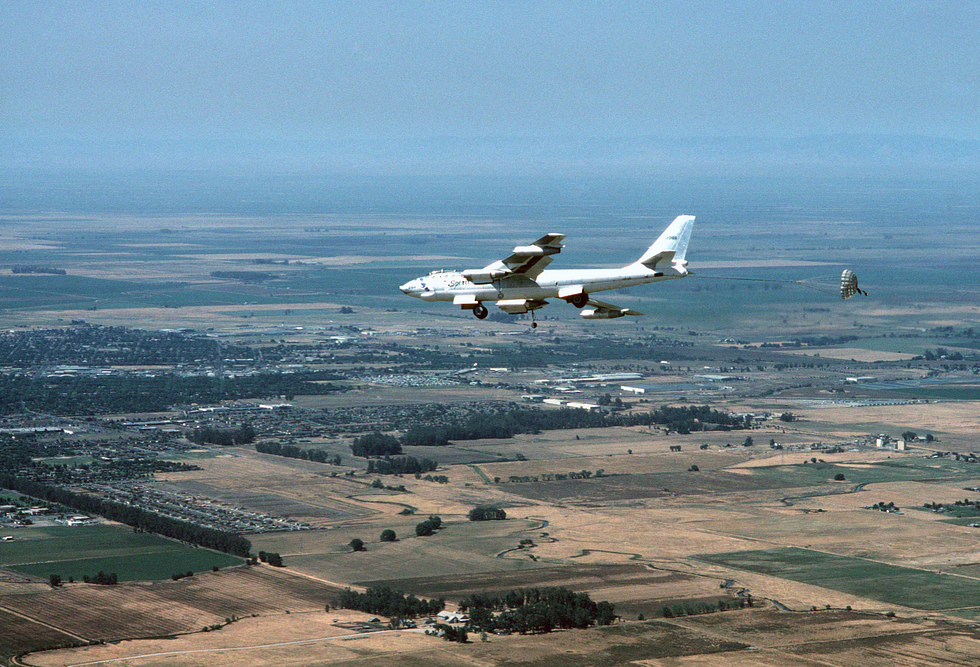
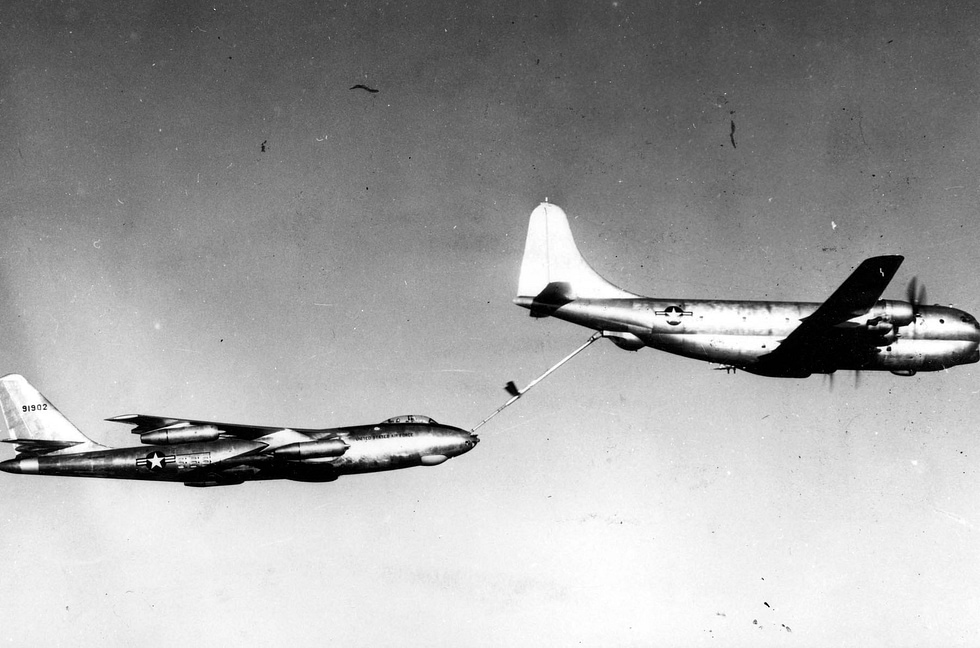
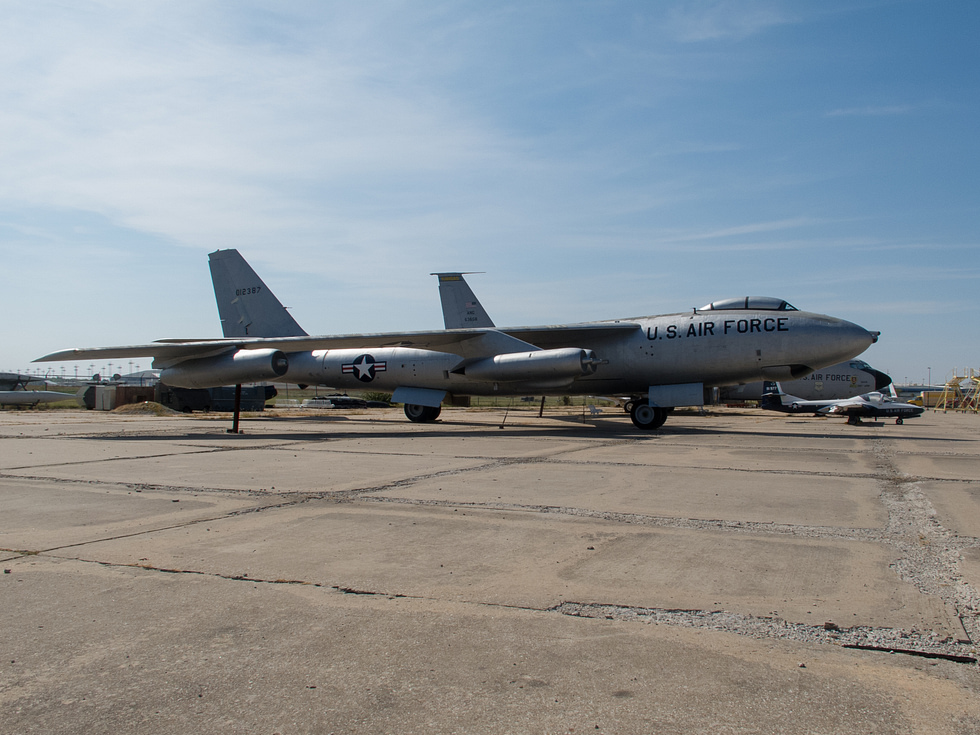
Where the Stratojet flew
The war it never fought
The B-47 never dropped a bomb in anger. Built to carry nuclear weapons in a war that thankfully never came, its combat history is written entirely in reconnaissance — the unarmed and lightly armed RB-47s that flew intelligence missions along the edge of Soviet airspace, and occasionally paid for it.
Compare the combat record of every military aircraft. Figures as of July 2026.
Everything people ask about the B-47
Can I fly in a B-47?
What made the B-47 revolutionary?
Was the B-47 ever used in combat?
Why did the B-47 have bicycle landing gear?
How many B-47s were built?
What replaced the B-47?
Are any B-47s still flying?
You can’t fly the B-47.
These, you can.
Some legends only live in museums — others are fuelled and waiting. MiGFlug has put civilians in real military jet cockpits since 2004.
 Fly the L-39 AlbatrosThe world’s most-flown jet trainer — aerobatics included
 Fly the F-104 Starfighter“The missile with a man in it”
 Fly the MiG-21The Cold War’s most-produced jet
 טסו על ה-T-33 Shooting StarAmerica’s first jet trainer
 Fly the DH VampireA piece of early jet history
 Fly the S.211Agile Italian jet trainer
 Fly the MB-326The classic Aermacchi jet
 Fly the MiG-15The Soviet legend of the Korean War
Continue the tour
Every fact, checked
- National Museum of the U.S. Air Force — RB-47H fact sheetPrimary reference for service history, the reconnaissance role and specifications.
- Strategic Air Command & Aerospace MuseumB-47E exhibit data on dimensions, performance and production numbers.
- AirVectors — The Boeing B-47 StratojetDetailed development history, the swept-wing decision and design evolution.
- This Day in AviationAccount of the XB-47’s first flight on 17 December 1947.
- GlobalSecurity — B-47 designEngineering detail on the podded engines, bicycle gear and RATO takeoff.
- MilitaryHistoryNowThe 1957–58 wing-fatigue crisis and the structural-reinforcement programme.
- The Aviation Geek ClubThe 1 July 1960 Barents Sea RB-47H shootdown and its aftermath.
- SkytamerCross-reference for B-47E dimensions, weights and unit cost.