
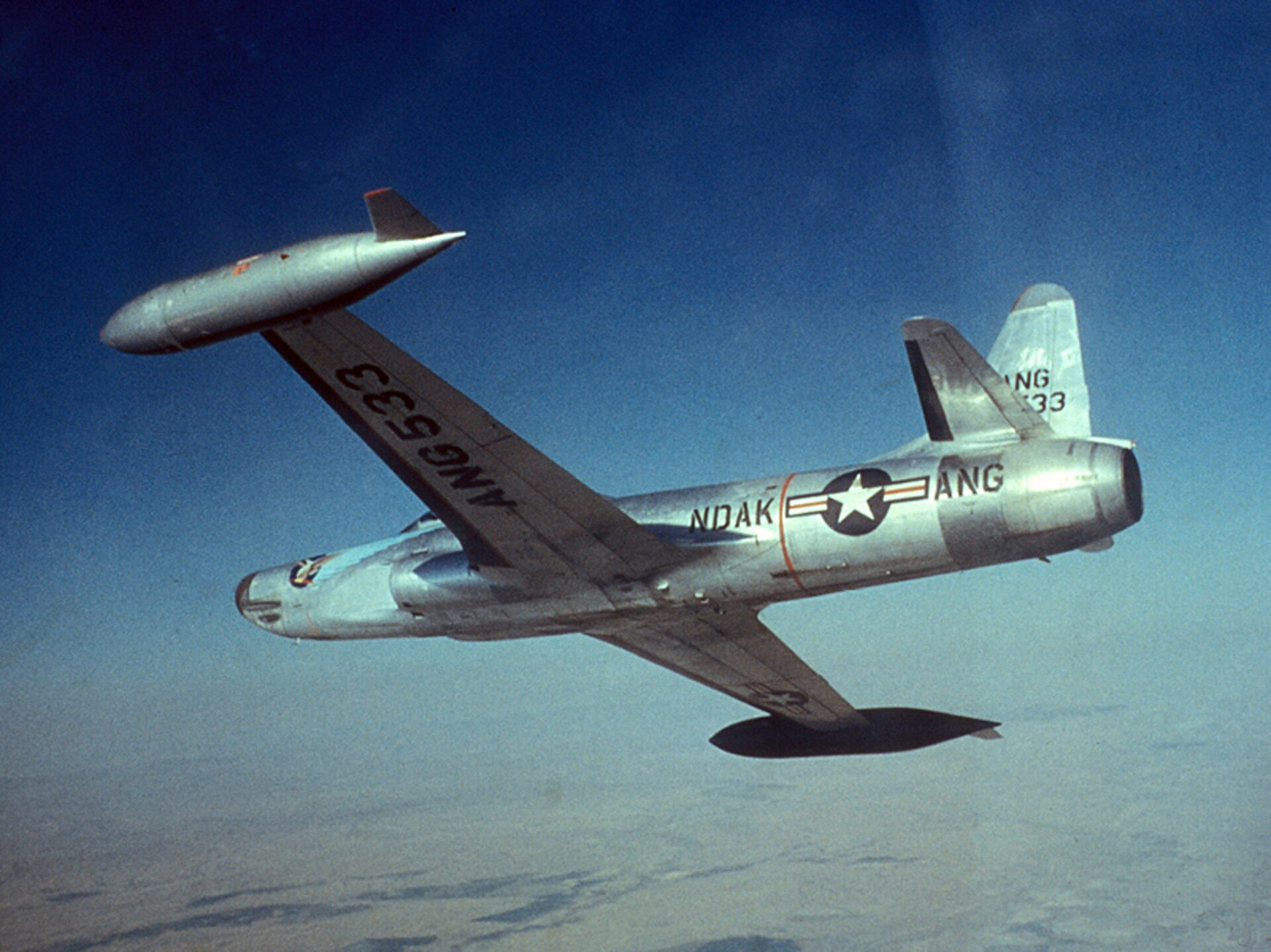
Lockheed F-94
“Starfire”
America’s first jet all-weather interceptor with an afterburner — a radar-nosed, two-seat night fighter grown from the T-33 trainer, and the jet that flew some of the first radar-guided night interceptions of the Korean War.
The interceptor grown from a trainer
By the end of the 1940s the United States faced a threat it could not yet answer: Soviet bombers able to strike at night and in bad weather, against which the piston-engined interceptors of 1945 were nearly useless. The Air Force needed a jet all-weather interceptor — a two-seat machine carrying radar and an electronic fire-control system that could find a bomber in cloud and darkness. It needed one quickly, and Lockheed found a shortcut.
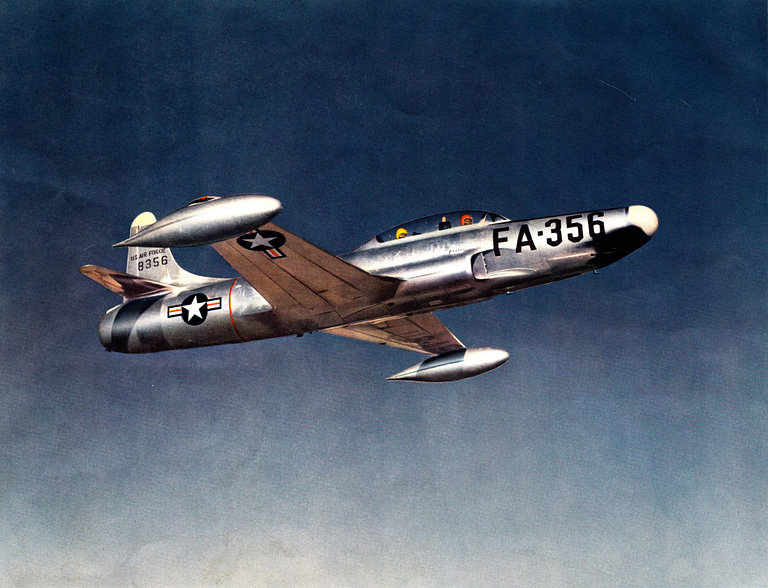
Rather than start from a blank sheet, Lockheed took its T-33 two-seat trainer — itself a stretched derivative of the P-80 Shooting Star, America’s first operational jet fighter — and rebuilt it into an interceptor. Two TF-80C trainers were fitted with a radar nose, a Hughes fire-control system, a radar gunsight and four nose machine guns. The result, unofficially the YF-94, first flew on 16 April 1949 with Lockheed test pilot Tony LeVier at the controls. Deliveries began that December and the type reached squadrons in May 1950, replacing the F-82 Twin Mustang as the USAF’s first jet all-weather interceptor.
To get the performance an interceptor needed, the F-94A married that airframe to an Allison J33 with an afterburner — making it, by most accounts, the first US production jet fighter to enter service with reheat as standard. Early F-94A and F-94B models kept the four .50-calibre guns; their job was to be vectored onto a bomber in the dark and hit it on the first pass, not to dogfight.
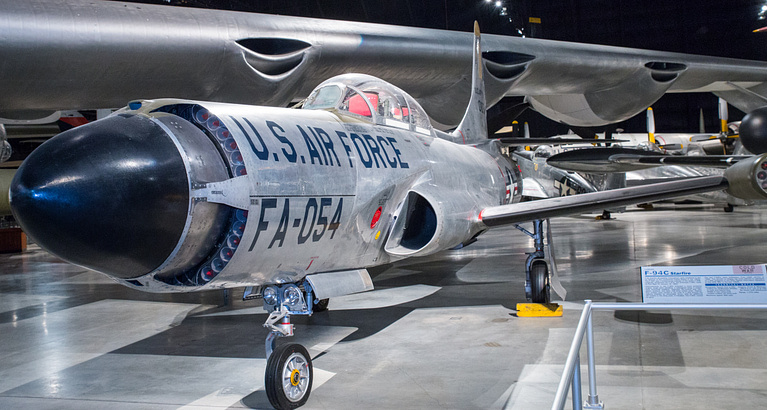
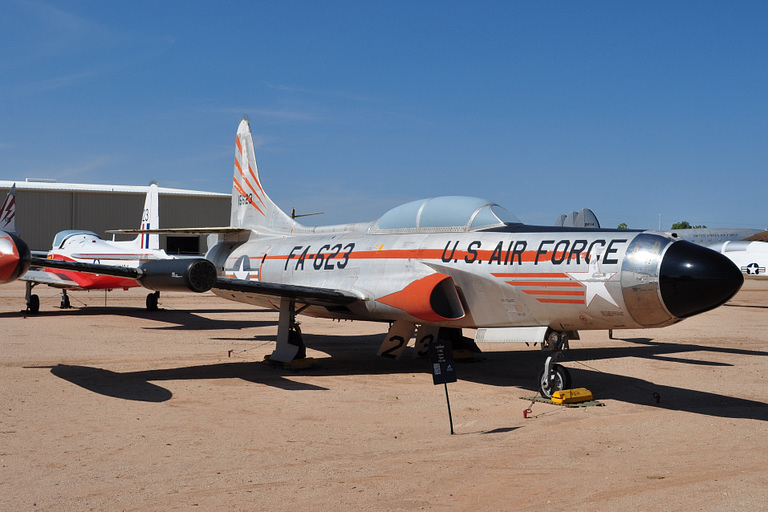
The definitive version was a near-new aeroplane. The F-94C Starfire — briefly given its own designation, F-97 — got a thinner wing, a swept tail, bigger intakes and a license-built Rolls-Royce Tay engine, the Pratt & Whitney J48. Most radically, it threw out its guns entirely: a ring of 24 unguided “Mighty Mouse” rockets encircled the nose radome behind snap-open doors, with optional wing pods bringing the total to 48. It was the USAF’s first gun-less, all-rocket interceptor. Starfires stood air-defence alert into the late 1950s, saw night combat in Korea, and were retired by 1959 as supersonic interceptors took over.
01The Lockheed F-94 Starfire’s lineage: from the P-80 fighter to the T-33 trainer to a radar interceptor
Few aircraft families show a clearer evolutionary line. Lockheed’s P-80 Shooting Star was the first US jet fighter to see operational service. Stretched into a two-seat trainer it became the T-33 (originally the TF-80C), one of the most widely built jet trainers in history. When the Air Force needed a radar-equipped night fighter in a hurry, Lockheed reached for that same airframe again, converting two TF-80C trainers into interceptor prototypes with a lengthened nose for radar and fire control.
Reusing a proven airframe drastically shortened development and cost — but it also set limits. The F-94 inherited a design conceived as a fighter-trainer, not a purpose-built interceptor, which is part of why the definitive F-94C ended up with a new wing, a new tail and a new engine to wring more performance from the concept. The trade was speed of fielding against ultimate capability, and in 1949–50 speed of fielding was what the USAF needed most.
What makes it special
The first USAF jet all-weather interceptor — and first with an afterburner
The F-94A combined nose air-intercept radar and a Hughes electronic fire-control system with an afterburning Allison J33, giving Air Defense Command its first radar-equipped, reheat-boosted night and all-weather jet fighter. It is widely credited as the first US production jet fighter to enter service with an afterburner as standard equipment — a genuine capability first for the USAF.
All-rocket, gun-less interception (F-94C)
The F-94C deleted its guns entirely. A ring of 24 folding-fin 2.75-inch “Mighty Mouse” rockets encircled the nose radome behind doors that snapped open to fire, optionally doubled by two mid-wing pods for 48 rockets in total. The idea was a saturating salvo — a shotgun blast of unguided rockets fired into a bomber’s path — making the Starfire the USAF’s first gun-less all-rocket interceptor.
A new wing and a Rolls-Royce heart
To push the design toward Mach 0.9 the F-94C received a thinner wing with more dihedral, a swept tail, enlarged intakes and a redesigned rear fuselage around a bigger engine — the Pratt & Whitney J48, a license-built Rolls-Royce Tay rated at about 8,750 lbf in afterburner. The changes were extensive enough that the aircraft briefly carried its own type number, F-97, before reverting to F-94C.
02The F-94C Starfire’s rocket ring: how an unguided-rocket interceptor was meant to fight
The F-94C’s armament reflected a very 1950s idea about killing bombers. Instead of aiming guns or early guided missiles, the interceptor would be steered by its radar into a firing position and then loose a salvo of unguided 2.75-inch rockets in a spreading pattern, trusting probability rather than precision. Twenty-four rockets sat in a ring around the nose radar behind retractable doors; when required, two mid-wing pods added another twenty-four.
In practice the concept had drawbacks — firing the nose rockets could disturb the radar and briefly blind the crew with smoke and flame — and guided air-to-air missiles soon made the unguided salvo obsolete. But at the time it represented the leading edge of automated, radar-directed interception, and the Starfire was the first US aircraft built around the idea from the outset.
03The Lockheed F-94 Starfire’s variants: from gun-armed F-94A/B to the redesigned F-94C
The F-94A and F-94B were close to the trainer they came from: an afterburning Allison J33, a Hughes E-1 fire-control system and four .50-calibre nose guns. The F-94B added improved instrument-landing and navigation gear, making it a better all-weather machine, and it was the F-94B that carried the type into combat over Korea.
ה F-94C was effectively a new aircraft on the same theme. Company-funded and first designated F-97, it introduced the thin wing, the swept tail, the Pratt & Whitney J48 engine and the all-rocket armament. Around 387 F-94Cs were built out of roughly 855 Starfires of all types, and it was the F-94C that most people picture when they think of the Starfire.
Full specifications
Figures below are for the definitive F-94C Starfire. The earlier gun-armed F-94A/B were lighter, slower and powered by the Allison J33; several period figures vary between sources and are given as commonly cited values.
Airframe & Performance
- צוות
- 2 (pilot + radar operator)
- מֶשֶׁך
- ~13.56 m (44 ft 6 in)
- מוּטַת כְּנָפַים
- ~11.4 m (37 ft 4 in); ~12.9 m over tip tanks
- גוֹבַה
- ~4.55 m (14 ft 11 in)
- משקל ריק
- ~5,760 kg (~12,700 lb)
- Max takeoff weight
- ~10,900 kg (~24,200 lb)
- Max speed
- ~1,030 km/h (~640 mph, ~Mach 0.9)
- תקרת השירות
- ~15,700 m (~51,400 ft)
- לָנוּעַ
- ~2,050 km (~1,275 mi)
Propulsion, Armament & Cost
- מָנוֹעַ
- 1 × Pratt & Whitney J48-P-5 (license RR Tay)
- Thrust
- ~28 kN dry / ~39 kN (~8,750 lbf) afterburner
- Fire control
- Hughes E-5 radar / fire-control system
- Armament (F-94C)
- 24 nose + 24 wing 2.75-in “Mighty Mouse” rockets; no guns
- Armament (F-94A/B)
- 4 × .50-cal M3 machine guns
- First flight
- 16 April 1949 (YF-94)
- Built
- ~855 total (387 F-94C)
- Cost per flight hour
- No reliable public figure
04The F-94 Starfire’s cost: what an early-1950s all-weather interceptor was worth
The Starfire was a government procurement of the early 1950s, and no precise modern-style flyaway price is published for it. Because it was derived from the existing T-33 airframe, it was relatively economical to develop compared with a clean-sheet interceptor — one of the main reasons the Air Force chose the design when it needed an all-weather capability quickly. Any single dollar figure for the type should be read as an order-of-magnitude estimate rather than a sourced flyaway cost.
No reliable public cost-per-flight-hour number exists for the F-94. As with most first-generation Cold War interceptors, operating-cost data was never published in a form comparable to modern figures, so any precise dollar-per-hour claim is effectively a guess.
From trainer conversion to Guard interceptor
First flight
The YF-94 prototype — a converted TF-80C trainer — makes its maiden flight on 16 April 1949, Tony LeVier at the controls.
First production aircraft
The first F-94A is accepted by the USAF in December 1949, carrying an afterburning Allison J33 and nose radar.
Enters service
The F-94A reaches squadrons in May 1950 as the USAF’s first jet all-weather interceptor, replacing the F-82 Twin Mustang.
The F-97 becomes the F-94C
The redesigned, rocket-armed demonstrator flies and, in September 1950, its planned F-97 designation is changed to YF-94C.
Into Korea
From March 1952 the 319th Fighter-Interceptor Squadron begins flying F-94Bs from Suwon on night and all-weather patrols.
A first night radar kill
On 30 January 1953 an F-94B crew scores the type’s first kill — a radar-directed night interception, one of the first by a USAF jet.
The Starfire in service
The definitive F-94C enters squadron service, its all-rocket armament and new wing giving Air Defense Command its most capable Starfire.
Retirement
The last F-94Cs leave front-line USAF service in 1959, with remaining aircraft phasing out of the Air National Guard the same year.
Twelve F-94 Starfire stories
Why it is a “Starfire”
The interceptor’s night mission and rocket salvos earned it a suitably fiery name.
Read the full story
A fighter, a trainer, then a night fighter
The F-94 was the third act of the P-80 story: fighter to trainer to interceptor.
Read the full story
Built in a hurry
Reusing the T-33 airframe let Lockheed field a night fighter years faster than a clean design.
Read the full story
Reheat as standard
The F-94A is widely credited as the first US production jet fighter fielded with an afterburner.
Read the full story
A ring of rockets around the radar
The F-94C carried 24 rockets around its nose radome and up to 24 more in wing pods.
Read the full story
When firing blinded the crew
Loosing the nose rockets could dazzle the pilot and upset the very radar that aimed them.
Read the full story
Guarding the night sky
F-94Bs flew night and all-weather patrols over Korea from 1952, protecting B-29 raids.
Read the full story
Kept away from enemy lines
Fear of losing its secret radar kept the F-94 from flying over enemy territory at first.
Read the full story
A radar-guided night interception
On 30 January 1953 an F-94B crew scored the type’s first kill, guided entirely by radar in the dark.
Read the full story
Outrun by something slower
A Starfire could actually be too fast to catch the crawling Po-2 biplanes that harassed Korea.
Read the full story
Almost a new aeroplane
The F-94C changed so much it briefly earned its own designation, F-97.
Read the full story
The bridge to the century series
The Starfire pointed toward the supersonic, missile-armed interceptors that replaced it.
Read the full story
The Starfire in pictures
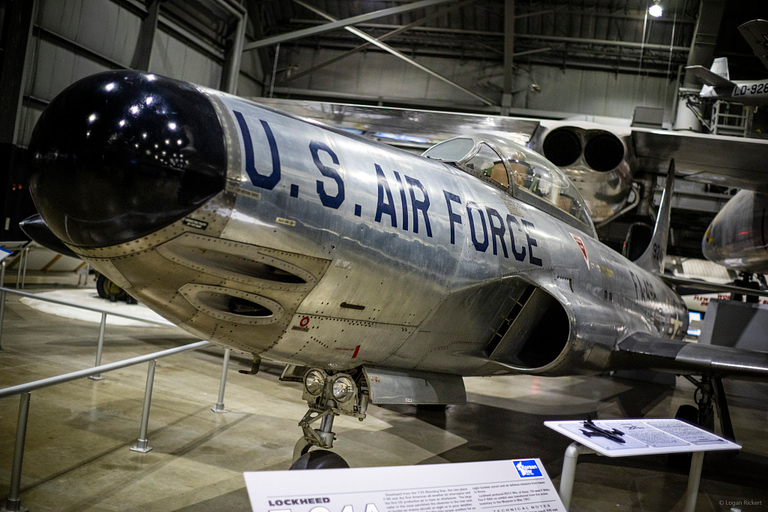
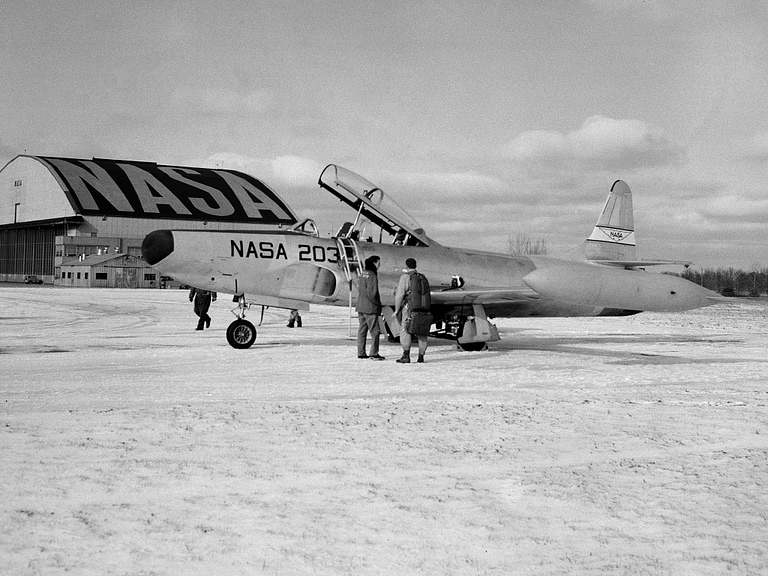
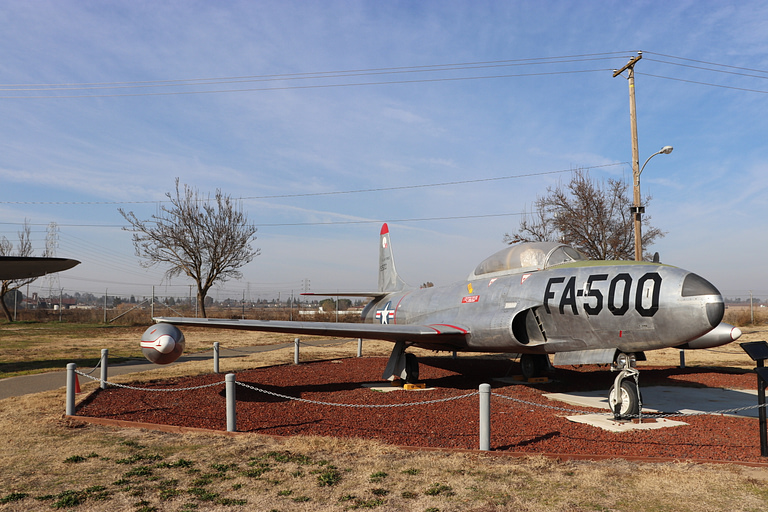
The Starfire in motion
A curated video feature for the Lockheed F-94 Starfire is coming soon. In the meantime, explore the photo gallery above and the operator map below.
Where the Starfire served
Where the record stands
The F-94 Starfire’s combat record is modest but historic. Its wartime service came at night over Korea, where F-94Bs of the 319th Fighter-Interceptor Squadron flew radar-directed patrols and scored a handful of kills — among the first night, radar-guided air-to-air victories by a US jet interceptor. Its real value, like most interceptors, lay in deterrence: standing air-defence alert across the United States, ready to meet a bomber threat that, in the end, never came.
Compare the combat record of every military aircraft. Figures as of July 2026.
Everything people ask about the F-94 Starfire
Can I fly in an F-94?
What was the F-94 Starfire developed from?
Was the F-94 really the first jet with an afterburner?
How was the F-94C Starfire armed?
Did the F-94 see combat in Korea?
Who operated the F-94 and when was it retired?
You can’t fly the Starfire.
These, you can.
Some legends only live in museums — others are fuelled and waiting. MiGFlug has put civilians in real military jet cockpits since 2004.
 Fly the L-39 AlbatrosThe world’s most-flown jet trainer — aerobatics included
 Fly the F-104 Starfighter“The missile with a man in it”
 Fly the MiG-21The Cold War’s most-produced jet
 טסו על ה-T-33 Shooting StarAmerica’s first jet trainer
 Fly the DH VampireA piece of early jet history
 Fly the S.211Agile Italian jet trainer
 Fly the MB-326The classic Aermacchi jet
 Fly the MiG-15The Soviet legend of the Korean War
Continue the tour
Every fact, checked
- National Museum of the USAF — F-94C Starfire fact sheetOfficial specifications, all-rocket armament and the 1959 retirement.
- National Museum of the USAF — F-94A Starfire fact sheetThe afterburner “first,” the Allison J33 and total production.
- Joe Baugher — YF-94 and F-94AThe TF-80C conversion, first flight and afterburner history.
- Joe Baugher — F-94B and KoreaThe 319th FIS, the radar-secrecy restriction and the 30 January 1953 kill.
- Joe Baugher — F-97 / F-94CThe redesign, the Pratt & Whitney J48 and the 48-rocket armament.
- This Day in Aviation — 16 April 1949Details of the YF-94 first flight with Tony LeVier.
- GlobalSecurity — F-94C StarfireProgramme history and the all-rocket armament concept.
- Pima Air & Space Museum — F-94C StarfireContext on a preserved F-94C airframe and its service.