
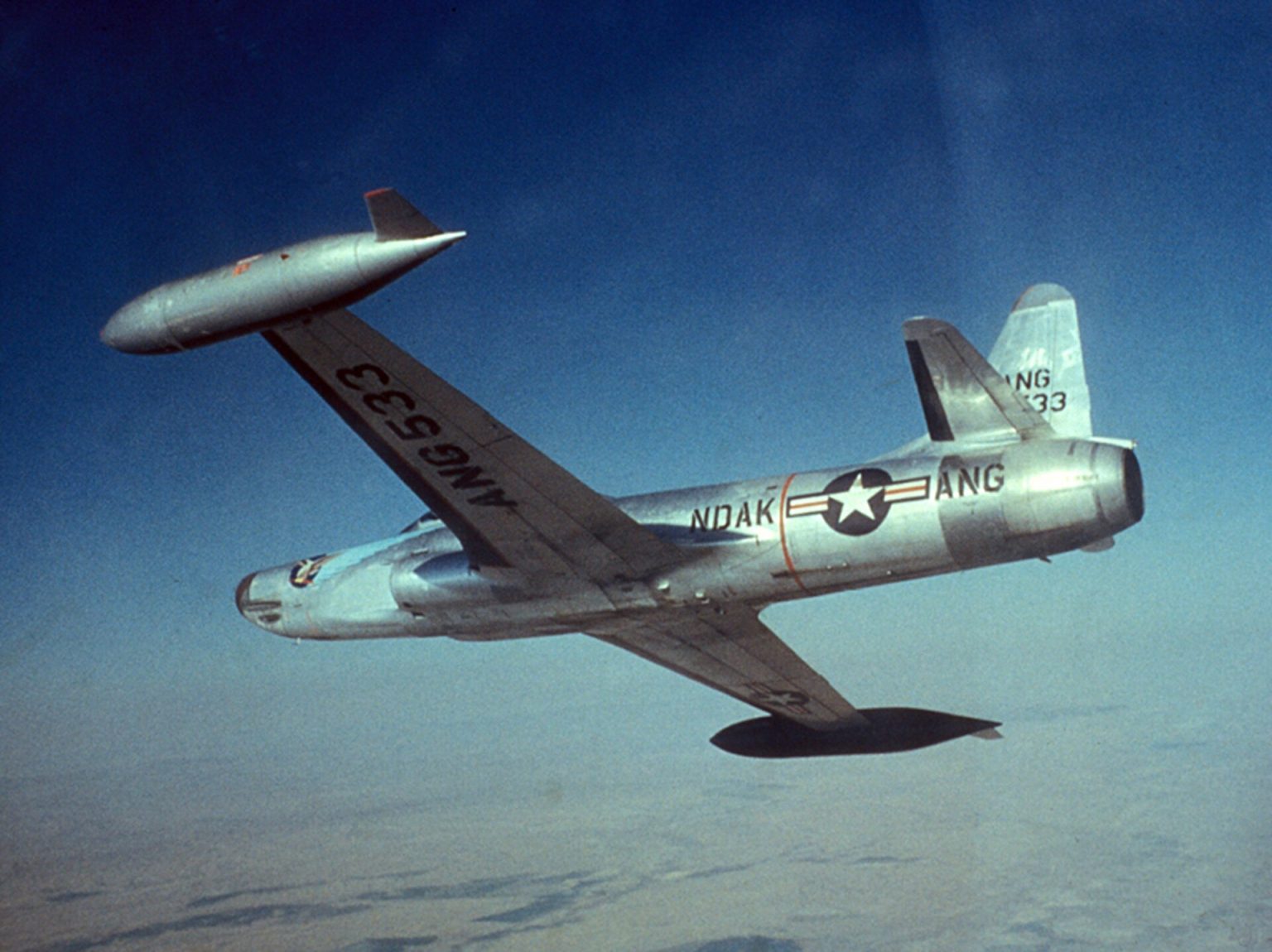
Lockheed F-94
“Starfire”
America’s first jet all-weather interceptor with an afterburner — a radar-nosed, two-seat night fighter grown from the T-33 trainer, and the jet that flew some of the first radar-guided night interceptions of the Korean War.
The interceptor grown from a trainer
By the end of the 1940s the United States faced a threat it could not yet answer: Soviet bombers able to strike at night and in bad weather, against which the piston-engined interceptors of 1945 were nearly useless. The Air Force needed a jet all-weather interceptor — a two-seat machine carrying radar and an electronic fire-control system that could find a bomber in cloud and darkness. It needed one quickly, and Lockheed found a shortcut.
Rather than start from a blank sheet, Lockheed took its T-33 two-seat trainer — itself a stretched derivative of the P-80 Shooting Star, America’s first operational jet fighter — and rebuilt it into an interceptor. Two TF-80C trainers were fitted with a radar nose, a Hughes fire-control system, a radar gunsight and four nose machine guns. The result, unofficially the YF-94, first flew on 16 April 1949 with Lockheed test pilot Tony LeVier at the controls. Deliveries began that December and the type reached squadrons in May 1950, replacing the F-82 Twin Mustang as the USAF’s first jet all-weather interceptor.
To get the performance an interceptor needed, the F-94A married that airframe to an Allison J33 with an afterburner — making it, by most accounts, the first US production jet fighter to enter service with reheat as standard. Early F-94A and F-94B models kept the four .50-calibre guns; their job was to be vectored onto a bomber in the dark and hit it on the first pass, not to dogfight.
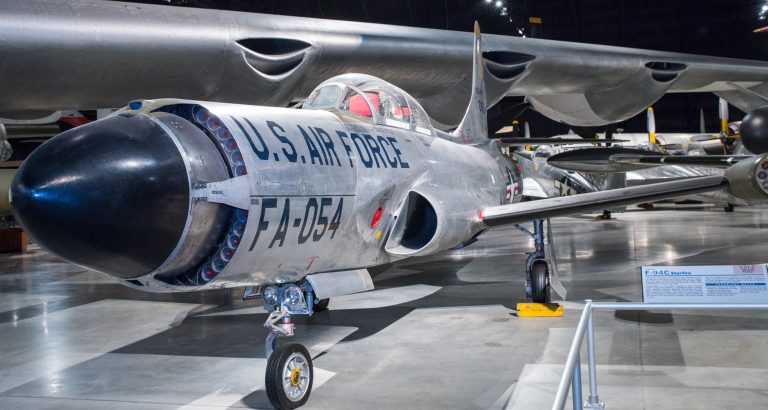
The definitive version was a near-new aeroplane. The F-94C Starfire — briefly given its own designation, F-97 — got a thinner wing, a swept tail, bigger intakes and a license-built Rolls-Royce Tay engine, the Pratt & Whitney J48. Most radically, it threw out its guns entirely: a ring of 24 unguided “Mighty Mouse” rockets encircled the nose radome behind snap-open doors, with optional wing pods bringing the total to 48. It was the USAF’s first gun-less, all-rocket interceptor. Starfires stood air-defence alert into the late 1950s, saw night combat in Korea, and were retired by 1959 as supersonic interceptors took over.
01The Lockheed F-94 Starfire’s lineage: from the P-80 fighter to the T-33 trainer to a radar interceptor
Few aircraft families show a clearer evolutionary line. Lockheed’s P-80 Shooting Star was the first US jet fighter to see operational service. Stretched into a two-seat trainer it became the T-33 (originally the TF-80C), one of the most widely built jet trainers in history. When the Air Force needed a radar-equipped night fighter in a hurry, Lockheed reached for that same airframe again, converting two TF-80C trainers into interceptor prototypes with a lengthened nose for radar and fire control.
Reusing a proven airframe drastically shortened development and cost — but it also set limits. The F-94 inherited a design conceived as a fighter-trainer, not a purpose-built interceptor, which is part of why the definitive F-94C ended up with a new wing, a new tail and a new engine to wring more performance from the concept. The trade was speed of fielding against ultimate capability, and in 1949–50 speed of fielding was what the USAF needed most.
What makes it special
The first USAF jet all-weather interceptor — and first with an afterburner
The F-94A combined nose air-intercept radar and a Hughes electronic fire-control system with an afterburning Allison J33, giving Air Defense Command its first radar-equipped, reheat-boosted night and all-weather jet fighter. It is widely credited as the first US production jet fighter to enter service with an afterburner as standard equipment — a genuine capability first for the USAF.
All-rocket, gun-less interception (F-94C)
The F-94C deleted its guns entirely. A ring of 24 folding-fin 2.75-inch “Mighty Mouse” rockets encircled the nose radome behind doors that snapped open to fire, optionally doubled by two mid-wing pods for 48 rockets in total. The idea was a saturating salvo — a shotgun blast of unguided rockets fired into a bomber’s path — making the Starfire the USAF’s first gun-less all-rocket interceptor.
A new wing and a Rolls-Royce heart
To push the design toward Mach 0.9 the F-94C received a thinner wing with more dihedral, a swept tail, enlarged intakes and a redesigned rear fuselage around a bigger engine — the Pratt & Whitney J48, a license-built Rolls-Royce Tay rated at about 8,750 lbf in afterburner. The changes were extensive enough that the aircraft briefly carried its own type number, F-97, before reverting to F-94C.
02The F-94C Starfire’s rocket ring: how an unguided-rocket interceptor was meant to fight
The F-94C’s armament reflected a very 1950s idea about killing bombers. Instead of aiming guns or early guided missiles, the interceptor would be steered by its radar into a firing position and then loose a salvo of unguided 2.75-inch rockets in a spreading pattern, trusting probability rather than precision. Twenty-four rockets sat in a ring around the nose radar behind retractable doors; when required, two mid-wing pods added another twenty-four.
In practice the concept had drawbacks — firing the nose rockets could disturb the radar and briefly blind the crew with smoke and flame — and guided air-to-air missiles soon made the unguided salvo obsolete. But at the time it represented the leading edge of automated, radar-directed interception, and the Starfire was the first US aircraft built around the idea from the outset.
03The Lockheed F-94 Starfire’s variants: from gun-armed F-94A/B to the redesigned F-94C
The F-94A and F-94B were close to the trainer they came from: an afterburning Allison J33, a Hughes E-1 fire-control system and four .50-calibre nose guns. The F-94B added improved instrument-landing and navigation gear, making it a better all-weather machine, and it was the F-94B that carried the type into combat over Korea.
The F-94C was effectively a new aircraft on the same theme. Company-funded and first designated F-97, it introduced the thin wing, the swept tail, the Pratt & Whitney J48 engine and the all-rocket armament. Around 387 F-94Cs were built out of roughly 855 Starfires of all types, and it was the F-94C that most people picture when they think of the Starfire.
Full specifications
Figures below are for the definitive F-94C Starfire. The earlier gun-armed F-94A/B were lighter, slower and powered by the Allison J33; several period figures vary between sources and are given as commonly cited values.
Baseline note: the figures below describe the F-94C Starfire, the last and most numerous mark — 387 of the 852 production airframes — powered by a single afterburning Pratt & Whitney J48-P-5, carrying no guns at all, armed entirely with 2.75 in folding-fin rockets, and fitted with the thin new wing and the swept, power-boosted tailplane that finally separated it from the rest of the P-80 family. It is the right baseline because it is the only mark that was designed as an interceptor rather than adapted into one, and because it is what most surviving airframes are. Deltas for the F-94A of 1950 and the F-94B of 1951 — Allison J33-A-33, Hughes E-1 fire control with AN/APG-33 radar, four .50 in Browning M3 machine guns — are in grey. Five warnings before any number below is read. First, the lineage is the specification. This aircraft is a Lockheed T-33A trainer with a radar nose, and the T-33 is a two-seat P-80 Shooting Star; Lockheed and the USAF have both put the early F-94’s component commonality with the F-80 and T-33 at roughly 75 per cent. That is why it existed at all in 1949 — it was quick and cheap — and it is also why it was slow, why it needed wingtip tanks to reach anywhere, why its cockpit was too narrow for two men in winter flying kit to scramble out of quickly, and why it was outclassed by the MiG-15 from the day it arrived. The straight, thick, low-set trainer wing set the ceiling on everything. Second, the headline 1,030 km/h (640 mph) for the F-94C is a sea-level figure; the practical limit is the quoted Mach 0.84, and USAF assessments put the C roughly 40 knots slower than the Northrop F-89 Scorpion it was meant to complement. Third, the F-94C wingspan of 12.93 m (42 ft 5 in) is measured over the permanently fitted wingtip fuel tanks, not to bare wingtips; the F-94B figure quoted below is the bare-wing span. Fourth, production totals wobble. New-build airframes are 109 F-94A, 355 or 356 F-94B and 387 F-94C, giving 851 or 852; totals of 853, 855 and 856 appear elsewhere once the two YF-94 conversions, the YF-94B and the two YF-94C airframes are counted in. Fifth, the afterburner claim needs stating exactly: the F-94A was the first US production fighter to enter squadron service with an afterburner fitted as standard equipment. It was not the first aircraft to fly with one, and the early J33-A-33 afterburner was so troublesome — igniter and flame stabilisation both — that Allison and Lockheed spent much of 1949 making it light reliably at all.
Dimensions & weights
- Crew
- 2 — pilot and radar observer in tandem under a single long canopy (the T-33 instructor’s seat, repurposed; the observer flew the intercept, the pilot flew the aircraft)
- Length
- 13.56 m (44 ft 6 in); F-94B 12.22 m (40 ft 1 in) — the C gained over a metre, almost all of it radar nose and afterburner tailpipe
- Wingspan
- 12.93 m (42 ft 5 in) over the fitted wingtip tanks; F-94B 11.43 m (37 ft 6 in) bare wing
- Height
- 4.55 m (14 ft 11 in)
- Wing area
- 21.63 m² (232.8 sq ft)
- Wing
- Straight, unswept, of new and markedly thinner section on the C with increased dihedral (the A and B flew the unmodified F-80/T-33 wing)
- Tailplane
- Swept, power-boosted on the C, adopted to cure the buffet and vibration that the straight surface suffered at high indicated speed (A and B: straight, manually operated)
- Empty weight
- 5,764 kg (12,708 lb)
- Gross weight
- 8,301 kg (18,300 lb)
- Maximum take-off weight
- 10,970 kg (24,184 lb)
- Wing loading at gross weight
- 384 kg/m² (78.6 lb/sq ft)
- Fuel
- Fuselage and wing tankage plus two wingtip tanks carried as standard — 165 US gal (625 l) each on early aircraft, later Fletcher tanks of ~230 US gal (~871 l) each (published internal-fuel totals for the C disagree and are best treated as unsettled)
Performance
- Maximum speed
- 1,030 km/h at sea level (640 mph); F-94B 975 km/h (606 mph)
- Maximum Mach number
- Mach 0.84 (the airframe limit that matters; everything above it is a dive figure)
- Supersonic capability
- Mach 1.1 achieved in a steep dive from about 13,700 m (45,000 ft) — the only member of the P-80 / T-33 / F-94 family ever to exceed Mach 1, and only that way
- Rate of climb
- 40.5 m/s (7,980 ft/min) with afterburner lit
- Service ceiling
- 15,700 m (51,400 ft); F-94B 14,630 m (48,000 ft)
- Practical firing ceiling
- About 7,900 m (26,000 ft) with a full rocket load — above that a full salvo could flame the engine out, so the aeroplane’s armament ceiling was barely half its service ceiling
- Range
- 1,296 km (805 miles); F-94B 1,070 km (665 miles)
- Ferry range
- 2,052 km (1,275 miles) with tip tanks
- Combat radius
- ~485 km (~300 miles) on a night patrol with tip tanks — inferred from the quoted range rather than published as such, and short enough that Korean-based F-94s worked from Suwon rather than Japan
- Thrust-to-weight ratio
- 0.48 at gross weight with afterburner (dry, roughly 0.35)
- Minimum practical intercept speed
- The limiting number of the type’s war: one Korean F-94 was lost after slowing to 180 km/h (110 mph) trying to stay behind a Polikarpov Po-2 biplane it could not otherwise engage
- Endurance on alert
- Not published as a figure; ADC practice was ground alert with a short scramble-to-height profile, not a standing patrol — the fuel state did not allow one
Propulsion & systems
- Engine
- 1 × Pratt & Whitney J48-P-5 centrifugal-flow turbojet with afterburner (a licence-built Rolls-Royce Tay; the -5A appears on later blocks)
- Rated thrust
- 28.2 kN dry (6,350 lbf), 38.9 kN with afterburner (8,750 lbf; 8,300 lbf is also widely quoted for the -5)
- Earlier engine
- F-94A and F-94B: Allison J33-A-33 or -33A, 19.6 kN (4,400 lbf) dry and 26.7 kN (6,000 lbf) with afterburner — the whole margin of the early aircraft came from the afterburner, and early J33s also shed turbine blades
- Afterburner
- Standard equipment from the F-94A onward, the first US production fighter to enter service that way — a genuine first, and a genuinely unreliable one for the first two years
- Fire control
- Hughes E-5, computing a lead-collision rocket-firing solution and pulling the trigger itself (F-94A and F-94B: Hughes E-1, the first fire-control system of its kind in USAF service)
- Radar
- AN/APG-40 in an enlarged nose (F-94A and F-94B: AN/APG-33, itself derived from the AN/APG-3 that aimed the tail turret of the Convair B-36; a few sources write APG-32, which appears to be an error)
- Sight and computer
- Sperry A-1C computing gunsight on the gun-armed marks, working with the E-1; on the C the pilot flew the steering dot and the system fired the rockets
- Interception method
- Ground-controlled interception to within a few miles, then airborne radar for the final run-in — APG-33 range was short enough that the F-94 was in practice a GCI-directed weapon rather than an independent hunter
- Flight instruments
- Sperry Zero Reader flight director introduced on the F-94B for instrument approaches, with a high-pressure oxygen system and a reworked hydraulic system — the B is the mark that made the type usable in bad weather
- Crew escape
- Ejection seats for both crew, but with insufficient clearance on early aircraft; the fatal consequences of that, and a canopy that was later reframed, are among the reasons the F-94A was disliked in service
- Known systems weakness
- Water ingress into the C’s electrics: at one base in wet weather 80 per cent of the alert aircraft were reported unserviceable at once
- Unit cost
- ~US$534,073 for the F-94C (airframe $380,755, engine $90,147, electronics $7,058, armament $55,595) against ~US$196,248 for an F-94B — the C cost about 2.7 times the B, in USAF programme accounting
04The F-94 Starfire’s cost: what an early-1950s all-weather interceptor was worth
The Starfire was a government procurement of the early 1950s, and no precise modern-style flyaway price is published for it. Because it was derived from the existing T-33 airframe, it was relatively economical to develop compared with a clean-sheet interceptor — one of the main reasons the Air Force chose the design when it needed an all-weather capability quickly. Any single dollar figure for the type should be read as an order-of-magnitude estimate rather than a sourced flyaway cost.
No reliable public cost-per-flight-hour number exists for the F-94. As with most first-generation Cold War interceptors, operating-cost data was never published in a form comparable to modern figures, so any precise dollar-per-hour claim is effectively a guess.
Armament & payload
The F-94 swapped four machine guns for a ring of rockets that could stop its own engine
The F-94A and F-94B carried four .50 in Browning M3 machine guns with 300 rounds each, buried in the nose beneath the radar — the same battery a P-80 carried, halved. It was thin armament for a bomber-killer in 1950, and some aircraft were given a twin-gun pod under each wing to take the total to eight. The F-94C threw all of it away. Its armament was twenty-four 2.75 in Mk 4 folding-fin aerial rockets in four groups of six, arranged in a ring around the nose behind spring-loaded doors that blew open as the salvo went; after the hundredth airframe, a pod was faired into each wing leading edge holding twelve more, for a maximum of forty-eight.
The reasoning was orthodox for its moment and it was wrong. Against a formation of high-flying jet bombers, a gun pass meant closing to a few hundred metres in the dark and holding an aim; a salvo of unguided rockets fired from a mile out on a computed lead-collision course, with the fire-control system squeezing the trigger, looked like better arithmetic. The USAF armed the F-89D and the F-86D the same way and Avro Canada armed the CF-100 Mk 5 the same way. Against anything that manoeuvred, or merely jinked, the Mighty Mouse proved close to useless, as live-fire trials later demonstrated at length.
The F-94C added a failure of its own. Firing the nose ring threw rocket exhaust straight down the intakes: the engine could flame out, and with a full load above roughly 7,900 m (26,000 ft) it frequently did, which on a single-engined night interceptor over water is a plausible way to lose the aeroplane and the crew. The muzzle flash and smoke of twenty-four rockets going off around the windscreen also destroyed the crew’s night vision at the exact moment they needed it. Squadrons responded by simply not loading the nose ring, so the aeroplane that had given up its guns for rockets routinely flew with half of its rockets absent. Fits varied sharply by mark and by block: an F-94A or B had guns and no rockets, the first hundred F-94Cs had the nose ring only, later F-94Cs had nose ring and wing pods, and in day-to-day service a great many F-94Cs carried the wing pods alone.
Gun
- 4 × .50 in (12.7 mm) Browning M3 machine guns, 300 rounds each, 1,200 rounds total, mounted in the fuselage nose below and around the radar — the entire fixed armament of the F-94A and F-94B.
- Optional twin-gun pod under each wing adding two M3s a side, taking the total to eight guns; fitted to a proportion of F-94Bs and to some upgraded F-94As.
- The M3 is a fast-firing development of a rifle-calibre design scaled up, and by 1950 four of them were already marginal against a large pressurised bomber. No cannon of any calibre was ever fitted to a service F-94.
- None on the F-94C. The guns went out with the redesign and nothing replaced them, so the most numerous mark of the type could not engage anything at all once its rockets were gone.
- The single YF-94D fighter-bomber prototype was later flown as a test bed for the General Electric M61 Vulcan rotary cannon — the gun that made the all-rocket doctrine obsolete, tested on the airframe that had abandoned guns.
Air-to-air
- No guided air-to-air missile was ever operational on any F-94, of any mark. The card is kept because the gap is the point: the F-94 was the USAF’s first all-weather jet interceptor and it fought its whole career with weapons that could not be steered.
- The Hughes E-5 fire-control system had no missile channel. It computed a rocket-firing solution and nothing else; there was no seeker interface and no provision to add one.
- The Hughes GAR-1 Falcon, which entered service on the F-89H in 1956 and made the whole rocket generation redundant, was never carried by an F-94 and would have required a new fire-control system to be of any use.
- The AIM-9 Sidewinder was equally absent. Nothing on the aircraft could cue an infrared seeker, and by the time Sidewinder was common the F-94 was leaving the Air National Guard.
- This is the clearest measure of how quickly the type aged: it was obsolete as a weapon system before it was worn out as an airframe.
Air-to-surface guided
- None, on any mark, at any point. No anti-radiation weapon, no command-guided or television-guided missile, no anti-ship round.
- The APG-33 and APG-40 had no ground-mapping or air-to-surface modes, and neither the E-1 nor the E-5 carried ballistics for a surface target.
- The one attempt to point the airframe at the ground was the YF-94D, a single-seat fighter-bomber with a solid gun nose and underwing stores. One prototype was built, the order for 112 was cancelled, and the idea died there.
- In Korea the F-94 was never used for ground attack. Its work was night and all-weather interception, and Fifth Air Force was in no mood to risk the radar over enemy ground for a few bombs.
Bombs
- 2 × 1,000 lb (450 kg) bombs could be hung on the wingtip stations of the F-94A and F-94B in place of the drop tanks — a paper capability, rarely used, and mutually exclusive with the fuel the aircraft needed to reach anything.
- There was no bomb bay, no internal stowage and no bombsight worth the name; the A-1C was a gunsight computing an air-to-air lead.
- None on the F-94C. The new thin wing carried rocket pods and tip tanks, and the mark had no bomb-carrying provision at all.
- No F-94 of any mark ever dropped a bomb in anger, in Korea or anywhere else.
Rockets
- 24 × 2.75 in (70 mm) Mk 4 folding-fin aerial rockets — the Mighty Mouse — in four groups of six in a ring around the F-94C nose, behind doors that opened for the salvo and closed again to preserve the radome profile.
- 2 × 12-round mid-wing pods faired into the leading edges from the 101st F-94C, giving a maximum load of 48 rockets. Later Mk 40 rounds were also carried.
- Firing the nose ring could flame out the engine. Rocket efflux was ingested by the intakes; with a full load above roughly 7,900 m (26,000 ft) the failure was common enough to be a recognised cause of aircraft loss.
- Blinding. Twenty-four rockets igniting around the windscreen wrecked the night vision of a two-man crew whose entire job was flying at night. Between the two problems, most F-94Cs flew with the nose ring empty and the wing pods as their sole armament.
- No F-94 ever fired a rocket in combat. Every one of the type’s claimed victories was scored by a gun-armed F-94B in Korea, and the rocket-armed mark reached squadrons after the shooting had effectively stopped.
Pods & other stores
- Wingtip fuel tanks of 165 US gal (625 l), later Fletcher tanks of about 230 US gal (871 l) — not optional in practice. The F-94C’s quoted span is measured over them because they were part of the aeroplane.
- Mid-wing rocket pods on later F-94Cs, twelve rounds a side, faired into the leading edge rather than hung beneath it — drag-efficient, and in service the aircraft’s real weapon.
- Twin .50 in gun pods under each wing of upgraded gun-armed aircraft, four extra guns in total.
- No reconnaissance pod ever entered service. A single EF-94C was flown as a test airframe toward a reconnaissance variant that was not proceeded with.
- No targeting pod, no electronic-countermeasures pod, no buddy refuelling, no in-flight refuelling receptacle of any kind. Everything the F-94 could carry, it carried on four stations at the wingtips and leading edges.
Three typical loadouts
- Night combat air patrol, 319th FIS, Suwon, 1953 (F-94B)
- Four .50 in M3 with 1,200 rounds, two 165 US gal wingtip tanks, E-1 fire control with APG-33. Screening between the Yalu and the Chongchon for B-29s at night, under ground control, with orders that kept the aircraft clear of ground the enemy could reach.
- Air Defense Command runway alert, 1955 (F-94C, the usual fit)
- Twenty-four rockets in the two mid-wing pods, nose ring empty, two Fletcher wingtip tanks, E-5 fire control with APG-40. The standard compromise: half the designed firepower, in exchange for an engine that would still be running after the salvo.
- Full designed intercept load (F-94C, as the brochure had it)
- Forty-eight rockets — twenty-four in the nose ring, twenty-four in the wing pods — fired as a computed lead-collision salvo against a bomber formation. Flown on trials, avoided on the flight line, and never used against an enemy aircraft.
Sourcing caveat: rocket totals and pod capacities are consistent across USAF fact sheets, Joe Baugher’s serial and type histories and the standard English-language references, but the number of rounds actually carried on a given sortie is a squadron decision that the paperwork rarely records. Ammunition of 300 rounds per gun for the .50 in battery, and the 1,000 lb bomb option on the wingtip stations, come from Baugher and from René Francillon’s Lockheed Aircraft since 1913 (Putnam, 1982) and Richard Hallion’s 1980 Air Enthusiast survey respectively; neither is corroborated by an operational photograph we could point to. Rated afterburning thrust for the J48-P-5 is given as both 8,750 lbf and 8,300 lbf by reputable sources and both are quoted above.
Variants
Every F-94 is an argument about how far a trainer airframe could be pushed
In March 1948 the USAF asked Lockheed whether it could hang armament and a Hughes E-1 fire-control system on the TF-80C two-seat trainer. The Soviet Union had flown the Tu-4 in 1947 and detonated a bomb in 1949, and the United States had no jet night fighter at all. Lockheed said yes, and delivered: the first aircraft flew on 16 April 1949 with Tony LeVier and Glenn Fulkerson at Van Nuys, the USAF accepted the first F-94A in December 1949, and the type was in squadron service by May 1950, ahead of everything designed from scratch for the same job. That speed was the entire argument for the aeroplane.
The bill came afterwards. The F-94A was disliked from the start: a J33 that shed turbine blades, an afterburner that would not light, an unreliable fuel system, an unreliable radar, poor stability and handling at height, and a cockpit so narrow that crews could not get out of it quickly when a seat had to be used — and the ejection seats themselves lacked clearance. The F-94B fixed most of what could be fixed with a screwdriver, adding the Sperry Zero Reader, better hydraulics, high-pressure oxygen and better tanks, and it was the mark that went to war.
The F-94C was the only real attempt to escape the ancestry, and it was so extensive a redesign that Lockheed originally offered it as the L-188 and the USAF designated it F-97A. On 12 September 1950 it was renamed YF-94C, openly so that Congress would read it as a development of an aircraft already in production rather than a new type. Thin wing, swept and power-boosted tailplane, J48 in place of J33, E-5 and APG-40 in place of E-1 and APG-33, and no guns. It was the only member of the P-80 family ever to go supersonic, in a dive, and it was still about 40 knots slower than the F-89 at height.
Korea is where the compromise was tested and largely found wanting. F-94Bs reached the Far East Air Force in 1951 and replaced the F-82G Twin Mustangs of the 68th Fighter-All Weather Squadron, which flew from Itazuke in Japan with aircraft forward at Suwon; in January 1952 Air Defense Command was ordered to send the 319th Fighter-Interceptor Squadron from Larson AFB, Washington to Japan and then to Suwon, where it began operational night missions in March 1952. Until November 1952 Fifth Air Force confined the Starfires to local air defence so that the airborne intercept radar could not be compromised — crews were kept away from anywhere a shot-down aircraft could be reached by the other side. When the first F-94 was lost in February 1952 chasing an unknown contact over the Yellow Sea, the wreck went into deep water and took its classified equipment with it, which was treated as the acceptable outcome. Once the restriction lifted the 319th flew night screens between the Yalu and the Chongchon for the B-29s. Between January 1952 and the armistice of 27 July 1953 the USAF lost 28 F-94s in theatre, exactly one of them to enemy action.
The most-repeated claim about the type needs correcting. On 30 January 1953 an F-94B of the 319th FIS, crewed by Captain Ben L. Fithian with Lieutenant Sam R. Lyons as radar observer, scored the F-94’s first victory in a radar-directed night interception. What is documented consistently — in USAF-derived accounts, in Joe Baugher’s type history and in the standard references — is that the target was identified as a Lavochkin La-9: a piston-engined, propeller-driven fighter. It was therefore not a jet-versus-jet engagement, and it was not the first night radar interception of one jet by another. That credit belongs to a US Marine Corps F3D-2 Skyknight of VMF(N)-513 flown by Major William T. Stratton with Master Sergeant Hans Hoglind on 2 November 1952. Some popular English-language accounts assert a first jet-versus-jet night victory over a MiG-15 but attach no date and no crew to it, and we could not corroborate it in any detailed account. F-94 crews were credited with four enemy aircraft destroyed in all, and the well-attested engagements are against slow, low, piston-engined intruders — precisely the targets this aeroplane was worst against, one F-94 being lost after slowing to 180 km/h (110 mph) behind a Po-2 it could not stay behind.
- YF-94 (1949 / 2 conversions)
- Two TF-80C airframes, serials 48-356 and 48-373, converted with a lengthened radar nose, guns, E-1 fire control and an afterburning J33; formally ETF-80C then ET-33A. First flight 16 April 1949.
- F-94A (1949–1950 / 109 built)
- First production mark. J33-A-33, Hughes E-1 with APG-33, four .50 in M3. Accepted from December 1949, in service May 1950 replacing F-82 Twin Mustangs; unpopular, unreliable, and largely gone from the active force by mid-1954.
- YF-94B (1950 / 1 conversion)
- A single F-94A rebuilt as the aerodynamic and systems test aircraft for the B standard.
- F-94B (1951–1952 / 355 or 356 built)
- Outwardly almost identical to the A, internally a different aeroplane: Sperry Zero Reader, high-pressure oxygen, revised hydraulics, larger and better-shaped tip tanks. Delivered to the 61st FIS at Selfridge from April 1951; the only F-94 to score a victory.
- YF-94C (1950–1951 / 2 conversions, originally YF-97A)
- Two F-94B airframes rebuilt with the thin wing, swept tailplane and J48 to prove the C configuration. Redesignated from YF-97A on 12 September 1950 for budgetary presentation.
- F-94C Starfire (1951–1954 / 387 built)
- The definitive mark and the only one to carry the Starfire name from the outset. J48-P-5, E-5 fire control with APG-40, all-rocket armament; wing pods from the 101st aircraft. In squadron service from June 1953 with the 437th FIS at Otis AFB, Massachusetts.
- YF-94D (1951–1952 / 1 built, 112 cancelled)
- Single-seat fighter-bomber derivative with a solid gun nose and underwing stores. The production order was cancelled; the prototype survived as the flying test bed for the General Electric M61 Vulcan cannon.
- EF-94C (1 airframe)
- A single test aircraft flown toward a proposed reconnaissance variant that was not proceeded with.
- No export or licence production (0 aircraft)
- Unusually for a US fighter of the period, the F-94 was never sold abroad and never built under licence. Its radar and fire-control system were classified, its performance was unremarkable, and the market went to the F-86D and the CF-100 instead. Every F-94 built served with the USAF, the Air National Guard, Alaskan Air Command or Northeast Air Command.
Closing note on survivors and disposal. The F-94 left the active-duty Air Force in November 1957, when the 319th FIS at Bunker Hill AFB, Indiana gave up the last F-94Cs; the final active-duty airframes were gone by 1958, and the Air National Guard finished with the type in the summer of 1959 when the 179th FIS converted to the F-89J, the last aircraft going to storage in December 1959. Nothing was sold on and nothing was converted to another role. Published museum and gate-guard listings run to fifteen airframes, all in the United States and all original machines rather than reproductions: one YF-94A (48-356, Air Force Flight Test Museum at Edwards), three F-94As (including 49-2498 at the National Museum of the USAF), and eleven F-94Cs, among them 50-0980 at the National Museum of the USAF (displayed in the markings of 50-1054), 51-5623 at Pima, 51-13575 at Evergreen and 50-1006 at the Peterson Air & Space Museum. That list contains no F-94B at all, which is worth flagging: 355 or more were built and the mark did all of the type’s fighting, so either preservation missed it entirely or the published lists are incomplete — gate guardians are often catalogued loosely and some displayed airframes are repainted as marks they never were. No F-94 of any mark is airworthy, and none has flown since the 1960s.
From trainer conversion to Guard interceptor
First flight
The YF-94 prototype — a converted TF-80C trainer — makes its maiden flight on 16 April 1949, Tony LeVier at the controls.
First production aircraft
The first F-94A is accepted by the USAF in December 1949, carrying an afterburning Allison J33 and nose radar.
Enters service
The F-94A reaches squadrons in May 1950 as the USAF’s first jet all-weather interceptor, replacing the F-82 Twin Mustang.
The F-97 becomes the F-94C
The redesigned, rocket-armed demonstrator flies and, in September 1950, its planned F-97 designation is changed to YF-94C.
Into Korea
From March 1952 the 319th Fighter-Interceptor Squadron begins flying F-94Bs from Suwon on night and all-weather patrols.
A first night radar kill
On 30 January 1953 an F-94B crew scores the type’s first kill — a radar-directed night interception, one of the first by a USAF jet.
The Starfire in service
The definitive F-94C enters squadron service, its all-rocket armament and new wing giving Air Defense Command its most capable Starfire.
Retirement
The last F-94Cs leave front-line USAF service in 1959, with remaining aircraft phasing out of the Air National Guard the same year.
Twelve F-94 Starfire stories
Why it is a “Starfire”
The interceptor’s night mission and rocket salvos earned it a suitably fiery name.
Read the full story
A fighter, a trainer, then a night fighter
The F-94 was the third act of the P-80 story: fighter to trainer to interceptor.
Read the full story
Built in a hurry
Reusing the T-33 airframe let Lockheed field a night fighter years faster than a clean design.
Read the full story
Reheat as standard
The F-94A is widely credited as the first US production jet fighter fielded with an afterburner.
Read the full story
A ring of rockets around the radar
The F-94C carried 24 rockets around its nose radome and up to 24 more in wing pods.
Read the full story
When firing blinded the crew
Loosing the nose rockets could dazzle the pilot and upset the very radar that aimed them.
Read the full story
Guarding the night sky
F-94Bs flew night and all-weather patrols over Korea from 1952, protecting B-29 raids.
Read the full story
Kept away from enemy lines
Fear of losing its secret radar kept the F-94 from flying over enemy territory at first.
Read the full story
A radar-guided night interception
On 30 January 1953 an F-94B crew scored the type’s first kill, guided entirely by radar in the dark.
Read the full story
Outrun by something slower
A Starfire could actually be too fast to catch the crawling Po-2 biplanes that harassed Korea.
Read the full story
Almost a new aeroplane
The F-94C changed so much it briefly earned its own designation, F-97.
Read the full story
The bridge to the century series
The Starfire pointed toward the supersonic, missile-armed interceptors that replaced it.
Read the full story
The Starfire in pictures
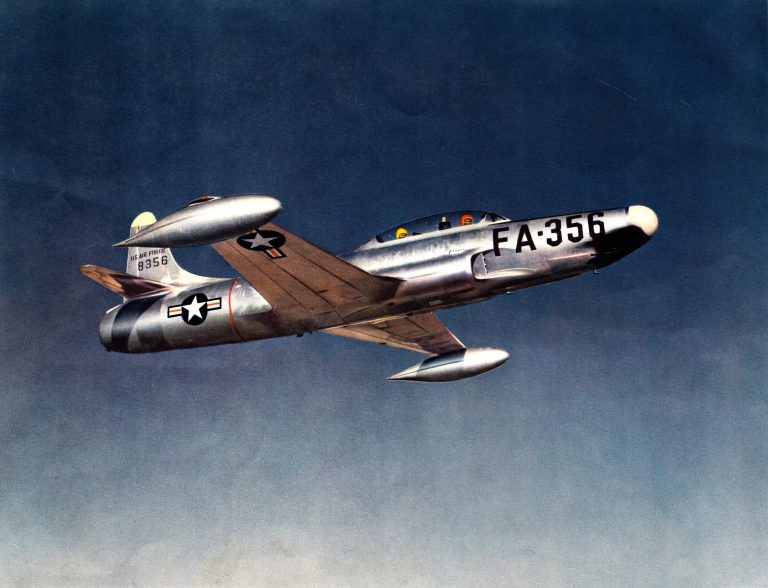
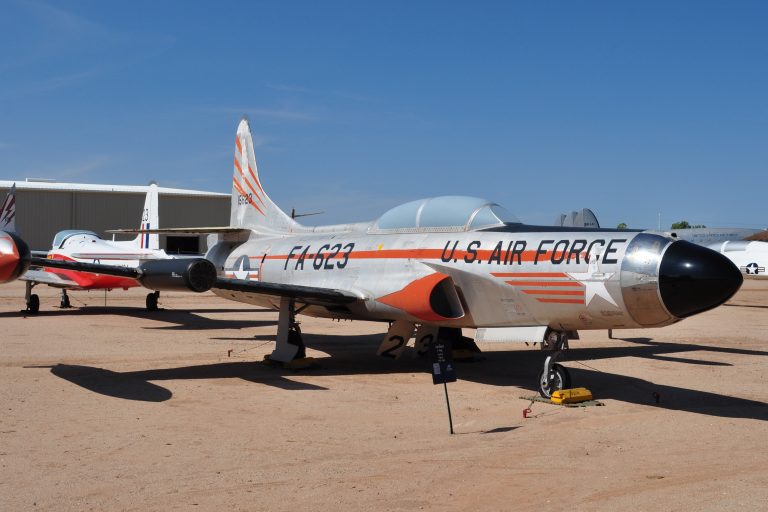
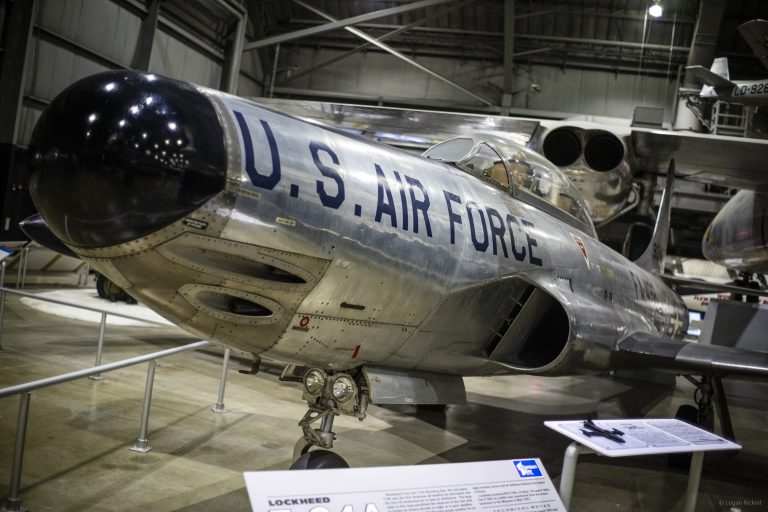
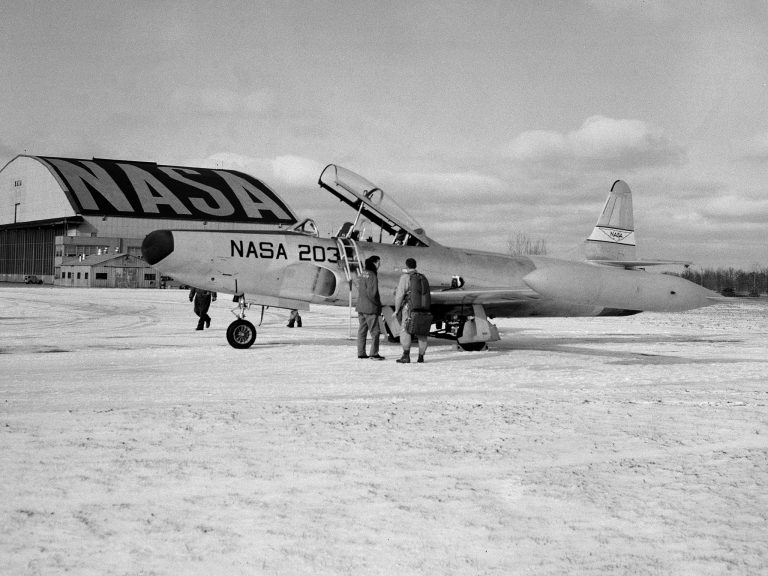
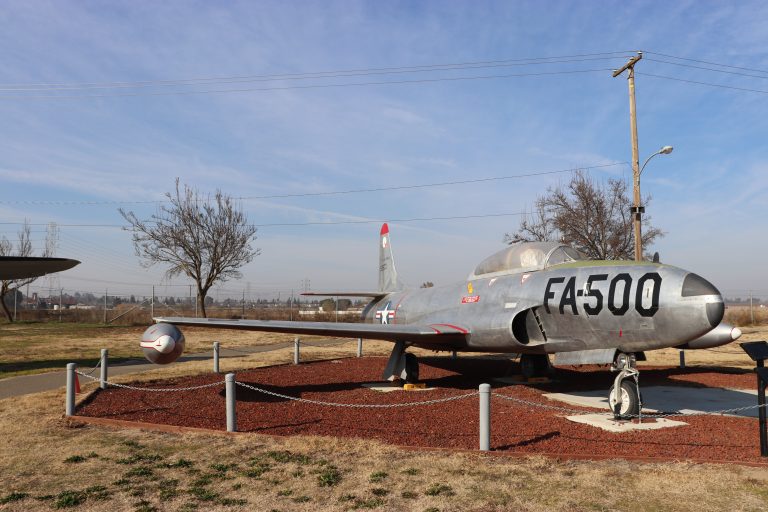
The Starfire in motion
A curated video feature for the Lockheed F-94 Starfire is coming soon. In the meantime, explore the photo gallery above and the operator map below.
Where the Starfire served
Where the record stands
The F-94 Starfire’s combat record is modest but historic. Its wartime service came at night over Korea, where F-94Bs of the 319th Fighter-Interceptor Squadron flew radar-directed patrols and scored a handful of kills — among the first night, radar-guided air-to-air victories by a US jet interceptor. Its real value, like most interceptors, lay in deterrence: standing air-defence alert across the United States, ready to meet a bomber threat that, in the end, never came.
Compare the combat record of every military aircraft. Figures as of July 2026.
Everything people ask about the F-94 Starfire
Can I fly in an F-94?
What was the F-94 Starfire developed from?
Was the F-94 really the first jet with an afterburner?
How was the F-94C Starfire armed?
Did the F-94 see combat in Korea?
Who operated the F-94 and when was it retired?
You can’t fly the Starfire.
These, you can.
Some legends only live in museums — others are fuelled and waiting. MiGFlug has put civilians in real military jet cockpits since 2004.
 Fly the L-39 AlbatrosThe world’s most-flown jet trainer — aerobatics included
 Fly the F-104 Starfighter“The missile with a man in it”
 Fly the MiG-21The Cold War’s most-produced jet
 Fly the T-33 Shooting StarAmerica’s first jet trainer
 Fly the DH VampireA piece of early jet history
 Fly the S.211Agile Italian jet trainer
 Fly the MB-326The classic Aermacchi jet
 Fly the MiG-15The Soviet legend of the Korean War
Continue the tour
Every fact, checked
- National Museum of the USAF — F-94C Starfire fact sheetOfficial specifications, all-rocket armament and the 1959 retirement.
- National Museum of the USAF — F-94A Starfire fact sheetThe afterburner “first,” the Allison J33 and total production.
- Joe Baugher — YF-94 and F-94AThe TF-80C conversion, first flight and afterburner history.
- Joe Baugher — F-94B and KoreaThe 319th FIS, the radar-secrecy restriction and the 30 January 1953 kill.
- Joe Baugher — F-97 / F-94CThe redesign, the Pratt & Whitney J48 and the 48-rocket armament.
- This Day in Aviation — 16 April 1949Details of the YF-94 first flight with Tony LeVier.
- GlobalSecurity — F-94C StarfireProgramme history and the all-rocket armament concept.
- Pima Air & Space Museum — F-94C StarfireContext on a preserved F-94C airframe and its service.