
Bell X-1
“Glamorous Glennis”
The bullet-shaped rocket plane that broke the sound barrier — the first aircraft to carry a human past Mach 1, and the machine that launched the American X-plane era.
The rocket plane that punched through the sound barrier
In the last months of the Second World War, one question haunted aeronautics: what happens at the speed of sound? Pilots diving high-performance fighters had run into a wall of violent buffeting and vanishing control — the so-called sound barrier — and some had died trying to push through it. In 1944 the US Army Air Forces, ה- National Advisory Committee for Aeronautics (NACA) וה- Bell Aircraft Corporation of Buffalo agreed to build an aircraft to find out. The contract for three aircraft was signed on 16 March 1945. It answered to no military or commercial mission; it existed only to fly into the unknown transonic region and come back with data — effectively inventing the dedicated research aircraft.
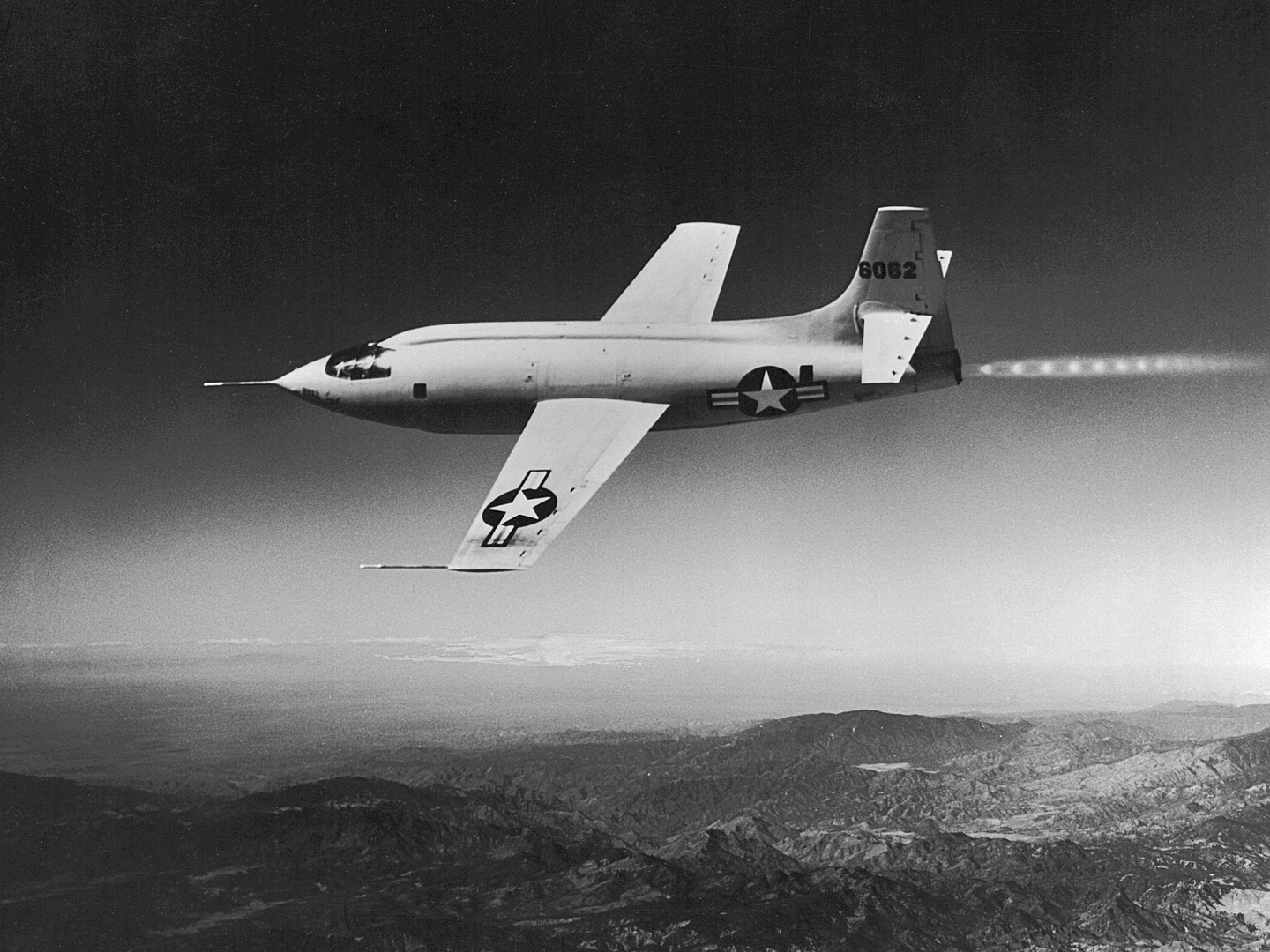
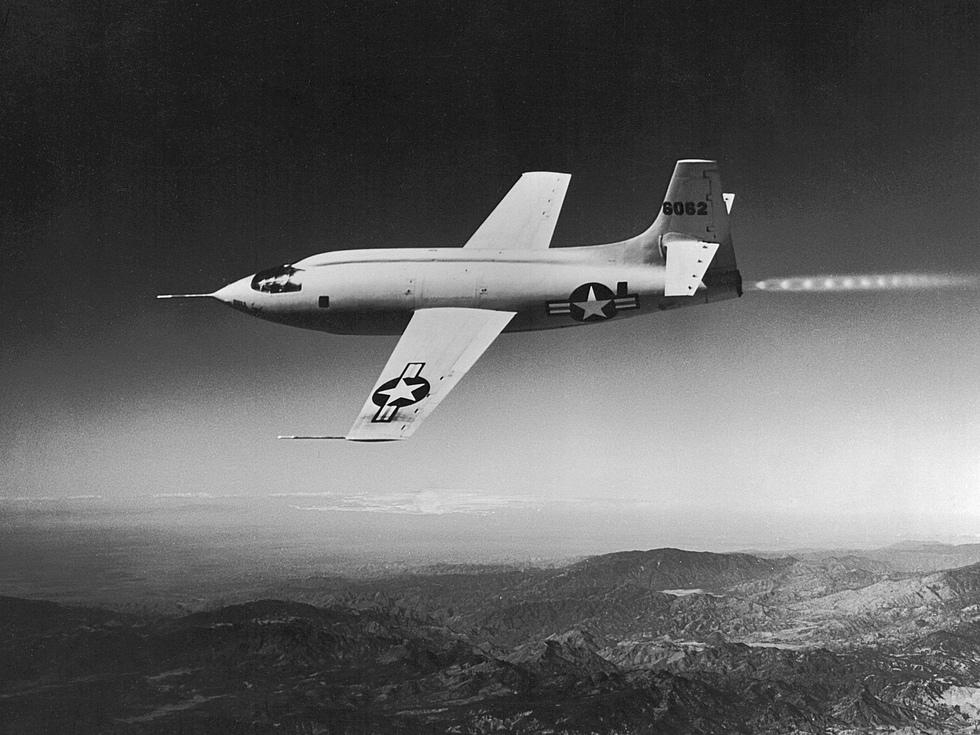
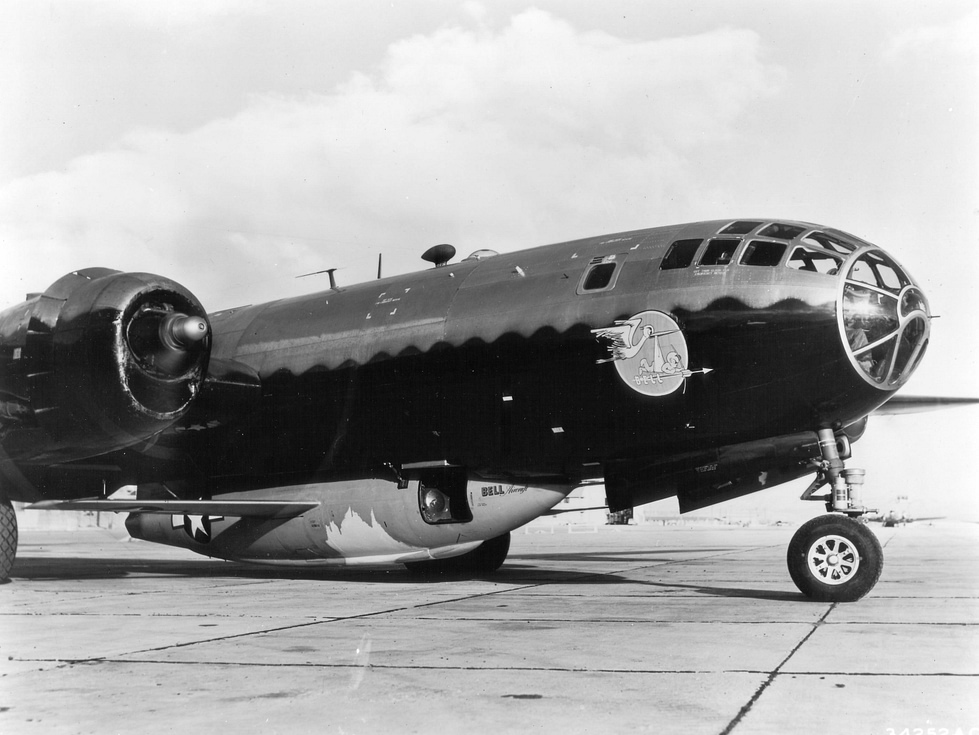
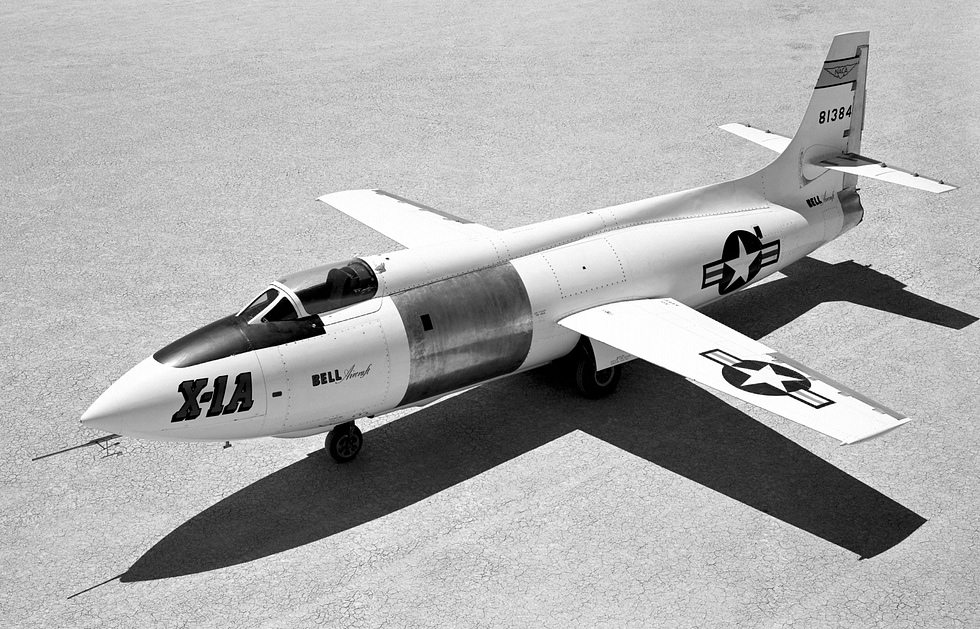
Bell’s answer was a small, straight-winged rocket plane painted international orange, its fuselage shaped like a .50-caliber machine-gun bullet — a form already known to stay stable faster than sound. Because a rocket burns its propellant in minutes, the X-1 could not take off with enough fuel to climb and still make a supersonic run, so it was carried aloft in the bomb bay of a modified B-29 Superfortress and dropped at around 25,000 feet, lighting its Reaction Motors rocket only once clear of the mother ship.
On 14 October 1947, US Army Air Forces Captain צ'אק ייגר was dropped over the Mojave at Muroc Army Air Field — later Edwards Air Force Base — fired the rocket, and pushed the aircraft he had named “Glamorous Glennis,” after his wife, to about Mach 1.06 at roughly 43,000 feet. For the first time a piloted aircraft had flown faster than sound and returned. On the desert floor, observers heard what sounded like distant thunder — one of the first sonic booms ever made by an aircraft.
The achievement was classified. It leaked to the press in December 1947 and was only officially confirmed in 1948 — the same year the team behind it (Bell, Yeager and NACA’s John Stack) shared the Collier Trophy. What made the flight possible mattered as much as the flight itself: as shock waves rendered the conventional elevator useless near Mach 0.92, Yeager kept pitch control using the X-1’s all-moving horizontal stabilizer, a trimming tailplane that soon became standard on every supersonic fighter that followed.
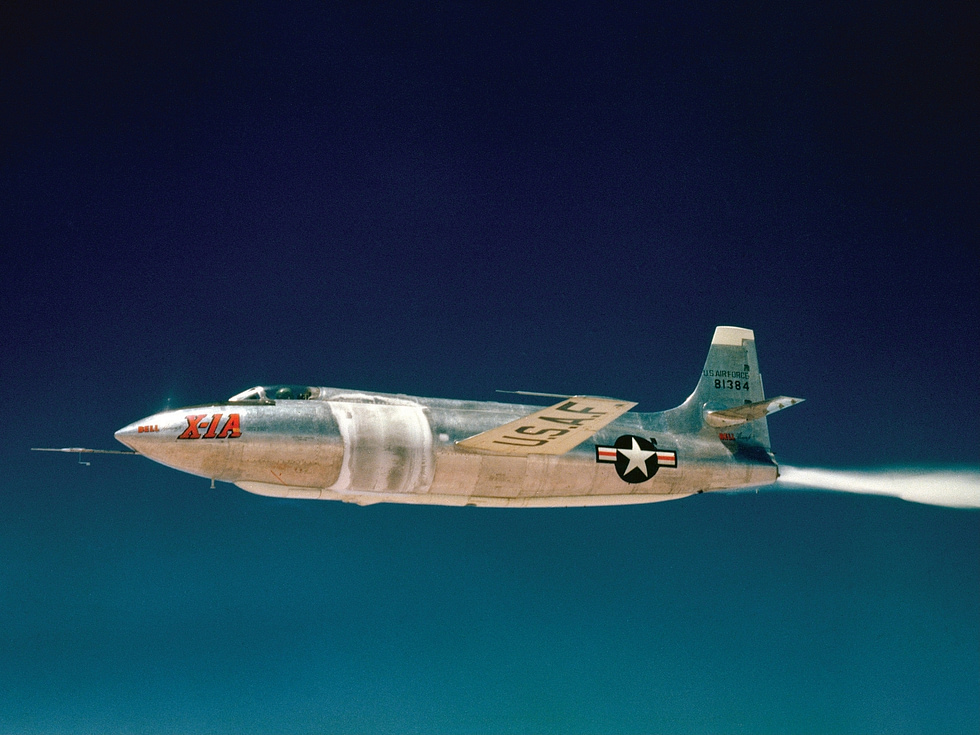
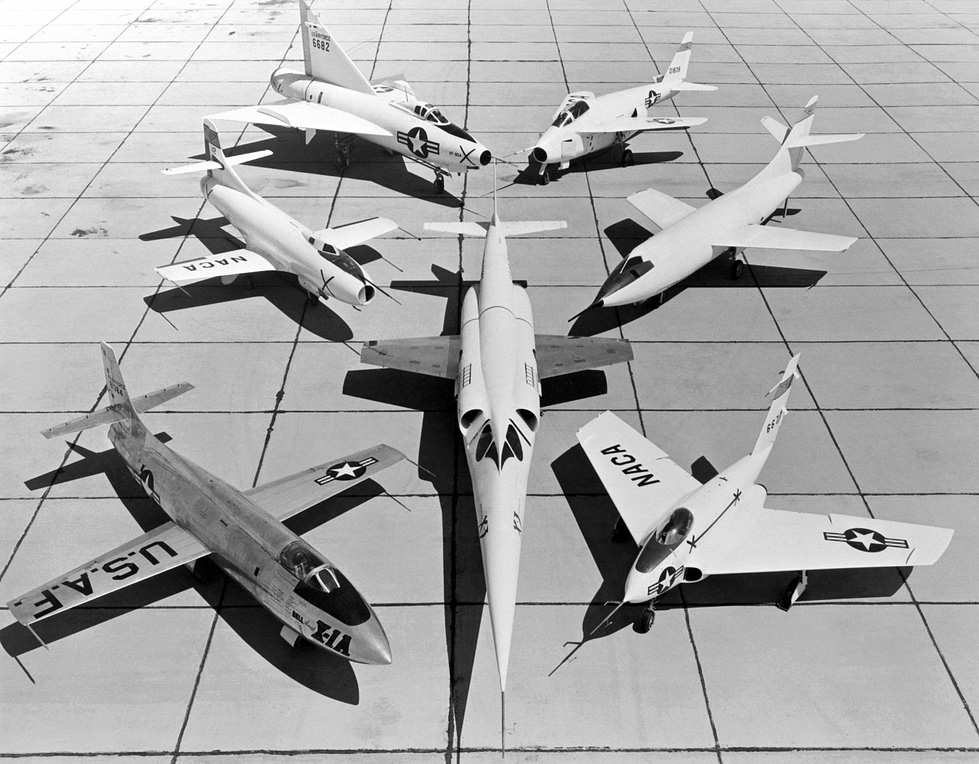
The X-1 was only the beginning. Later versions pushed further and faster: on 12 December 1953 Yeager took the boosted X-1A to about Mach 2.44 before it tumbled out of control in a then-unknown phenomenon called inertia coupling, falling tens of thousands of feet before he recovered. Other X-1s set altitude records; several were lost to violent liquid-oxygen explosions later traced to a leather-gasket problem. The type retired in 1958 — but it had already launched the entire American X-plane dynasty that led, through the X-15, to the edge of space. Two of the original aircraft survive: “Glamorous Glennis” hangs in the Smithsonian, and the rebuilt X-1E stands at NASA Armstrong.
01The Bell X-1’s secret first supersonic flight: why the world did not hear for months
The most important flight since Kitty Hawk was a military secret. When Yeager took the X-1 past Mach 1 on 14 October 1947, the result was classified — the United States did not want the Soviet Union to know it had cracked the transonic problem. The story broke only when it leaked to Aviation Week in December 1947, and the US Air Force did not officially confirm it until 1948. By the time the public learned that a human had outrun sound, it had already been true for months.
What makes it special
Rocket power and a mid-air launch
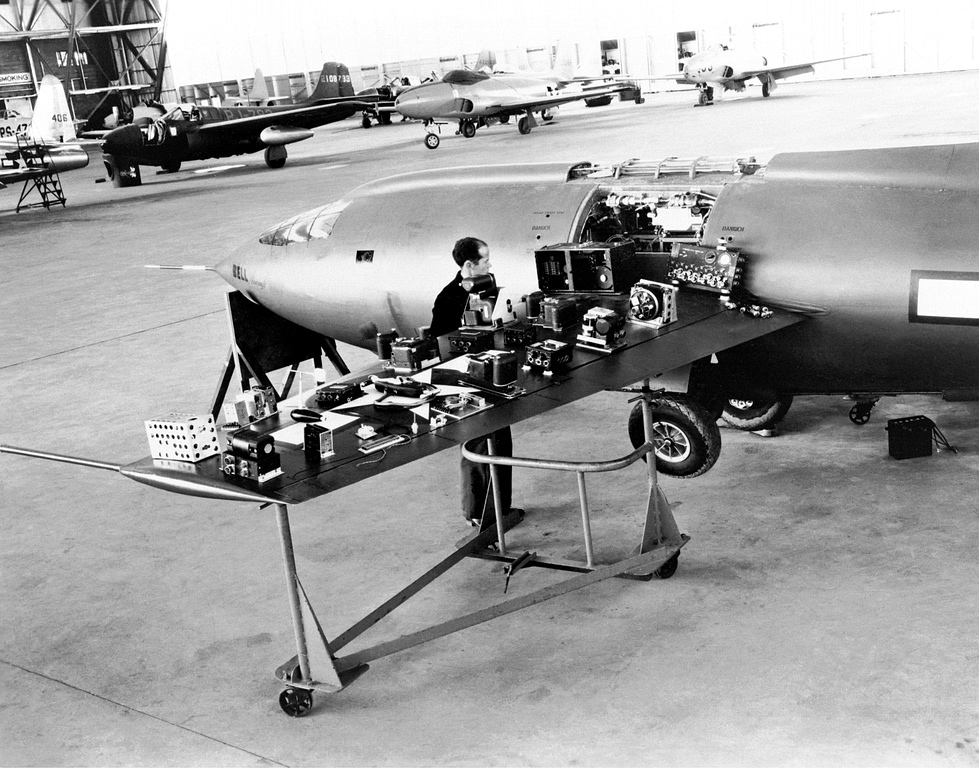
The X-1 was driven by a single Reaction Motors XLR-11 rocket with four combustion chambers, each fired independently for roughly 1,500 lbf — about 6,000 lbf (~26 kN) combined. It burned ethyl alcohol diluted with water ו liquid oxygen, and drained its tanks in only a few minutes. Because it could never take off with enough propellant to climb ו run supersonic, it was carried aloft in a B-29’s bomb bay and dropped at altitude.
The all-moving tail that beat Mach 1
Near Mach 0.92, shock waves over the tail made the conventional hinged elevator almost useless — the classic transonic loss of pitch control that had killed pilots. Bell built the X-1 with a horizontal stabilizer whose whole angle could be trimmed in flight. Using that all-moving tailplane, Yeager kept control through and past Mach 1. The idea was quickly adopted on the F-86 Sabre and every supersonic fighter since.
A fuselage shaped like a .50-caliber bullet
Nobody knew what shape stayed stable beyond the speed of sound, so Bell copied one that did: the fuselage was modeled on a .50-caliber Browning bullet, already proven supersonic. It was fitted with very thin, straight (unswept) wings — the first two aircraft used 8% and 10% thickness ratios so engineers could compare transonic behavior.
02The Bell X-1’s stabilator: the control breakthrough that made Mach 1 survivable
The single most important piece of engineering on the X-1 was not its rocket but its tail. As the aircraft approached the speed of sound, a shock wave formed on the horizontal tail and blanked the hinged elevator, so pulling the stick did almost nothing — the phenomenon that had destroyed aircraft in high-speed dives. Bell had given the X-1 a fully trimmable stabilizer driven by an electric screw-jack, and NACA engineer Jack Ridley worked out that moving the entire tailplane a fraction of a degree at a time restored pitch authority. That “flying tail” carried Yeager through Mach 1 and became a defining feature of supersonic aircraft design.
03The Bell X-1’s rocket and B-29 air-launch: why it was dropped, not flown, off the ground
A rocket engine is enormously powerful but ferociously thirsty — the XLR-11 emptied the X-1’s propellant tanks in a matter of minutes. An aircraft loaded with enough alcohol and liquid oxygen to reach test altitude ו accelerate past Mach 1 simply could not have taken off from a runway under its own power. The solution was to make the X-1 a parasite: a modified B-29 (and later a B-50) carried it up to about 25,000 feet, slowed, and released it. Only once it had fallen clear did the pilot light the rocket — a launch technique that would define the whole X-plane program right through to the X-15.
Full specifications
Airframe & Performance
- צוות
- 1
- מֶשֶׁך
- 9.4 m (30 ft 11 in)
- מוּטַת כְּנָפַים
- 8.5 m (28 ft)
- גוֹבַה
- 3.3 m (10 ft 10 in)
- משקל ריק
- ~2,780 kg (6,130 lb)
- Launch weight
- ~5,545 kg (~12,250 lb) · estimate
- Max speed (X-1)
- Mach 1.45 · ~1,540 km/h (1948)
- First supersonic
- Mach 1.06 · ~1,130 km/h (14 Oct 1947)
- Altitude record (X-1)
- 21,900 m (71,902 ft, 1949)
- Max speed (X-1A)
- ~Mach 2.44 (1953)
- Altitude record (X-1A)
- 27,566 m (90,440 ft, 1954)
Propulsion & Systems
- מָנוֹעַ
- 1 × Reaction Motors XLR-11
- Configuration
- Four rocket combustion chambers
- Thrust
- ~26 kN (~6,000 lbf) total
- Propellant
- Ethyl alcohol/water + liquid oxygen
- Powered endurance
- ~2–5 minutes
- Launch method
- Air-dropped from a B-29/B-50
- First flight (glide)
- January 1946
- Built
- 6 X-1-series airframes (1945–55)
- Unit cost
- No fixed price (research prototypes)
- Cost per flight hour
- Not applicable · one-off research program
04The Bell X-1’s cost: a research program, not a production aircraft
The X-1 was never priced like a service aircraft. It was a government research program of a handful of hand-built prototypes — three first-generation X-1s plus the later X-1A, X-1B, X-1D and the rebuilt X-1E — funded jointly by the Army Air Forces (later the Air Force) and the NACA. There is no meaningful flyaway unit price or cost-per-flight-hour for an aircraft that existed only to gather data, flew a few dozen times each, and was launched from a converted bomber. Any dollar figure attached to a single X-1 is, in practice, an accounting estimate rather than a market price.
From a wartime question to the edge of space
The idea takes shape
The Army Air Forces and NACA begin the design study (MX-524, then MX-653) for an aircraft to probe the transonic region no fighter could safely enter.
Bell is contracted
On 16 March, Bell Aircraft is awarded the contract to build three XS-1 research aircraft in Buffalo, New York.
First flights
Jack Woolams makes the first unpowered glide flight in January; in December, Bell pilot Chalmers “Slick” Goodlin makes the first powered flight.
The sound barrier falls
On 14 October, Capt. Chuck Yeager flies “Glamorous Glennis” to about Mach 1.06 — the first crewed supersonic flight. The result is kept secret.
The Collier Trophy
The achievement is confirmed publicly and the year’s Collier Trophy is shared by Bell, Yeager and NACA’s John Stack.
An altitude record
Maj. Frank Everest takes an X-1 to 71,902 ft (21,900 m), stretching the type’s envelope higher still.
The wild ride of the X-1A
On 12 December, Yeager reaches about Mach 2.44 in the X-1A, then tumbles in an inertia-coupling spin, falling tens of thousands of feet before recovering.
Ninety thousand feet
Maj. Arthur “Kit” Murray zoom-climbs the X-1A to about 90,440 ft (27,566 m), an altitude record for the type.
The program ends
The rebuilt X-1E makes the last flight of the X-1 family, closing a program that launched the entire American X-plane era.
From the flight line: twelve X-1 stories
Two broken ribs and a broomstick
Yeager broke the sound barrier hurt — and rigged a broomstick to close the hatch.
Read the full story
Glamorous Glennis
Every X-1 Yeager flew carried his wife’s name.
Read the full story
The barrier broke in silence
The most important flight since Kitty Hawk was classified for months.
Read the full story
A bullet with wings
Not knowing what shape stayed stable past Mach 1, Bell copied a gun.
Read the full story
The tail that saved the flight
As the elevator went dead near Mach 0.92, the whole tail took over.
Read the full story
The wild ride of the X-1A
Going too fast in 1953 nearly killed Yeager.
Read the full story
The Mach jump
The needle itself told the story of breaking through.
Read the full story
The bonus that opened the door
A pay dispute helped hand the flight to a military pilot.
Read the full story
The drop
The X-1 was launched, not flown, off the ground.
Read the full story
The Collier Trophy
Breaking the barrier earned aviation’s top prize.
Read the full story
The first boom
People on the desert floor heard the barrier break.
Read the full story
From X-1 to X-15
The orange bullet started a dynasty.
Read the full story
The X-1 in pictures
The X-1 in motion
A hand-picked, high-authority film of the Bell X-1 breaking the sound barrier is on the way — video coming soon.
Where the X-1 flew
The records that define it
The X-1 never fired a shot in anger — it was a research aircraft, and its victories were milestones rather than kills. Every one of them expanded what a piloted aircraft was known to be able to do, and each was won in the thin air over the California desert.
Explore the whole collection in the MiGFlug Aircraft Museum.
Everything people ask about the Bell X-1
Can I fly in a Bell X-1?
Who broke the sound barrier in the X-1?
How fast could the Bell X-1 go?
What engine did the X-1 use?
How did the X-1 take off?
What made the X-1 able to fly supersonic?
Where can I see a Bell X-1 today?
You can’t fly the X-1.
These, you can.
Some legends only live in museums — others are fuelled and waiting. MiGFlug has put civilians in real military jet cockpits since 2004.
 Fly the L-39 AlbatrosThe world’s most-flown jet trainer — aerobatics included
 Fly the F-104 Starfighter“The missile with a man in it”
 Fly the MiG-21The Cold War’s most-produced jet
 טסו על ה-T-33 Shooting StarAmerica’s first jet trainer
 Fly the DH VampireA piece of early jet history
 Fly the S.211Agile Italian jet trainer
 Fly the MB-326The classic Aermacchi jet
 Fly the MiG-15The Soviet legend of the Korean War
Continue the tour
Every fact, checked
- Smithsonian National Air and Space Museum — Bell X-1 “Glamorous Glennis”Primary museum record for dimensions, engine, flight totals and current display.
- NASA — First Generation X-1Authoritative on serials, wing thicknesses, air-launch, pilots and the X-1-3 explosion.
- NASA Armstrong — X-1E Research AircraftThe rebuilt X-1E’s specifications, flights and its display at NASA Armstrong.
- Aerotech News & Review — The Bell X-1 programThe most complete variant-by-variant rundown, losses and the TCP/Ulmer-leather cause.
- Smithsonian Magazine — How the Bell X-1 Ushered in the Supersonic AgeCollier Trophy recipients, the secrecy and leak, and the flight’s significance.
- The Chuck Yeager FoundationDetailed first-person account of the X-1A’s Mach 2.44 flight and inertia-coupling spin.
- HistoryNet — Bell X-1: Dropping the Orange BeastThe broken ribs, the broomstick, the drop procedure and the stabilizer fix.
- National Museum of the US Air Force — Bell X-1BOfficial record for the surviving X-1B and its reaction-control research.