
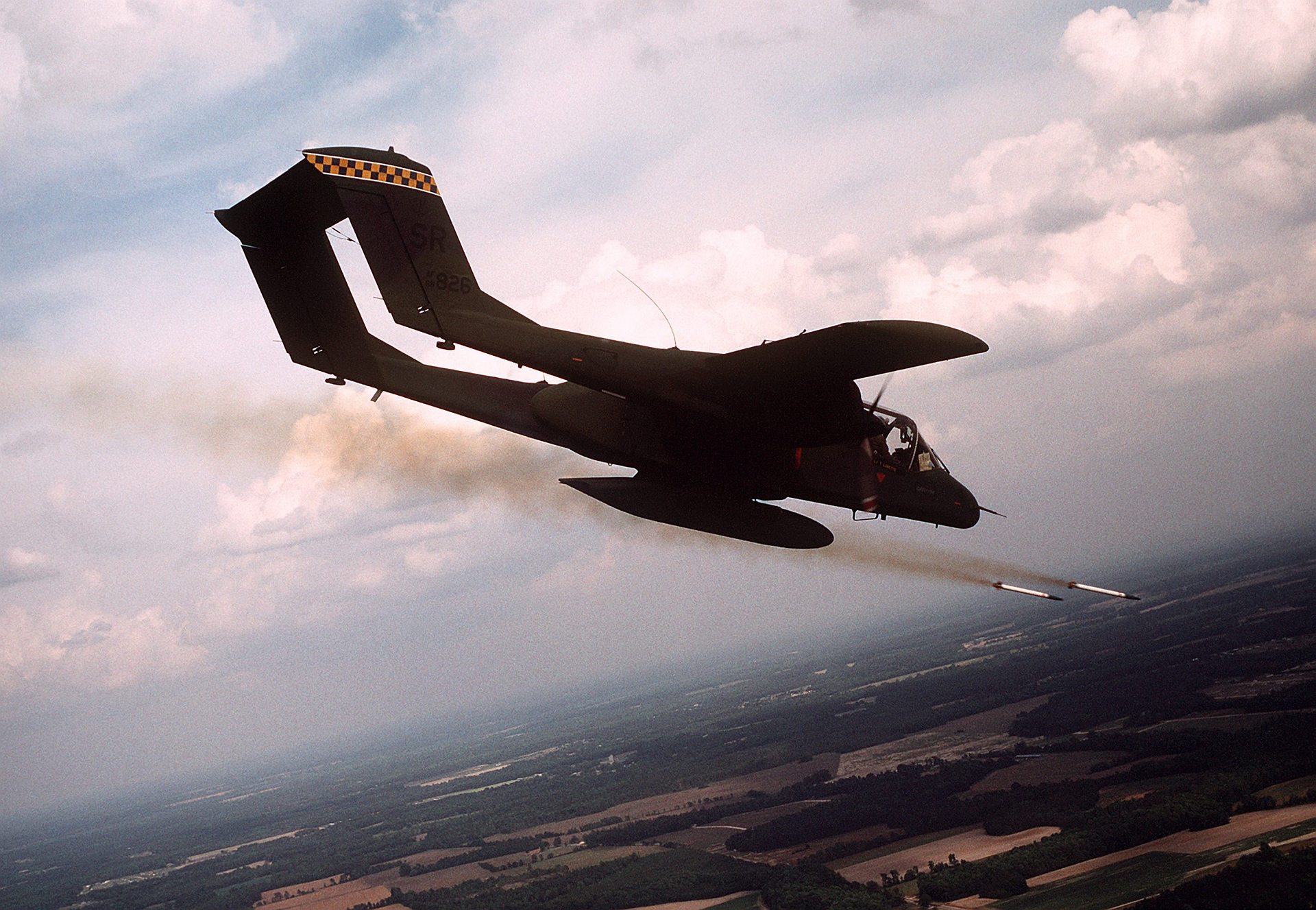
North American OV-10
“Bronco”
The twin-boom turboprop built for the brushfire wars — a slow, tough forward-air-control and light-attack aircraft that marked targets over Vietnam, flew fire lines over California, and returned to combat against ISIS half a century after its first flight.
The OV-10 Bronco: built for the brushfire wars
Most Cold-War aircraft were built to fly higher and faster than the last. The OV-10 Bronco was built to do the opposite — to fly low, slow and cheap, from a dirt strip a few hundred metres long, right next to the troops it supported. In the early 1960s American planners looking at Vietnam-style “brushfire” conflicts realised they had nothing suited to counter-insurgency: their jets were too fast to see the enemy and needed long paved runways. The tri-service LARA requirement — Light Armed Reconnaissance Aircraft — was written around that gap, and North American Aviation won the competition in 1964.
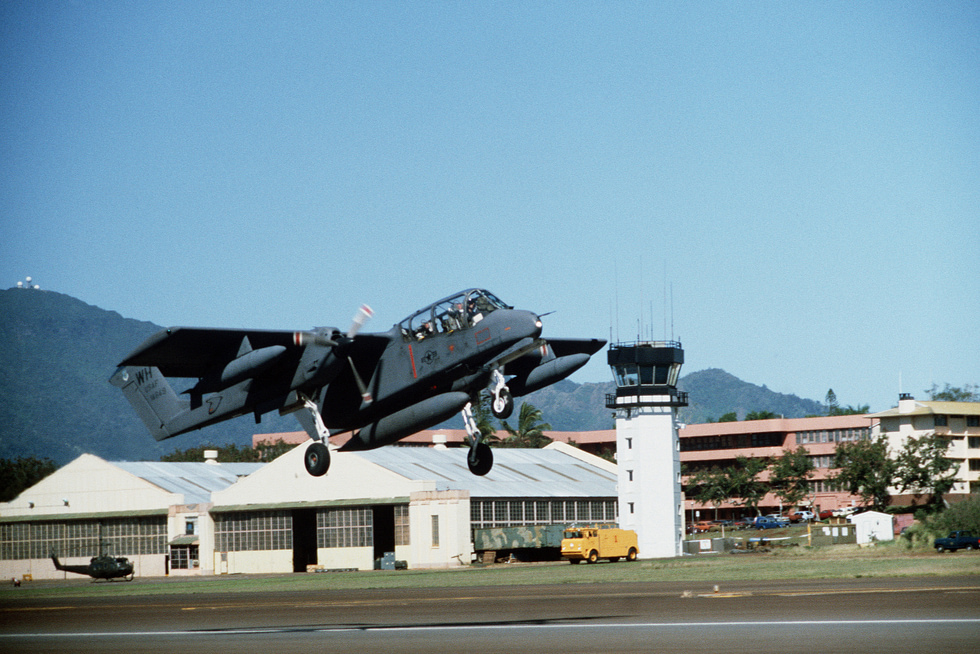
The result was one of the few US combat aircraft designed from scratch for the job. A short central nacelle carried two crew in tandem under a huge glazed “greenhouse” canopy, flanked by two turboprops on twin tail booms. Below the fuselage, stub-wing sponsons held four machine guns and hardpoints for rockets and bombs, while the nacelle hid a small cargo bay. The prototype first flew on 16 July 1965, and by July 1968 Broncos were in Vietnam with the US Air Force and Marine Corps.
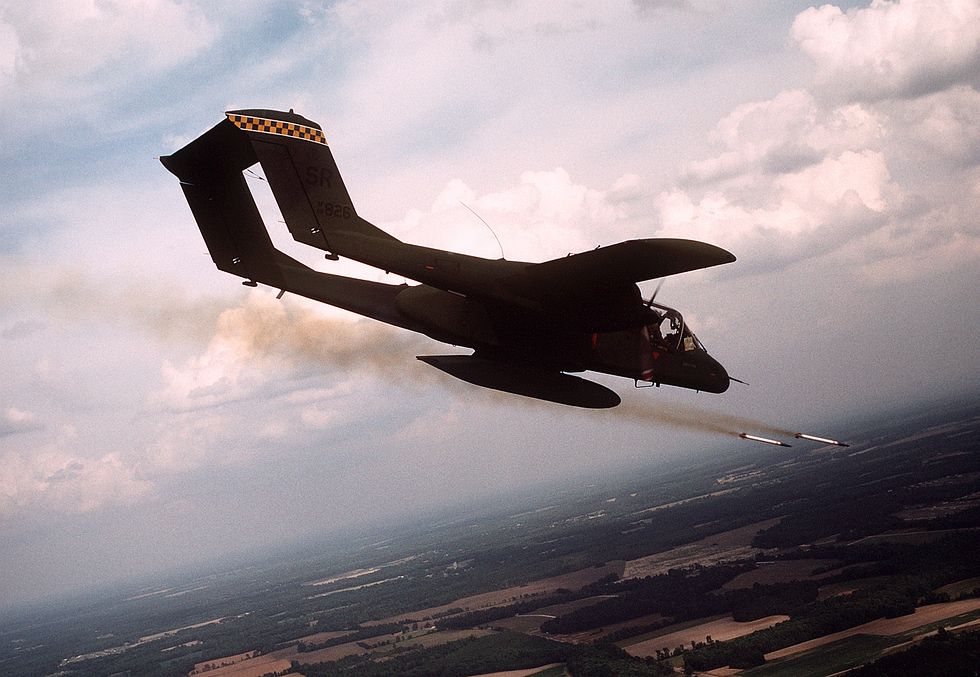
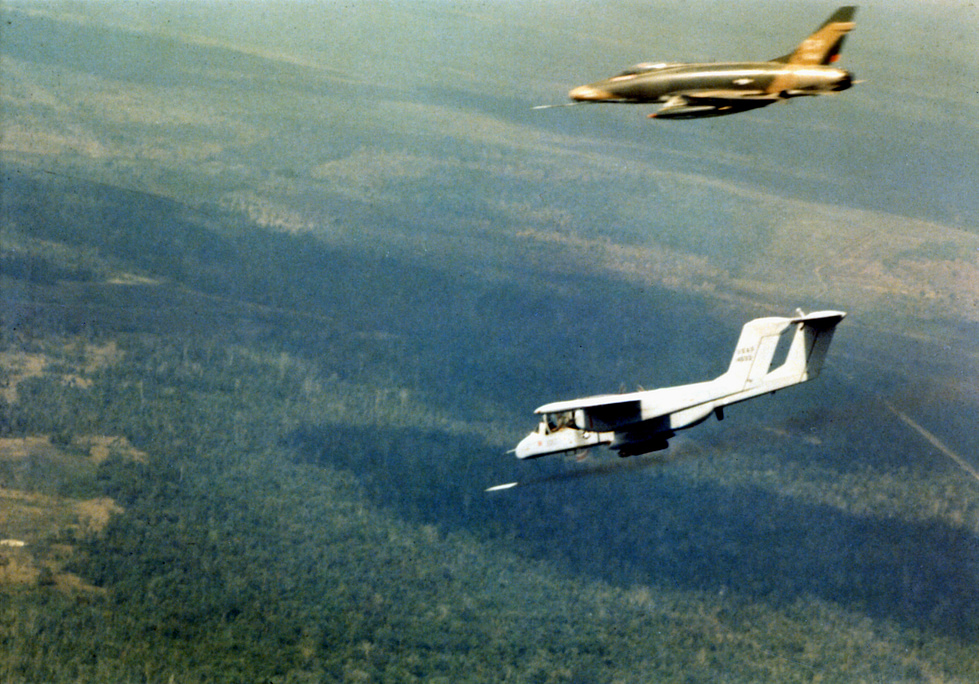
Its signature job was forward air control: loitering over the jungle, spotting hidden positions, then firing a white-phosphorus smoke rocket to mark the target for inbound strike jets. The US Navy went further, standing up its only Bronco squadron — Light Attack Squadron VA(L)-4, the “Black Ponies” — to hunt over the Mekong Delta and protect river patrol boats and SEAL teams. That blend of visibility, loiter, toughness and firepower proved so useful that the Bronco kept finding new work for six decades: the Gulf War, drug interdiction, wildfire spotting, and, in 2015, a startling return to frontline combat against ISIS.
01The OV-10 Bronco’s LARA origins: a warplane designed from scratch for counter-insurgency
By the late 1950s a small group of US Marine and Army officers argued that the wars America was actually fighting were small, dirty and close to the ground — and that supersonic jets were the wrong tool for them. Their thinking hardened into the tri-service LARA specification of the early 1960s: a cheap, rugged, two-seat aircraft able to take off and land in a few hundred metres from rough ground, loiter for hours, carry light ordnance, and be maintained in the field. North American Aviation’s NA-300 design won the competition in 1964, and seven YOV-10A prototypes were ordered.
Early testing forced real changes — the wing was widened and more powerful engines fitted before the production OV-10A flew in 1967 — but the concept held. The Bronco became one of the very few Western combat aircraft conceived specifically for counter-insurgency rather than adapted from a trainer or a fast jet, and that clarity of purpose is why the design kept proving relevant long after its contemporaries were scrapped.
What makes it special
A twin-boom flying observation deck
The Bronco was built around seeing the battlefield. Its crew sat in tandem under a vast glazed “greenhouse” canopy that gave near-panoramic views down and to the sides — essential for spotting, marking and directing strikes. The high straight wing and twin tail booms kept the aircraft stable and slow, and its STOL design let it operate from short, rough, unimproved strips close to the front line.
Light attack from stub-wing sponsons
Under the fuselage, two sponsons carried four 7.62 mm M60C machine guns plus hardpoints; total external load reached about 1,630 kg (3,600 lb) of rockets, gun pods and bombs. Uniquely for its size, the central nacelle hid a small utility bay that could carry five paratroopers, two litter patients with a medic, or cargo — and both crew had ejection seats, rare on a slow observation type.
Six decades of relevance
Cheap to fly and matched to counter-insurgency, the Bronco kept coming back. After Vietnam it served in the Gulf War, fought wildfires, chased smugglers, and flew with a string of foreign air forces. In 2015 two modernised OV-10G+ flew real combat sorties against ISIS in Iraq — a Vietnam-era design returning to the front line fifty years after its first flight.
02The OV-10 Bronco’s STOL design: why a warplane needed no runway
Short takeoff and landing was a hard LARA requirement, not a bonus. The Bronco’s big high-lift wing, light wing loading and twin turboprops let it get airborne and stop again in a few hundred metres of rough, unprepared ground — and in trials it operated from roads and even carrier decks. The point was basing: instead of flying from a distant paved airfield, a Bronco could work from a strip scraped out beside the troops it supported, cutting response time to minutes. That rough-field toughness, combined with hours of loiter, is exactly why counter-insurgency planners kept rediscovering the type across six decades.
03The OV-10G+ and Combat Dragon II: a fifty-year-old Bronco fighting ISIS
In 2015 the US ran an experiment called Combat Dragon II. Two ex-Marine Broncos — airframes that had passed through civilian agency hands — were rebuilt as OV-10G+, fitted with a stabilised L3 WESCAM MX-15 electro-optical sensor turret, laser-guided APKWS 70 mm rockets and secure datalinks, at a reported cost near $20 million for the pair. A tiny detachment deployed them to Iraq, where over roughly 120 sorties they reportedly acted as precise “flying snipers” against ISIS at a fraction of a jet’s operating cost. The trial fed directly into later US light-attack programmes.
Full specifications
Airframe & Performance (OV-10A)
- צוות
- 2 (pilot + aerial observer)
- מֶשֶׁך
- 12.67 m (41 ft 7 in)
- מוּטַת כְּנָפַים
- 12.19 m (40 ft 0 in)
- גוֹבַה
- ~4.62 m (15 ft 2 in)
- משקל ריק
- ~3,127 kg
- Max takeoff weight
- ~6,552 kg (14,444 lb)
- Max speed
- ~452 km/h (281 mph)
- מהירות שיוט
- ~359 km/h
- לָנוּעַ
- ~1,995 km (ferry, with tanks higher)
- תקרת השירות
- ~7,300–7,900 m (24,000–26,000 ft)
Propulsion, Armament & Systems
- Engines
- 2 × Garrett T76-G-410/412 turboprop
- Power
- ~715 shp each (OV-10A)
- Guns
- 4 × 7.62 mm M60C in sponsons
- External load
- ~1,630 kg (3,600 lb) on 5 hardpoints
- Utility bay
- 5 paratroops / 2 litters / cargo
- Crew escape
- Ejection seats (both crew)
- First flight
- 16 July 1965 (YOV-10A)
- Built
- ~356 (all variants); 157 OV-10A to USAF
- Unit cost
- No single reliable public figure
- Cost per flight hour
- Low by combat-aircraft standards; no reliable public figure
04The OV-10 Bronco’s operating costs: the cheap-to-fly case for a turboprop warplane
The Bronco’s whole rationale was economy. A pair of small turboprops, a simple airframe and field maintenance meant it cost a small fraction of a jet fighter to buy and to fly — the argument that made LARA attractive in the first place and that resurfaced in the 2010s light-attack debate. No authoritative modern flyaway unit price or cost-per-flight-hour figure exists in the open record for the OV-10A, and the frequently quoted numbers are estimates rather than sourced accounting. What is well documented is the comparison the 2015 Combat Dragon II trial drew: a modernised Bronco could deliver precise strikes for a tiny fraction of the hourly cost of a fast jet — the enduring economic case for the type.
From LARA concept to the last Bronco
The LARA idea
US planners write a tri-service requirement for a cheap, rugged, short-field counter-insurgency aircraft — the Light Armed Reconnaissance Aircraft.
North American wins
North American Aviation’s NA-300 wins the LARA competition; seven YOV-10A prototypes are ordered.
First flight
The first YOV-10A flies on 16 July 1965. Testing widens the wing and adds more powerful engines before production.
Combat debut in Vietnam
USAF and Marine OV-10As reach Vietnam in July 1968 for forward air control and armed reconnaissance.
The Black Ponies
US Navy Light Attack Squadron VA(L)-4 stands up, flying Broncos on light attack over the Mekong Delta.
Desert Storm
Marine Broncos fly FAC and recon in the Gulf War; two OV-10s are shot down by shoulder-fired missiles.
Second careers
Retired from US service, Broncos go to work fighting wildfires (CAL FIRE) and flying drug-interdiction patrols.
Combat Dragon II vs ISIS
Two modernised OV-10G+ fly roughly 120 combat sorties against ISIS in Iraq — a 50-year-old design back at the front.
The last military Bronco
The Philippine Air Force retires the OV-10 on 28 December 2024 — the world’s last military operator stands the type down.
From the cockpit: twelve Bronco stories
Born for a brushfire war
The Bronco was designed from scratch for counter-insurgency, not adapted from a jet.
Read the full story
A decade before it fought ISIS
The first YOV-10A flew on 16 July 1965, one of seven prototypes.
Read the full story
The Black Ponies of the Mekong
The only US Navy squadron ever to fly the Bronco.
Read the full story
Marking targets with “Willie Pete”
A slow plane that told the fast jets where to bomb.
Read the full story
The greenhouse canopy
A cockpit built like a flying observation deck.
Read the full story
The off-road warplane
A combat aircraft that did not need a runway.
Read the full story
The Bronco’s secret cargo bay
A gunship that could also carry paratroopers.
Read the full story
Ejection seats on a slow plane
Escape engineered into a low-and-slow mission.
Read the full story
From gunfire to wildfires
The Bronco traded Vietnam for the California fire lines.
Read the full story
The smuggler-chasing Bronco
A drug-war castoff that became a combat aircraft again.
Read the full story
Fifty years old, fighting ISIS
“One shot, one kill” from a Vietnam-era design.
Read the full story
The Bronco’s last stand
The type’s final war, in the streets of a besieged city.
Read the full story
The Bronco in pictures
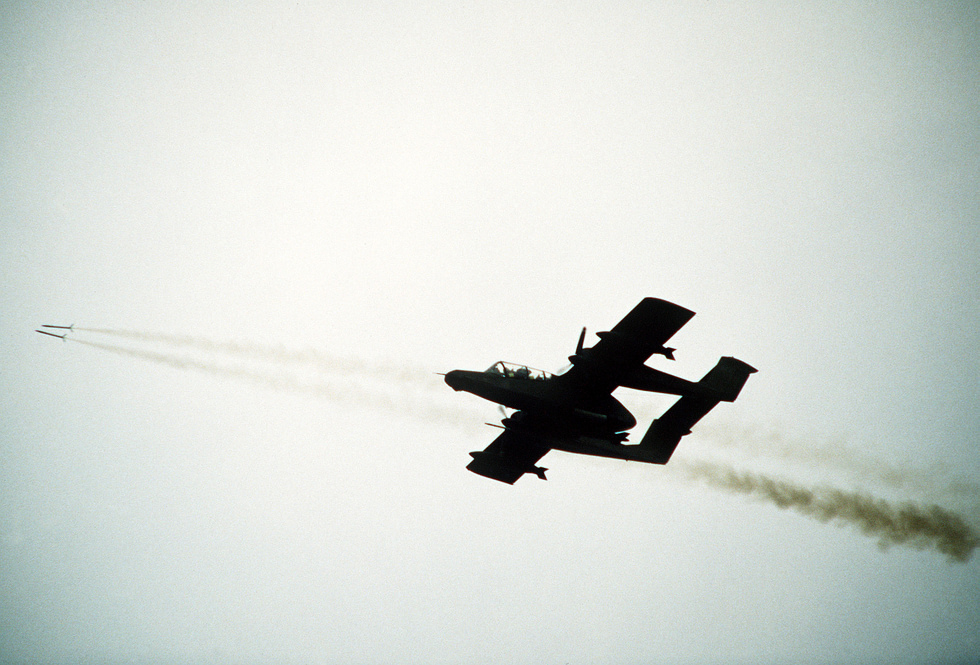
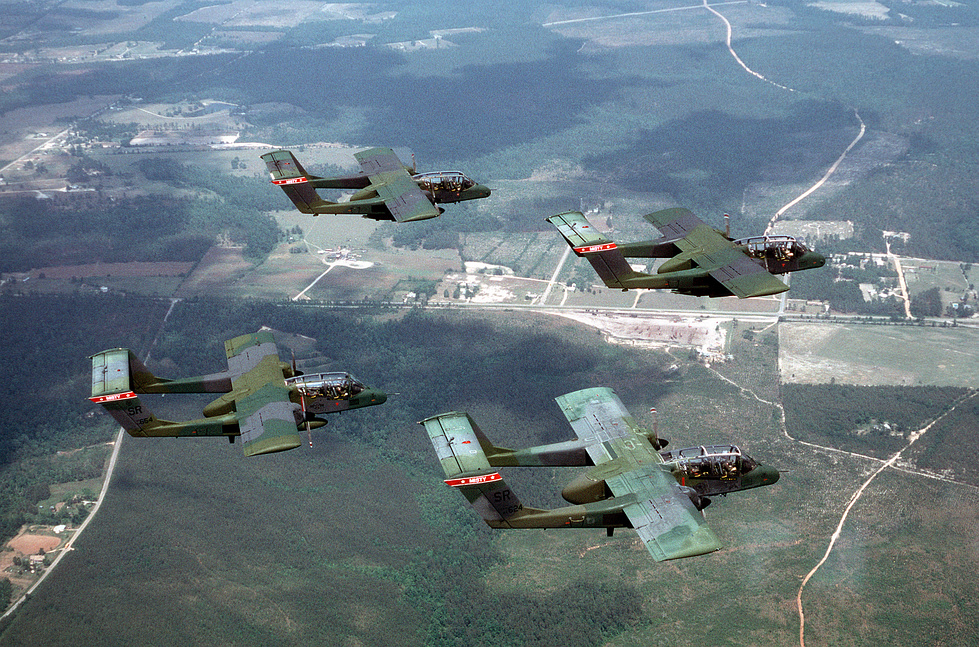
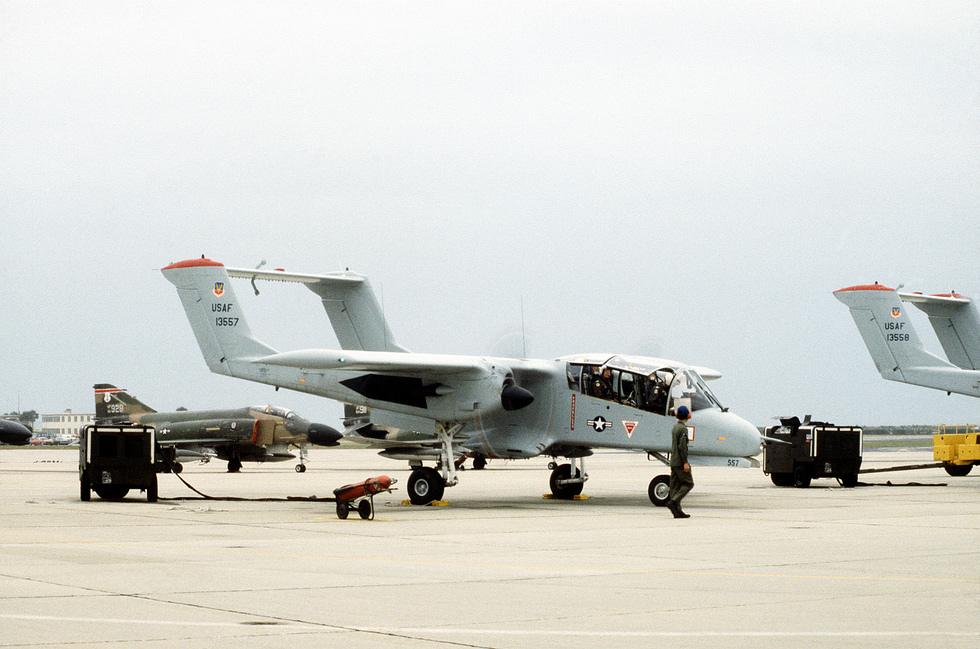
The Bronco in motion
A hand-picked video feature for the OV-10 Bronco is on the way. Video coming soon.
Where the Bronco flew
The score that defines it
The Bronco was never a dogfighter — its record is written in observation, target marking and low-level fire support across half a century of small wars. It directed countless air strikes over Vietnam, hunted over the Mekong Delta with the Black Ponies, flew forward air control in the Gulf, backed Philippine troops in the streets of Marawi, and returned to combat against ISIS in 2015.
Compare the combat record of every military aircraft.
Everything people ask about the OV-10 Bronco
Can I fly in an OV-10 Bronco?
What was the OV-10 Bronco used for?
How fast is the OV-10 Bronco?
Why does the Bronco have twin booms?
Did the OV-10 fight against ISIS?
Is the OV-10 Bronco still in service?
Which countries flew the OV-10 Bronco?
How many OV-10 Broncos were built?
You can’t fly the Bronco.
These, you can.
Some legends only live in museums — others are fuelled and waiting. MiGFlug has put civilians in real military jet cockpits since 2004.
 Fly the L-39 AlbatrosThe world’s most-flown jet trainer — aerobatics included
 Fly the F-104 Starfighter“The missile with a man in it”
 Fly the MiG-21The Cold War’s most-produced jet
 טסו על ה-T-33 Shooting StarAmerica’s first jet trainer
 Fly the DH VampireA piece of early jet history
 Fly the S.211Agile Italian jet trainer
 Fly the MB-326The classic Aermacchi jet
 Fly the MiG-15The Soviet legend of the Korean War
Continue the tour
Every fact, checked
- National Museum of the US Air Force — OV-10A Bronco fact sheetSpecifications and USAF service history.
- Naval History and Heritage Command — OV-10 BroncoUS Navy service and the VA(L)-4 Black Ponies.
- US Naval Institute — “A Low, Slow Plane for Limited War”Design origins and combat use of the Bronco.
- Defense Media Network — Combat Dragon IIThe 2015 OV-10G+ modernisation and capabilities.
- The War Zone — the Broncos that fought ISISDetail on the Iraq deployment and results.
- The Aviationist — Philippines retire the OV-10The December 2024 retirement of the last military operator.
- The Aviation Geek Club — last USMC Bronco lossMarine OV-10 combat losses and Gulf War use.
- Military Factory — OV-10 BroncoProduction totals, variants and engine data.