
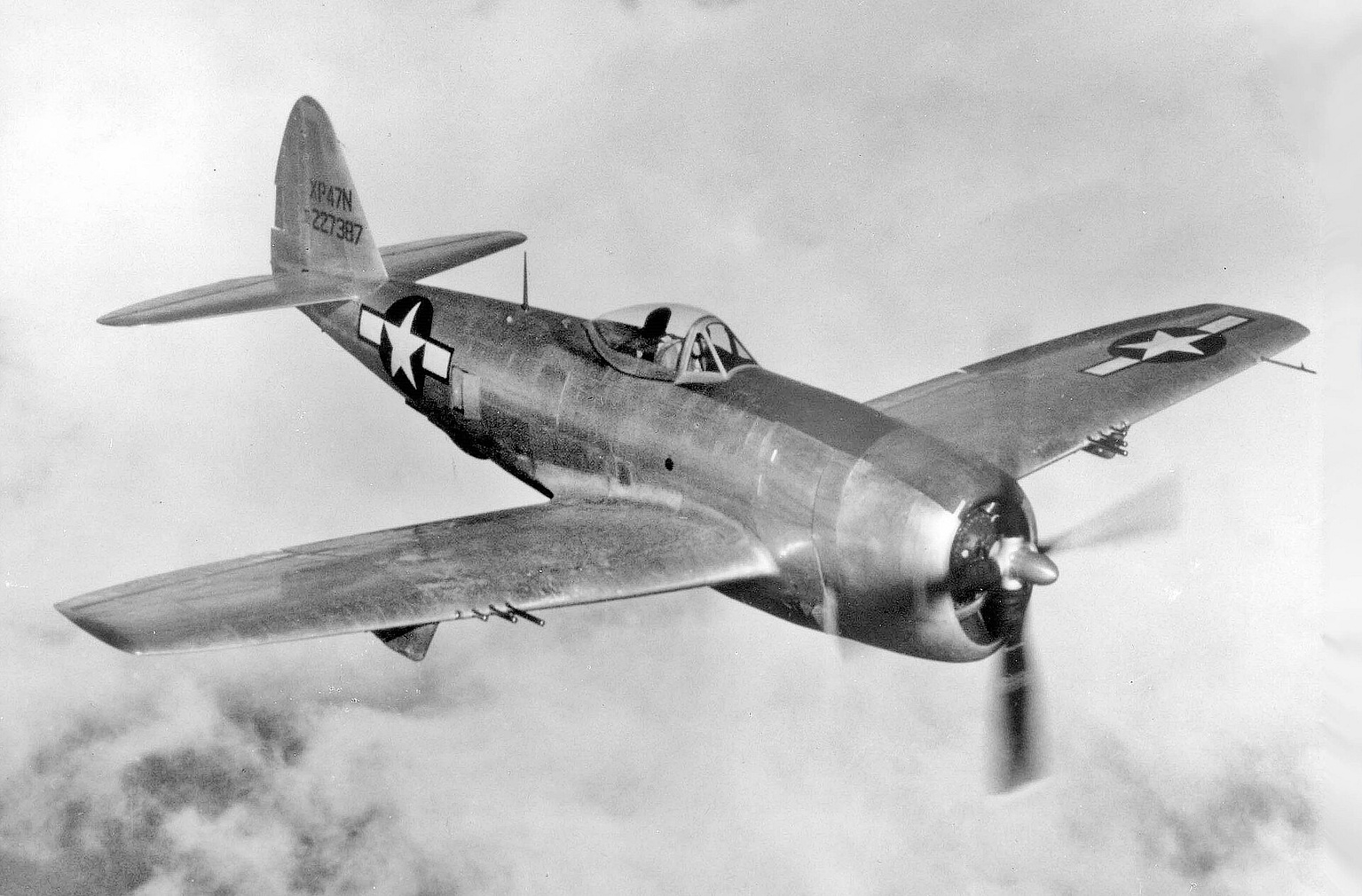
Republic P-47 Thunderbolt
“The Jug”
The biggest and heaviest single-engine piston fighter of the Second World War — a turbo-supercharged brute that escorted bombers at the edge of the stratosphere, then became the Allies’ most devastating ground-attack aircraft.
Built around an engine — and built to take a beating
In June 1940, as the Battle of Britain raged, Republic Aviation’s chief engineer Alexander Kartveli — a Georgian émigré who had worked for Blériot and Fokker — laid out a fighter unlike any other. Rather than draw an airframe and then find an engine, Kartveli started with the powerplant: the enormous 18-cylinder, turbo-supercharged Pratt & Whitney R-2800 Double Wasp radial and the maze of ducting its turbocharger demanded. Ordered as the XP-47B on 6 September 1940 and first flown on 6 May 1941, the result was the biggest and heaviest single-engine piston fighter of the war — a deep-bellied machine that tipped the scales past 17,000 lb loaded and carried eight .50-calibre Browning machine guns.
Thunderbolts reached England in 1942 and flew their first combat sweeps over occupied Europe in the spring of 1943 with the 4th and 56th Fighter Groups. Up high the Jug was in its element: the turbo-supercharger fed the R-2800 near-sea-level power above 25,000 ft, and nothing in the sky could out-dive it. But even with drop tanks it could not reach the deepest German targets, and from late 1943 the longer-legged P-51 Mustang took over primary long-range bomber escort. The Thunderbolt was handed a new job — and it found its true calling in it.
From the spring of 1944 the P-47 became the Allies’ pre-eminent fighter-bomber. Ranging over Normandy, the Falaise Gap and beyond, Ninth Air Force Thunderbolts strafed and rocketed German road and rail traffic into wreckage; USAAF tallies credit the type with thousands of locomotives, tens of thousands of railway cars and trucks, and thousands of armoured vehicles destroyed. What made it possible was the aircraft’s legendary toughness: the air-cooled radial had no coolant system to puncture, the engine itself formed a two-ton shield ahead of the pilot, and Jugs came home with cylinders shot away and fuselages riddled. By the time production ended in December 1945, Republic and its partners had built about 15,600 — more than any other American fighter in history.
01The Republic P-47 Thunderbolt’s nickname: why pilots called it the ‘Jug’
The most-repeated explanation is the simplest: the Thunderbolt’s fat, bottle-shaped fuselage reminded ground crews of a glass milk jug of the era. A more romantic story holds that “Jug” was short for “Juggernaut,” a nod to its size and hitting power — a version happily embraced by wartime public affairs. Neither origin is firmly documented, so the milk-jug shape is the safer bet, with juggernaut treated as folk etymology. Either way the nickname stuck, and no P-47 pilot ever seemed to mind it.
What makes it special
A turbocharger buried behind the pilot
Kartveli placed the General Electric turbo-supercharger in the rear fuselage, not on the engine. Exhaust from all 18 cylinders piped aft to spin the turbine, then compressed air ran forward through an intercooler to the carburettor. That ductwork is why the Jug was so deep and heavy — but it let the R-2800 make near-sea-level power above 25,000 ft, giving the Thunderbolt its high-altitude edge and a terminal dive nothing could match.
Built to bring its pilot home
The air-cooled radial had no radiator or coolant lines to sever, so a P-47 could keep flying with a whole cylinder shot away. The two-ton engine also formed a shield in front of the cockpit, and the pilot sat behind armour plate. Combat losses ran under 0.7% per sortie. Ace Robert Johnson famously limped home after taking some 21 cannon shells and 200-plus bullets from an Fw 190.
Eight fifties and a two-tonne punch
The Thunderbolt carried eight .50-calibre M2 Brownings — about 12.7 lb of lead per second, well above its rivals — plus up to roughly 2,500 lb of bombs or ten 5-inch HVAR rockets. That salvo, likened to a battery of field guns, shredded German rail, road and armoured columns and made the Jug the Allies’ deadliest ground-attack fighter in the West.
02The Republic P-47 Thunderbolt’s engine: how a rear-fuselage turbo made it a high-altitude fighter
The R-2800 Double Wasp was an 18-cylinder, two-row air-cooled radial rated at about 2,000 hp for take-off, and up to roughly 2,400–2,500 hp with water injection on late P-47D engines. Its high-altitude secret was the ducting: ambient air entered under the engine, was compressed and heated by the rear-fuselage turbo-supercharger, passed through an intercooler venting out the fuselage sides, and only then reached the carburettor. The system was heavy and complex, but it kept the engine breathing thin air at 30,000 ft — where the Jug fought best and dived like a stone.
03The Republic P-47 Thunderbolt as a fighter-bomber: what eight fifties and a rocket salvo did to the Wehrmacht
Once the P-51 took over long-range escort in late 1943, the Thunderbolt turned to the ground war and dominated it. Across the European theatre USAAF Thunderbolts are credited with wrecking on the order of 9,000 locomotives, 86,000 railway cars, 68,000 trucks and 6,000 armoured vehicles. The Brazilian squadron alone claimed 1,304 vehicles, 250 railway cars and 25 bridges. Eight fifties, up to 2,500 lb of bombs and rockets, and an airframe that could absorb ground fire made the Jug the aircraft German drivers feared on every road in daylight.
Full specifications
Airframe & Performance (P-47D)
- צוות
- 1
- מֶשֶׁך
- 11.0 m · 36 ft 1 in
- מוּטַת כְּנָפַים
- 12.4 m · 40 ft 9 in
- גוֹבַה
- 4.32 m · 14 ft 2 in
- משקל ריק
- ~4,540 kg · ~10,000 lb
- Max takeoff weight
- ~7,900 kg · ~17,500 lb
- Max speed
- 697 km/h · 433 mph (at ~30,000 ft)
- תקרת השירות
- ~12,800 m · ~42,000 ft
- Range (drop tanks)
- ~1,800 km · ~1,100 mi
- קצב הטיפוס
- ~14 m/s · ~2,780 ft/min
Propulsion & Armament
- מָנוֹעַ
- 1 × Pratt & Whitney R-2800-59 Double Wasp
- Power
- ~2,000 hp; up to ~2,500 hp with water injection
- Guns
- 8 × .50-cal M2 Browning (~3,400 rounds)
- Ordnance
- up to ~1,130 kg (2,500 lb) bombs + 10 × 5-in rockets
- First flight
- 6 May 1941 (XP-47B)
- Built
- ~15,600 (1941–1945)
- Unit cost
- ~$85,000 (1944, flyaway)
- Cost per flight hour
- No reliable public figure (rare warbirds)
04The Republic P-47 Thunderbolt’s cost: what a Jug was worth then and now
In wartime dollars the Thunderbolt cost roughly $85,000 per aircraft at the 1944 flyaway price — cheaper than a P-38 Lightning and comparable to a P-51 Mustang, with early examples costing more. Because the type left frontline service decades ago, there is no meaningful modern cost-per-flight-hour figure: only a handful of airworthy warbirds survive, and their owners burn expensive avgas through a thirsty 2,000-hp radial. Any precise operating cost you see quoted for a flying P-47 today is a private estimate, not a published rate.
From drawing board to the last piston fighter
Kartveli’s design
Republic submits the XP-47B; the Army orders a prototype on 6 September, built around the turbo-supercharged R-2800.
First flight
The XP-47B flies on 6 May — then the largest and heaviest single-engine fighter yet built.
Into combat
The 4th and 56th Fighter Groups fly the first P-47 sweeps over Europe in spring 1943 as high-altitude bomber escorts.
The Mustang takes escort
From late 1943 the longer-ranged P-51 assumes deep bomber escort, freeing the Jug for the ground war.
The fighter-bomber war
After D-Day, Ninth Air Force Thunderbolts wreck German road and rail traffic across Normandy and the Falaise Gap.
Gabreski goes down
On 20 July, top USAAF ETO ace Gabby Gabreski strikes his propeller on a strafing run and is taken prisoner.
Production ends
Final deliveries in December bring the total to about 15,600 — the most of any US fighter.
The last Jugs
Peru retires the last operational P-47s, ending roughly a quarter-century of Thunderbolt service.
From the cockpit: twelve Thunderbolt stories
The plane that would not die
Robert Johnson flew home in a flying sieve after an Fw 190 emptied its guns into him.
Read the full story
Gabby Gabreski’s last pass
America’s top ace in Europe scored 28 — then lost it all on one more strafing run.
Read the full story
Why ‘Jug’?
A milk jug, not a juggernaut — probably.
Read the full story
Handing off to the Mustang
The Jug cleared the skies; the Mustang went the distance.
Read the full story
Death in the Falaise Gap
Eight guns and rockets turned a German retreat into a slaughter.
Read the full story
Home on 17 cylinders
The Double Wasp shrugged off shot-away cylinders.
Read the full story
Thunderbolts with red stars
The Soviets got about 195 Jugs and never quite warmed to them.
Read the full story
Big, burly and just right for the jungle
830 Thunderbolts fought Japan under British roundels.
Read the full story
Senta a Pua!
South America’s only fighter squadron in the war flew the Jug over Italy.
Read the full story
The Aztec Eagles
Escuadrón 201 flew the Mexican flag over Luzon.
Read the full story
Razorback to bubbletop
Cutting down the spine to let pilots see behind them.
Read the full story
The long Latin twilight
The Jug soldiered on into the 1960s.
Read the full story
The Thunderbolt in pictures
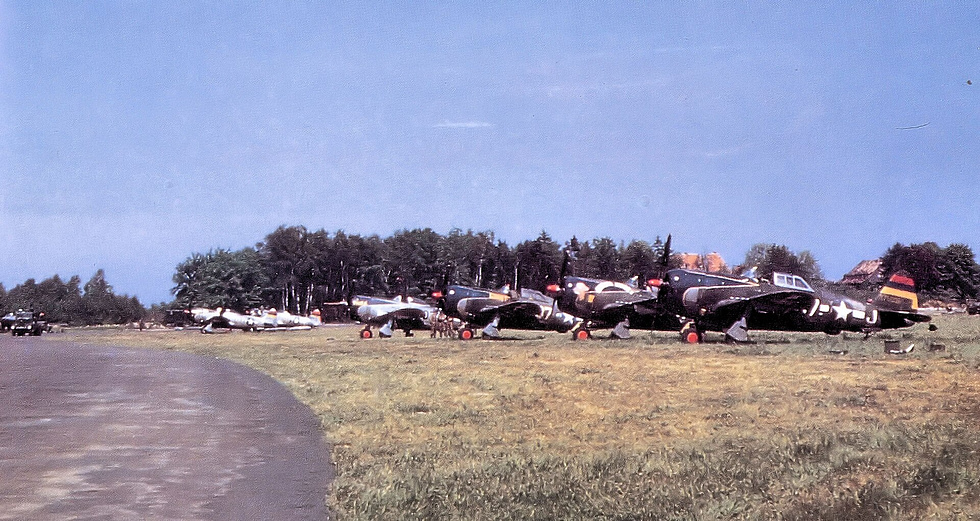
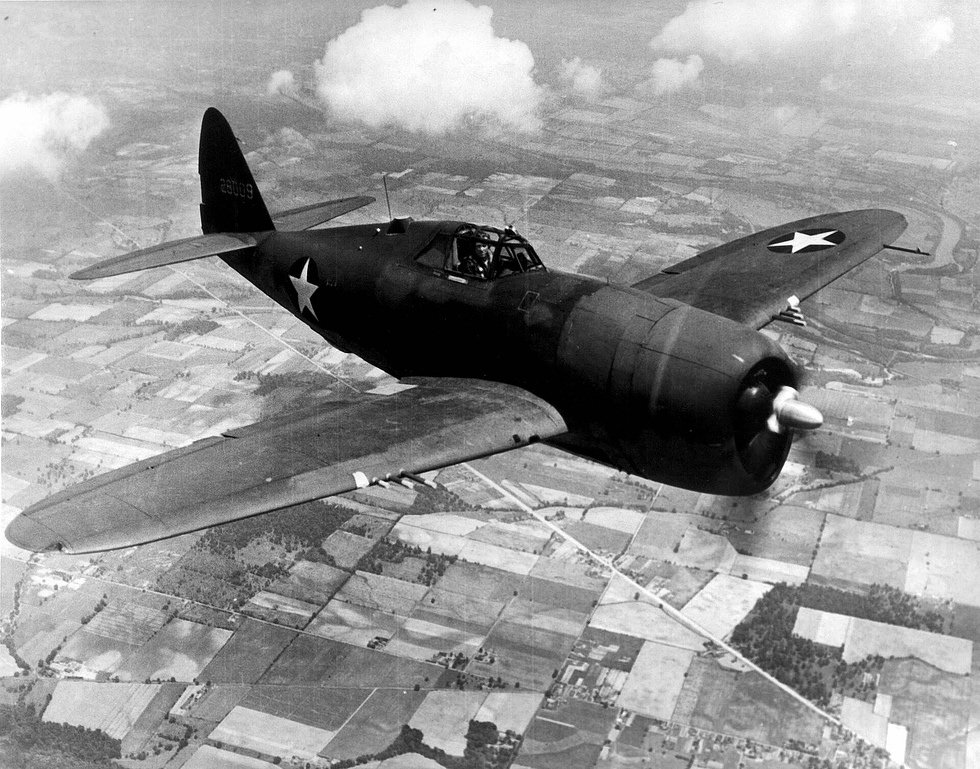
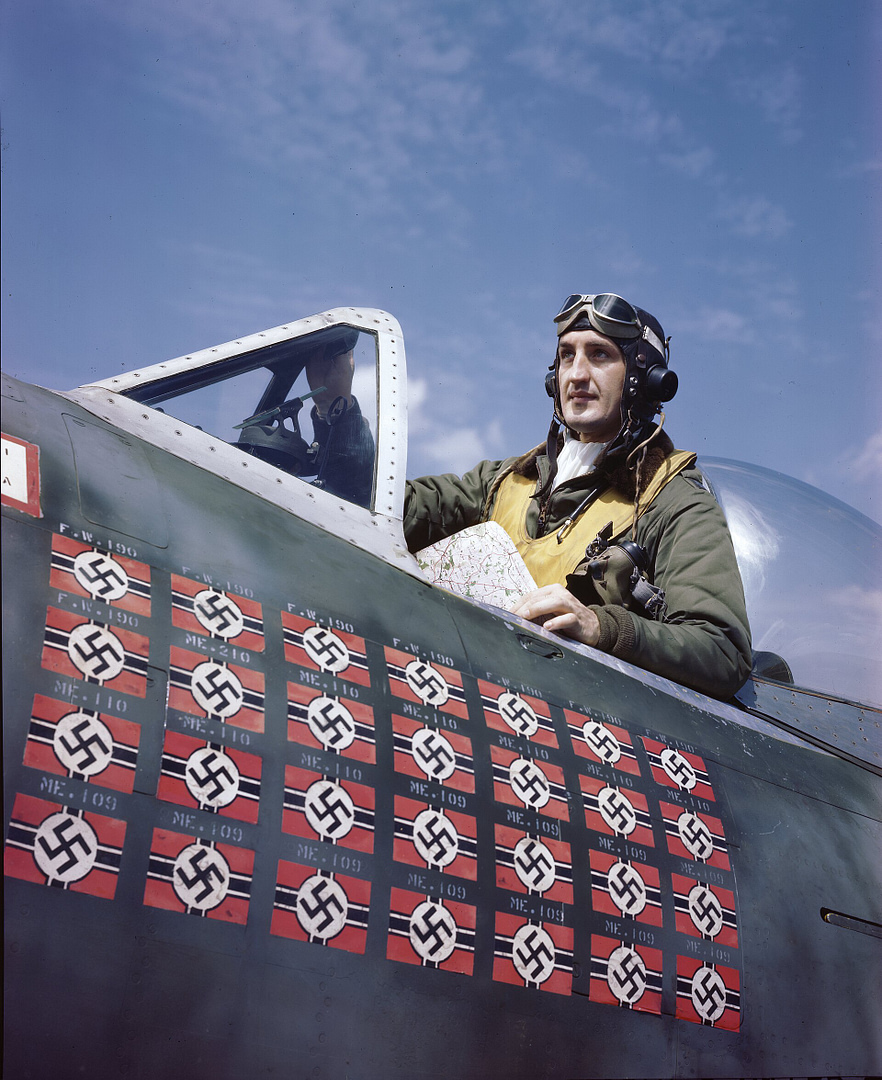
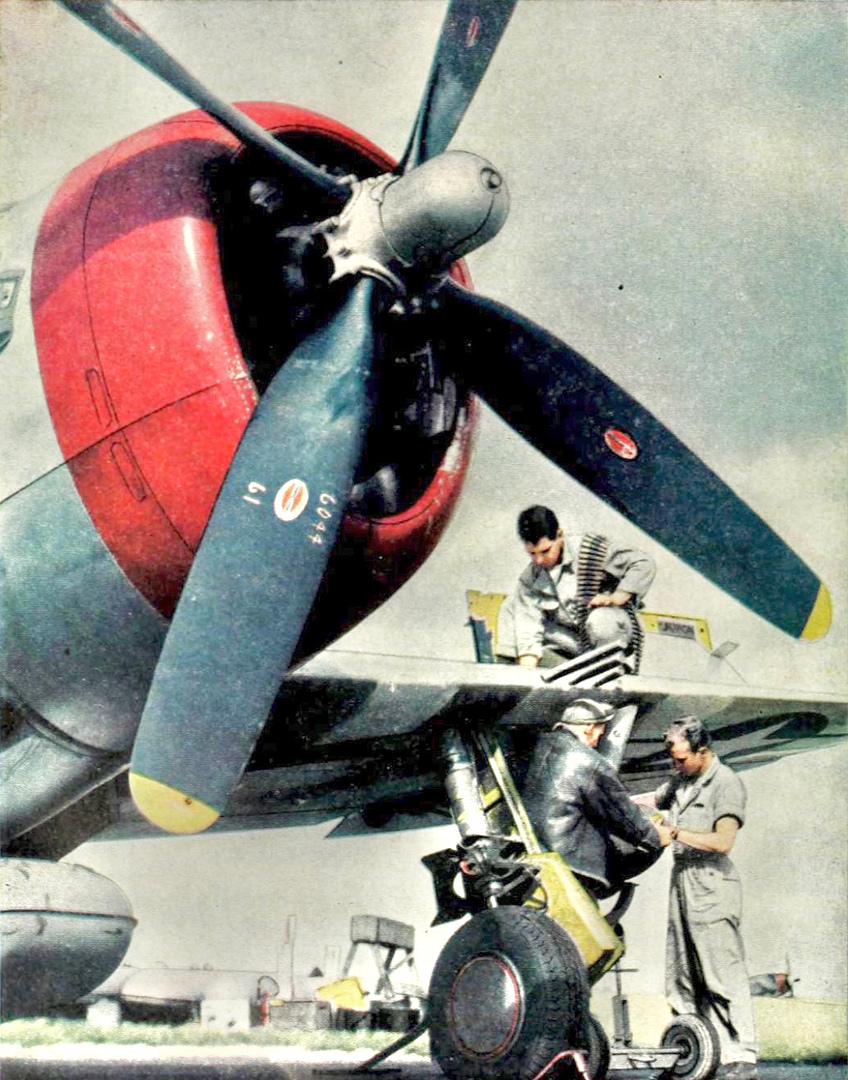
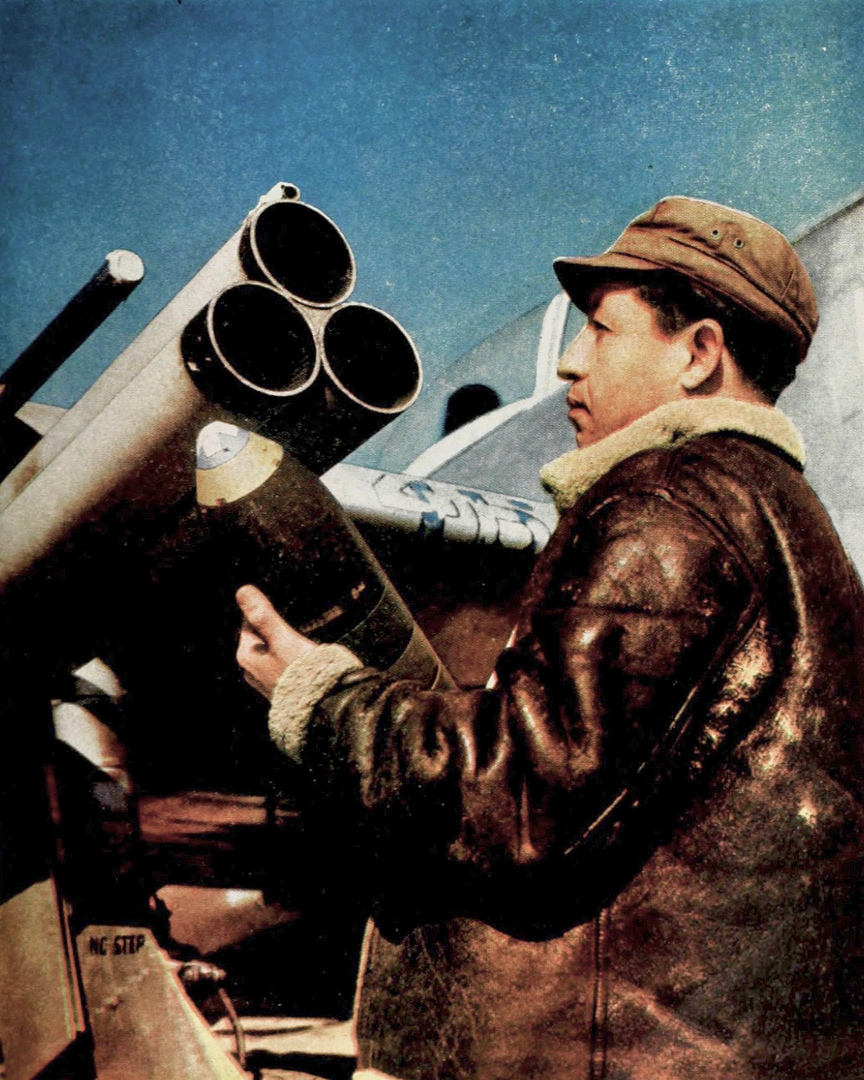
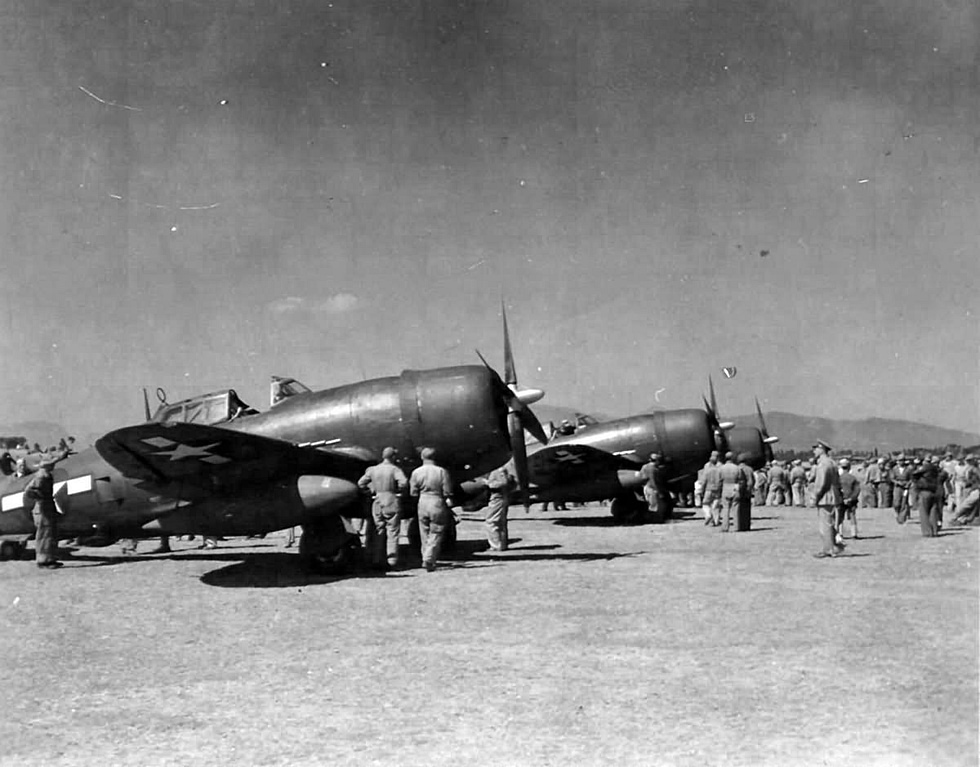
The Thunderbolt in motion
A curated, high-authority Thunderbolt film is coming soon to this exhibit. In the meantime, explore the photo gallery and the twelve stories above for the Jug’s history in detail.
Where the Thunderbolt flew
The score that defines it
The Thunderbolt’s record is written less in dogfights than in destruction. Even so, USAAF Thunderbolts were credited with shooting down 3,572 German aircraft — more than any other US fighter type — while flying about 546,000 sorties, at a loss rate under 0.7 percent per sortie. Its most enduring victories, though, were on the ground.
Compare the combat record of every military aircraft. Figures as of July 2026.
Everything people ask about the P-47
Can I fly in a P-47?
How many P-47 Thunderbolts were built?
Why was the P-47 called the “Jug”?
What engine did the P-47 use?
Was the P-47 better than the P-51 Mustang?
Who were the top P-47 aces?
Can you still fly a P-47 today?
You can’t fly the Thunderbolt.
These, you can.
Some legends only live in museums — others are fuelled and waiting. MiGFlug has put civilians in real military jet cockpits since 2004.
 Fly the L-39 AlbatrosThe world’s most-flown jet trainer — aerobatics included
 Fly the F-104 Starfighter“The missile with a man in it”
 Fly the MiG-21The Cold War’s most-produced jet
 טסו על ה-T-33 Shooting StarAmerica’s first jet trainer
 Fly the DH VampireA piece of early jet history
 Fly the S.211Agile Italian jet trainer
 Fly the MB-326The classic Aermacchi jet
 Fly the MiG-15The Soviet legend of the Korean War
Continue the tour
Every fact, checked
- National Museum of the US Air Force — P-47D fact sheetOfficial dimensions, performance, engine and armament figures.
- Smithsonian National Air and Space MuseumProduction totals, ground-attack tallies, kill ratio and loss rate.
- This Day in AviationKartveli’s design, the XP-47B contract and the 6 May 1941 first flight.
- HistoryNet — the P-47 “Jug”Nickname, firepower, Luftwaffe kills, ground-attack record and the escort handoff.
- HistoryNet — Gabby GabreskiThe 20 July 1944 prop-strike, capture, and his two-war ace record.
- acepilots.com — Robert S. JohnsonThe 26 June 1943 battle-damage survival and Johnson’s 27 victories.
- History of War — P-47 in RAF serviceThe 830 RAF Thunderbolts and 16 squadrons in Burma.
- The Lyncean Group — P-47 powerplantThe rear-fuselage turbo-supercharger, intercooler and exhaust ducting.