
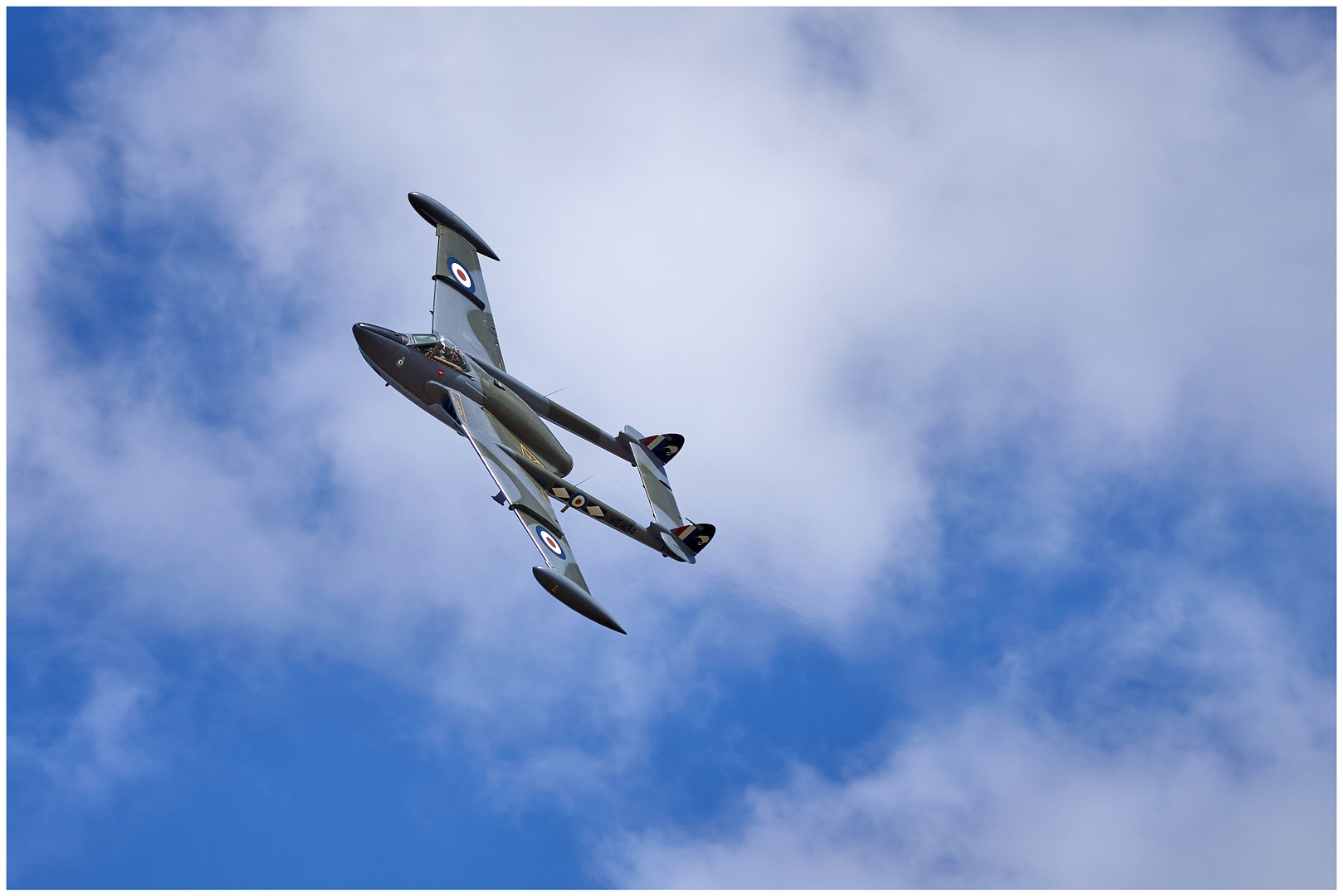
de Havilland Venom
& Sea Venom
Britain’s twin-boom early jet, developed from the Vampire with a thinner wing and a more powerful de Havilland Ghost engine — a fighter-bomber, all-weather night-fighter and carrier-borne naval strike jet that fought at Suez and flew on in Switzerland until 1983.
The de Havilland Venom and Sea Venom: Britain’s twin-boom jet fighter-bomber
の de Havilland Venom was born from a simple wish: to take the promising but underpowered 吸血鬼 and make it faster, higher-flying and harder-hitting. De Havilland kept the Vampire’s distinctive twin-boom layout — a short, egg-shaped fuselage pod with the tail carried on two slender booms — but gave the new aircraft a thinner, sharper wing and a far more powerful engine. The result, first flown on 2 September 1949, looked like a Vampire but flew like a different animal.
The transformation came from the de Havilland Ghost, a big centrifugal-flow turbojet developed from the Vampire’s Goblin. Producing around 4,850 lb of thrust, it pushed the Venom to roughly 640 mph and up towards 40,000 feet — a genuine improvement in the era when jet fighters were still finding their feet. Armed with four 20 mm Hispano cannon and able to carry bombs and rockets under its wings, the single-seat Venom FB.1 entered RAF service in 1952 as a fast, punchy fighter-bomber.
The Venom was never a world-beater in the way the swept-wing ホーカーハンター that followed it was — its straight wing and early engine put it firmly in the first jet generation. But it was rugged, simple and effective, and it arrived just when the RAF needed numbers. It served across the world, and above all in the heat: Venoms flew ground-attack strikes in the Malayan Emergency — more than 300 sorties against guerrillas before the type was withdrawn from Malaya in late 1957 — and operated in the tense skies over Aden and the Middle East.
De Havilland also turned the Venom into a night-fighter. The two-seat NF.2 and improved NF.3 carried an airborne-interception radar and a second crewman to work it, giving Fighter Command an all-weather interceptor while more modern designs were still on the drawing board. That radar-equipped, two-seat formula led directly to the aircraft’s most distinctive branch — the navy version.
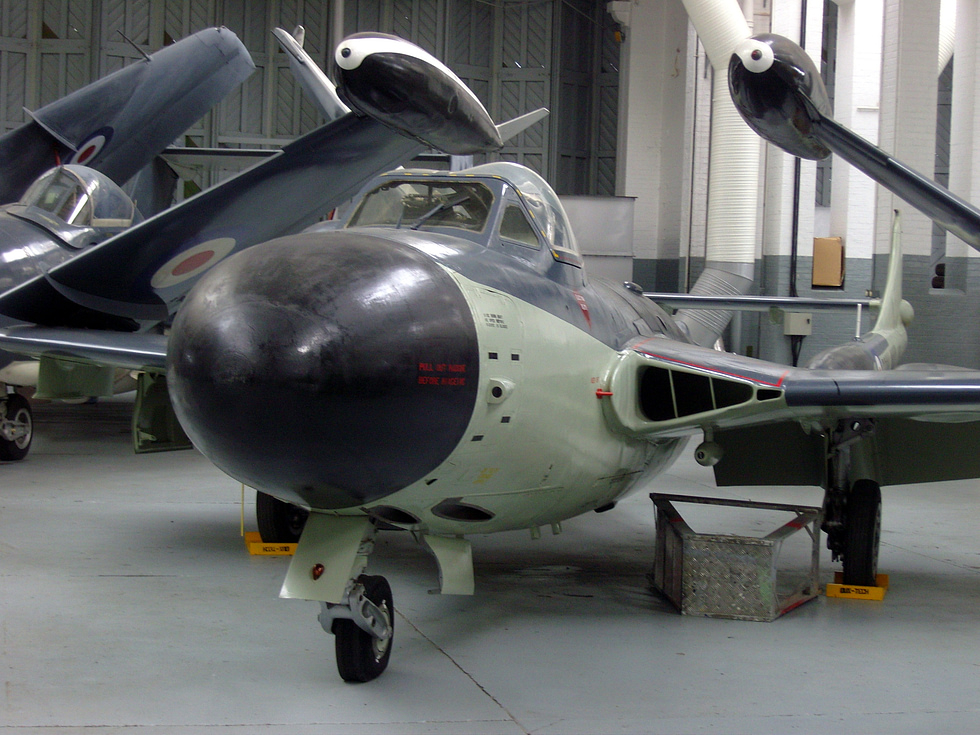
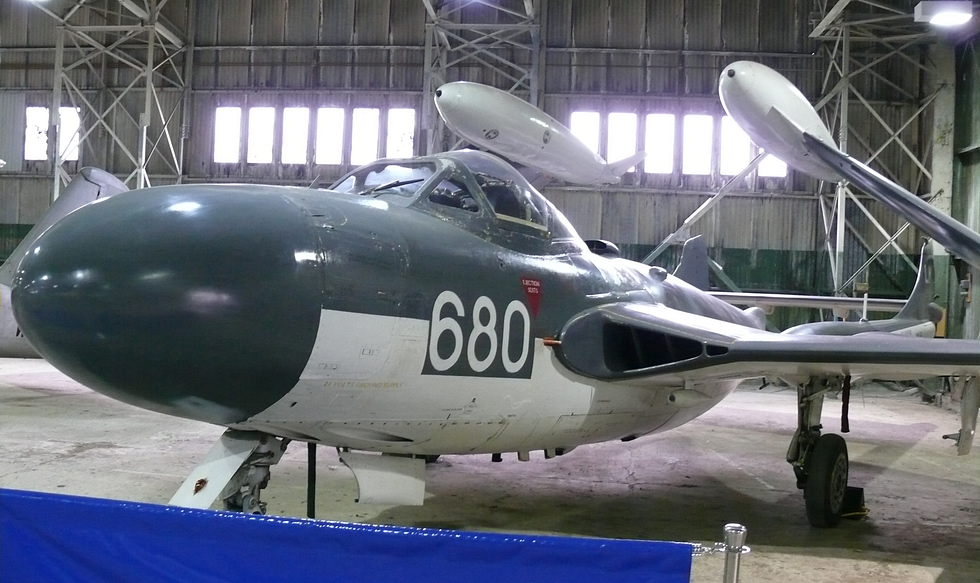
の Sea Venom was a proper carrier aeroplane: folding wings, an arrester hook, a strengthened long-stroke undercarriage and, up front, the same two-seat radar cockpit as the night-fighter. First flown in 1951, it gave the Royal Navy’s Fleet Air Arm its first effective all-weather jet. Sea Venoms saw combat in the 1956 Suez Crisis, flying strike sorties from the carriers HMS Eagle, Albion and Bulwark during Operation Musketeer. The French Navy liked the design enough to build it under licence as the Aquilon, and the Royal Australian Navy flew its own Sea Venoms well into the 1960s.
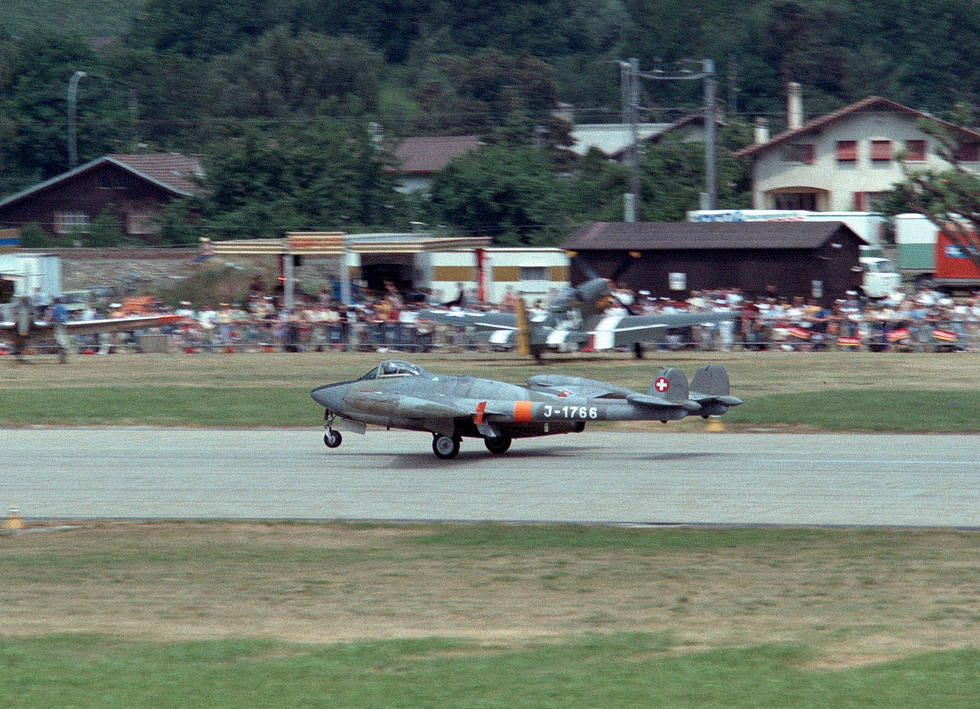
The Venom’s longest and most famous career, though, was neutral. スイス license-built the type in large numbers and flew it from Alpine airfields for three decades — long after the RAF had moved on. When the Swiss Air Force finally retired its Venoms in 1983, they were the last operational Venoms anywhere in the world, a straight-winged relic of the early jet age still earning its keep among the mountains a generation after it first flew.
01The de Havilland Venom’s origins: how a better wing and the Ghost engine transformed the Vampire
The Vampire had proved the twin-boom, single-jet layout worked, but by the late 1940s it was running out of performance. De Havilland’s answer was not a clean-sheet design but a thorough reworking. The new thinner wing, with a modest leading-edge sweep on its inner section, delayed the drag rise of high-speed flight and let the aircraft fly faster and higher before compressibility bit. Under the skin went the de Havilland Ghost — a scaled-up development of the Goblin centrifugal turbojet, and notable in its own right as one of the first jet engines certified for civil airliner use, in the de Havilland Comet.
The pairing worked. Where the Vampire topped out around 540 mph, the Venom pushed past 600, with a markedly better climb and ceiling. It kept the Vampire’s virtues — light, simple, easy to build and maintain — while closing much of the gap to the swept-wing fighters just appearing. Officially the DH.112, the Venom was in many ways the Vampire finally allowed to reach its potential, and it became the bridge between de Havilland’s first jet and the jet age proper.
What makes the de Havilland Venom special
The twin-boom layout — a Vampire made sharper
Like the Vampire before it, the Venom carried its tail on two slender booms either side of a stubby central pod, keeping the jet pipe short and efficient in an age when early engines lost thrust down long ducts. What set the Venom apart was its new thin wing, with a slight leading-edge sweep inboard, that let it fly faster and higher than the Vampire while keeping the same friendly, forgiving handling. It is one of the most recognisable shapes of the early jet age.
The de Havilland Ghost — the engine that made it possible
The Venom’s performance came from a single de Havilland Ghost centrifugal-flow turbojet of roughly 4,850 lb thrust, a development of the Vampire’s Goblin. Simple and robust, the Ghost was reliable enough that a version became one of the first turbojets certified to power a civil airliner. In the Venom it delivered a top speed near 640 mph and a ceiling close to 40,000 feet — a real step up over its predecessor.
One airframe, three jobs — and a naval version
Few early jets stretched as far as the Venom. The single-seat FB.1 and FB.4 were fighter-bombers with four 20 mm cannon and underwing ordnance; the two-seat NF.2 and NF.3 added radar to become all-weather night-fighters; and the navalised Sea Venom gained folding wings, an arrester hook and a strengthened undercarriage to fly from carrier decks. From one basic design de Havilland covered strike, interception and naval aviation.
02The Sea Venom: how the RAF’s night-fighter went to sea with the Fleet Air Arm
Turning a land-based night-fighter into a carrier aircraft is never trivial, and the Sea Venom shows why. The Royal Navy needed an all-weather jet that could find and attack targets in darkness or cloud, so de Havilland took the two-seat, radar-equipped NF layout and made it fit for the sea. The wings were given folding tips to fit carrier lifts and hangars; an arrester hook and a stronger, long-stroke undercarriage absorbed the punishment of deck landings; and the airframe was strengthened throughout for catapult launches.
The result, first flown in 1951, gave the Fleet Air Arm its first genuinely capable all-weather jet fighter. Sea Venoms flew strike missions during the 1956 Suez operation from British carriers, and the type served through the late 1950s and into the 1960s. Its influence spread abroad, too: France built a license version, the SNCASE Aquilon, for its own navy, and Australia operated Sea Venoms from shore and ship. The naval Venom is a neat example of how a single sound design could be adapted far beyond its original brief.
03The Venom in Swiss service: why Switzerland flew it longer than anyone
The Venom’s most remarkable career belonged to a country that never fired it in anger. スイス chose the type for its air force in the early 1950s and built it under licence at home, producing large numbers of the fighter-bomber variants. The straight-winged, docile Venom suited Swiss needs perfectly: it could operate from short Alpine airfields, was cheap and simple to maintain, and its rugged airframe stood up to decades of hard mountain flying.
Long after Britain, France and Australia had retired their Venoms, Switzerland kept flying. Its aircraft soldiered on through the 1960s and 1970s in the ground-attack and training roles, and only in 1983 did the Swiss Air Force finally withdraw the last examples — making them the last operational Venoms in the world. Many Swiss airframes survive today in museums and private hands, and it is thanks to Switzerland that the Venom remained a flying military aeroplane into the 1980s at all.
Full de Havilland Venom FB.1 specifications
Airframe & Performance
- クルー
- 1 (2 in night-fighter & Sea Venom)
- 長さ
- ~9.7 m (31 ft 10 in)
- 翼幅
- ~12.7 m (41 ft 8 in)
- 身長
- ~1.9 m (6 ft 2 in)
- 空虚重量
- ~4,175 kg (~9,200 lb)
- Max takeoff weight
- ~6,950 kg (~15,300 lb)
- Max speed
- ~1,030 km/h (640 mph)
- サービス天井
- ~12,000 m (~39,400 ft)
- Configuration
- Twin-boom, straight thin wing
- Wing
- Thinner than the Vampire, slight inner sweep
Propulsion, Armament & Systems
- エンジン
- 1 × de Havilland Ghost 103 turbojet
- Thrust
- ~21.6 kN (~4,850 lbf)
- 武装
- 4 × 20 mm Hispano cannon
- Ordnance
- Bombs & rocket projectiles underwing
- Radar (NF / Sea Venom)
- Airborne-interception radar, 2-seat
- First flight
- 2 September 1949
- Built
- ~1,430 including Sea Venom
- Unit cost
- No reliable public figure (1950s)
- Cost per flight hour
- No reliable public figure
04The de Havilland Venom’s costs: why no reliable unit price or cost-per-hour survives
The Venom was a product of the early-1950s British and Swiss defence procurement systems, bought in bulk under government contracts and, in Switzerland’s case, license-built at home. Prices were quoted in 1950s pounds and francs that mean little today, and no consistent, verified flyaway unit cost circulates in modern sources. Any single dollar figure you see attached to a Venom should be treated as an estimate rather than a documented price.
There is likewise no credible published cost-per-flight-hour for the type. Operating-cost accounting of the kind kept for modern jets simply was not compiled — or has not survived in the open record — for a first-generation fighter retired decades ago. For the Venom, treat all precise cost numbers with caution.
From Vampire successor to the last flying Venom
First flight
The DH.112 Venom, a thinner-winged, Ghost-powered development of the Vampire, makes its first flight on 2 September 1949.
The Sea Venom takes shape
The navalised Sea Venom flies for the first time and begins carrier trials — folding wings, arrester hook and a two-seat radar cockpit for the Fleet Air Arm.
RAF service
The single-seat Venom FB.1 enters Royal Air Force service as a fast fighter-bomber armed with four 20 mm cannon.
War in Malaya
RAF Venoms fly hundreds of ground-attack sorties against guerrillas during the Malayan Emergency before being withdrawn from the theatre in late 1957.
Suez
Sea Venoms fly strike missions from the carriers HMS Eagle, Albion and Bulwark during the Anglo-French Suez operation, Operation Musketeer.
Exported worldwide
Venoms and Sea Venoms serve with Switzerland, Sweden, France, Australia, Venezuela, Iraq, New Zealand and Italy — one of the most widely used early British jets.
RAF and navy retire the type
Faster swept-wing fighters such as the Hawker Hunter and Sea Vixen replace the Venom in British service through the early and mid 1960s.
The last Venoms
Switzerland retires its license-built Venoms — the final operational examples anywhere in the world, more than three decades after the first flight.
Twelve de Havilland Venom stories
A better wing and a bigger engine
The Venom was the Vampire reimagined — same twin booms, thinner wing, far more power.
Read the full story
From fighter to airliner
The Venom’s Ghost turbojet was reliable enough that a version powered the first jet airliner.
Read the full story
A hard-hitting fighter-bomber
With four 20 mm Hispano cannon plus bombs and rockets, the Venom FB packed a serious punch.
Read the full story
Three hundred strikes in the jungle
RAF Venoms flew hundreds of ground-attack sorties against insurgents during the Malayan Emergency.
Read the full story
Policing the Middle East
Venoms operated in the fierce heat over Aden and the Arabian approaches through the 1950s.
Read the full story
Radar in the twin boom
The two-seat NF.2 and NF.3 added radar and a second crewman to make an all-weather interceptor.
Read the full story
A jet for the carrier deck
Folding wings, a hook and a strengthened undercarriage turned the night-fighter into a naval jet.
Read the full story
Sea Venoms over Egypt
During Operation Musketeer, Sea Venoms flew strikes from British carriers against Egyptian targets.
Read the full story
France builds its own
The French Navy liked the Sea Venom enough to build a license version, the SNCASE Aquilon.
Read the full story
Australia’s Sea Venoms
The Royal Australian Navy flew its own Sea Venoms from carrier and shore into the 1960s.
Read the full story
Switzerland’s mountain jet
Switzerland license-built the Venom and flew it from Alpine airfields for three decades.
Read the full story
Still flying in 1983
When Switzerland finally retired its Venoms in 1983, they were the last operational examples on earth.
Read the full story
The de Havilland Venom in pictures
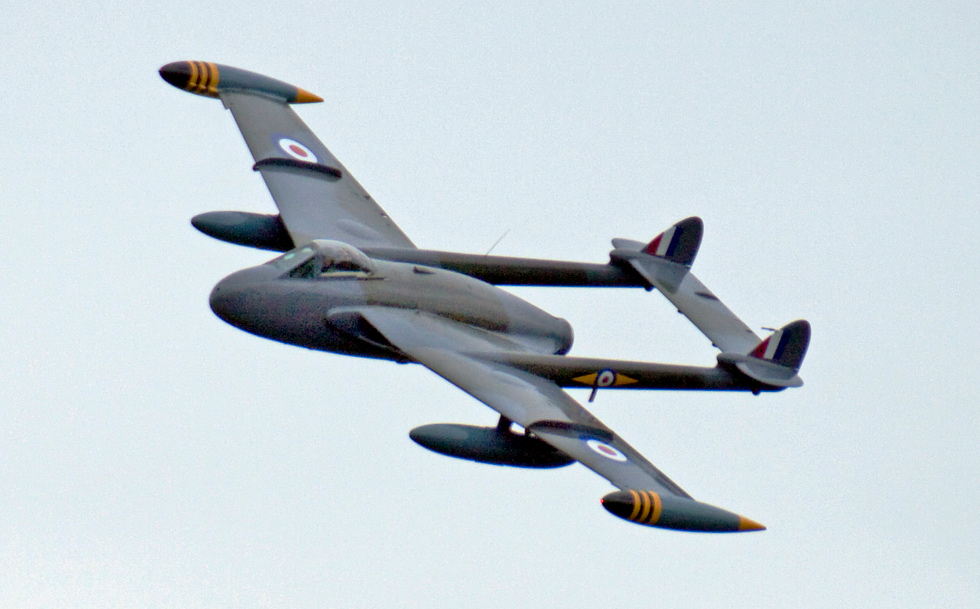
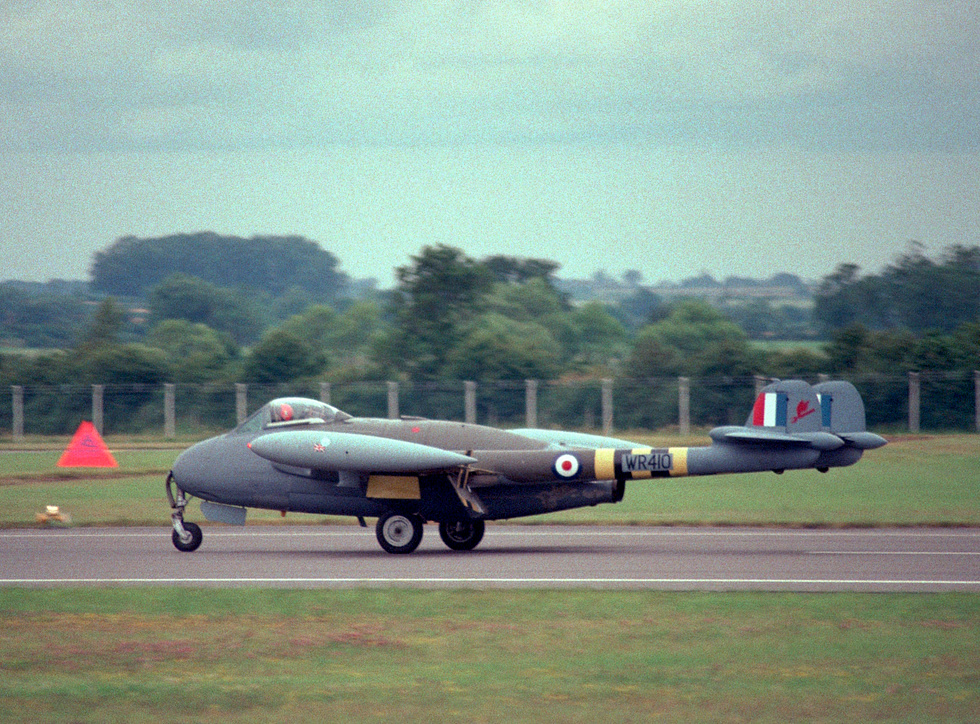
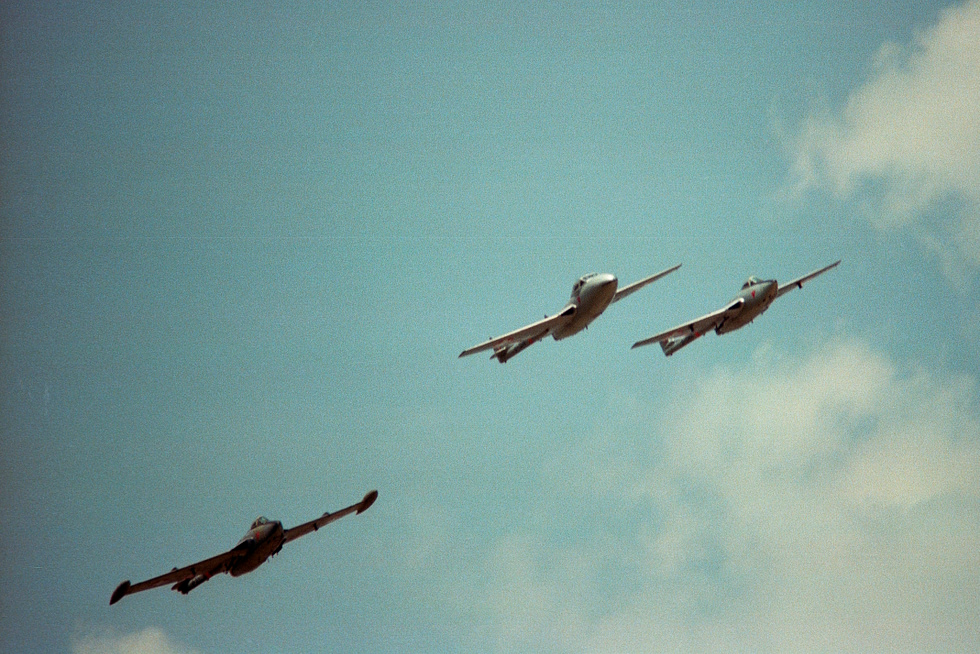
Where the de Havilland Venom flew
An early jet that fought on three continents and at sea
The Venom family never fought a great air battle, but it saw more real action than most first-generation jets. RAF Venoms flew hundreds of ground-attack sorties in the Malayan Emergency and policed the skies over Aden and the Middle East, while the Fleet Air Arm’s Sea Venoms struck Egyptian targets from carriers during the 1956 Suez Crisis. It was, above all, a workhorse — a rugged strike and all-weather aircraft that turned up wherever Britain needed jets in the 1950s.
See how later jets compare in the combat record of every military aircraft. The Venom’s legacy is breadth — a single design that served as fighter-bomber, night-fighter and naval strike jet across a dozen air arms.
Everything people ask about the de Havilland Venom
Can I fly in a de Havilland Venom?
What is the difference between the Venom and the Vampire?
What was the Sea Venom?
Did the Venom see combat?
Why did Switzerland fly the Venom until 1983?
Who else operated the Venom?
You can’t fly the Venom.
These, you can.
Some legends only live in museums — others are fuelled and waiting. MiGFlug has put civilians in real military jet cockpits since 2004.
 Fly the L-39 AlbatrosThe world’s most-flown jet trainer — aerobatics included
 Fly the F-104 Starfighter“The missile with a man in it”
 Fly the MiG-21The Cold War’s most-produced jet
 T-33シューティングスターを操縦しようAmerica’s first jet trainer
 Fly the DH VampireA piece of early jet history
 Fly the S.211Agile Italian jet trainer
 Fly the MB-326The classic Aermacchi jet
 Fly the MiG-15The Soviet legend of the Korean War
Continue the tour
Every fact, checked
- RAF Museum — de Havilland DH.112 VenomDevelopment from the Vampire, the Ghost engine, RAF service and variant history.
- Fleet Air Arm MuseumThe Sea Venom as the Royal Navy’s first all-weather jet and its Suez combat service.
- Imperial War MuseumsThe 1956 Suez operation and British carrier air power in the 1950s.
- Military Factory — de Havilland DH.112 VenomSpecifications, variants, production totals and the list of operators.
- Military Factory — de Havilland DH.112 Sea VenomSea Venom naval features, the French Aquilon and Australian service.
- BAE Systems Heritage — de Havilland VenomCorporate history of the de Havilland design and its production.
- National Museum of the US Air ForceReference for early-jet-age fighter-bomber development context.
- Thunder & Lightnings — de Havilland VenomSurviving-airframe history and preserved Swiss and RAF Venom examples.