
North American B-45 Tornado
America’s first operational jet bomber — and the first US jet able to drop an atomic bomb. A four-engined interim striker whose reconnaissance version flew some of the most dangerous missions of the early Cold War.
ストーリー
The North American B-45 Tornado: America’s first jet bomber
The North American B-45 Tornado holds a permanent place in aviation history as the first operational jet bomber built by the United States, and the first American jet aircraft capable of carrying an atomic bomb. It was not a beautiful aircraft, nor a long-lived one, and it was soon overshadowed by the sleek swept-wing bombers that followed it. But when it entered service at the end of the 1940s, the Tornado gave the young United States Air Force a jet-powered strategic striking arm for the first time — and its reconnaissance version went on to fly some of the most secret and dangerous missions of the early Cold War.
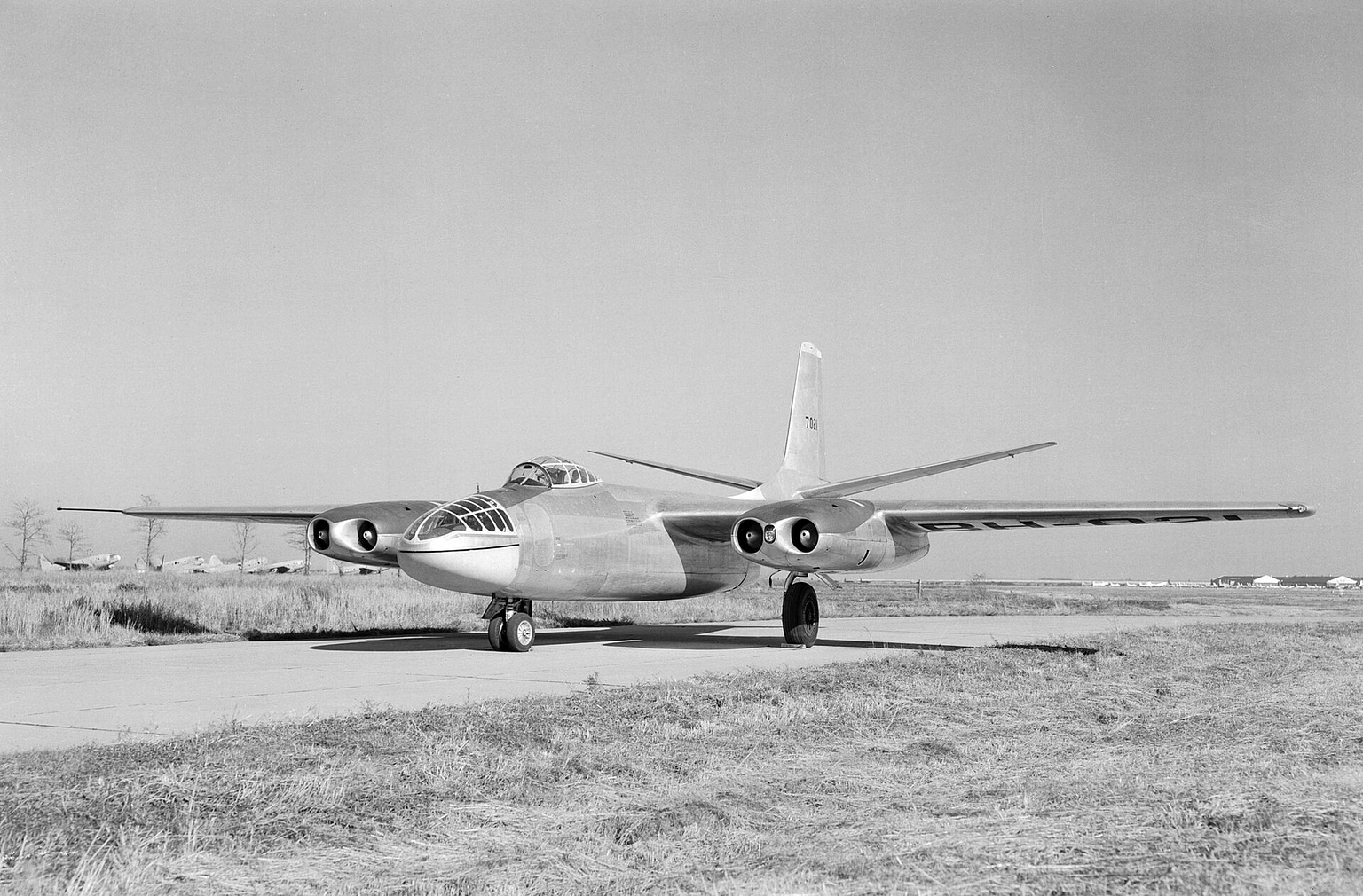
The Tornado was designed by North American Aviation, the company behind the P-51 Mustang and the F-86 Sabre, in the immediate aftermath of the Second World War, when jet propulsion was transforming military aviation. The prototype, the XB-45, first flew in March 1947. It was a conventional-looking aircraft by later standards — a straight, unswept wing, a high-set fuselage with a glazed nose for the bombardier, and four turbojet engines grouped in two large nacelles slung under the wings, two engines to a nacelle. It carried a crew of four: two pilots seated in tandem under a fighter-style canopy, a bombardier-navigator in the glazed nose, and a tail gunner in the rear to defend against fighters.
Power was both the making and the limiting of the Tornado. The first aircraft used Allison J35 turbojets, but the definitive versions flew behind the more powerful General Electric J47 — the same engine family that gave the F-86 Sabre its edge — four of them together hauling the big bomber to speeds no piston bomber could match. Yet the straight wing that made the B-45 stable and easy to fly also capped its performance: it could not approach the speeds a swept wing would soon unlock, and that limitation was built into the airframe from the day it was drawn.
“The first American jet bomber, and the first US jet that could drop an atomic bomb — the Tornado carried the Air Force into the jet age.”— the B-45’s place in history, in a sentence
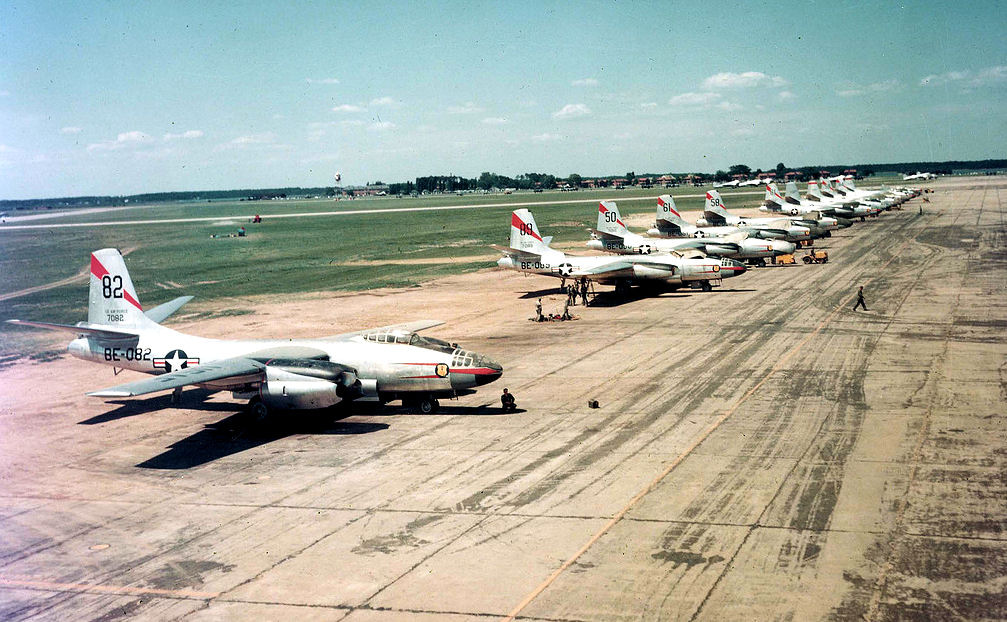
The B-45A entered service with the USAF’s Strategic Air Command around 1948 and 1949. Its significance was enormous: for the first time the United States had a jet bomber in squadron service, able to fly higher and faster than the piston-engined bombers it supplemented. Just as importantly, the Tornado was developed into a nuclear-capable aircraft, and in 1952 nuclear-armed B-45As of the 47th Bombardment Wing were deployed to England, at RAF Sculthorpe, giving the West a jet-borne atomic strike capability positioned within reach of the Soviet Union. It was a landmark in the nuclear standoff that would define the next four decades.
For all its importance, though, the B-45 was very much an interim aircraft. It had been designed to a wartime-era conception of what a jet bomber should be, with its straight wing and podded engines, and the state of the art was moving fast. Boeing’s revolutionary swept-wing B-47 Stratojet — far faster, longer-ranged and more capable — was already in development, and once it matured it would render the straight-winged Tornado obsolete as a bomber. The B-45 was, in effect, a bridge: the aircraft that let the Air Force learn to operate jet bombers while the definitive design was perfected.
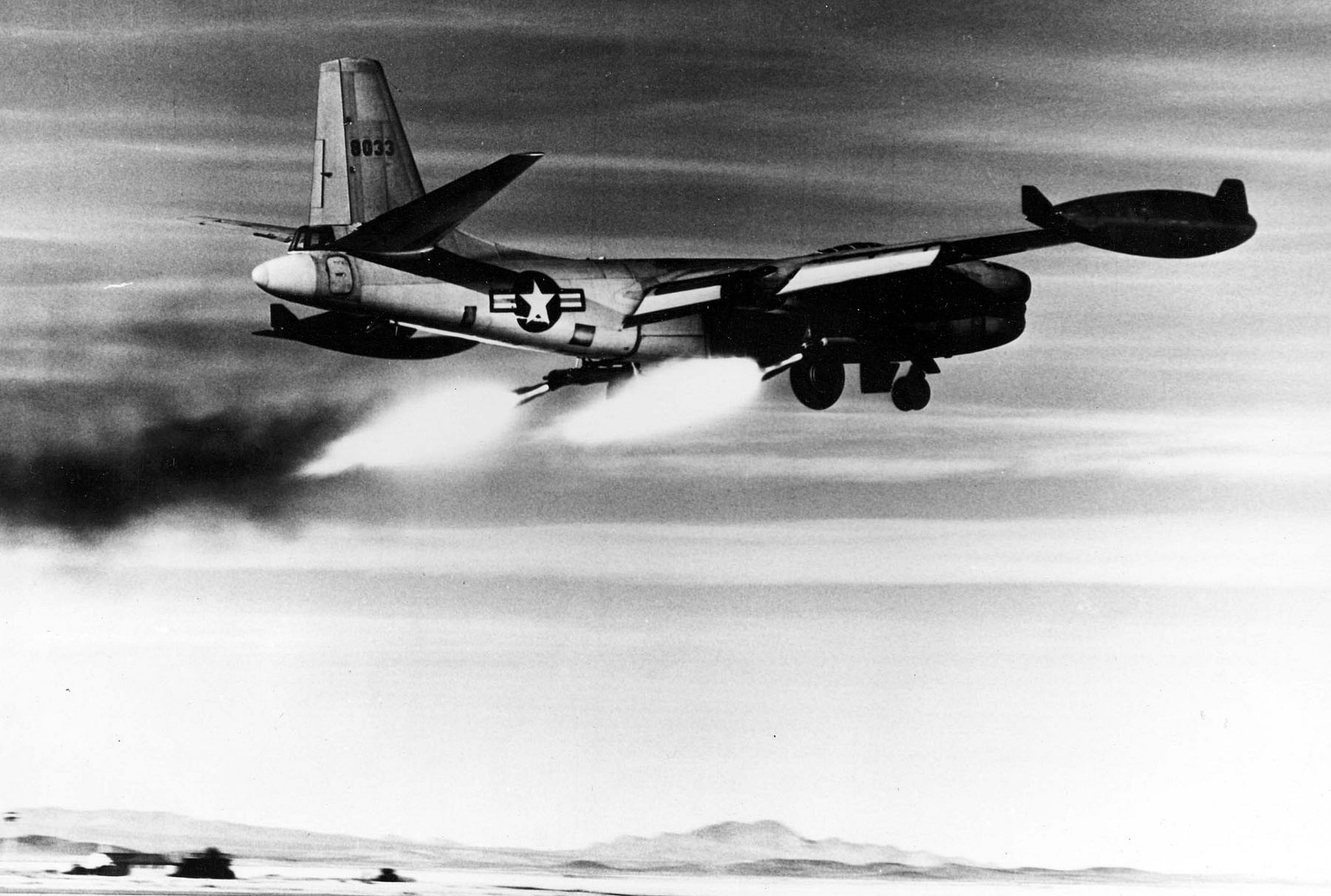
Even as an interim type, the B-45 did valuable spadework. It was among the aircraft on which Strategic Air Command worked out how to fold jets into a bomber force still built largely around piston aircraft — how to maintain temperamental early turbojets in the field, how to fly and fight at the higher speeds and altitudes jets made possible, and how to hold nuclear weapons on alert. Fitted for air-to-air refuelling, later Tornados could reach far beyond their unrefuelled radius, a technique that would become central to the global reach of the jet bomber force to come.
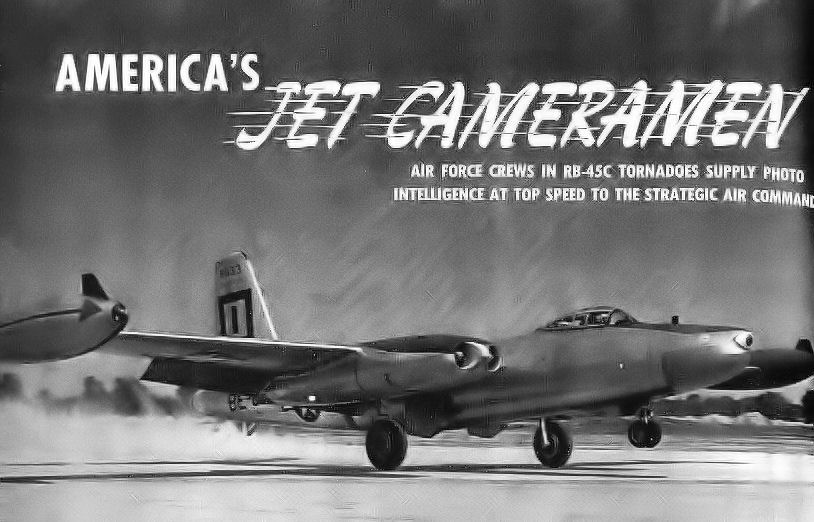
The Tornado’s most remarkable career, however, was not as a bomber at all but as a spy. A dedicated reconnaissance version, the RB-45C, was built with cameras and other sensors in place of the bomb load, and fitted for in-flight refuelling to extend its reach. These aircraft flew strategic photographic and electronic reconnaissance, and they took on some of the riskiest work of the early Cold War: probing the edges of, and at times flying deep into, hostile airspace to gather intelligence on a Soviet Union that was otherwise almost closed to Western eyes.
It is hard, from an age of reconnaissance satellites, to grasp how blind the West was to what lay behind the Iron Curtain in the early 1950s. There were no spy satellites; the only way to photograph a Soviet airfield or map its radar defences was to send an aircraft to look. That made machines like the RB-45C strategically precious, and their crews extraordinarily brave — because the missions that mattered most were exactly the ones that carried the greatest risk.
The most extraordinary of these operations were the overflights of the Soviet Union itself. In the early 1950s, RB-45Cs are recorded as flying deep-penetration night reconnaissance missions over Soviet territory — and, in a politically sensitive arrangement, some were flown by Royal Air Force crews in aircraft repainted with RAF markings, to provide a measure of deniability for both governments. These “Special Duty Flight” missions, long classified and still incompletely documented, were among the most dangerous flown in the whole Cold War: single unarmed-for-the-purpose aircraft, deep over hostile territory at night, with no realistic hope of rescue if anything went wrong. That such flights were made at all is a measure of how urgently the West needed to see behind the Iron Curtain.
The RB-45C also went to war in Korea, flying reconnaissance over the peninsula. There the Tornado ran up against the new Soviet-built MiG-15, and RB-45Cs were involved in some of the early encounters between jet bombers and jet fighters — dangerous meetings that underlined how vulnerable even a fast jet bomber was to a modern swept-wing interceptor, and that helped push reconnaissance towards ever higher and faster aircraft.
The Tornado’s front-line life was short. As the B-47 Stratojet entered service in numbers through the 1950s, the B-45 was withdrawn from the bomber role, and the reconnaissance RB-45Cs were retired by the end of the decade as newer, higher-flying aircraft took over. Only around 142 Tornados of all versions were ever built, and the type was flown operationally only by the United States. But its importance far outstrips its modest numbers: it was the aircraft that carried the US Air Force into the jet-bomber age, the first American jet to hold nuclear weapons at readiness, and the mount for some of the boldest reconnaissance flights ever attempted. A handful survive in American museums, quiet reminders of a pioneering aircraft that did difficult, historic work in the tensest years of the Cold War.
01The B-45’s origins: America’s first jet bomber+
The Tornado was born in the immediate post-war years, when the arrival of the jet engine made every existing bomber suddenly look obsolete. The US Army Air Forces, soon to become the independent US Air Force, wanted jet bombers, and North American Aviation — already famous for the Mustang and the Sabre — produced the design that became the B-45.
The prototype XB-45 first flew in March 1947, and the aircraft entered service as the B-45A around 1948. It was the first jet bomber to serve operationally with the United States, a genuine milestone. Conventional in layout — straight wing, four podded jets, glazed nose — it nonetheless represented a decisive step from the piston-engined bombers of the Second World War into the jet age.
02Four jets in two nacelles: the Tornado’s layout+
The B-45 was powered by four turbojet engines — early aircraft used Allison J35s, later ones the more powerful General Electric J47 — grouped two to a nacelle in two large pods slung beneath a straight, unswept wing. This arrangement was typical of first-generation jet thinking, before designers learned to bury or streamline engines for higher speed.
The straight wing gave the Tornado docile handling and a reasonable field performance, but it limited top speed and put a ceiling on how far the design could be developed. The whole configuration — sturdy, conventional and straightforward — reflected a bomber conceived at the very start of the jet era, when the swept wing and its dramatic performance gains were still being understood.
03A crew of four: pilots, bombardier and tail gunner+
The Tornado carried a crew of four. Two pilots sat in tandem beneath a fighter-style bubble canopy at the top of the forward fuselage; a bombardier-navigator worked in the glazed nose, aiming the bombs and handling navigation; and a tail gunner sat in the extreme rear, operating a defensive gun position to fend off attacking fighters.
This layout — a glass nose for aiming and a manned tail gun for defence — was inherited from wartime bomber practice, and it marks the B-45 as a design straddling two eras. Later jet bombers would move away from the glazed nose and the manned tail turret as radar bombing and the sheer speed of jets changed how bombers were built and defended.
04The first US jet to carry an atomic bomb+
One of the Tornado’s defining distinctions is that it was the first American jet aircraft capable of carrying an atomic bomb. Adapting the B-45 to the nuclear role gave the US Air Force, for the first time, a jet-powered means of delivering the most powerful weapon in its arsenal — faster and higher than the piston-engined bombers that had held the mission until then.
This was a significant strategic step at the dawn of the nuclear standoff. It meant the deterrent no longer depended solely on propeller-driven aircraft, and it prefigured the jet-powered nuclear bomber force — the B-47 and B-52 — that would follow. For all that it was an interim type, the B-45 was a real pioneer of the airborne nuclear deterrent.
05Nuclear-armed in England: the 47th Bombardment Wing+
In 1952 nuclear-capable B-45A Tornados of the 47th Bombardment Wing were deployed to England, based at RAF Sculthorpe. This put a jet-borne American atomic strike capability within reach of targets in the Soviet Union and its allies, at a time of acute Cold War tension.
The deployment was strategically important: it demonstrated that the United States could position a jet nuclear-strike force forward, in Europe, ready to respond quickly in a crisis. The B-45s stood this nuclear alert in England for several years, a tangible part of the Western deterrent, until they were superseded by more capable aircraft as the decade went on.
06An interim bomber before the B-47 Stratojet+
The B-45 was always, in effect, a stopgap. Even as it entered service, Boeing was developing the B-47 Stratojet — a radically advanced swept-wing jet bomber with six engines, far higher speed, greater range and a much more modern design. The Stratojet represented the true shape of the jet bomber to come, and once it matured and entered service in quantity it made the straight-winged Tornado obsolete in the bomber role.
Rather than a failure, this makes the B-45 an important bridge. It let the Strategic Air Command gain real experience operating jet bombers — their maintenance, their tactics, their nuclear procedures — during the years it took to perfect the definitive design. The Tornado did the essential early work so that the B-47, and later the B-52, could carry it forward.
07The RB-45C: strategic reconnaissance Tornado+
The most significant version of the Tornado was the RB-45C, a dedicated strategic reconnaissance aircraft. In place of the bomb load it carried a suite of cameras and other sensors for photographic and electronic reconnaissance, and it was fitted for in-flight refuelling, greatly extending its range for long-distance missions.
Only around thirty-three RB-45Cs were built, but they punched far above their numbers. In an era before reconnaissance satellites, gathering intelligence on the closed Soviet bloc meant flying aircraft to the edge of — and sometimes deep into — hostile airspace. The RB-45C was among the first jet aircraft the West had that could attempt such missions, and it took on some of the most secret and hazardous flying of the early Cold War.
08The Soviet overflights and the RAF “Special Duty Flight”+
The RB-45C’s most extraordinary missions were deep-penetration overflights of the Soviet Union itself. In the early 1950s, RB-45Cs are recorded as flying night reconnaissance sorties over Soviet territory to gather radar-scope photography and other intelligence — flights of great length and greater danger, deep over hostile ground with no prospect of help if things went wrong.
In a politically sensitive arrangement, some of these missions were flown not by American crews but by Royal Air Force crews, in RB-45Cs repainted with RAF markings, to give both governments a measure of deniability. These “Special Duty Flight” operations were kept secret for decades and remain only partly documented; the account here is deliberately cautious. What is clear is that they were among the boldest and most perilous reconnaissance missions of the whole Cold War.
09Korea: reconnaissance and early jet-bomber-versus-MiG encounters+
The RB-45C also served in the Korean War, flying photographic and electronic reconnaissance over the peninsula. There it came up against the Soviet-built MiG-15, the swept-wing jet fighter that had come as such a shock to Western air forces, and RB-45Cs were involved in some of the early encounters between jet bombers and jet interceptors.
These meetings were sobering. Fast as it was, the straight-winged Tornado was no match for a MiG-15 in a fight, and the vulnerability of even a jet bomber to a modern fighter was made plain. The lesson — that reconnaissance would have to be flown ever higher and faster to survive — pointed directly towards the specialised high-altitude reconnaissance aircraft, and eventually the satellites, that would follow.
Design & Engineering
How the Tornado was built: a first-generation jet bomber
The B-45 was a straightforward, conventional design — a straight wing, four podded jets and a wartime-style crew layout — that got the US Air Force into the jet-bomber age while the revolutionary swept-wing designs were perfected.
Four jets, straight wing
Four turbojets in two underwing nacelles and an unswept wing — sturdy and docile, but first-generation, and soon outpaced by the swept-wing B-47.
Wartime-style crew
Two pilots under a bubble canopy, a bombardier in a glazed nose and a tail gunner at the rear — a bomber straddling the piston and jet eras.
Bomber and spy
Built as an atomic-capable bomber, and adapted into the RB-45C reconnaissance aircraft with cameras, sensors and in-flight refuelling for long-range missions.
仕様
North American B-45 Tornado specifications: dimensions, performance and cost
| タイプ | Four-engined strategic jet bomber (and reconnaissance aircraft) |
| クルー | 4 (two pilots, bombardier-navigator, tail gunner) |
| 長さ | ~22.9 m (75 ft 4 in) — approx. |
| 翼幅 | ~27.1 m (89 ft) — approx. |
| 身長 | ~7.7 m (25 ft 2 in) — approx. |
| 空虚重量 | ~20,700 kg (~45,600 lb) — approx. |
| Max takeoff weight | ~50,000 kg (~110,000 lb) — approx. |
| Engines | 4 × turbojet — Allison J35, later General Electric J47 |
| 武装 | Two .50-cal machine guns in a tail position; bomb load incl. nuclear weapon (RB-45C: cameras/sensors) |
| Max speed | ~920 km/h (~570 mph) — est. |
| 範囲 | ~1,900 km combat radius; farther with in-flight refuelling — est. |
| サービス天井 | ~13,000 m (~43,000 ft) — est. |
| First flight | 17 March 1947 (XB-45) |
| Introduced | ~1948 (US Air Force) |
| Retired | late 1950s (bomber and reconnaissance roles) |
| Number built | ~142 (all versions: XB-45, B-45A, B-45C, RB-45C) |
| Main variants | B-45A (bomber), B-45C, RB-45C (reconnaissance) |
| Operators | United States (USAF); RB-45C overflights flown with RAF crews |
| Unit cost | not reliably recorded (early Cold War procurement) |
| Cost per flight hour | not reliably recorded |
10The Tornado’s variants, from XB-45 to RB-45C+
The Tornado was built in a small number of versions. Three XB-45 prototypes led to the main production bomber, the B-45A, of which around ninety-six were built; a small run of improved B-45Cs followed, with provision for wingtip fuel tanks and other refinements. The most important derivative was the RB-45C reconnaissance aircraft, of which about thirty-three were produced.
Across all versions only around 142 Tornados were built — a modest total that reflects the aircraft’s interim status. There was no sprawling family of sub-types as with longer-lived designs; the B-45’s variants trace a straight line from prototype to bomber to reconnaissance aircraft over a short but historically dense career.
11The North American B-45 Tornado’s operating costs: what the records show+
As with most early Cold War military aircraft, there is no single reliable, transparent public figure for the B-45’s unit cost, cost per flight hour or total programme cost. It was procured in modest numbers in the late 1940s and early 1950s through government contracts rather than at a published list price, and consistent lifetime cost data for so short-lived a type is not available. Any single figure quoted for it should be treated with caution.
The Tornado was, moreover, a pioneering jet with demanding early engines and systems, which made it expensive to operate by the standards of the day — one reason the Air Force was keen to move to the more capable and efficient designs that followed. Rather than invent numbers, we list the cost fields here as “not reliably recorded.”
12Why the B-45’s career was so short+
The Tornado entered service around 1948 and was largely gone from the front line by the late 1950s — a short career even by the fast-moving standards of early jet aviation. The reason was simple: it had been designed at the very beginning of the jet era, and the technology advanced so rapidly that it was overtaken almost at once.
The swept-wing Boeing B-47 Stratojet was a generational leap ahead in speed, range and capability, and once it was available in numbers there was little reason to keep the straight-winged B-45 in the bomber role. The reconnaissance RB-45Cs lasted a little longer, because their specialised mission had no immediate replacement, but they too gave way by the end of the 1950s to higher-flying successors. The B-45 was overtaken not because it was bad, but because it arrived at a moment of extraordinarily rapid change.
13Surviving B-45 Tornados+
Because so few Tornados were built and the type was retired long ago, survivors are rare, and all are in the United States — fitting for an aircraft flown operationally only by the US Air Force. A small number are preserved in American museums, including at the National Museum of the United States Air Force at Dayton, Ohio, and other collections.
These survivors are the last tangible reminders of a genuinely pioneering aircraft: the first American jet bomber, the first US jet to carry an atomic bomb, and the mount for some of the most daring reconnaissance flights of the Cold War. For a type that never sought fame and served only briefly, the preserved Tornados preserve an outsized piece of history.
Timeline
The North American B-45 Tornado through the years
The North American XB-45 prototype flies on 17 March 1947 — the start of America’s first jet bomber.
The B-45A enters Strategic Air Command service as the first operational jet bomber of the United States.
The B-45 becomes the first American jet aircraft able to carry an atomic bomb, giving the deterrent a jet delivery aircraft.
RB-45Cs fly reconnaissance over Korea and take part in early encounters between jet bombers and MiG-15 fighters.
Nuclear-armed B-45As of the 47th Bombardment Wing deploy to RAF Sculthorpe, placing a jet atomic-strike force forward in Europe.
RB-45Cs fly deep-penetration night reconnaissance over the Soviet Union, some by RAF crews in RAF-marked aircraft — secret “Special Duty Flight” missions.
RB-45Cs, refuelled in flight, carry out long-range strategic photographic and electronic reconnaissance for the US Air Force.
The swept-wing Boeing B-47 Stratojet enters service in numbers and supersedes the straight-winged B-45 in the bomber role.
The last B-45 bombers and RB-45C reconnaissance aircraft are withdrawn as more capable aircraft take over.
A small number of Tornados are preserved in US museums, including the National Museum of the US Air Force.
Stories & Eyewitnesses
The North American B-45 Tornado in stories: the moments that defined it
America’s first jet bomber, the first US jet to carry an atomic bomb, nuclear alert in England, and secret reconnaissance deep over the Soviet Union — the Tornado’s history told through the moments that stuck.
America’s First
The first US jet bomber
The B-45 was the first operational US jet bomber.
When the B-45A entered Strategic Air Command service at the end of the 1940s, it became the first jet bomber to serve operationally with the United States — a genuine milestone in the jet age.
It gave the young US Air Force jet-powered striking reach for the first time.
Four Jets
Two nacelles, straight wing
The Tornado had four jets in two underwing pods.
The B-45 carried four turbojets grouped two to a nacelle under a straight, unswept wing — the typical layout of the very first jet-bomber generation.
Sturdy and docile, it was soon outpaced by the swept-wing designs that followed.
Glass Nose, Tail Gun
A wartime-style crew
The B-45 had a glazed nose and a manned tail gun.
Two pilots sat under a bubble canopy, a bombardier worked in the glazed nose, and a tail gunner defended the rear — a crew layout inherited straight from wartime bombers.
It marks the Tornado as a design straddling the piston and jet ages.
The Atomic Jet
First US jet to carry the bomb
The B-45 was the first US jet able to drop an atomic bomb.
Adapted for the nuclear role, the Tornado became the first American jet aircraft capable of carrying an atomic bomb — a landmark at the dawn of the nuclear standoff.
It meant the deterrent no longer depended solely on propeller-driven bombers.
Nuclear Alert
B-45s in England
Nuclear-armed B-45s stood alert at RAF Sculthorpe.
In 1952 nuclear-capable B-45As of the 47th Bombardment Wing deployed to England, placing a jet atomic-strike force forward in Europe, within reach of the Soviet Union.
They were a tangible part of the Western deterrent in the tensest early Cold War years.
Interim Bomber
A bridge to the B-47
The B-45 filled the gap before the B-47 Stratojet.
The straight-winged Tornado was always a stopgap while Boeing perfected the revolutionary swept-wing B-47 Stratojet.
It let Strategic Air Command learn to operate jet bombers — their tactics and nuclear procedures — until the definitive design was ready.
The RB-45C
The reconnaissance Tornado
A camera-equipped version flew strategic recon.
The RB-45C carried cameras and sensors in place of bombs, and was fitted for in-flight refuelling to extend its reach for long-range reconnaissance.
Only about thirty-three were built, but they took on some of the most secret flying of the early Cold War.
Over the USSR
The secret overflights
RB-45Cs flew deep reconnaissance over Soviet territory.
In the early 1950s RB-45Cs are recorded as flying deep-penetration night reconnaissance missions over the Soviet Union — long, dangerous sorties deep over hostile ground.
They were among the boldest reconnaissance flights of the whole Cold War.
RAF Markings
The Special Duty Flight
Some overflights were flown by RAF crews for deniability.
In a politically sensitive arrangement, some Soviet overflights were flown by Royal Air Force crews in RB-45Cs repainted with RAF markings, to give both governments a measure of deniability.
Long classified, these “Special Duty Flight” missions are still only partly documented.
Korea
Jet bomber meets MiG
RB-45Cs met MiG-15s over Korea.
Flying reconnaissance in the Korean War, the RB-45C ran into the swept-wing MiG-15 in some of the first encounters between jet bombers and jet fighters.
They showed how vulnerable even a fast jet bomber was to a modern interceptor.
Overtaken
A short front-line life
The B-47 quickly made the B-45 obsolete.
As the far more capable swept-wing B-47 Stratojet entered service in numbers, the straight-winged B-45 was withdrawn from the bomber role by the late 1950s.
It had arrived at a moment of extraordinarily rapid change and was overtaken almost at once.
US Only
Flown by one air force
Only the US operated the Tornado.
Around 142 Tornados were built and the type was flown operationally only by the United States Air Force — though its RB-45C overflights were flown, remarkably, with Royal Air Force crews.
It was a small, purely American fleet that did outsized work.
The Survivors
Preserved in America
A few Tornados survive in US museums.
Because so few were built and it retired long ago, only a handful of Tornados survive, all in the United States, including at the National Museum of the US Air Force.
They are the last reminders of a pioneering aircraft that did historic work.
Photo Gallery
The North American B-45 Tornado in photographs
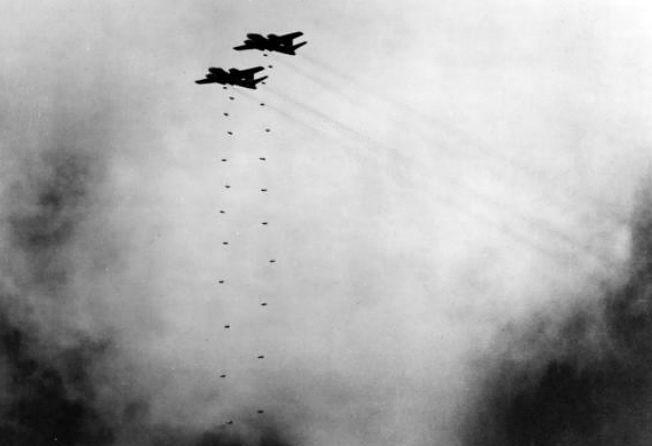
US Air Force, NASA and museum photographs of the Tornado and its variants, each credited to its source and licence. Click any photo to enlarge.



On Film
The North American B-45 Tornado on video: a documentary history
A documentary on the Tornado — America’s first jet bomber, its atomic-strike role and the high-risk reconnaissance career of the RB-45C.
“B-45 Tornado” by Dark Skies (approx. 628,000 views at time of writing; running time ~9 minutes) — a documentary on the North American B-45 Tornado, its design and its service.
Operations Overview
Where the North American B-45 Tornado flew: an operator map
Designed, built and flown operationally by the United States alone. Its reconnaissance overflights of the Soviet Union were, remarkably, flown in part by Royal Air Force crews in RAF-marked aircraft — so Britain appears here for that involvement rather than as an owner of the type. Hover or tap a country for detail.
Categories: Design, Manufacture & USAF (United States) · RAF-crewed reconnaissance overflights (United Kingdom — RAF crews flew RB-45C overflights; the aircraft remained US) · Surviving Airframes (United States). The Tornado was operated as a type only by the USA.
Service Record
The Tornado’s record: a pioneer of the jet-bomber age
The B-45’s significance is measured in firsts — the first US jet bomber, the first US atomic-capable jet — and in the daring of its reconnaissance career.
Questions & Answers
North American B-45 Tornado: your questions answered
Can I fly in a North American B-45 Tornado?
No — there is no bookable Tornado flight experience, and MiGFlug does not offer one. Only around 142 were built, all retired by the late 1950s, and the handful that survive are static museum exhibits rather than flying aircraft. If what you actually want is the real thing — strapping into a genuine military jet and flying it — you very much can do that today in other types. MiGFlug arranges flights in real fighter jets and warbirds around the world. Start here: migflug.com/flights-prices.
Why is the North American B-45 Tornado historically important?
The B-45 was the first operational jet bomber built and flown by the United States, and the first American jet aircraft capable of carrying an atomic bomb. Entering service around 1948, it carried the US Air Force into the jet-bomber age and gave the nuclear deterrent a jet delivery aircraft for the first time. Its reconnaissance version, the RB-45C, then flew some of the most daring intelligence missions of the early Cold War.
What was the RB-45C, and what missions did it fly?
The RB-45C was the strategic reconnaissance version of the Tornado, carrying cameras and sensors instead of bombs and fitted for in-flight refuelling. About thirty-three were built. They flew long-range photographic and electronic reconnaissance, including reconnaissance in the Korean War and, most remarkably, deep-penetration night overflights of the Soviet Union in the early 1950s — among the most dangerous reconnaissance missions of the whole Cold War.
Did the RAF fly the B-45?
Yes, in a very particular way. The B-45 was a US aircraft, operated as a type only by the US Air Force. But some of the RB-45C’s secret overflights of the Soviet Union in the early 1950s were flown by Royal Air Force crews in aircraft repainted with RAF markings, in a politically sensitive arrangement designed to give both governments a measure of deniability. The aircraft themselves remained American; it was the crews and the markings that were British for those “Special Duty Flight” missions.
Was the B-45 the first US jet to carry an atomic bomb?
Yes. The Tornado was the first American jet aircraft capable of carrying an atomic bomb. Nuclear-armed B-45As were deployed to RAF Sculthorpe in England from 1952, placing a jet-borne US atomic-strike force forward in Europe within reach of the Soviet Union. This was a significant early step in the jet-powered nuclear deterrent that the B-47 and B-52 would later carry forward.
Why did the B-45 have such a short career?
The Tornado was designed at the very start of the jet era, and technology advanced so fast that it was overtaken almost immediately. The swept-wing Boeing B-47 Stratojet was a generational leap ahead in speed, range and capability, and once it entered service in numbers there was little reason to keep the straight-winged B-45 in the bomber role. The B-45 was essentially an interim aircraft — a bridge that let the Air Force learn to operate jet bombers until the definitive design was ready.
Who operated the B-45 Tornado?
The B-45 was operated as a type only by the United States Air Force, chiefly its Strategic Air Command (bombers) and reconnaissance wings (RB-45Cs). It had no foreign operators, although its RB-45C Soviet overflights were flown with Royal Air Force crews. Around 142 aircraft of all versions were built, and they served from about 1948 until the late 1950s.
Was the North American B-45 Tornado a good aircraft?
It was a sound, useful aircraft for its brief moment, and above all a genuinely important pioneer. As a bomber it was quickly outclassed by the swept-wing B-47, and its front-line career was short. But it did exactly what a first-generation jet bomber needed to do: it proved that the US Air Force could operate jet bombers, it became the first US jet to carry the atomic bomb, and its RB-45C reconnaissance version flew missions of extraordinary daring. Judged as a pioneer rather than a performer, the Tornado was a real success.
Fly For Real
You can’t fly the B-45 Tornado — but these, you can
No Tornado is a bookable ride today. The urge behind it — to strap into a real military aircraft and actually fly — is very much still bookable. MiGFlug puts you in genuine fighters and warbirds around the world.
Fighter Jet Flights
Take the controls of a real ex-military jet with an experienced pilot.
Warbird experiences
Fly in a genuine ex-military warbird from the early jet age.
All flights are operated by MiGFlug’s vetted partners with professional pilots. Browse every option and current pricing at migflug.com/flights-prices. MiGFlug does not operate North American B-45 Tornado flights — no bookable example exists.
Related Aircraft
If the North American B-45 Tornado interests you, explore these
Sources & Further Reading
Where this North American B-45 Tornado history comes from
Note on figures: dimensions, performance and production numbers for the B-45 vary between sources and by variant, and are hedged here as approximate. Cost fields are listed as not reliably recorded because trustworthy early Cold War procurement cost data is not consistently available. The RB-45C’s reconnaissance history, including the Soviet overflights and the RAF-crewed “Special Duty Flight” missions, was long classified and remains only partly documented; it is presented here in summary and with due care. A few B-45s survive in US museums.