
North American B-45 Tornado
America’s first operational jet bomber — and the first US jet able to drop an atomic bomb. A four-engined interim striker whose reconnaissance version flew some of the most dangerous missions of the early Cold War.
The Story
The North American B-45 Tornado: America’s first jet bomber
The North American B-45 Tornado holds a permanent place in aviation history as the first operational jet bomber built by the United States, and the first American jet aircraft capable of carrying an atomic bomb. It was not a beautiful aircraft, nor a long-lived one, and it was soon overshadowed by the sleek swept-wing bombers that followed it. But when it entered service at the end of the 1940s, the Tornado gave the young United States Air Force a jet-powered strategic striking arm for the first time — and its reconnaissance version went on to fly some of the most secret and dangerous missions of the early Cold War.
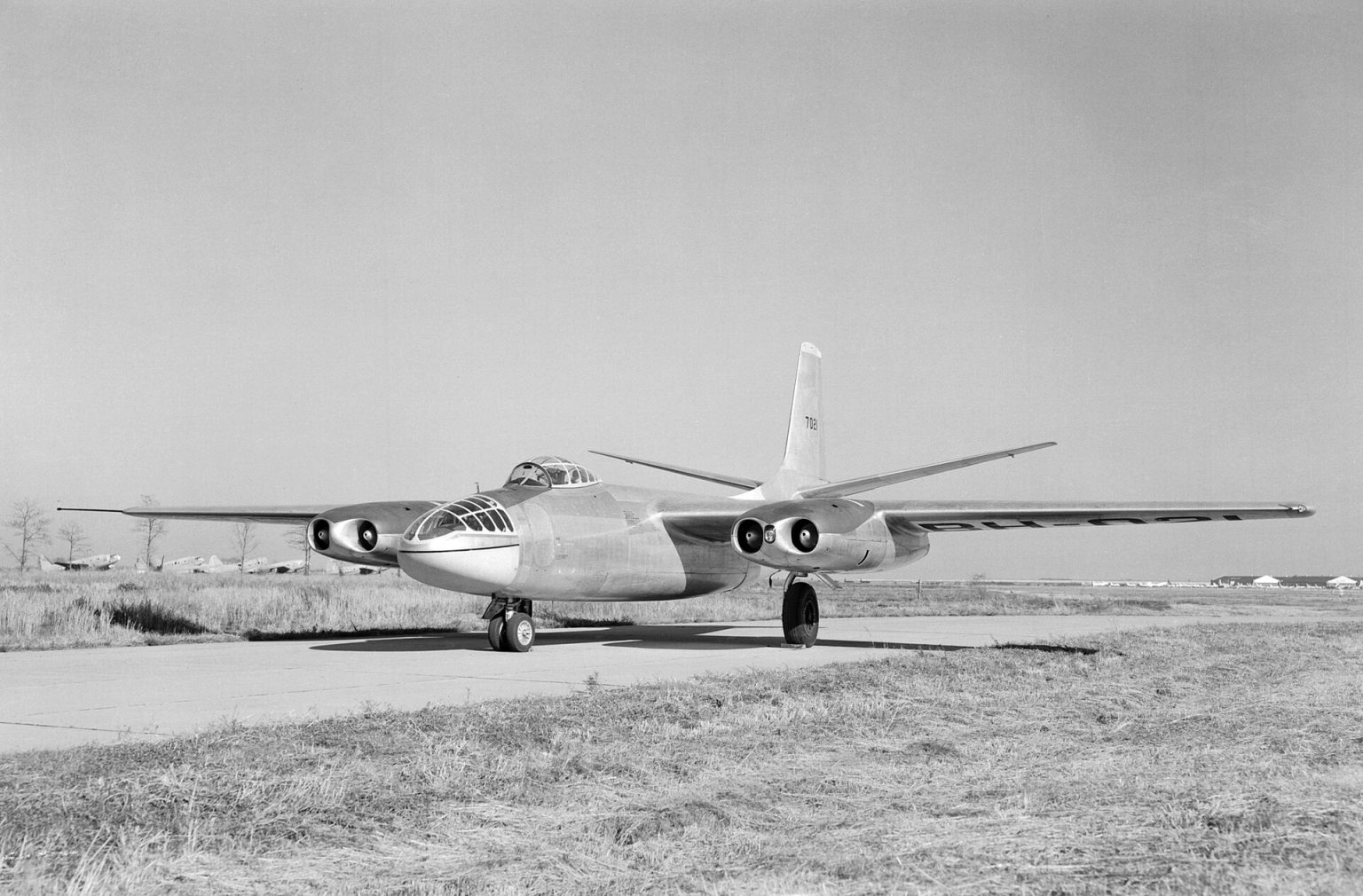
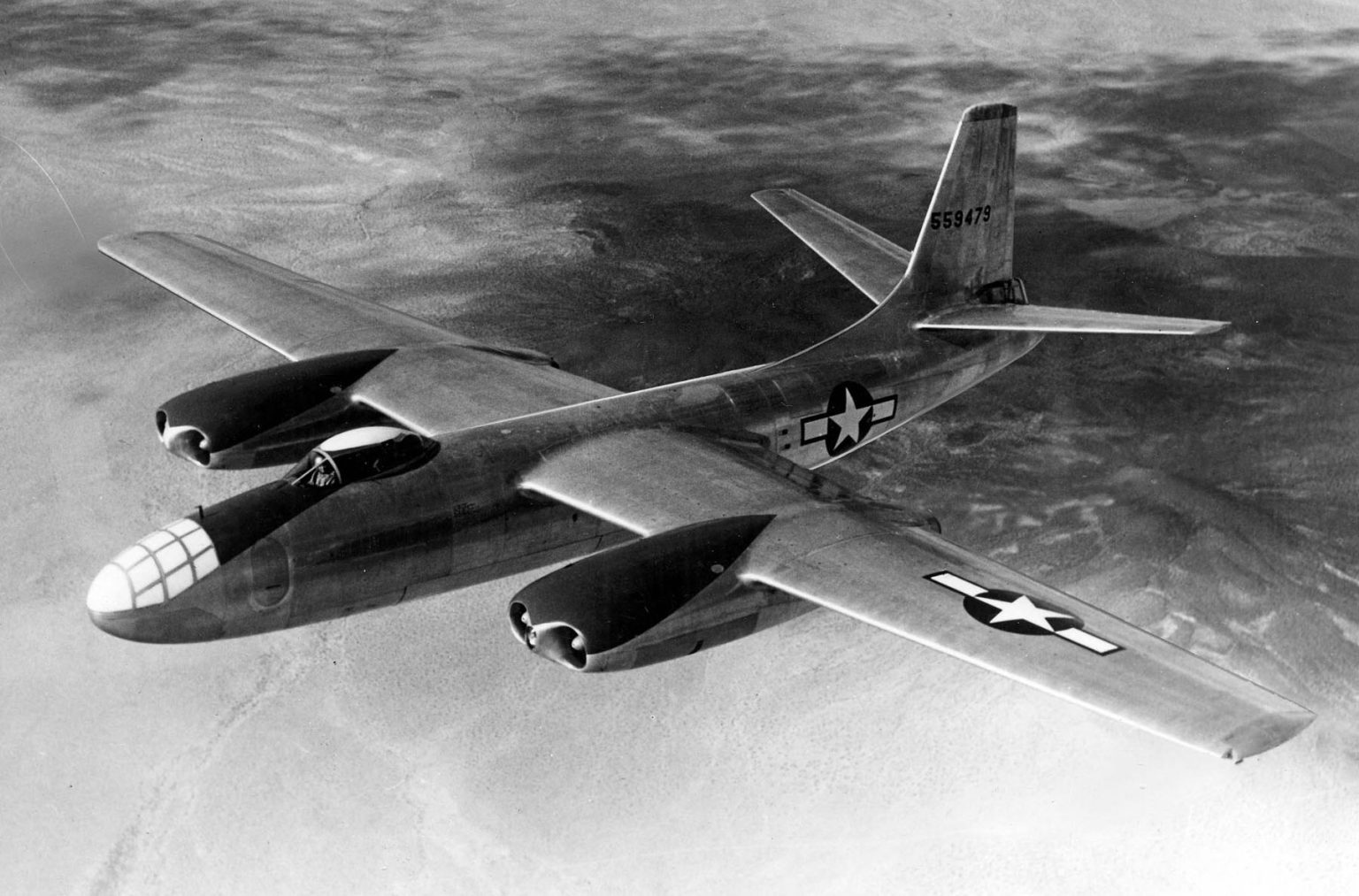
The Tornado was designed by North American Aviation, the company behind the P-51 Mustang and the F-86 Sabre, in the immediate aftermath of the Second World War, when jet propulsion was transforming military aviation. The prototype, the XB-45, first flew in March 1947. It was a conventional-looking aircraft by later standards — a straight, unswept wing, a high-set fuselage with a glazed nose for the bombardier, and four turbojet engines grouped in two large nacelles slung under the wings, two engines to a nacelle. It carried a crew of four: two pilots seated in tandem under a fighter-style canopy, a bombardier-navigator in the glazed nose, and a tail gunner in the rear to defend against fighters.
Power was both the making and the limiting of the Tornado. The first aircraft used Allison J35 turbojets, but the definitive versions flew behind the more powerful General Electric J47 — the same engine family that gave the F-86 Sabre its edge — four of them together hauling the big bomber to speeds no piston bomber could match. Yet the straight wing that made the B-45 stable and easy to fly also capped its performance: it could not approach the speeds a swept wing would soon unlock, and that limitation was built into the airframe from the day it was drawn.
“The first American jet bomber, and the first US jet that could drop an atomic bomb — the Tornado carried the Air Force into the jet age.”— the B-45’s place in history, in a sentence
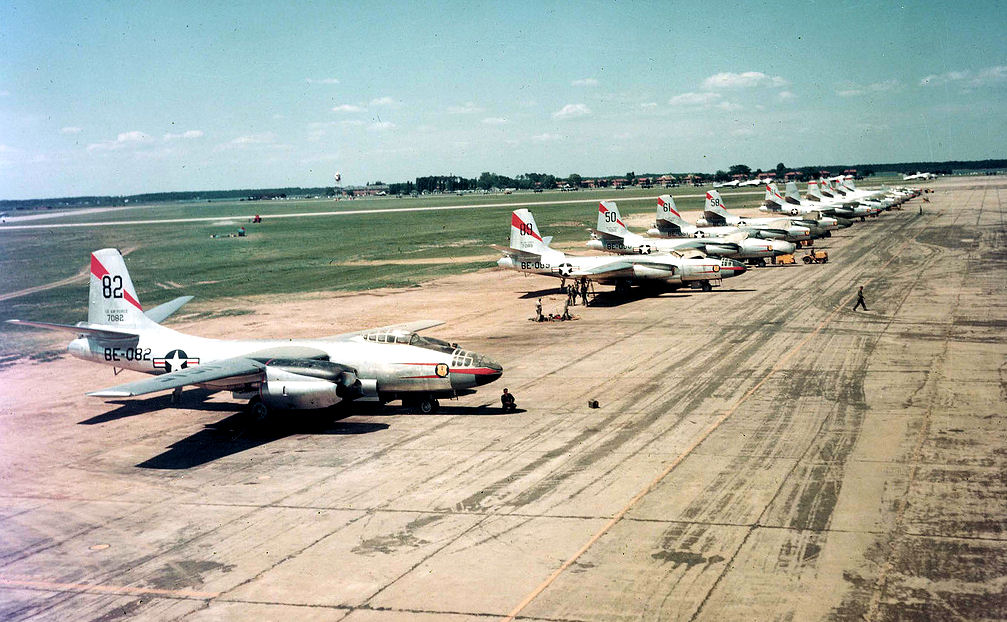
The B-45A entered service with the USAF’s Strategic Air Command around 1948 and 1949. Its significance was enormous: for the first time the United States had a jet bomber in squadron service, able to fly higher and faster than the piston-engined bombers it supplemented. Just as importantly, the Tornado was developed into a nuclear-capable aircraft, and in 1952 nuclear-armed B-45As of the 47th Bombardment Wing were deployed to England, at RAF Sculthorpe, giving the West a jet-borne atomic strike capability positioned within reach of the Soviet Union. It was a landmark in the nuclear standoff that would define the next four decades.
For all its importance, though, the B-45 was very much an interim aircraft. It had been designed to a wartime-era conception of what a jet bomber should be, with its straight wing and podded engines, and the state of the art was moving fast. Boeing’s revolutionary swept-wing B-47 Stratojet — far faster, longer-ranged and more capable — was already in development, and once it matured it would render the straight-winged Tornado obsolete as a bomber. The B-45 was, in effect, a bridge: the aircraft that let the Air Force learn to operate jet bombers while the definitive design was perfected.
Even as an interim type, the B-45 did valuable spadework. It was among the aircraft on which Strategic Air Command worked out how to fold jets into a bomber force still built largely around piston aircraft — how to maintain temperamental early turbojets in the field, how to fly and fight at the higher speeds and altitudes jets made possible, and how to hold nuclear weapons on alert. Fitted for air-to-air refuelling, later Tornados could reach far beyond their unrefuelled radius, a technique that would become central to the global reach of the jet bomber force to come.
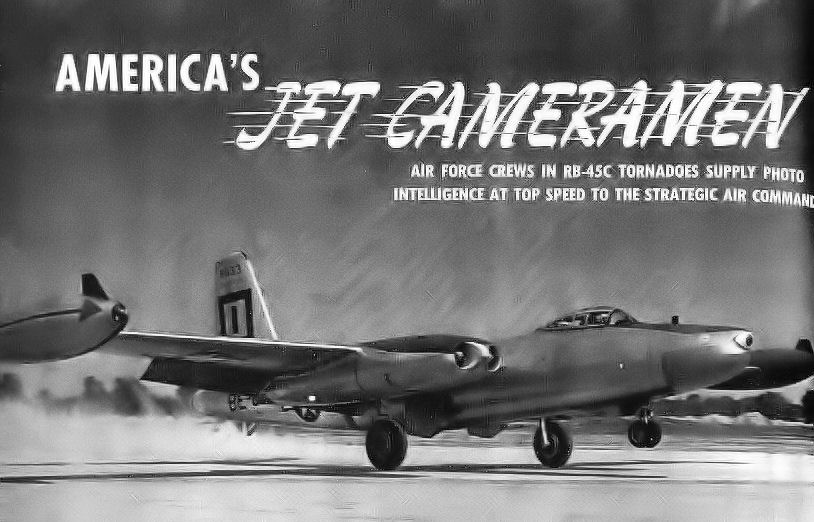
The Tornado’s most remarkable career, however, was not as a bomber at all but as a spy. A dedicated reconnaissance version, the RB-45C, was built with cameras and other sensors in place of the bomb load, and fitted for in-flight refuelling to extend its reach. These aircraft flew strategic photographic and electronic reconnaissance, and they took on some of the riskiest work of the early Cold War: probing the edges of, and at times flying deep into, hostile airspace to gather intelligence on a Soviet Union that was otherwise almost closed to Western eyes.
It is hard, from an age of reconnaissance satellites, to grasp how blind the West was to what lay behind the Iron Curtain in the early 1950s. There were no spy satellites; the only way to photograph a Soviet airfield or map its radar defences was to send an aircraft to look. That made machines like the RB-45C strategically precious, and their crews extraordinarily brave — because the missions that mattered most were exactly the ones that carried the greatest risk.
The most extraordinary of these operations were the overflights of the Soviet Union itself. In the early 1950s, RB-45Cs are recorded as flying deep-penetration night reconnaissance missions over Soviet territory — and, in a politically sensitive arrangement, some were flown by Royal Air Force crews in aircraft repainted with RAF markings, to provide a measure of deniability for both governments. These “Special Duty Flight” missions, long classified and still incompletely documented, were among the most dangerous flown in the whole Cold War: single unarmed-for-the-purpose aircraft, deep over hostile territory at night, with no realistic hope of rescue if anything went wrong. That such flights were made at all is a measure of how urgently the West needed to see behind the Iron Curtain.
The RB-45C also went to war in Korea, flying reconnaissance over the peninsula. There the Tornado ran up against the new Soviet-built MiG-15, and RB-45Cs were involved in some of the early encounters between jet bombers and jet fighters — dangerous meetings that underlined how vulnerable even a fast jet bomber was to a modern swept-wing interceptor, and that helped push reconnaissance towards ever higher and faster aircraft.
The Tornado’s front-line life was short. As the B-47 Stratojet entered service in numbers through the 1950s, the B-45 was withdrawn from the bomber role, and the reconnaissance RB-45Cs were retired by the end of the decade as newer, higher-flying aircraft took over. Only around 142 Tornados of all versions were ever built, and the type was flown operationally only by the United States. But its importance far outstrips its modest numbers: it was the aircraft that carried the US Air Force into the jet-bomber age, the first American jet to hold nuclear weapons at readiness, and the mount for some of the boldest reconnaissance flights ever attempted. A handful survive in American museums, quiet reminders of a pioneering aircraft that did difficult, historic work in the tensest years of the Cold War.
01The B-45’s origins: America’s first jet bomber+
The Tornado was born in the immediate post-war years, when the arrival of the jet engine made every existing bomber suddenly look obsolete. The US Army Air Forces, soon to become the independent US Air Force, wanted jet bombers, and North American Aviation — already famous for the Mustang and the Sabre — produced the design that became the B-45.
The prototype XB-45 first flew in March 1947, and the aircraft entered service as the B-45A around 1948. It was the first jet bomber to serve operationally with the United States, a genuine milestone. Conventional in layout — straight wing, four podded jets, glazed nose — it nonetheless represented a decisive step from the piston-engined bombers of the Second World War into the jet age.
02Four jets in two nacelles: the Tornado’s layout+
The B-45 was powered by four turbojet engines — early aircraft used Allison J35s, later ones the more powerful General Electric J47 — grouped two to a nacelle in two large pods slung beneath a straight, unswept wing. This arrangement was typical of first-generation jet thinking, before designers learned to bury or streamline engines for higher speed.
The straight wing gave the Tornado docile handling and a reasonable field performance, but it limited top speed and put a ceiling on how far the design could be developed. The whole configuration — sturdy, conventional and straightforward — reflected a bomber conceived at the very start of the jet era, when the swept wing and its dramatic performance gains were still being understood.
03A crew of four: pilots, bombardier and tail gunner+
The Tornado carried a crew of four. Two pilots sat in tandem beneath a fighter-style bubble canopy at the top of the forward fuselage; a bombardier-navigator worked in the glazed nose, aiming the bombs and handling navigation; and a tail gunner sat in the extreme rear, operating a defensive gun position to fend off attacking fighters.
This layout — a glass nose for aiming and a manned tail gun for defence — was inherited from wartime bomber practice, and it marks the B-45 as a design straddling two eras. Later jet bombers would move away from the glazed nose and the manned tail turret as radar bombing and the sheer speed of jets changed how bombers were built and defended.
04The first US jet to carry an atomic bomb+
One of the Tornado’s defining distinctions is that it was the first American jet aircraft capable of carrying an atomic bomb. Adapting the B-45 to the nuclear role gave the US Air Force, for the first time, a jet-powered means of delivering the most powerful weapon in its arsenal — faster and higher than the piston-engined bombers that had held the mission until then.
This was a significant strategic step at the dawn of the nuclear standoff. It meant the deterrent no longer depended solely on propeller-driven aircraft, and it prefigured the jet-powered nuclear bomber force — the B-47 and B-52 — that would follow. For all that it was an interim type, the B-45 was a real pioneer of the airborne nuclear deterrent.
05Nuclear-armed in England: the 47th Bombardment Wing+
In 1952 nuclear-capable B-45A Tornados of the 47th Bombardment Wing were deployed to England, based at RAF Sculthorpe. This put a jet-borne American atomic strike capability within reach of targets in the Soviet Union and its allies, at a time of acute Cold War tension.
The deployment was strategically important: it demonstrated that the United States could position a jet nuclear-strike force forward, in Europe, ready to respond quickly in a crisis. The B-45s stood this nuclear alert in England for several years, a tangible part of the Western deterrent, until they were superseded by more capable aircraft as the decade went on.
06An interim bomber before the B-47 Stratojet+
The B-45 was always, in effect, a stopgap. Even as it entered service, Boeing was developing the B-47 Stratojet — a radically advanced swept-wing jet bomber with six engines, far higher speed, greater range and a much more modern design. The Stratojet represented the true shape of the jet bomber to come, and once it matured and entered service in quantity it made the straight-winged Tornado obsolete in the bomber role.
Rather than a failure, this makes the B-45 an important bridge. It let the Strategic Air Command gain real experience operating jet bombers — their maintenance, their tactics, their nuclear procedures — during the years it took to perfect the definitive design. The Tornado did the essential early work so that the B-47, and later the B-52, could carry it forward.
07The RB-45C: strategic reconnaissance Tornado+
The most significant version of the Tornado was the RB-45C, a dedicated strategic reconnaissance aircraft. In place of the bomb load it carried a suite of cameras and other sensors for photographic and electronic reconnaissance, and it was fitted for in-flight refuelling, greatly extending its range for long-distance missions.
Only around thirty-three RB-45Cs were built, but they punched far above their numbers. In an era before reconnaissance satellites, gathering intelligence on the closed Soviet bloc meant flying aircraft to the edge of — and sometimes deep into — hostile airspace. The RB-45C was among the first jet aircraft the West had that could attempt such missions, and it took on some of the most secret and hazardous flying of the early Cold War.
08The Soviet overflights and the RAF “Special Duty Flight”+
The RB-45C’s most extraordinary missions were deep-penetration overflights of the Soviet Union itself. In the early 1950s, RB-45Cs are recorded as flying night reconnaissance sorties over Soviet territory to gather radar-scope photography and other intelligence — flights of great length and greater danger, deep over hostile ground with no prospect of help if things went wrong.
In a politically sensitive arrangement, some of these missions were flown not by American crews but by Royal Air Force crews, in RB-45Cs repainted with RAF markings, to give both governments a measure of deniability. These “Special Duty Flight” operations were kept secret for decades and remain only partly documented; the account here is deliberately cautious. What is clear is that they were among the boldest and most perilous reconnaissance missions of the whole Cold War.
09Korea: reconnaissance and early jet-bomber-versus-MiG encounters+
The RB-45C also served in the Korean War, flying photographic and electronic reconnaissance over the peninsula. There it came up against the Soviet-built MiG-15, the swept-wing jet fighter that had come as such a shock to Western air forces, and RB-45Cs were involved in some of the early encounters between jet bombers and jet interceptors.
These meetings were sobering. Fast as it was, the straight-winged Tornado was no match for a MiG-15 in a fight, and the vulnerability of even a jet bomber to a modern fighter was made plain. The lesson — that reconnaissance would have to be flown ever higher and faster to survive — pointed directly towards the specialised high-altitude reconnaissance aircraft, and eventually the satellites, that would follow.
Design & Engineering
How the Tornado was built: a first-generation jet bomber
The B-45 was a straightforward, conventional design — a straight wing, four podded jets and a wartime-style crew layout — that got the US Air Force into the jet-bomber age while the revolutionary swept-wing designs were perfected.
Four jets, straight wing
Four turbojets in two underwing nacelles and an unswept wing — sturdy and docile, but first-generation, and soon outpaced by the swept-wing B-47.
Wartime-style crew
Two pilots under a bubble canopy, a bombardier in a glazed nose and a tail gunner at the rear — a bomber straddling the piston and jet eras.
Bomber and spy
Built as an atomic-capable bomber, and adapted into the RB-45C reconnaissance aircraft with cameras, sensors and in-flight refuelling for long-range missions.
Specifications
North American B-45 Tornado specifications: dimensions, performance and cost
Baseline: the North American B-45C Tornado of 1950 — four General Electric J47-GE-13/15 turbojets in paired underwing nacelles, a straight wing carrying two jettisonable tip tanks, a manned tail turret and a single bomb bay big enough for 22,000 lb — because it is the definitive airframe standard and because the reconnaissance RB-45C, which did nearly all of the type’s historically important work, was built to it. Deltas for the XB-45 prototypes, the J35-powered B-45A-1, the J47-powered B-45A-5, the nuclear-modified Backbreaker B-45As and the RB-45C are in grey. Four cautions before the figures. First, the production count. The brief given to this page said 143 built, and 143 is the number normally quoted, but it needs unpacking: three XB-45 prototypes, 96 flying B-45As on serials 47-001 to 47-096, one further B-45A airframe (47-097) completed only as a static-test specimen and never flown, ten B-45Cs and 33 RB-45Cs. That is 142 aeroplanes that flew and 143 airframes that were built. Sources that give 142 and sources that give 143 are both right and are answering different questions. Second, there is no single set of B-45 numbers. The type changed engines twice in three years, gained tip tanks, gained an in-flight refuelling receptacle and gained about 30,000 lb of permitted gross weight between the XB-45 of 1947 and the RB-45C of 1951, so a figure quoted without a mark attached is close to meaningless; every row below names the mark it describes. Third, the performance here is clean-airframe, standard-day manufacturer and USAF data. The service B-45 carried a maintenance-heavy AN/APQ-24 radar, a pressurisation system that frequently would not hold altitude, and by 1952 an aft bomb-bay fuel tank; nobody flew a squadron Tornado at 579 mph at sea level for long. Fourth, on the deterrent claim. The B-45 was the first American jet bomber assigned an operational nuclear strike role, and from mid-1952 the Backbreaker aircraft at RAF Sculthorpe were Tactical Air Command’s first-line atomic force in Europe. It was not the first aircraft to drop a nuclear weapon, and the frequently repeated line that it was the first jet bomber to do so is not supported by any documented test drop; treat it as folklore until somebody produces the sortie record.
Dimensions & weights
- Crew
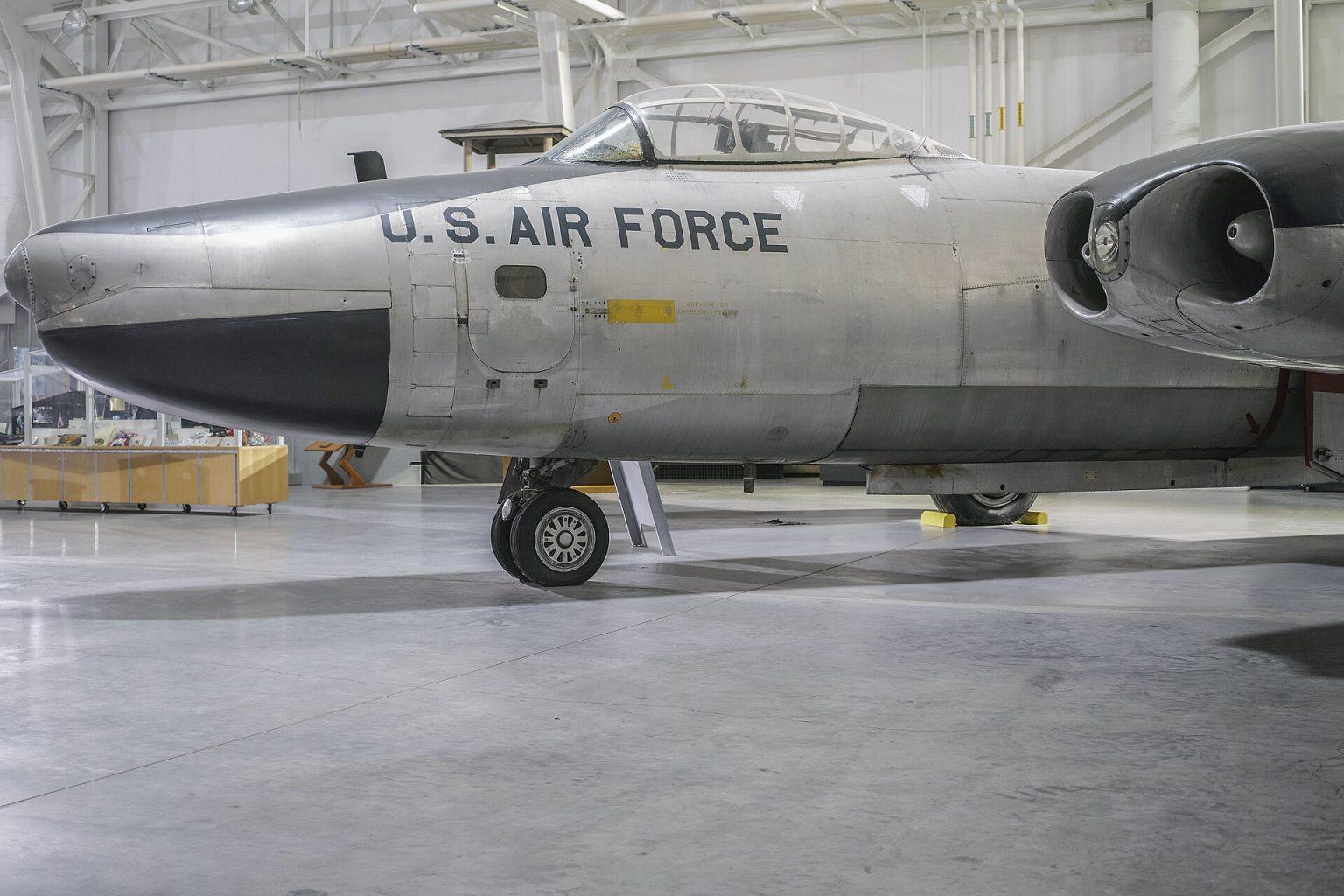
- 4 — pilot, co-pilot/radio operator, bombardier-navigator, tail gunner The two pilots sat in tandem under a fighter-style canopy, the bombardier-navigator in a glazed nose, the gunner alone in the tail. On the RB-45C the glazed nose was faired over into a solid “duck bill” housing a forward oblique camera and the bombardier became a navigator-photographer. Crew escape was uneven: the pilots had upward ejection seats from the B-45A onward, the nose and tail crew did not, and getting out of the bombardier’s station at speed was widely regarded as theoretical.
- Length
- 22.96 m (75 ft 4 in) XB-45 22.56 m (74 ft 0 in); RB-45C 23.14 m (75 ft 11 in), the extra inches being the camera nose.
- Wingspan
- 27.13 m (89 ft 0 in) without tip tanks 29.26 m (96 ft 0 in) on the RB-45C with its 1,200-US-gallon tip tanks fitted, which is the span most photographs show. The XB-45 measured 27.28 m (89 ft 6 in).
- Height
- 7.67 m (25 ft 2 in)
- Wing area
- 109.2 m² (1,175 sq ft) Unchanged across every mark, which is the whole story of the B-45: the wing was frozen in 1945 and the aeroplane grew 46,000 lb of permitted weight around it.
- Aspect ratio
- 6.74 A straight, high-aspect, unswept wing of conventional stressed-skin construction. It was chosen deliberately — the USAAF picked the XB-45 over the Convair XB-46 precisely because it departed least from proven practice — and it is why the Tornado was obsolete on the day the swept-wing B-47 flew.
- Empty weight
- 22,182 kg (48,903 lb) XB-45 18,995 kg (41,876 lb); B-45A 20,726 kg (45,694 lb); RB-45C 22,673 kg (49,984 lb). Nearly three tonnes of structural and equipment growth in four years, on an unaltered wing.
- Gross weight
- 36,931 kg (81,418 lb) for the B-45A The B-45A figure is quoted here because it is the one all the published B-45A performance describes.
- Maximum take-off weight
- 51,234 kg (112,952 lb) B-45C Against 41,628 kg (91,775 lb) for the B-45A and 37,467 kg (82,600 lb) for the XB-45. The B-45C could take off at more than a third again the prototype’s weight on the same wing and the same undercarriage geometry, which is why the C got a strengthened airframe and why heavy-weight departures so often needed JATO bottles or a very long runway.
- Internal fuel
- ~30,785 l (~8,133 US gal) total capacity, RB-45C, tip and external tanks included The single most important number on this page. Everything the RB-45C did that mattered — the Alaska-to-Japan flight, the Ukrainian overflights, the deep sorties from Yokota — was a fuel problem before it was anything else, and the answer was always more tankage plus a KB-29.
- External fuel
- Two 4,542 l (1,200 US gal) jettisonable wingtip tanks on the B-45C and RB-45C; two 810 l (214 US gal) underwing tanks optional on the RB-45C The 40 Backbreaker B-45As instead received a 4,542 l (1,200 US gal) tank in the aft bomb bay, trading half the bomb load for the radius to reach targets in eastern Europe from Norfolk.
- Bomb bay
- One unobstructed bay, maximum ~9,979 kg (~22,000 lb) Sized in 1944 around the largest conventional weapons then contemplated. It was a genuinely enormous bay for a 1947 aeroplane and it is the reason the B-45 could be handed a nuclear weapon at all, but the aircraft could not carry anything like 22,000 lb any useful distance.
- Undercarriage
- Retractable tricycle gear, twin-wheel main units retracting into the fuselage The fuselage-mounted main gear kept the thin wing clean and left the nacelles undisturbed, but it gave a narrow track for a 50-tonne aeroplane and contributed to a landing accident record that was poor even by early-jet standards. The aircraft was also short of drag on the approach, which crews disliked.
Performance
- Maximum speed
- 932 km/h (579 mph, 503 kn) at sea level, B-45C B-45A 919 km/h (571 mph) at 1,070 m (3,500 ft); XB-45 830 km/h (516 mph) at 4,270 m (14,000 ft); RB-45C 917 km/h (570 mph) at 1,220 m (4,000 ft). The jump from prototype to production mark is almost entirely the J47 replacing the J35.
- Maximum speed at altitude
- 819 km/h (509 mph, 442 kn) at 9,906 m (32,500 ft) This, not the sea-level figure, is the number that mattered. At operating height the Tornado was roughly 200 km/h slower than a MiG-15bis and about 1,500 m lower. Over north-western Korea in 1951 that arithmetic ended daylight reconnaissance.
- Cruising speed
- 734 km/h (456 mph, 396 kn) B-45A 756 km/h (470 mph) at 10,670 m (35,000 ft). More than 320 km/h faster than the B-29 it replaced, which is what the USAF had bought and what it got.
- Stalling speed
- 246 km/h (153 mph, 133 kn) High, and a straightforward consequence of a 338 kg/m² wing loading with no leading-edge devices. Approach speeds in this bracket, a narrow-track undercarriage and slow-spooling early turbojets are the ingredients of the type’s landing accidents.
- Rate of climb
- 29.5 m/s (5,800 ft/min) at sea level, B-45C Against 10.5 m/s (2,070 ft/min) for the J35-powered XB-45, which needed 19 minutes to reach 9,145 m (30,000 ft). The J35 aircraft were, by any standard, badly underpowered.
- Service ceiling
- 13,167 m (43,200 ft) B-45C Combat ceiling 13,045 m (42,800 ft) for the B-45A, 12,268 m (40,250 ft) for the heavier RB-45C, and only 11,460 m (37,600 ft) for the XB-45. In practice cabin pressurisation failures repeatedly capped squadron aircraft well below these figures, which is a maintenance statement rather than an aerodynamic one.
- Combat radius
- ~1,622 km (~1,008 miles, 876 nmi) with 4,536 kg (10,000 lb) of bombs, B-45C The B-45A managed only ~858 km (533 miles) on the same load, which is the number that made the type marginal as a strategic bomber and is precisely why the Backbreaker conversion traded bomb bay volume for a fuel tank.
- Ferry range
- 3,904 km (2,426 miles, 2,108 nmi) B-45C; 4,072 km (2,530 miles, 2,199 nmi) RB-45C
- Wing loading
- 338 kg/m² (69.3 lb/sq ft) at B-45A gross weight Rising to 469 kg/m² (96 lb/sq ft) at the B-45C maximum take-off weight, on a wing designed in 1945 for a much lighter aeroplane.
- Thrust-to-weight
- 0.26 at B-45A gross weight Falling to about 0.21 at B-45C maximum weight even counting water injection. This is the honest measure of the aircraft: four engines producing less combined thrust than a single modern military turbofan, hauling a bomber sized for a war that had already ended.
- Endurance and refuelling
- Extended indefinitely by boom refuelling from KB-29 tankers on the C-series aircraft On 29 July 1952 Major Louis Carrington and his 91st Strategic Reconnaissance Wing crew flew an RB-45C non-stop from Alaska to Japan in 9 hours 50 minutes with two air refuellings, the first non-stop trans-Pacific jet flight, and took the Mackay Trophy for it. The B-45C had earlier become the first multi-engined jet bomber to be refuelled in the air.
- Against the MiG-15bis
- Roughly 200 km/h slower and 1,500 m lower at operating height Stated plainly because it settles the type’s combat history. The B-45 was fast enough to embarrass piston-engined interceptors and hopelessly outclassed by the first-generation swept-wing fighter. An RB-45C was shot down over Chinese territory on 4 December 1950 — widely cited as the first destruction of a jet bomber by a jet fighter — and after further MiG encounters from April 1951 the daylight reconnaissance mission over north-western Korea was abandoned for night work.
Propulsion & systems
- Engines
- Four General Electric J47-GE-13 and J47-GE-15 turbojets, 23.1 kN (5,200 lbf) each, 26.7 kN (6,000 lbf) with water injection The J47 was the making of the aeroplane and the most-produced turbojet in history, with more than 30,000 built. Note the mixed fit: production B-45A-5s and C-series aircraft carried two engines of one dash number and two of another, because the -13 and -15 differ in accessory drive and rotation for the left- and right-hand installations.
- Early engines
- XB-45: four Allison J35-A-7, 17.8 kN (4,000 lbf) each; B-45A-1: four Allison J35-A-11 The first 22 production aircraft went to the squadrons with J35s purely because the J47 was not ready, and they were markedly inferior machines — slower, shorter-legged and much poorer climbers. Sources differ on the exact prototype dash number, some giving the J35-A-4; the thrust rating of 4,000 lbf is not in dispute.
- Installation
- Two engines per nacelle, one nacelle under each wing A neat, low-drag and thoroughly conventional arrangement that also meant an engine fire or a compressor failure sat directly beside its twin. Engine fires were among the defects logged against early B-45As, and paired installation made them frightening.
- Water injection
- Fitted to the J47-GE-13/15, lifting take-off thrust to 26.7 kN (6,000 lbf) per engine Essential rather than optional at the C-series weights, and one of the reasons published RB-45C thrust figures are usually quoted wet while B-45A figures are quoted dry. Comparing the two directly is a common error.
- Fuel and refuelling
- Internal fuselage and wing tanks, tip tanks on C-series aircraft, single-point ground refuelling receptacle on the left side of the bomb bay Single-point ground refuelling was a genuine operational advance in 1949, cutting turnaround time for an aircraft with a very large fuel load.
- In-flight refuelling
- Boom receptacle in the upper fuselage, B-45C and RB-45C The B-45 is where USAF boom refuelling of jets began in earnest. Without it the RB-45C could not have reached the Ukraine from Norfolk or Japan from Alaska, and every overflight described on this page was flown on tanker support.
- Bombing and navigation radar
- AN/APQ-24 radar bombing and navigation system The single worst thing about the aeroplane. It was a maintenance nightmare, spares were chronically short, and the earliest B-45As reached their squadrons with no bombsight and no bomb fire-control system at all — a bomber that could not aim. Serviceable radar sets, not airframes, set how many Tornadoes could actually fly a mission.
- Autopilot
- E-4 automatic pilot Which failed repeatedly when the bomb bay doors were open, that being the one moment in the sortie when it was most needed.
- Other early defects
- Gyrocompass errors at high speed, bomb shackles releasing unbidden, unreliable emergency brakes, inaccurate fuel pressure gauges, unreliable cabin pressurisation This is not a padded list; it is the documented state of the B-45A in 1948–50, the direct product of ordering 96 aircraft in January 1947 before the prototype had flown. Pressurisation failures in particular limited the altitude at which squadron aircraft could work, which for a bomber whose only defence was height was close to disabling.
- Defensive fire control
- Manned tail turret with a direct optical sight The radar-directed remotely-controlled turret that the design assumed was not ready, so North American fitted a conventional manned position as a stopgap. The B-45B, which existed to introduce the proper radar and fire-control fit, was never built, and the stopgap served for the type’s entire life. The Backbreaker conversions of 1952 finally brought an improved defensive system to 40 aircraft.
- Reconnaissance fit (RB-45C)
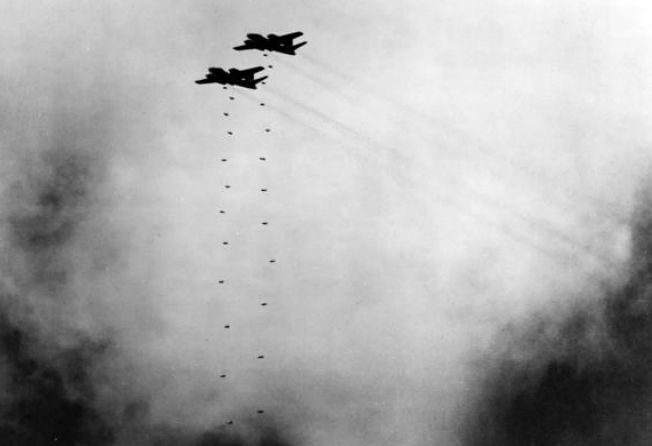
- Up to 12 cameras in four stations, or a single camera with a 2.54 m (100 in) focal-length lens; K-17C trimetrogon installation on a pallet near the wing trailing edge The 100-inch lens was the long-range oblique tool that let an RB-45C photograph across a border it was not allowed to cross. The bomb bay carried 25 M-122 photoflash bombs of 85 kg (188 lb) each for night work, plus fuel.
- Take-off assistance
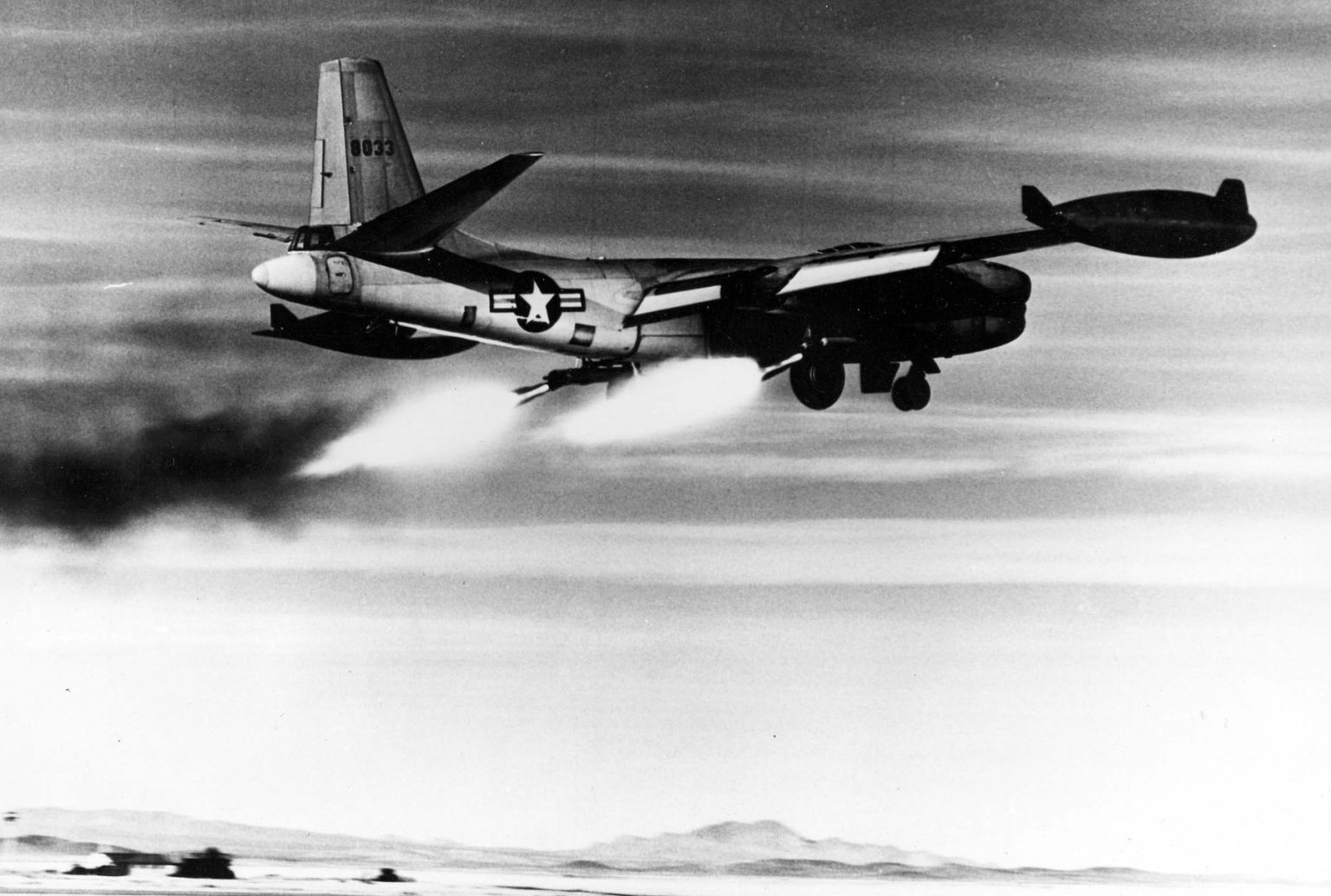
- Two JATO rocket bottles, optional on the RB-45C Carried in place of the underwing tanks. At 50 tonnes on a hot day from a short runway they were not a luxury.
10The Tornado’s variants, from XB-45 to RB-45C+
The Tornado was built in a small number of versions. Three XB-45 prototypes led to the main production bomber, the B-45A, of which around ninety-six were built; a small run of improved B-45Cs followed, with provision for wingtip fuel tanks and other refinements. The most important derivative was the RB-45C reconnaissance aircraft, of which about thirty-three were produced.
Across all versions only around 142 Tornados were built — a modest total that reflects the aircraft’s interim status. There was no sprawling family of sub-types as with longer-lived designs; the B-45’s variants trace a straight line from prototype to bomber to reconnaissance aircraft over a short but historically dense career.
11The North American B-45 Tornado’s operating costs: what the records show+
As with most early Cold War military aircraft, there is no single reliable, transparent public figure for the B-45’s unit cost, cost per flight hour or total programme cost. It was procured in modest numbers in the late 1940s and early 1950s through government contracts rather than at a published list price, and consistent lifetime cost data for so short-lived a type is not available. Any single figure quoted for it should be treated with caution.
The Tornado was, moreover, a pioneering jet with demanding early engines and systems, which made it expensive to operate by the standards of the day — one reason the Air Force was keen to move to the more capable and efficient designs that followed. Rather than invent numbers, we list the cost fields here as “not reliably recorded.”
12Why the B-45’s career was so short+
The Tornado entered service around 1948 and was largely gone from the front line by the late 1950s — a short career even by the fast-moving standards of early jet aviation. The reason was simple: it had been designed at the very beginning of the jet era, and the technology advanced so rapidly that it was overtaken almost at once.
The swept-wing Boeing B-47 Stratojet was a generational leap ahead in speed, range and capability, and once it was available in numbers there was little reason to keep the straight-winged B-45 in the bomber role. The reconnaissance RB-45Cs lasted a little longer, because their specialised mission had no immediate replacement, but they too gave way by the end of the 1950s to higher-flying successors. The B-45 was overtaken not because it was bad, but because it arrived at a moment of extraordinarily rapid change.
13Surviving B-45 Tornados+
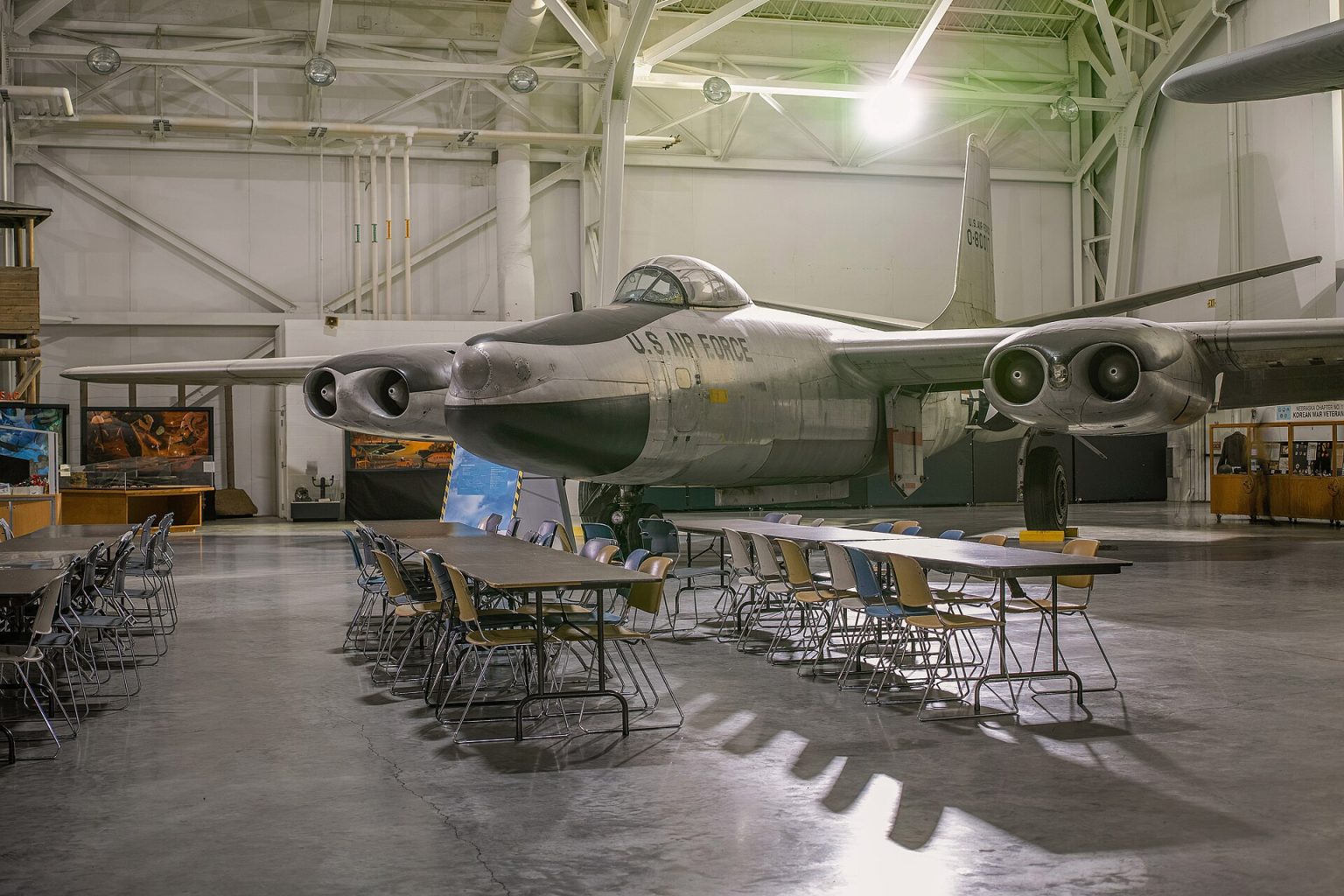
Because so few Tornados were built and the type was retired long ago, survivors are rare, and all are in the United States — fitting for an aircraft flown operationally only by the US Air Force. A small number are preserved in American museums, including at the National Museum of the United States Air Force at Dayton, Ohio, and other collections.
These survivors are the last tangible reminders of a genuinely pioneering aircraft: the first American jet bomber, the first US jet to carry an atomic bomb, and the mount for some of the most daring reconnaissance flights of the Cold War. For a type that never sought fame and served only briefly, the preserved Tornados preserve an outsized piece of history.
Armament & payload
The B-45 was a very large bomb bay with four engines bolted to it, and two machine guns as an afterthought
The Tornado’s offensive load was its entire reason for existing and its defensive armament was an admission of failure. The bomb bay was sized in 1944 for the heaviest conventional weapons then imagined, up to 9,979 kg (22,000 lb), and that generosity is what later allowed the aircraft to be handed a nuclear weapon; but the radius with anything like a full bay was so short that the useful load was closer to 4,536 kg (10,000 lb) and, on the Backbreaker aircraft, closer to a single light atomic bomb plus a bomb-bay fuel tank. Defence was two 0.50 in machine guns in a manned tail turret, fitted because the radar-directed remote system the design assumed did not exist yet, and never replaced. Against the propeller-driven interceptors of 1948 that was arguably sufficient; against a MiG-15 in 1951 it was decoration, and the crews responded by flying at night. Fits varied by mark and by conversion: the B-45A-1 arrived with neither bombsight nor bomb fire-control system, the 40 Backbreaker aircraft of 1952 had a revised defensive fit and reduced bay volume, and the RB-45C carried no bombs at all beyond photoflash cartridges.
Gun
- Two 0.50 in (12.7 mm) Browning M-3 machine guns in a manned tail turret on the B-45A
- Two 0.50 in (12.7 mm) M-7 guns in the same position on the B-45C and RB-45C
- Manned position with a direct optical sight, not remotely controlled and not radar-directed
- Fitted as a stopgap because the intended radar-directed remote turret was unavailable; the B-45B that was to introduce it was cancelled before a single aircraft was built
- Two heavy machine guns against a cannon-armed swept-wing fighter is not a defence, and by 1951 everyone involved knew it
Air-to-air
- None beyond the tail guns; no air-to-air missile existed in USAF bomber service in the B-45 era
- The design’s real air-to-air answer was speed and height, which worked against piston fighters and failed completely against the MiG-15
- No forward-firing armament of any kind was fitted or proposed
- The practical countermeasure adopted in Korea was operational rather than technical: fly at night, and later stand off and shoot obliquely across the border
Air-to-surface guided
- None. The Tornado never carried a guided weapon of any kind in service
- The contemporary Razon and Tarzon radio-guided bombs went to the B-29 force, not to the B-45
- No stand-off missile was ever integrated, and none was seriously proposed before the type was overtaken by the B-47
- Its only claim to precision was the AN/APQ-24 radar bombing system, which was among the least reliable pieces of equipment in the aircraft
Bombs
- Maximum ~9,979 kg (22,000 lb) in a single unobstructed bay, a genuinely exceptional figure for a 1947 jet
- 4,536 kg (10,000 lb) is the load all the published combat-radius figures assume, and is the realistic operational maximum
- Nuclear: from mid-1952, one light tactical implosion weapon of the Mark 5 / Mark 7 generation on the 40 Fandango/Backbreaker aircraft, together with a 4,542 l (1,200 US gal) aft bomb-bay fuel tank
- The nuclear mission only became practical when weapons small and light enough arrived; the physical size of the bay was never the constraint, the radius was
- Early-service B-45As suffered bomb shackles that unhooked without being commanded, one of several defects that kept the fleet from being combat-ready before 1950
Rockets
- No air-to-ground rockets were carried or cleared; the B-45 was never a tactical strafing or rocket-attack aircraft
- The only rockets associated with the type were two JATO take-off assistance bottles, optionally fitted to the RB-45C in place of the underwing tanks
- That is propulsion, not armament, and it is listed here so the omission is not mistaken for an oversight
- Rocket-armed variants were neither proposed nor tested
Pods & other stores
- Two 4,542 l (1,200 US gal) jettisonable wingtip tanks, B-45C and RB-45C, adding 2.1 m to the span
- Two 810 l (214 US gal) underwing tanks on the RB-45C, alternatives to the JATO bottles
- Reconnaissance fit: up to 12 cameras in four fuselage stations, or one camera with a 2.54 m (100 in) focal-length lens, plus a K-17C trimetrogon pallet
- 25 M-122 photoflash bombs of 85 kg (188 lb) in the RB-45C bomb bay for night photography, alongside auxiliary fuel
- Electronic intelligence receivers were carried on the Special Duties Flight overflights; the fit has never been described in open sources in any detail
Three typical loadouts
- Conventional level bombing, 47th Bombardment Group, 1949–51
- 4,536 kg (10,000 lb) of general-purpose bombs in the single bay, AN/APQ-24 radar bombing system, full tail-gun ammunition, no external stores. Combat radius about 858 km (533 miles) on the B-45A, which is a tactical radius on a strategic aeroplane and is the fundamental criticism of the type.
- Nuclear alert, 47th Bombardment Wing, RAF Sculthorpe, 1952–58
- One light tactical atomic weapon forward in the bay, a 4,542 l (1,200 US gal) fuel tank aft, revised defensive fit, tanker support planned into the route. Half the bomb bay given up for the fuel to reach targets in eastern Europe from Norfolk and, in principle, come back. This is the load that made the B-45 matter: Tactical Air Command’s first-line atomic deterrent in Europe from June 1952 until enough B-47s existed to take the job away.
- Night photographic reconnaissance, 91st Strategic Reconnaissance Wing, Japan and Korea, 1951–53
- Camera nose plus up to twelve cameras in four stations, 25 M-122 photoflash bombs and auxiliary fuel in the bay, tip tanks fitted, tail guns loaded, KB-29 refuelling on the outbound leg for the deeper sorties. Flown at night after MiG-15 encounters made daylight work over north-western Korea untenable from April 1951.
Sourcing caveat: weapon fits for the Fandango/Backbreaker nuclear aircraft remain thinly documented in open literature, and the specific weapon marks loaded at Sculthorpe are inferred from what the United States deployed to Europe in 1952–54 rather than from a released loading list. The electronic intelligence equipment carried on the RB-45C overflights has never been described in detail. Gun designations differ between sources, some giving M-3 throughout and others M-7 throughout; the split shown here follows the mark-by-mark specification blocks. Where a figure could not be corroborated it has been left out rather than guessed.
Variants
The B-45 changed engines twice, lost its bombsight, gained a camera nose, and was obsolete before the last one was delivered
The Tornado was ordered in a hurry and it shows. The requirement went out on 17 November 1944, prompted by the Arado Ar 234 and the realisation that Germany had flown a jet bomber first; North American, Convair, Boeing and Martin all submitted; North American’s NA-130 won in 1946 for the explicit reason that it was the least adventurous of the four and therefore the least likely to fail. A production contract for 96 aircraft was signed in January 1947, two months before the prototype flew. That decision bought the United States an operational jet bomber years earlier than caution would have allowed, and it also guaranteed that the aeroplane entering service would be an unfinished one.
What followed is a familiar shape. The first 22 aircraft went out with the wrong engines because the right ones were late. The bombing radar was a maintenance disaster and the earliest aircraft had no bombsight at all. The defensive turret was a placeholder for a system that never arrived, and the variant meant to fix it was cancelled. Fifty-one aircraft were struck off the programme on budget grounds in an announcement of 7 January 1949, against an original intention of something like 190 machines; the published cancellation figures and the final production total of 142 flying airframes do not reconcile cleanly, and anyone quoting a tidy subtraction is quoting further than the sources go. Of 43 B-45Cs ordered only ten were completed as bombers; the remaining 33 were finished as RB-45C reconnaissance aircraft, because by 1949 the Air Force had already decided that the swept-wing B-47 Stratojet was the bomber and the Tornado was a stopgap.
The stopgap then did the most interesting work of its life. As a bomber the B-45 spent six years standing nuclear alert in Norfolk and never dropped a weapon in anger. As a reconnaissance aircraft it flew over Korea, over Chinese territory, and — in four aircraft with their USAF markings stripped off and RAF roundels applied, crewed by RAF officers under Squadron Leader John Crampton and answering to nobody the Soviet Union could plausibly complain to — deep into the western Soviet Union at night in April 1952 and again in April 1954. Those sorties, flown because President Truman and then President Eisenhower would not authorise American crews to overfly Soviet territory but a British government under Churchill would, produced the radar-scope photography on which both the Royal Air Force and Strategic Air Command built their target folders. They stayed secret until 1994.
- XB-45 (first flight 17 March 1947; 3 built, 45-59479 to 45-59481)
- Prototypes, four Allison J35-A-7 of 4,000 lbf, no ejection seats, no operational equipment. One was destroyed in testing with the loss of both pilots. 131 test flights were flown across the three aircraft; the survivors were accepted in July and August 1948 and were relegated to ground instruction by 1950.
- B-45A-1-NA (1948; 22 built, 47-001 to 47-022)
- First production block, delivered from April 1948 with Allison J35-A-11 engines because the General Electric J47 was not ready. Improved ejection seats, better radio, E-4 autopilot. No bombsight and no bomb fire-control system on delivery, which for a bomber is a remarkable sentence to have to write.
- B-45A-5-NA (1948–March 1950; 74 built, 47-023 to 47-096)
- The definitive bomber, re-engined with J47s — two -7 or -13 and two -9 or -15 per aircraft, handed for left and right installations. AN/APQ-24 radar where sets were available. Entered operational service with the 47th Bombardment Group in November 1948.
- B-45A static test airframe (1 airframe, 47-097, never flown)
- Completed for structural testing only. It is the difference between the 142 and 143 figures quoted for total production, and the reason both numbers appear in reputable sources.
- B-45B (none built)
- Proposed improvement with the radar and fire-control systems the design had always assumed, including a proper radar-directed defensive installation. Cancelled without an airframe being laid down, leaving the manned tail turret in place for the type’s whole career.
- B-45C (first flight 3 May 1949; 10 built of 43 ordered, 48-001 to 48-010)
- Strengthened airframe, thicker canopy, two 1,200 US gallon jettisonable wingtip tanks, J47-GE-13/15 with water injection, and a boom receptacle in the upper fuselage that made it the first multi-engined jet bomber in the world to refuel in the air. Production stopped at ten so that resources could go to the B-47.
- RB-45C (first flight April 1950; 33 built, delivered June 1950 to October 1951, 48-011 to 48-043)
- The reconnaissance conversion of the cancelled B-45C airframes and much the most historically significant mark. Solid faired nose with a forward oblique camera in place of the bombardier’s glazing, up to 12 cameras in four stations or one 100-inch focal-length camera, 25 photoflash bombs and fuel in the bomb bay, tip tanks, tail guns retained. Equipped the 322nd, 323rd and 324th Strategic Reconnaissance Squadrons of the 91st Strategic Reconnaissance Wing.
- B-45A, Operation Fandango / Backbreaker conversion (1952; 40 aircraft converted)
- Not a new designation but the most consequential modification the type received: an improved defensive system, additional fuel tankage including a 1,200 US gallon tank in the aft bomb bay, and clearance to carry a tactical atomic weapon. Deployment to the United Kingdom began in May 1952 and was complete by mid-June, making the 47th Bombardment Wing at RAF Sculthorpe the first-line American atomic strike force in Europe until the B-47 and then the B-66 relieved it.
- Special Duties Flight aircraft (1951–54; 4 RB-45C, no separate designation)
- Four RB-45Cs leased from the 91st Strategic Reconnaissance Wing in July 1951, stripped of USAF markings, painted with RAF roundels and flown by Royal Air Force crews drawn largely from Nos. 35 and 115 Squadrons under Squadron Leader John Crampton. Three aircraft plus a spare flew three separate routes over the western Soviet Union on the night of 17/18 April 1952, and the operation was repeated on the night of 28/29 April 1954; the southern route aircraft was engaged by radar-laid heavy anti-aircraft fire near Kyiv at about 11,000 m (36,000 ft) and ran for Germany at full power. All aircraft returned on both occasions. The Canberra took the task over under Project Robin, working some 5,000 m higher.
- JRB-45C and test conversions (early 1950s; small numbers)
- RB-45C 48-017 was converted to JRB-45C for temporary special test duties, and at least one C-series aircraft ended its career as a flying engine testbed with Pratt & Whitney. A handful of Tornadoes were still flying trials work into the early 1970s, long after the last operational aircraft had gone.
- Export and licence production (none)
- There was none. The B-45 was never sold abroad and never licence-built. The single foreign operation, the RAF Special Duties Flight, used American aircraft on American serials that were loaned rather than transferred, which is exactly why the markings could be changed twice in a week.
Survivors, precisely: three complete airframes exist, all of them original North American production aircraft and none of them a reproduction, replica or composite. B-45A-1-NA 47-0008 is at the Castle Air Museum on the former Castle Air Force Base at Atwater, California. B-45C 48-0010 is in the Korean War Gallery of the National Museum of the United States Air Force at Wright-Patterson Air Force Base near Dayton, Ohio, having served as an engine testbed with Pratt & Whitney before being flown in to the museum in 1971 — some accounts give 48-009 as the Pratt & Whitney testbed, and the two aircraft are occasionally confused. RB-45C 48-0017, the aircraft converted to JRB-45C standard, is at the Strategic Air Command and Aerospace Museum at Ashland, Nebraska. Not one is airworthy and none has flown since the type left test work in the early 1970s; three survivors from 142 aeroplanes is a survival rate of about two per cent, which for an aircraft retired in the late 1950s and largely scrapped where it stood is unremarkable. On the retirement itself: front-line bomber squadrons had given the type up by the mid-1950s as the B-47 arrived, fewer than 50 B-45s remained in service in January 1958, the last RB-45Cs went from the 19th Tactical Reconnaissance Squadron in the spring of 1958, and the type was gone from the active inventory by 1959. Eleven years from first flight to withdrawal is a short life even for the 1950s, and it is the correct verdict on the aeroplane: the B-45 was the right aircraft at exactly the right moment and had no business existing a day longer than it did.
Timeline
The North American B-45 Tornado through the years
The North American XB-45 prototype flies on 17 March 1947 — the start of America’s first jet bomber.
The B-45A enters Strategic Air Command service as the first operational jet bomber of the United States.
The B-45 becomes the first American jet aircraft able to carry an atomic bomb, giving the deterrent a jet delivery aircraft.
RB-45Cs fly reconnaissance over Korea and take part in early encounters between jet bombers and MiG-15 fighters.
Nuclear-armed B-45As of the 47th Bombardment Wing deploy to RAF Sculthorpe, placing a jet atomic-strike force forward in Europe.
RB-45Cs fly deep-penetration night reconnaissance over the Soviet Union, some by RAF crews in RAF-marked aircraft — secret “Special Duty Flight” missions.
RB-45Cs, refuelled in flight, carry out long-range strategic photographic and electronic reconnaissance for the US Air Force.
The swept-wing Boeing B-47 Stratojet enters service in numbers and supersedes the straight-winged B-45 in the bomber role.
The last B-45 bombers and RB-45C reconnaissance aircraft are withdrawn as more capable aircraft take over.
A small number of Tornados are preserved in US museums, including the National Museum of the US Air Force.
Stories & Eyewitnesses
The North American B-45 Tornado in stories: the moments that defined it
America’s first jet bomber, the first US jet to carry an atomic bomb, nuclear alert in England, and secret reconnaissance deep over the Soviet Union — the Tornado’s history told through the moments that stuck.
America’s FirstThe first US jet bomber
The B-45 was the first operational US jet bomber.
When the B-45A entered Strategic Air Command service at the end of the 1940s, it became the first jet bomber to serve operationally with the United States — a genuine milestone in the jet age.
It gave the young US Air Force jet-powered striking reach for the first time.
Four JetsTwo nacelles, straight wing
The Tornado had four jets in two underwing pods.
The B-45 carried four turbojets grouped two to a nacelle under a straight, unswept wing — the typical layout of the very first jet-bomber generation.
Sturdy and docile, it was soon outpaced by the swept-wing designs that followed.
Glass Nose, Tail GunA wartime-style crew
The B-45 had a glazed nose and a manned tail gun.
Two pilots sat under a bubble canopy, a bombardier worked in the glazed nose, and a tail gunner defended the rear — a crew layout inherited straight from wartime bombers.
It marks the Tornado as a design straddling the piston and jet ages.
The Atomic JetFirst US jet to carry the bomb
The B-45 was the first US jet able to drop an atomic bomb.
Adapted for the nuclear role, the Tornado became the first American jet aircraft capable of carrying an atomic bomb — a landmark at the dawn of the nuclear standoff.
It meant the deterrent no longer depended solely on propeller-driven bombers.
Nuclear AlertB-45s in England
Nuclear-armed B-45s stood alert at RAF Sculthorpe.
In 1952 nuclear-capable B-45As of the 47th Bombardment Wing deployed to England, placing a jet atomic-strike force forward in Europe, within reach of the Soviet Union.
They were a tangible part of the Western deterrent in the tensest early Cold War years.
Interim BomberA bridge to the B-47
The B-45 filled the gap before the B-47 Stratojet.
The straight-winged Tornado was always a stopgap while Boeing perfected the revolutionary swept-wing B-47 Stratojet.
It let Strategic Air Command learn to operate jet bombers — their tactics and nuclear procedures — until the definitive design was ready.
The RB-45CThe reconnaissance Tornado
A camera-equipped version flew strategic recon.
The RB-45C carried cameras and sensors in place of bombs, and was fitted for in-flight refuelling to extend its reach for long-range reconnaissance.
Only about thirty-three were built, but they took on some of the most secret flying of the early Cold War.
Over the USSRThe secret overflights
RB-45Cs flew deep reconnaissance over Soviet territory.
In the early 1950s RB-45Cs are recorded as flying deep-penetration night reconnaissance missions over the Soviet Union — long, dangerous sorties deep over hostile ground.
They were among the boldest reconnaissance flights of the whole Cold War.
RAF MarkingsThe Special Duty Flight
Some overflights were flown by RAF crews for deniability.
In a politically sensitive arrangement, some Soviet overflights were flown by Royal Air Force crews in RB-45Cs repainted with RAF markings, to give both governments a measure of deniability.
Long classified, these “Special Duty Flight” missions are still only partly documented.
KoreaJet bomber meets MiG
RB-45Cs met MiG-15s over Korea.
Flying reconnaissance in the Korean War, the RB-45C ran into the swept-wing MiG-15 in some of the first encounters between jet bombers and jet fighters.
They showed how vulnerable even a fast jet bomber was to a modern interceptor.
OvertakenA short front-line life
The B-47 quickly made the B-45 obsolete.
As the far more capable swept-wing B-47 Stratojet entered service in numbers, the straight-winged B-45 was withdrawn from the bomber role by the late 1950s.
It had arrived at a moment of extraordinarily rapid change and was overtaken almost at once.
US OnlyFlown by one air force
Only the US operated the Tornado.
Around 142 Tornados were built and the type was flown operationally only by the United States Air Force — though its RB-45C overflights were flown, remarkably, with Royal Air Force crews.
It was a small, purely American fleet that did outsized work.
The SurvivorsPreserved in America
A few Tornados survive in US museums.
Because so few were built and it retired long ago, only a handful of Tornados survive, all in the United States, including at the National Museum of the US Air Force.
They are the last reminders of a pioneering aircraft that did historic work.
Photo Gallery
The North American B-45 Tornado in photographs
US Air Force, NASA and museum photographs of the Tornado and its variants, each credited to its source and licence. Click any photo to enlarge.
On Film
The North American B-45 Tornado on video: a documentary history
A documentary on the Tornado — America’s first jet bomber, its atomic-strike role and the high-risk reconnaissance career of the RB-45C.
“B-45 Tornado” by Dark Skies (approx. 628,000 views at time of writing; running time ~9 minutes) — a documentary on the North American B-45 Tornado, its design and its service.
Operations Overview
Where the North American B-45 Tornado flew: an operator map
Designed, built and flown operationally by the United States alone. Its reconnaissance overflights of the Soviet Union were, remarkably, flown in part by Royal Air Force crews in RAF-marked aircraft — so Britain appears here for that involvement rather than as an owner of the type. Hover or tap a country for detail.
Categories: Design, Manufacture & USAF (United States) · RAF-crewed reconnaissance overflights (United Kingdom — RAF crews flew RB-45C overflights; the aircraft remained US) · Surviving Airframes (United States). The Tornado was operated as a type only by the USA.
Service Record
The Tornado’s record: a pioneer of the jet-bomber age
The B-45’s significance is measured in firsts — the first US jet bomber, the first US atomic-capable jet — and in the daring of its reconnaissance career.
Questions & Answers
North American B-45 Tornado: your questions answered
Can I fly in a North American B-45 Tornado?
No — there is no bookable Tornado flight experience, and MiGFlug does not offer one. Only around 142 were built, all retired by the late 1950s, and the handful that survive are static museum exhibits rather than flying aircraft. If what you actually want is the real thing — strapping into a genuine military jet and flying it — you very much can do that today in other types. MiGFlug arranges flights in real fighter jets and warbirds around the world. Start here: migflug.com/flights-prices.
Why is the North American B-45 Tornado historically important?
The B-45 was the first operational jet bomber built and flown by the United States, and the first American jet aircraft capable of carrying an atomic bomb. Entering service around 1948, it carried the US Air Force into the jet-bomber age and gave the nuclear deterrent a jet delivery aircraft for the first time. Its reconnaissance version, the RB-45C, then flew some of the most daring intelligence missions of the early Cold War.
What was the RB-45C, and what missions did it fly?
The RB-45C was the strategic reconnaissance version of the Tornado, carrying cameras and sensors instead of bombs and fitted for in-flight refuelling. About thirty-three were built. They flew long-range photographic and electronic reconnaissance, including reconnaissance in the Korean War and, most remarkably, deep-penetration night overflights of the Soviet Union in the early 1950s — among the most dangerous reconnaissance missions of the whole Cold War.
Did the RAF fly the B-45?
Yes, in a very particular way. The B-45 was a US aircraft, operated as a type only by the US Air Force. But some of the RB-45C’s secret overflights of the Soviet Union in the early 1950s were flown by Royal Air Force crews in aircraft repainted with RAF markings, in a politically sensitive arrangement designed to give both governments a measure of deniability. The aircraft themselves remained American; it was the crews and the markings that were British for those “Special Duty Flight” missions.
Was the B-45 the first US jet to carry an atomic bomb?
Yes. The Tornado was the first American jet aircraft capable of carrying an atomic bomb. Nuclear-armed B-45As were deployed to RAF Sculthorpe in England from 1952, placing a jet-borne US atomic-strike force forward in Europe within reach of the Soviet Union. This was a significant early step in the jet-powered nuclear deterrent that the B-47 and B-52 would later carry forward.
Why did the B-45 have such a short career?
The Tornado was designed at the very start of the jet era, and technology advanced so fast that it was overtaken almost immediately. The swept-wing Boeing B-47 Stratojet was a generational leap ahead in speed, range and capability, and once it entered service in numbers there was little reason to keep the straight-winged B-45 in the bomber role. The B-45 was essentially an interim aircraft — a bridge that let the Air Force learn to operate jet bombers until the definitive design was ready.
Who operated the B-45 Tornado?
The B-45 was operated as a type only by the United States Air Force, chiefly its Strategic Air Command (bombers) and reconnaissance wings (RB-45Cs). It had no foreign operators, although its RB-45C Soviet overflights were flown with Royal Air Force crews. Around 142 aircraft of all versions were built, and they served from about 1948 until the late 1950s.
Was the North American B-45 Tornado a good aircraft?
It was a sound, useful aircraft for its brief moment, and above all a genuinely important pioneer. As a bomber it was quickly outclassed by the swept-wing B-47, and its front-line career was short. But it did exactly what a first-generation jet bomber needed to do: it proved that the US Air Force could operate jet bombers, it became the first US jet to carry the atomic bomb, and its RB-45C reconnaissance version flew missions of extraordinary daring. Judged as a pioneer rather than a performer, the Tornado was a real success.
Fly For Real
You can’t fly the B-45 Tornado — but these, you can
No Tornado is a bookable ride today. The urge behind it — to strap into a real military aircraft and actually fly — is very much still bookable. MiGFlug puts you in genuine fighters and warbirds around the world.
Fighter Jet Flights
Take the controls of a real ex-military jet with an experienced pilot.
All flights are operated by MiGFlug’s vetted partners with professional pilots. Browse every option and current pricing at migflug.com/flights-prices. MiGFlug does not operate North American B-45 Tornado flights — no bookable example exists.
Related Aircraft
If the North American B-45 Tornado interests you, explore these
Sources & Further Reading
Where this North American B-45 Tornado history comes from
Note on figures: dimensions, performance and production numbers for the B-45 vary between sources and by variant, and are hedged here as approximate. Cost fields are listed as not reliably recorded because trustworthy early Cold War procurement cost data is not consistently available. The RB-45C’s reconnaissance history, including the Soviet overflights and the RAF-crewed “Special Duty Flight” missions, was long classified and remains only partly documented; it is presented here in summary and with due care. A few B-45s survive in US museums.