
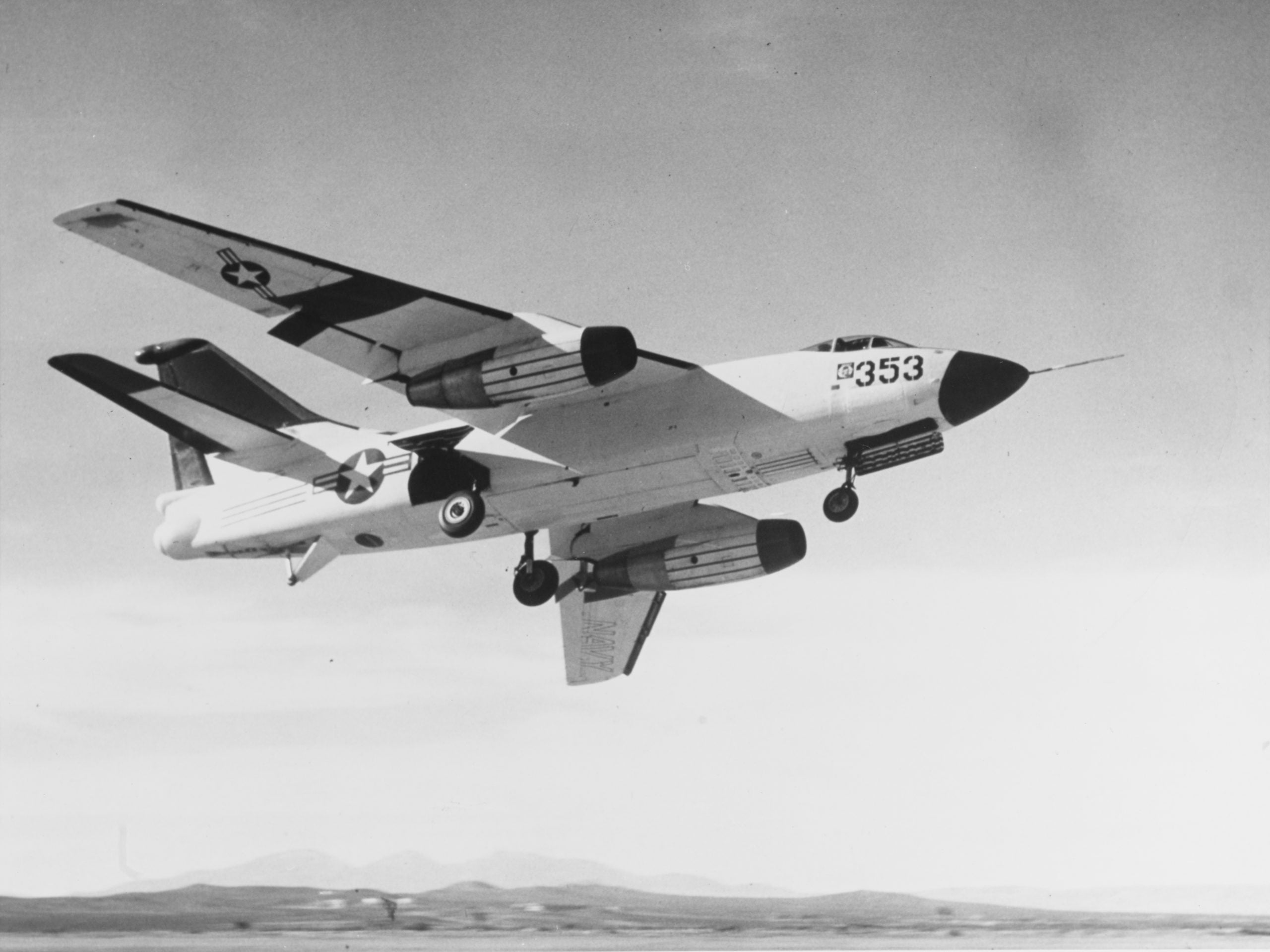
Douglas A-3 Skywarrior
“The Whale”
The largest and heaviest aircraft ever to operate routinely from an aircraft carrier — a carrier-borne nuclear bomber that outlived its own mission to become the fleet’s tanker, spy and electronic-warfare workhorse for 35 years.
The nuclear bomber that flew from a carrier deck
In the late 1940s the U.S. Navy wanted something the other services said was impossible: a jet bomber that could lift an early atomic bomb off an aircraft carrier and carry it some 2,000 nautical miles to a target. Nuclear weapons of the era were huge, and every existing design that could haul one was far too big and heavy for a flight deck. At Douglas, chief engineer Ed Heinemann — the man behind the tiny A-4 Skyhawk — answered with fanatical weight discipline, and won the contract in 1949.
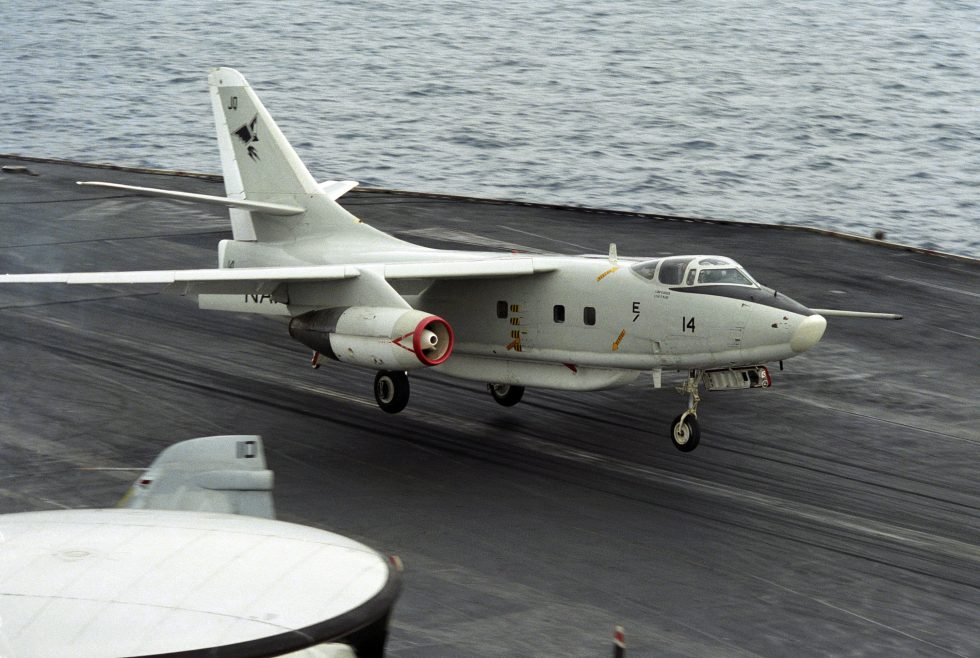
The result first flew on 28 October 1952 and reached the fleet in 1956. Even trimmed to Heinemann’s limits it was enormous: at over 70,000 lb loaded, the Skywarrior is widely described as the largest and heaviest aircraft ever to operate routinely from a carrier. The crews took one look at the slab-sided giant and named it “The Whale.” Its outer wings and vertical tail folded so it could squeeze onto carrier lifts and into hangar bays.
To save weight, Heinemann made one notorious choice: no ejection seats. The three-man crew was meant to bail out down an internal chute — a system that worked poorly low, fast or over water. Aviators turned the A3D designation into a grim joke: “All Three Dead.” Yet the airframe proved astonishingly adaptable. As the nuclear-strike role faded, the Whale was rebuilt into buddy-tankers (KA-3B), electronic-warfare and reconnaissance platforms (EA-3B, EKA-3B) that served through Vietnam and, in tiny numbers, all the way to 1991.
01The A-3 Skywarrior’s land-based cousin: the USAF B-66 Destroyer
The U.S. Air Force liked the Skywarrior enough to adapt it into a land-based tactical bomber and reconnaissance aircraft, the Douglas B-66 Destroyer. On paper it was the same family, but the redesign went much further than expected: a reworked fuselage and wing, different Allison J71 engines in place of the J57s, revised landing gear — and, tellingly, ejection seats, which the carrier A-3 never had. Aviation writers such as Bill Gunston argued many of the changes were needless inter-service tinkering, but the B-66 gives a clear picture of what a Skywarrior looked like once Heinemann’s brutal carrier weight limits were relaxed. We mention it only in passing here — the B-66 is a story of its own.
What makes the A-3 Skywarrior special
Heinemann’s weight obsession
The Navy’s requirement demanded a carrier jet able to loft a ~10,000 lb atomic bomb roughly 2,000 nautical miles. Rivals grew heavy; Ed Heinemann’s Douglas team came in reportedly around 32,000 lb lighter than the 100,000 lb aircraft the Navy requirement had assumed — light enough to work from older, modified WWII-era decks. That obsessive trimming is the reason a bomber this size could go to sea at all.
The biggest thing on the boat — and it folded
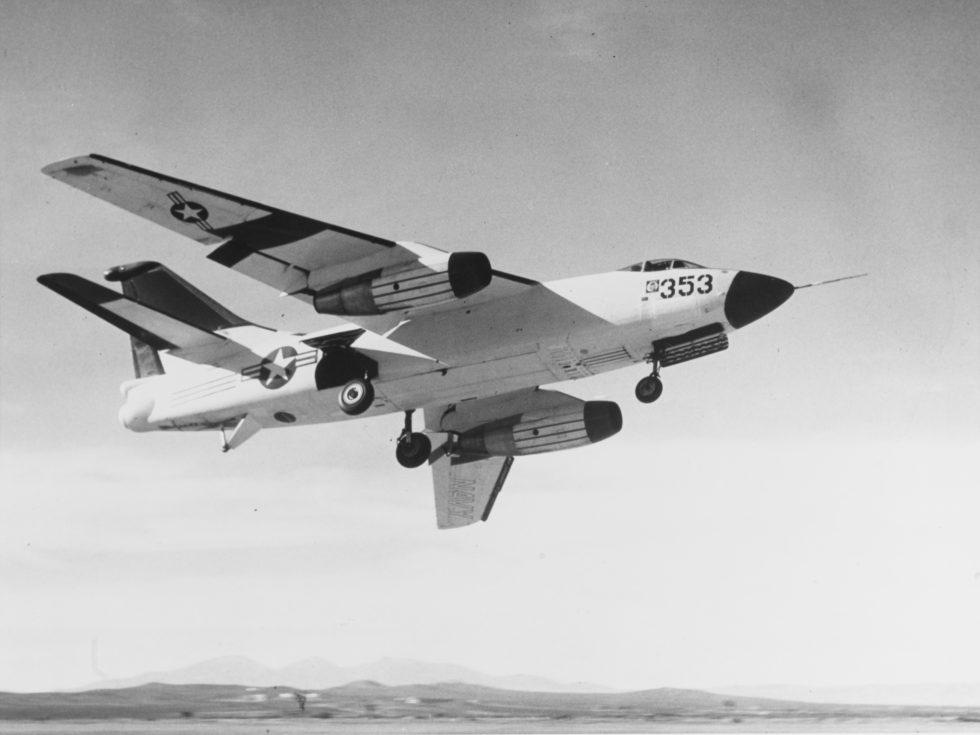
Even lightened, the A-3 was huge: over 70,000 lb loaded, the largest and heaviest aircraft to routinely fly from carriers, hence “The Whale.” To fit lifts and hangars, Heinemann gave it folding outer wings and a folding vertical tail. Twin podded Pratt & Whitney J57 turbojets hung under the wing in nacelles with distinctive bullet-shaped fairings — an instantly recognisable Skywarrior signature.
A nuclear bomb bay and no ejection seats
The Skywarrior was built around a large internal bomb bay sized for early atomic weapons (later cited at up to ~12,000 lb of ordnance). To hold the weight down, Heinemann deleted the ejection seats; the crew of three was to escape down an internal chute to the belly — a system nearly useless in low, fast or water emergencies, and the origin of the aircraft’s darkest nickname.
02The A-3 Skywarrior’s escape chute: why “All Three Dead” stuck
Ejection seats are heavy, and Heinemann was fighting for every pound, so the Skywarrior went to sea without them. Instead the three-man crew was meant to slide down an internal chute that ran from the cockpit to a hatch on the aircraft’s belly. In theory it worked; in practice it needed altitude, a controlled attitude and time — exactly what a low-level miss, a catapult failure or a ditching denied. Fatal accidents in which crews could not get out gave the A3D designation its grim gloss among aviators: “All Three Dead.” It was gallows humour built on a real and well-documented hazard, not just a bad joke.
03The A-3 Skywarrior’s second life: from nuclear bomber to tanker and spy plane
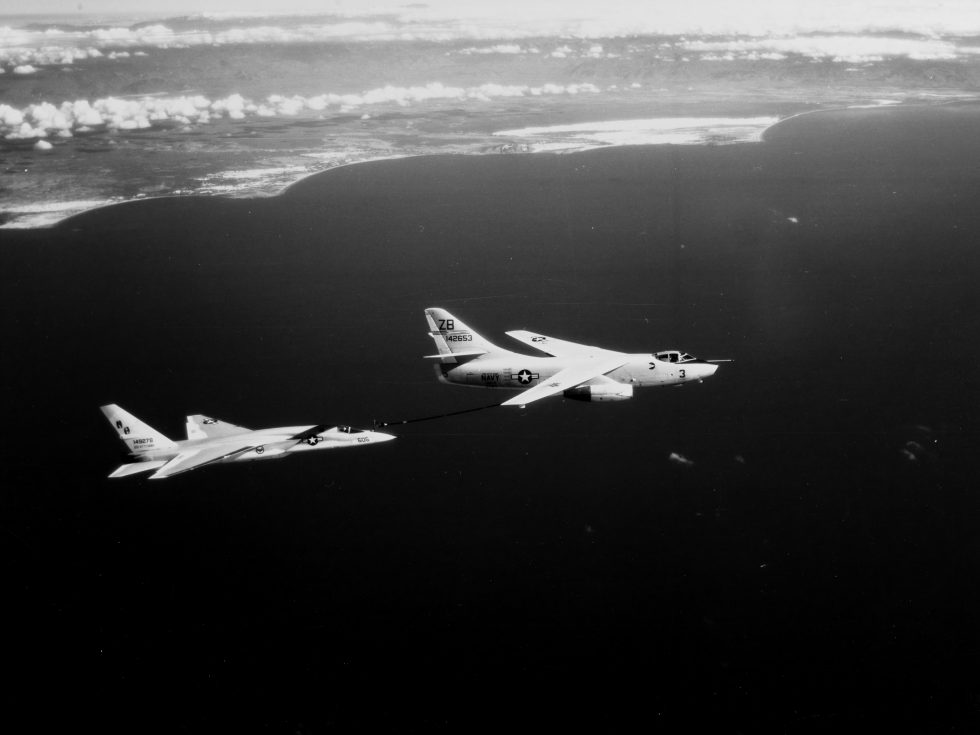
By the mid-1960s the carrier nuclear-strike mission was passing to smaller aircraft and submarine-launched missiles, but the Whale’s big, long-legged airframe made it ideal for other work. Converted KA-3B buddy-tankers turned it into the air wing’s flying gas station over Vietnam, saving battle-damaged jets that could not otherwise reach the boat. EKA-3B aircraft combined tanking with electronic countermeasures, while the EA-3B packed its former bomb bay with up to four electronic-intelligence operators — nicknamed “crows” — expanding the crew from three to seven. That flexibility, not the atom bomb, is why the Whale served for 35 years.
Douglas A-3 Skywarrior full specifications
Baseline note: the figures below describe the Douglas A3D-2, redesignated A-3B under the tri-service scheme of September 1962 — the definitive bomber version, 164 of which were delivered between 1956 and 1961 with a strengthened airframe, a slightly enlarged 812 sq ft wing and two Pratt & Whitney J57-P-10 turbojets in place of the A3D-1’s J57-P-6s. It is the right baseline because it is the aeroplane the fleet actually flew: the 49 A3D-1s were largely a development and work-up batch, and almost every later Skywarrior — tanker, jammer, trainer, testbed — is a converted A3D-2 airframe. Deltas for the EA-3B electronic reconnaissance aircraft, the KA-3B and EKA-3B tanker conversions, and the United States Air Force’s B-66 Destroyer are in grey. A word on the B-66 before any of it is used: it is not a Skywarrior with a star on the fin. Douglas redesigned the fuselage and the wing from scratch for low-level land-based work, fitted Allison J71 turbojets instead of J57s, deleted the carrier equipment, and — the difference that matters most in this article — gave the crew ejection seats. Where a figure below is labelled B-66 it is a comparison, not a variant. Six cautions. First, production: 282 aircraft were accepted, and the breakdown that reaches that total is 2 XA3D-1, 1 YA3D-1, 49 A3D-1, 164 A3D-2, 30 A3D-2P, 24 A3D-2Q and 12 A3D-2T. The figure 283 circulates widely and almost certainly counts the static-test airframe built alongside the two flying prototypes. Second, engine rating: the J57-P-10 is rated at 10,500 lbf dry, and Francillon adds 12,400 lbf with water injection — but the standard Pratt & Whitney literature states that the -P-10 had no water-injection capability. One of the two is wrong; the wet figure most likely belongs to a different dash number and should be quoted with that caveat attached. Third, maximum speed: 610 mph at 10,000 ft (Francillon) and 640 mph at 2,500 ft (Baugher) are both in print for the same mark. They are not reconcilable as a single number and are given here as two. Fourth, rate of climb: the primary specification table omits it entirely, and the figures that appear in online databases cannot be traced to a source. This page declines to invent one. Fifth, the famous claim. The Skywarrior was the heaviest aircraft to operate routinely and operationally from American carriers, which is true and remarkable; it was not the heaviest ever to use a carrier deck, because a Marine Corps KC-130F Hercules made unassisted take-offs and landings from Forrestal in 1963 as a trial. The distinction matters and is usually lost. Sixth, internal fuel: no primary table publishes a clean figure. The value below is derived from the published empty and maximum weights and should be read as an order of magnitude, not a number from a manual.
Dimensions & weights
- Crew
- 3 — pilot and bombardier/navigator side by side in a raised compartment under a heavily framed canopy, the pilot on the port side with the only full set of controls; behind them, facing aft, a third crewman who was navigator, gunner for the tail turret while it existed, and operator of the sextant and the defensive countermeasures. No one in the aeroplane had an ejection seat. On the EA-3B the crew rose to seven: pilot, co-pilot and navigator forward, an electronic warfare officer and three systems operators in the pressurised former weapons bay. The ERA-3B carried four plus a jump seat, the KA-3B three
- Length overall
- 23.27 m (76 ft 4 in). Aircraft fitted with the ECM tail fairing in place of the turret are marginally longer, and the ERA-3B’s extended tailcone longer again; the B-66B measured 22.90 m (75 ft 2 in)
- Wingspan
- 22.10 m (72 ft 6 in), identical on the B-66. The outer panels folded upward and then almost flat, hinged just outboard of the engine nacelles — an unusually far-inboard fold line, forced by the sheer span of a strategic bomber being asked to live in a Midway-class hangar
- Height
- 6.95 m (22 ft 9½ in) with the fin erect. The whole vertical stabiliser hinged over to starboard for stowage, which is a rarer arrangement than a folding fin tip and tells you how little headroom there was below deck
- Wing area
- 75.4 m² (812 sq ft) on the A3D-2, with leading-edge slats and cambered leading edges. The A3D-1 had 72.4 m² (779 sq ft); the extra 33 sq ft went in to recover low-speed handling as weights climbed. The B-66 used 72.5 m² (780 sq ft)
- Wing layout
- Shoulder-mounted, swept 36° — NACA 63-009.9 at the root and 63-008.25 at the tip, both modified with cambered leading edges. Thin, clean and conventional; Heinemann was not interested in novelty here, and the aeroplane’s reputation for pleasant handling came from the hydraulically boosted controls rather than from anything clever in the aerodynamics
- Empty weight
- 17,876 kg (39,409 lb). For comparison the B-66B, freed of carrier structure but burdened with ejection seats and a different mission fit, came out heavier at 19,300 kg (42,549 lb) — a useful corrective to the idea that navalisation is simply a weight penalty
- Gross weight
- 31,751 kg (70,000 lb), the normal loaded figure. This is already two and a half times the loaded weight of an A-4 Skyhawk, and it was being flung off a steam catapult and caught by a wire several times a day
- Maximum take-off weight
- 37,195 kg (82,000 lb), with the type additionally qualified at the Navy’s insistence to an overload of 38,102 kg (84,000 lb) — the trials for which set the weight record for carrier operations. In 1958 a Skywarrior was catapulted from Saratoga at 42 tons
- Design gross weight
- 30,844 kg (68,000 lb) — the number that created the aeroplane. The Chief of Naval Operations’ 1948 requirement assumed 45,359 kg (100,000 lb) and a new class of supercarrier to fly it from. Six of the eight bidders withdrew saying it could not be done at all. Heinemann’s team came in at 68,000 lb, betting correctly that nuclear weapons would shrink faster than airframes could grow, and when the United States-class carriers were cancelled in April 1949 that bet won the contract outright
- Internal fuel
- ~13,500 kg (~29,800 lb, roughly 4,500 US gal of JP-5) — derived from the published weights rather than quoted from a manual, because no primary table gives a clean figure. The fuselage was, in effect, a flying tank with a bomb bay cut through it, and that surplus volume is the reason the strike aeroplane made such an outstanding tanker
- Weapons bay
- Roughly 4.6 m × 1.5 m (about 15 ft by 5 ft) internal — no manufacturer’s figure is published and these are measured approximations. Sized for a first-generation hydrogen bomb. Underwing pylons were designed in but almost never fitted in service; everything went inside, which cut drag and preserved the range. On the RA-3B the bay held twelve camera stations, on the EA-3B a pressurised compartment for four operators, on the KA-3B the fuel and the hose reel
- Wing loading
- 421 kg/m² (86.2 lb/sq ft) at gross weight — high for the period and the reason the A3D-2 needed the enlarged wing, the slats and a great deal of respect on the approach
Performance
- Maximum speed
- 982 km/h at 3,050 m (530 kt, 610 mph at 10,000 ft) per Francillon. Baugher gives 1,030 km/h (640 mph) at 760 m (2,500 ft) for the same mark; both are in wide circulation and this page prints both rather than choosing. Either way it was, for several years, faster than most of the fighters that would have had to intercept it
- Cruising speed
- 963 km/h (520 kt, 600 mph). The gap between cruise and maximum is remarkably narrow — a clean, high-aspect airframe on two economical turbojets, cruising close to its own limit, which is exactly what a strategic bomber wants and exactly what makes a good tanker
- Range
- 3,380 km (1,825 nmi, 2,100 miles). Beware the figure 1,691 km, which appears in at least one specification database and is a corrupted transcription rather than a real profile
- Ferry range
- 4,670 km (2,520 nmi, 2,900 miles)
- Design radius
- 2,000 nmi (3,700 km) with a 4,536 kg (10,000 lb) bomb load, as written into the January 1948 requirement. The delivered aeroplane met the intent of it, which is why the Navy accepted a bomber a third lighter than the one it had asked for
- Service ceiling
- 12,500 m (41,000 ft). The whole escape philosophy rested on this number: designers assumed the aeroplane would spend its working life high and cold, where a crew would have time to get down a chute. In Vietnam it spent its working life low, in the circuit, and at night
- Rate of climb
- Not published. Francillon’s table omits it and the values that appear in online compilations cannot be traced to any primary source. The Skywarrior was a cruiser rather than a climber, and no honest figure is available to print here
- Load factor
- +3.4 g — a bomber’s limit, not a fighter’s, and a reminder that for all its later work as a tanker and jammer this airframe was never meant to be thrown about
- Thrust-to-weight
- 0.357 at gross weight, dry. Two 10,500 lbf turbojets under 70,000 lb of aeroplane is not a generous margin, which is why twelve JATO bottles were designed into the airframe and why a hot, still day on a short-deck carrier concentrated the mind
- Carrier suitability
- Cleared for Midway, Forrestal and modernised Essex decks — the last of those with real reluctance. The Skywarrior was operated from Second World War hulls at weights nobody had contemplated when those hulls were laid down, and the accident record shows it: of roughly 120 airframes lost, a majority went in operational accidents rather than to enemy action
- Demonstrated range
- 5,150 km in under 6 hours (3,200 miles, Honolulu to Albuquerque, 1956) — a public demonstration flight made in the type’s first year of service, when the Navy had a strategic case to argue against the Air Force and every reason to argue it loudly
- Tanker offload
- KA-3B: about 12,680 litres (3,350 US gal, 21,775 lb) available for transfer, with roughly 29,000 lb quoted as deliverable at 740 km (460 miles) from the ship. The two figures come from different sources and different profiles and should not be added or averaged. For scale, one KA-3B could refill roughly two and a fifth F-4J Phantom IIs
Propulsion & systems
- Engines
- 2 × Pratt & Whitney J57-P-10 twin-spool axial turbojets, in nacelles slung under the wing on short pylons. The J57 was the first American engine in the 10,000 lbf class and one of the great engines of the era; it also powered the B-52, the F-100, the F-102 and the U-2
- Rated thrust
- 46.7 kN each (10,500 lbf) dry. Francillon adds 55.2 kN (12,400 lbf) with water injection, but Pratt & Whitney’s own variant listing states that the -P-10 had no water-injection provision. The contradiction is unresolved in the open literature and is flagged here rather than smoothed over
- Engine architecture
- 9-stage LP plus 7-stage HP compressor — roughly 12:1 overall pressure ratio. The two-spool layout was the J57’s innovation: it cured the compressor-stall problem that plagued long single-spool machines and gave far better throttle response, which on a carrier approach is not a footnote
- Earlier and other powerplants
- The XA3D-1 flew on Westinghouse J40-WE-3s, an engine Heinemann summarised as "not powerful enough" and which was eventually cancelled outright; the J40 fiasco is the single largest reason the Skywarrior took until 1956 to reach the fleet. The A3D-1 used the 43.1 kN (9,700 lbf) J57-P-6. The USAF B-66 used Allison J71-A-11 and -A-13 turbojets of 45.4 kN (10,200 lbf) — less thrust and more fuel burn than the J57 already in American service, a substitution most authors regard as inexplicable
- Take-off assistance
- Provision for 12 × 20 kN JATO bottles (4,500 lbf each). Rarely used in the fleet, but the fact that a carrier aeroplane needed the option designed in says everything about the margins involved
- Flight controls
- Fully hydraulically powered — and unusually well done. Heinemann’s team put real effort into the boosted surfaces, and pilots consistently reported that an aeroplane of this size and weight flew far more pleasantly than it had any right to. Hydraulics also drove the undercarriage, the arrester hook, the flaps and both the wing and tail folds
- Bombing and navigation
- AN/ASB-1A bomb-director system initially, replaced on the final 21 A3D-2s by the AN/ASB-7 under a flat-panel nose radome in place of the earlier pointed one — the quickest way to date a Skywarrior photograph. The third crewman also carried a sextant for celestial navigation, which on a 1950s trans-oceanic nuclear mission was not an antique but a necessity
- Defensive fit
- Westinghouse radar-directed tail turret, 2 × 20 mm — deleted early in A3D-2 production and replaced by an ECM tail fairing. The Navy concluded, correctly, that electrons were worth more than cannon shells to an aeroplane of this size, and every later mark carried countermeasures where the guns had been
- Escape system
- Escape chute, no ejection seats — ejection seats were deleted during design to save weight, on the assumption that the aircraft would operate high enough for a bail-out to work. Instead the crew unstrapped, went down a tunnel from the cockpit floor and left through a hatch in the belly, a spoiler ahead of the opening deflecting the airflow. The arrangement was borrowed from the F3D Skyknight. It required altitude, time and a controllable aeroplane, and a carrier accident supplies none of the three. In 1973 the widow of a crewman killed over Vietnam sued McDonnell Douglas over the omission
- In-flight refuelling
- Hose-and-drogue reel in the weapons bay — designed into later A3D-2s from the outset, which is why the conversion to a full tanker in 1967 was so straightforward. The KA-3B carried the reel plus bay tankage in place of all bombing equipment; the EKA-3B added jamming transmitters, four teardrop antenna blisters and a ventral canoe without giving up the hose
- EA-3B mission systems
- A pressurised, air-conditioned compartment built into the former weapons bay housing an electronic warfare officer and three operators at consoles, with receivers, direction-finding aerials and recorders fed by antennas scattered over the airframe. The pressurisation mattered: this was a crew working an eight-hour signals mission at altitude, not a bomb-aimer lying in a hole. The ERA-3B aggressor added an ALT-40 jammer, an ALR-75 receiver suite, chaff dispensers and two detachable ram-air-turbine ALQ-76 pods
04The A-3 Skywarrior’s operating costs: why no reliable price exists
The Skywarrior was a 1950s U.S. Navy programme, procured and operated as a military asset rather than sold on an open market, and no dependable per-aircraft flyaway price or cost-per-flight-hour figure survives in accessible public sources. What is documented is scale: roughly 282 airframes built and a service life stretching across 35 years and at least a dozen sub-variants, from nuclear bomber to tanker, trainer, photo-reconnaissance and electronic-intelligence platform. Any precise dollar cost you see attached to an A-3 should be treated as an estimate, not a sourced number.
Armament & payload
The Skywarrior was built around a bomb bay big enough for a hydrogen bomb, and spent most of its life carrying fuel
Everything about this aeroplane follows from one volume: an internal bay roughly fifteen feet long and five feet wide, sized in 1948 for a first-generation thermonuclear weapon that nobody had yet flown from a ship. Heinemann bet that warheads would shrink, designed the smallest airframe that could still swallow the biggest bomb then imaginable, and won — by the time the A3D-2 reached the fleet the weapons had indeed become small enough that the bay was embarrassingly capacious. That surplus volume, and not the bombing system, is what kept the type flying for thirty-five years: it could be filled with cameras, with signals-intelligence consoles, with jamming transmitters, or simply with several tons of fuel and a hose reel.
As a weapons carrier the Skywarrior was conventional to the point of dullness. One bay, no pylons in practice, no missiles of any kind, a tail turret that was deleted almost immediately, and free-fall stores dropped from level flight or lofted on a bombing system that was state of the art in 1956 and obsolete by 1962. It bombed in anger for about three years, from 1964 to 1967, and did so competently rather than brilliantly — it was too big and too valuable to send where a Skyhawk could go, and once the Navy had enough A-4s and A-6s there was no reason to risk one. The six cards below are the standard headings kept honestly: where a category is genuinely empty it says so and explains why, rather than being padded, and the interesting payload questions on this type are all in the last two cards.
Gun
- 2 × 20 mm M3L cannon in a Westinghouse radar-directed tail turret, aimed by the third crewman from his aft-facing station using a ranging radar rather than by eye.
- Fitted to the A3D-1 and to early A3D-2 airframes only. It was deleted during A3D-2 production and replaced by an electronic countermeasures fairing in the same tail position.
- The two prototypes never carried it at all, and no Skywarrior is credited with firing it at an enemy aircraft.
- Some RA-3Bs and early EA-3Bs kept the guns for a time; most were later brought up to the ECM tail standard of the late A-3Bs.
- The judgement behind the deletion was sound and early: against 1960s interceptors and missiles, a jammer in the tail was worth more than a turret. Every subsequent American carrier aircraft agreed.
Air-to-air
- None, on any mark, ever. No air-to-air missile was fitted to or cleared for any Skywarrior variant.
- The tail turret was the type’s only air-to-air weapon and it lasted a few years of a thirty-five-year career.
- From the mid-1960s the aeroplane’s entire defence was altitude, speed, its own countermeasures and, over North Vietnam, an escort. An EA-3B on a signals mission near hostile airspace was as unarmed as an airliner.
- This was a deliberate and correct choice, not an oversight. Weight spent on self-defence would have come straight out of range, and range was the reason the aeroplane existed.
- Tables that credit the type with Sidewinders are extrapolating from the drawn-but-unused underwing hardpoints.
Air-to-surface guided
- None carried operationally. No guided air-to-surface weapon was ever integrated on the Skywarrior in Navy service.
- The bombing system, AN/ASB-1A and later AN/ASB-7, was a radar bomb-director for free-fall stores. It computed a release point; it did not steer anything after release.
- Underwing pylons appear on the drawings and were fitted experimentally, but production aircraft in squadron service carried their load internally. Keeping stores inside cut drag and preserved the range that justified the aeroplane.
- Mine-laying, which the type did carry out over North Vietnamese waters, used unguided mines released from the same bay.
- By the time stand-off weapons became normal in carrier aviation, the surviving Skywarriors had no bombing role left to apply them to.
Bombs
- Up to 5,806 kg (12,800 lb) of free-fall bombs or mines in the internal bay; the round figure of 12,000 lb is also widely quoted and the difference is a matter of which fit is being counted.
- Typical internal loads: 12 × Mk 82 (500 lb), 6 × Mk 83 (1,000 lb), 8 × 1,600 lb armour-piercing, or 4 × 2,000 lb. Over Vietnam the Mk 84 2,000-pounder was the characteristic Skywarrior weapon.
- Nuclear: one free-fall weapon was the design case. The Mk 15 thermonuclear bomb is the store most firmly attested with the type; as warheads shrank through the Mk 27, Mk 28 and Mk 43 generations the bay was progressively under-used. Open-source clearance lists for United States naval nuclear stores are incomplete, and any detailed weapon-by-weapon table for this aircraft should be treated as reconstruction rather than record.
- Naval mines were laid from the same bay, and mining was among the few tasks for which the Skywarrior’s size and internal volume made it genuinely preferable to a smaller attack aircraft.
- The bomber career was short: conventional strike from 1964 to about 1967, after which more manoeuvrable aircraft took the work and the Whales moved to the tanker and jamming pattern.
Rockets
- None. No unguided rocket pod or rail was fitted to any operational Skywarrior.
- Rocket attack requires a dive, a pull-out and a tolerance for ground fire. A 70,000 lb bomber limited to +3.4 g had none of those things.
- The Navy had the A-1 Skyraider, then the A-4 Skyhawk and A-7 Corsair II, for exactly that job, and never asked the A-3 to do it.
- The only rocket motors associated with the type were the twelve JATO bottles designed into the airframe to help it off the deck — propulsion, not armament.
- This card is kept because the standard six are kept; on this aeroplane it is genuinely empty.
Pods & other stores
- Hose-and-drogue refuelling reel in the weapons bay with bay tankage — the KA-3B fit, and the single most consequential thing the Skywarrior ever carried. Roughly 12,680 litres (3,350 US gal) available for transfer.
- EKA-3B jamming fit: transmitters, four teardrop antenna blisters on the fuselage sides and a ventral canoe, added without removing the tanker equipment, so one aircraft could jam while waiting to pass fuel.
- RA-3B camera pallet: up to twelve camera stations plus photoflash cartridges in the bay, with the compartment pressurised well enough that an operator could climb in during flight and service the cameras. Infrared equipment was fitted for night traffic surveillance over Laos.
- EA-3B signals compartment: a pressurised cabin for four in the former bay, with receivers, direction-finders and recorders — a payload of people and electronics rather than ordnance.
- ERA-3B aggressor fit: ALT-40 jammer, ALR-75 receivers, chaff dispensers in the tailcone and aft fuselage, and two detachable ram-air-turbine ALQ-76 pods, one under each wing. The equipment could survive an arrested landing but not a catapult stroke, so the ERA-3B never deployed aboard ship.
Three typical loadouts
- Nuclear alert, 1958
- One free-fall thermonuclear weapon in the bay, bay doors closed, full internal fuel, AN/ASB-1A bomb-director, tail turret manned by the third crewman. Launched from a Midway- or Forrestal-class deck against a target several hundred miles beyond anything Air Force bombers could reach from their bases. The whole American carrier nuclear-strike case rested on this configuration for about five years, until the Polaris submarine made it redundant.
- Conventional strike, Tonkin Gulf, 1965
- A-3B of VAH-4 off Oriskany: four Mk 84 2,000 lb bombs or a mixed Mk 82/Mk 83 load in the bay, tail turret already replaced by the ECM fairing, no external stores, escorted. Effective but expensive — a very large, unarmoured, non-manoeuvring aeroplane over defended ground, with no ejection seats aboard. The Navy stopped doing it by 1967.
- Tanker and jammer, Yankee Station, 1972
- EKA-3B of VAQ-135: bay tankage and hose reel full, jamming transmitters live, blisters and ventral canoe fitted, three crew. Launched with the strike, jammed North Vietnamese acquisition radars during the ingress, then orbited to pass fuel to returning Crusaders and Phantom IIs — frequently to aircraft that would otherwise not have reached the ship. This is the mission that made the Whale beloved by an air wing that had once regarded it as a hangar-deck nuisance.
Sourcing caveat: the conventional bomb loads and the 12,800 lb figure come from Polmar’s 1988 study in Air Enthusiast and from Francillon; the 12,000 lb figure quoted elsewhere reflects a different accounting of the bay. Nuclear store clearances are the weakest part of the record: only the Mk 15 is firmly attested in open sources for this type, and lists naming half a dozen weapons should be read as informed inference. Fuel-offload figures for the KA-3B come from two different sources describing two different profiles and are not interchangeable.
Variants
Almost every Skywarrior that mattered was a bomber converted into something else
The Skywarrior’s designed purpose lasted about five years. It entered squadron service on 31 March 1956 as the United States Navy’s answer to the Air Force’s monopoly on strategic nuclear delivery; by 1961 the Polaris submarine had made carrier-borne strategic bombing an expensive irrelevance, and the heavy attack wings were disbanding or converting. What saved the type was the very thing that had made it awkward — a fuselage with an enormous hole in the middle of it and the fuel to fly a long way.
So the designations below divide cleanly in two. Everything up to the A3D-2T is a factory-built bomber, reconnaissance aircraft or trainer, delivered between 1956 and January 1961. Everything after it is a rebuild: 85 A-3Bs became KA-3B tankers at Alameda in 1967, 34 of those became EKA-3B tanker-jammers for the Vietnam War, RA-3Bs became electronic aggressors and test machines. The second list outlived the first by a quarter of a century. In September 1962 the whole family was renamed under the tri-service scheme, which is why every Skywarrior carries two designations and why so many published tables mix them.
And then there is the B-66, which is where most of the confusion in the literature comes from. The Air Force wanted a land-based tactical bomber and reconnaissance aircraft and started from the Skywarrior; by the time Douglas had finished redesigning the fuselage and wing for low-level work, fitted Allison J71s, stripped out the carrier equipment and installed ejection seats, 294 aircraft had been built that shared a silhouette with the Skywarrior and very little else. It is a relative, not a variant, and it is listed here only so that the difference is on the record.
- XA3D-1 (1952, 2 flying + 1 static)
- Prototypes on Westinghouse J40 turbojets, no tail guns. First flight 28 October 1952 at Edwards with George Jansen at the controls; a date of 22 October also appears in print. The J40 was the programme’s disaster and the reason service entry slipped to 1956.
- YA3D-1 / YA-3A (1953, 1)
- Pre-production aircraft re-engined with Pratt & Whitney J57s, which cured both the thrust shortfall and a flutter problem. Flown 16 October 1953 by most accounts, 16 September 1953 by the type association. Later a test machine at the Pacific Missile Test Center.
- A3D-1 / A-3A (1956–57, 49)
- First production bombers, J57-P-6 engines of 9,700 lbf, 779 sq ft wing, tail turret fitted. Used largely to develop the aeroplane and train the heavy attack community rather than as a front-line weapon.
- A3D-1P / RA-3A and A3D-1Q / EA-3A (1 and 5, conversions)
- One A3D-1 rebuilt as the photo-reconnaissance prototype with a camera pack in the bay; five more converted for electronic reconnaissance with four operators in the weapons bay — the first Skywarriors to do the job the type would still be doing in 1991.
- A3D-2 / A-3B (1956–61, 164)
- The definitive bomber and the baseline of this page: strengthened airframe, J57-P-10s, 812 sq ft wing with slats and cambered leading edges. The first 123 to that standard; later aircraft added the in-flight refuelling reel; the final 21 carried the AN/ASB-7 director under a flat-panel nose radome and the ECM tail in place of the turret.
- A3D-2P / RA-3B (from 1958, 30)
- Photo-reconnaissance, with up to twelve camera stations and photoflash cartridges in a pressurised bay an operator could enter in flight. Flown by VAP-61 from Guam and VAP-62 from Jacksonville, and out of Da Nang, Don Muang, Townsville and Osan — cartographic mapping of country for which no usable maps existed, and infrared night surveillance of the trails in Laos.
- A3D-2Q / EA-3B (from 1958, 24)
- Built as electronic reconnaissance aircraft, not converted: a pressurised compartment in the former bay for an electronic warfare officer and three operators, seven crew in all. The longest-serving mark, flown by VQ-1 from Atsugi and Guam and VQ-2 from Rota, working the Warsaw Pact periphery, the Mediterranean, the Ho Chi Minh Trail and Haiphong, and finally the 1991 Gulf War. Replaced by the ES-3A Shadow, which was itself scrapped within a decade.
- A3D-2T / TA-3B (from 1959, 12)
- Bombardier-navigator trainers with a bay full of instructor stations; five later became VIP transports, two of those redesignated UTA-3B. A separate pair of EA-3Bs became VA-3B staff transports for the Chief of Naval Operations, flown from Andrews.
- KA-3B (from 1967, 85 conversions)
- A-3B bombers stripped of all bombing equipment at Naval Air Rework Facility Alameda and fitted permanently as probe-and-drogue tankers. The role the aeroplane was best at and is best remembered for; two Naval Air Reserve squadrons, VAK-208 and VAK-308, flew them until the early 1990s.
- EKA-3B (from 1967, 34 conversions)
- KA-3Bs given jamming transmitters, side blisters and a ventral canoe without losing the hose — tanker and electronic warfare aircraft in one airframe, and the carrier air wing’s workhorse over Vietnam. Most had the ECM gear removed again after 1975 and reverted to KA-3B once the EA-6B Prowler took over the jamming.
- ERA-3B, NRA-3B, NTA-3B (8, 6 and 1 conversions)
- RA-3Bs rebuilt as electronic aggressors for fleet war-at-sea exercises, with an extended tailcone, four ram-air turbines and two detachable ALQ-76 pods, flown by VAQ-33 and VAQ-34; six more as general test machines; one converted by Hughes and Raytheon to fly the F-14D’s radar. The ERA-3B could take a wire but not a catapult, and never went to sea.
- Douglas B-66 Destroyer (USAF, 294 — a different aeroplane)
- Related by ancestry and almost nothing else: new fuselage and wing for low-level work, Allison J71s of 10,200 lbf, no carrier equipment, and ejection seats for all three crew. Built as RB-66A (5), RB-66B (145 or 149, depending on the source), B-66B (72), RB-66C (36) and WB-66D (36) — sub-totals that do not reconcile cleanly with the accepted 294. Best known in its EB-66C and EB-66E jamming forms over North Vietnam. Two WB-66Ds became the Northrop X-21A laminar-flow research aircraft.
Survivors: eighteen original airframes are known to exist, and there are no reproductions, no restorations to flight and nothing airworthy. On public display: the surviving XA3D-1 prototype (125413) at Fulton County Airport, New York; A-3A 135434 at the Air Force Flight Test Museum, Edwards; NA-3A 135418 and EA-3B 144865 at the National Naval Aviation Museum, Pensacola; YEA-3A 130361 at Pima; A-3B 142246 at the New England Air Museum; EA-3B 146448 at the National Cryptologic Museum, Fort Meade; EA-3B 146457 at Patriots Point; KA-3B 138944 aboard Lexington at Corpus Christi, 147648 at NAS Key West and 147666 at the Oakland Aviation Museum; NA-3B 142630 on Celebrity Row at Davis-Monthan; EKA-3B 142251 aboard Midway at San Diego; and NRA-3B 144825 with the A-3 Skywarrior Whidbey Memorial Foundation. Four more are under restoration: EA-3B 146453 at the Vintage Flying Museum, Fort Worth; KA-3B 138965 at Yanks Air Museum, Chino; ERA-3B 144843 at Castle Air Museum; and NTA-3B 144867 at Pearl Harbor. The Navy retired the type on 27 September 1991, but a handful continued flying as contractor radar and sensor testbeds for two decades more; the last flyable Skywarrior, EA-3B 144865, made its final flight to Pensacola on 30 June 2011. Of the 282 built, roughly 120 — about two in five — were destroyed or written off, and in around two-thirds of those accidents at least one crew member died. That statistic, more than any specification on this page, is the argument the escape chute lost.
From atomic bomber to electronic Whale
A carrier nuclear bomber is demanded
The U.S. Navy defines a requirement for a carrier jet able to deliver an atomic bomb ~2,000 nm. Douglas, under Ed Heinemann, wins the contract on 31 March 1949.
First flight
The XA3D-1 prototype flies for the first time on 28 October 1952.
Enters the fleet
The first production A3D-1 is delivered to squadron VAH-1 on 31 March 1956, entering service as a carrier-based strategic nuclear bomber.
Production winds down
The ~282-aircraft run ended with the last delivery in January 1961; the type is redesignated A-3 in the 1962 unified system.
Vietnam — bomber to tanker
Skywarriors fly conventional bombing early in the war, then shift rapidly toward the tanker, electronic-warfare and reconnaissance roles where they prove most valuable.
The conversion era
KA-3B buddy-tankers, EKA-3B tanker/ECM aircraft and EA-3B electronic-intelligence platforms (crew up to seven) take over frontline duties.
Ranger 12 lost on Nimitz
On 25 January 1987 an EA-3B of VQ-2 is lost in a barricade-landing accident aboard USS Nimitz; all seven aboard die. The tragedy hardens Navy resolve to retire the Whale.
Retirement — after one last war
Electronic Whales support Operation Desert Storm early in 1991; the Navy formally retires the type at NAS Key West on 27 September 1991. A civilian Raytheon testbed flies on until 2011.
From atomic strike to spy plane: twelve Whale stories
“All Three Dead”
Heinemann deleted the ejection seats to save weight — and the crews never forgot it.
Read the full story
Why they called it The Whale
The biggest thing that ever routinely landed on a carrier deck.
Read the full story
Heaviest on the boat
No heavier aircraft ever operated regularly from a flight deck.
Read the full story
Ocean to ocean in a day
Launched in the Pacific, recovered in the Atlantic — the same day.
Read the full story
From nuke-hauler to gas station
The Whale’s second career saved other pilots’ lives.
Read the full story
A bomb bay full of eavesdroppers
The electronic-warfare Whale carried a crew of seven.
Read the full story
Ranger 12 goes over the side
Seven lost on USS Nimitz — and the beginning of the end.
Read the full story
Drowned in the chute
A stark illustration of the price Heinemann accepted for weight.
Read the full story
The Air Force version that got seats
Same lineage, land-based — and, crucially, ejection seats included.
Read the full story
The Whale’s last war
Electronic Skywarriors flew combat support in Desert Storm.
Read the full story
The Navy says goodbye at Key West
27 September 1991 — 35 years of service ends.
Read the full story
The very last Whale flight
A civilian test Skywarrior flew on twenty years after retirement.
Read the full story
The Whale in pictures
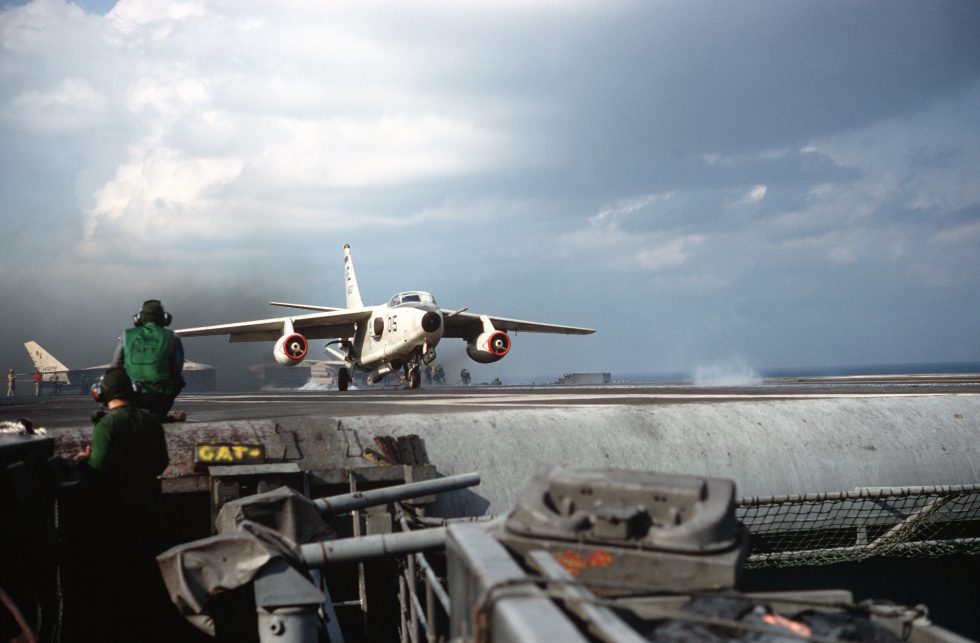
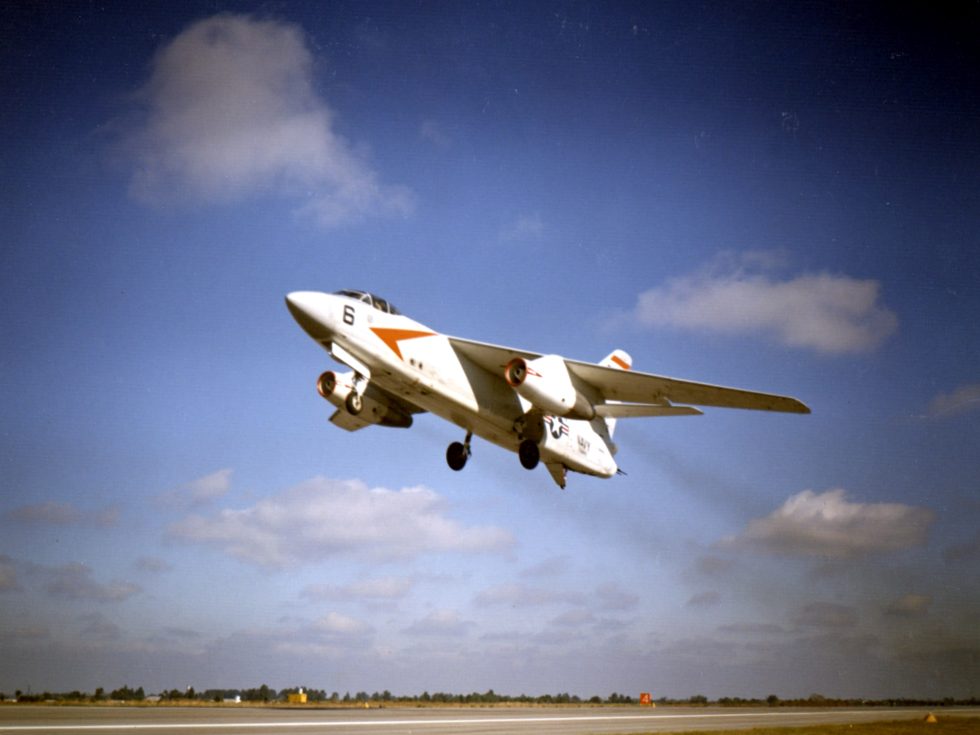
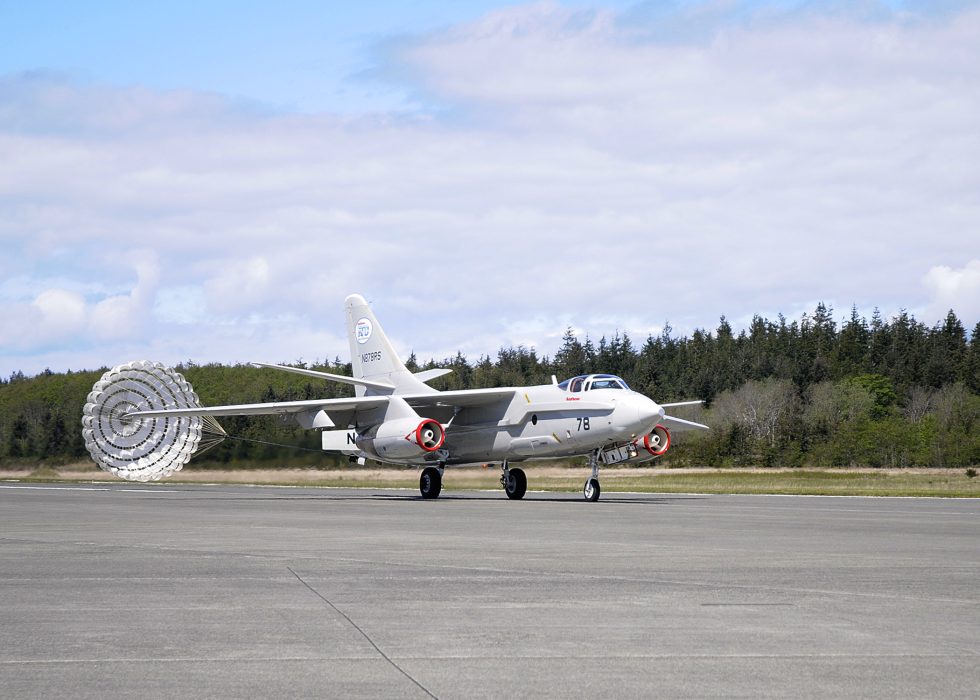
Where the A-3 Skywarrior served
A bomber, a tanker and a spy — its real legacy
The Skywarrior is not remembered for air-to-air kills; that was never its job. Its record is written in reach, adaptability and sheer endurance — a nuclear deterrent that became the fleet’s fuel truck and its ears, and stayed useful for 35 years.
Compare the combat record of every military aircraft. Figures as of July 2026.
Everything people ask about the A-3 Skywarrior
Can I fly in an A-3 Skywarrior?
Why did the A-3 Skywarrior have no ejection seats?
Why is the A-3 called “The Whale”?
What do KA-3, EA-3 and EKA-3B mean?
Was the A-3 Skywarrior nuclear-capable?
Did the A-3 serve in Vietnam?
What replaced the A-3 Skywarrior?
What was the B-66 Destroyer?
You can’t fly the Skywarrior.
These, you can.
Some legends only live in museums — others are fuelled and waiting. MiGFlug has put civilians in real military jet cockpits since 2004.
 Fly the L-39 AlbatrosThe world’s most-flown jet trainer — aerobatics included
 Fly the F-104 Starfighter“The missile with a man in it”
 Fly the MiG-21The Cold War’s most-produced jet
 Fly the T-33 Shooting StarAmerica’s first jet trainer
 Fly the DH VampireA piece of early jet history
 Fly the S.211Agile Italian jet trainer
 Fly the MB-326The classic Aermacchi jet
 Fly the MiG-15The Soviet legend of the Korean War
Continue the tour
Every fact, checked
- Naval History & Heritage Command — Skywarrior in DetailAuthoritative on the Heinemann design, weight limits, no ejection seats and the “All Three Dead” nickname.
- NHHC — Skywarriors on DisplayConfirms Desert Storm combat missions and the 30 June 2011 final flight to Pensacola.
- A-3 Skywarrior Association — Aircraft SpecsDetailed dimensions, weights, J57 thrust figures, speed, range and ceiling.
- The Aviation Geek Club — EA-3B Ranger 12The 25 January 1987 Nimitz accident, its seven crew and its link to retirement.
- AvGeekery — The Whale“The Whale” nickname, loaded weight, folding wings/tail and the 1957 two-ocean flight.
- Pearl Harbor Aviation Museum — A3D/A-3 SkywarriorThe Vietnam bombing-to-EW/tanker shift and the “crows/ravens” ELINT operators.
- Vintage Aviation News — Boneyard Files: A-3Variant rundown, nuclear capability and the “heaviest carrier aircraft” record.
- Military Factory — Douglas A-3 SkywarriorProduction total, first-flight date, engine variant and dimensions cross-check.