
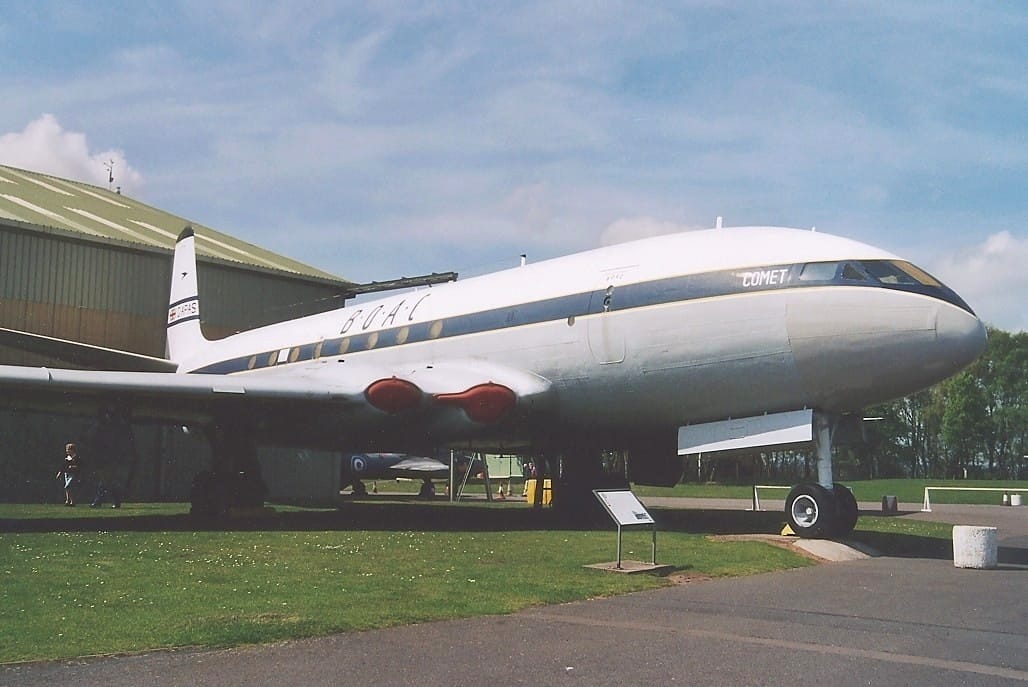
Three Comets Lost
On January 10, 1954, BOAC Flight 781 disintegrated as it climbed through 27,000 feet shortly after takeoff from Rome. All 35 people aboard were killed. The wreckage fell into the Mediterranean near the island of Elba. The Comet fleet was grounded. Engineers inspected every airframe, found nothing conclusive, and returned the type to service. Less than three weeks after the fleet returned to service, on April 8, 1954, South African Airways Flight 201 — flying a Comet chartered from BOAC — broke apart at altitude near Naples. Twenty-one dead. The Comet was grounded permanently. A third Comet had already been lost: BOAC Flight 783 crashed on takeoff from Calcutta in May 1953 during a violent storm, but this was attributed to structural overload in turbulence — a design problem, but a different one.The Comet Crashes
- BOAC Flight 783: 2 May 1953, Calcutta — 43 killed (structural failure in storm)
- BOAC Flight 781: 10 Jan 1954, Mediterranean near Elba — 35 killed (metal fatigue)
- SAA Flight 201: 8 Apr 1954, Mediterranean near Naples — 21 killed (metal fatigue)
The Comet disasters led to one of the most important and far-reaching investigations in aviation history. Every modern airliner flies more safely because the Comet failed first.
The Investigation That Changed Everything
The Royal Aircraft Establishment at Farnborough launched the most thorough accident investigation the world had ever seen. Engineers recovered wreckage from the Mediterranean seabed — a pioneering underwater salvage operation — and painstakingly reconstructed the fuselage of Flight 781. Then they did something no one had attempted before. They took a complete Comet fuselage, placed it in a water tank, and subjected it to repeated pressurisation cycles — inflating and deflating the cabin thousands of times to simulate years of service. After the equivalent of 3,057 flights, the test fuselage burst — the failure starting beside the forward escape hatch cut-out. In the recovered wreckage of G-ALYP itself, investigators traced the fatal crack to a rivet hole at the rear automatic direction finder (ADF) window cutout in the roof. Under repeated pressurisation loads, microscopic cracks formed at stress concentration points around the square-cornered openings. After roughly 1,000 flight cycles, these cracks propagated through the skin until the fuselage failed catastrophically.TIL the world’s first commercial jet airliner, the De Havilland Comet, suffered numerous fatal crashes in the 50’s because the windows were square
Square Windows Kill
The discovery was devastating in its simplicity. Square corners concentrate stress. Round corners distribute it. Every subsequent airliner — without exception — has used oval or round passenger windows. The Comet's square windows were not the only factor (the fuselage skin was also thinner than it should have been, and the rivet holes created additional stress risers), but they became the iconic lesson. More broadly, the Comet investigation established the discipline of metal fatigue analysis in aviation. Before the Comet crashes, fatigue was poorly understood and rarely tested. After them, every aircraft manufacturer was required to demonstrate that their designs could withstand tens of thousands of pressurisation cycles without failure. The fail-safe design philosophy — build structures so that a crack in one element does not cause catastrophic failure — became standard.The Bitter Irony
De Havilland redesigned the Comet with oval windows, thicker skin, and structural improvements. The Comet 4 entered service in 1958 and was perfectly safe. But it was too late. Boeing had used the years of the Comet's grounding to develop the 707, which was bigger, faster, and more economical. The 707 defined the jet age. The Comet, which should have owned it, became a footnote. The Comet’s three fatal crashes had killed 99 people. The investigation it triggered has saved hundreds of thousands. No airliner since has suffered a pressurisation-fatigue failure of the kind that destroyed Flights 781 and 201. That is the Comet's true legacy: the beautiful jet that taught the world how aircraft actually break.“The Comet pushed the state-of-the-art beyond its limits.”Sources: FAA Lessons Learned, RAF Museum, Admiral Cloudberg, Plane and Pilot, New Atlas
— Bill Withuhn, aviation historian
Related Questions
What was the de Havilland Comet?
The de Havilland Comet was the world's first jet airliner, entering service with BOAC on 2 May 1952. It flew roughly twice as fast and twice as high as propeller airliners, in a smooth, near-vibration-free cabin — a revolution in air travel that briefly made Britain the leader in jet transport.
Why did the de Havilland Comet crash?
A series of Comets broke apart in flight in 1953–1954 due to metal fatigue. Repeated cabin pressurisation cycles cracked the airframe at stress points — famously the corners of its window openings — causing catastrophic mid-air disintegration.
What did the Comet teach engineers about metal fatigue?
The Comet disasters taught the aviation world how repeated pressurisation cycles fatigue an airframe. Investigators traced the failures to cracks spreading from sharp window corners, leading to rounded windows, better fatigue testing and design standards that make every modern airliner safer.
When did the de Havilland Comet enter service?
The Comet 1 entered service with BOAC on 2 May 1952, the first commercial jet airliner. It was grounded after the 1954 crashes and later returned in a redesigned, much-strengthened form as the Comet 4.
Why do aircraft windows have rounded corners?
Because of the Comet. Its early near-square windows concentrated stress at the corners, where fatigue cracks began and led to fatal break-ups. Rounding the corners spreads the stress, and every pressurised aircraft since has used rounded windows as a direct result.

0 Comments