
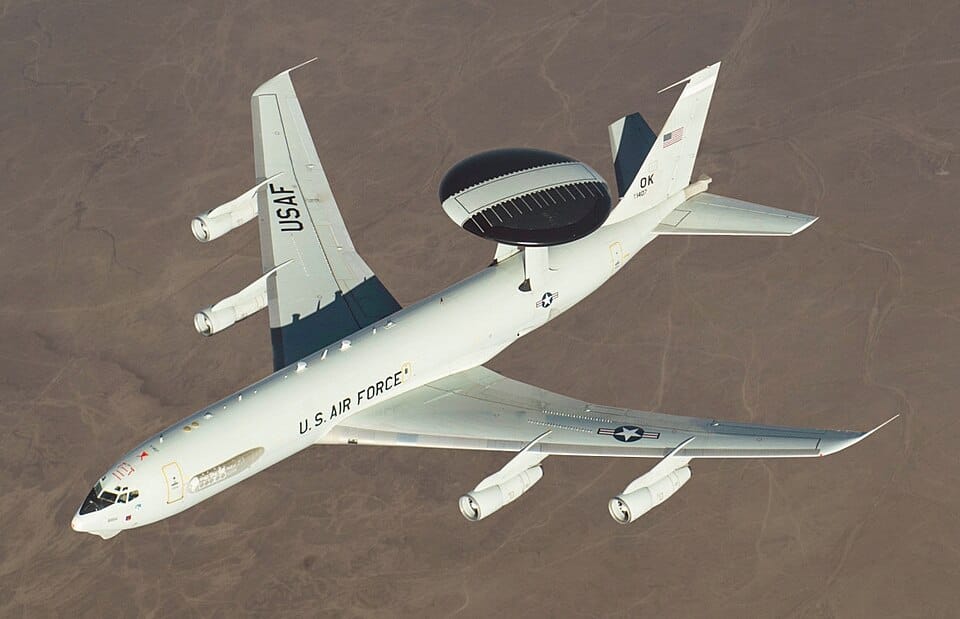
✈ Quick Facts
- Aircraft: Boeing E-3 Sentry (based on Boeing 707 airframe)
- Radar: AN/APY-1/2 (Westinghouse/Northrop Grumman) — pulse-Doppler, look-down/shoot-down capable
- Rotodome diameter: 30 feet (9.1 m), mounted 11 feet above fuselage
- Detection range: 250+ miles (400+ km) for fighter-sized targets
- Crew: ~20 (flight crew + mission crew of controllers, technicians, and communications operators)
- First flight: February 1972 (EC-137D prototype)
- In service: 1977 (USAF); also operated by NATO, UK, France, Saudi Arabia, Japan
- Endurance: 8+ hours unrefueled; unlimited with aerial refueling
- Nickname: "Eye in the Sky"
The Problem AWACS Solved
In the 1960s and 1970s, air combat was limited by one fundamental constraint: nobody could see the whole picture. Ground-based radar was blocked by terrain, limited by the Earth's curvature, and blind to low-flying aircraft beyond a few dozen miles. Fighter radars were short-ranged, narrow in scope, and could only see what was directly ahead. This meant that even the most powerful air force in the world operated with fragmentary awareness. Fighters were vectored toward threats that controllers could see, but threats below the radar horizon — low-flying aircraft, cruise missiles, terrain-masked attackers — were invisible until they were dangerously close. The AWACS concept was simple in principle: put a powerful radar on an aircraft flying at 30,000 feet, and the radar's horizon extends to over 250 miles in every direction. From that altitude, there is no terrain masking. Low-flying aircraft that are invisible to ground radar are clearly visible to a look-down radar operating from five miles up. The execution, however, was anything but simple.The Eye That Sees Everything
The E-3's AN/APY-1 (later upgraded to APY-2) radar is housed in the iconic 30-foot rotodome mounted on two struts above the rear fuselage. The rotodome rotates at 6 RPM, providing 360-degree coverage. The radar operates in pulse-Doppler mode, which allows it to detect and track moving targets against ground clutter — the critical look-down/shoot-down capability that ground-based radars of the era struggled to achieve. The system can detect fighter-sized targets at ranges exceeding 250 miles and track hundreds of targets simultaneously. The onboard mission computers correlate radar tracks, identify friend from foe using IFF (Identification Friend or Foe) transponder interrogation, and present the air picture to the mission crew on tactical displays. But the E-3's true capability is not the radar alone — it is what the mission crew does with the information. Sitting at consoles in the aircraft's cabin, weapons controllers direct fighter intercepts, deconflict friendly aircraft, coordinate tanker support, manage airspace, and provide real-time threat warnings. They are the conductor of the air battle orchestra.Desert Storm: The Proving Ground
AWACS came of age in Operation Desert Storm. E-3 Sentries flew continuous orbits throughout the 43-day air campaign, providing the coalition with a god's-eye view of the entire theater. Every coalition aircraft was tracked. Every Iraqi aircraft that took off was detected, classified, and assigned to an intercept within minutes. The results were devastating for Iraq. Coalition fighters, vectored by AWACS controllers, achieved 33 air-to-air kills for the loss of just one coalition aircraft in air-to-air combat. Iraqi pilots were consistently ambushed by fighters they never saw coming — because AWACS controllers had detected them on takeoff, calculated their heading and speed, and positioned coalition fighters for optimal intercept geometry before the Iraqi pilots knew they were being hunted. The most famous AWACS-directed engagement was Captain Steve Tate's F-15C kill of an Iraqi Mirage F1 on the first night: the E-3 controller detected the Iraqi aircraft, tracked its course, and vectored Tate into a firing position from which the Mirage was destroyed with a single AIM-7 Sparrow before it ever detected the F-15.AWACS fundamentally changed air combat from a reactive business to a proactive one. Instead of fighters searching for targets with their own radar — and revealing themselves in the process — they could fly radar-silent, guided by controllers who saw everything.
— Assessment based on Gulf War Air Power Survey (USAF)
Force Multiplier
The military concept of a "force multiplier" — something that makes existing forces more effective without adding more units — was practically invented for AWACS. A flight of four F-15s operating without AWACS support has the situational awareness of four radar cones pointed forward. The same four F-15s with AWACS support have 360-degree awareness to 250+ miles, optimized intercept vectors, real-time threat updates, and coordination with every other friendly aircraft in the area. Studies conducted after Desert Storm estimated that AWACS increased the combat effectiveness of coalition fighters by a factor of three to five. That is, four F-15s with AWACS were equivalent to 12–20 F-15s without it. This is why every major air force that can afford an AEW&C (Airborne Early Warning and Control) capability has acquired one — and why nations without one are at a crippling disadvantage in any air engagement.Beyond the E-3: The Next Generation
The E-3 Sentry is aging. The airframes — based on the Boeing 707, which ceased production in 1979 — are expensive to maintain and increasingly difficult to support. The USAF is replacing its E-3 fleet with the Boeing E-7A Wedgetail, based on the 737-700 airframe and equipped with the Northrop Grumman Multi-role Electronically Scanned Array (MESA) radar. The E-7 offers significant improvements: an electronically scanned array (AESA) radar that does not require a rotating rotodome, better reliability, lower operating costs, and modern networking capabilities designed to integrate with fifth-generation fighters like the F-35. Australia, South Korea, Turkey, and the UK already operate E-7 variants. NATO is also transitioning from the E-3A to a next-generation AEW&C capability, and several NATO nations are acquiring their own E-7A or similar platforms.The Lesson That Never Gets Old
AWACS proved a truth that has only become more relevant with time: in modern warfare, information is more valuable than firepower. The side that sees the battlefield first, understands it fastest, and acts on that understanding most effectively will win — regardless of which side has more or better individual weapons platforms. Every modern air force doctrine, from the USAF's Joint All-Domain Command and Control (JADC2) to NATO's Alliance Future Surveillance and Control (AFSC), traces its intellectual lineage to the lessons learned by AWACS controllers circling over the Iraqi desert in 1991. The platform may change. The principle never will: the side that sees first, wins. Sources: Gulf War Air Power Survey (USAF), Boeing E-3 Sentry program history, NATO AWACS Component records, Air Force Historical Research Agency, "Every Man a Tiger" by Tom Clancy/Chuck HornerRelated Questions
What is an AWACS aircraft?
AWACS (Airborne Warning and Control System) is a flying radar station, most famously the Boeing E-3 Sentry. With a huge rotating radar dome on its back, it detects aircraft hundreds of miles away and directs friendly fighters, giving its side a God's-eye view of the sky.
How does AWACS work?
An AWACS like the E-3 Sentry carries a powerful pulse-Doppler radar in a 30-foot rotating dome mounted above the fuselage. The radar can spot fighter-sized targets more than 250 miles away, while a mission crew of controllers tracks them and vectors friendly aircraft to intercept.
What aircraft is the E-3 Sentry based on?
The Boeing E-3 Sentry is based on the Boeing 707 airliner airframe, fitted with the distinctive radar rotodome. The prototype first flew in 1972 and the type entered U.S. Air Force service in 1977.
How far can AWACS radar detect targets?
The E-3's radar can detect fighter-sized aircraft at ranges of more than 250 miles (400+ km). This long reach lets it see threats long before they appear on a fighter's own radar, transforming how air battles are managed.
Why did AWACS change air warfare?
By giving one side a constant, wide-area picture of the sky and the ability to direct its fighters in real time, AWACS turned air combat from individual dogfights into coordinated, information-led battles — a decisive advantage for whoever controls the radar plane.
0 Comments