
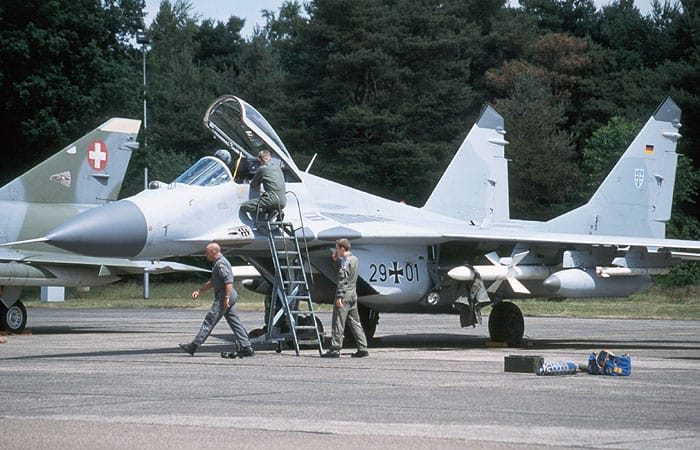
The inherited Soviet Fighter Jet
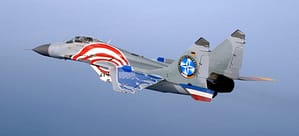
MiG-29-Fulcrum-Farewell-USA-2003
The MiG-29 is a rocket. It is as simple as that.It soon turned out that claims that the MiG-29 was superior to Western fighter jets in certain areas proved correct - for example, the Helmet Mounted Weapons Sight (HMS) - a technology the US Air Force and Navy didn't have operational before 2003 - or the dogfight capability and manoeuvrability, especially at slow speed. The MiG-29 demonstrated it's ability impressively during joint US-German dissimilar air combat training. But we'll have a closer look at that below. In 2003 22 MiG-29s were sold to the Polish Air Force for a symbolic 1 EUR per Fulcrum, 14 were taken into service with the 41. elt after an overhauled. Of the remaining two German MiGs, one had crashed after a pilot's fault, and one (the 29+03) is on display at Laage-Rostock airport.
MiG-29 strengths and weaknesses
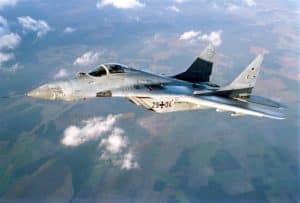
German-MiG-29A-Fulcrum
- Incredible turn rate. The manually controlled MiG-29 (28°/sec) even beats the fly by wire F-16 Block 50 (26°/sec).
- The Archer is able to target 45° off boresight
- Superior in dogfights/close combat to US 4th generation fighter aircraft like McDonnell Douglas F-15 Eagle, General Dynamic F-16 Fighting Falcon and McDonnell Douglas F/A-18 Hornet (as proved in dogfights with the Swiss Air Force among others).
- Helmet Mounted Sight
Inside ten nautical miles I’m hard to defeat, and with the IRST, helmet sight and ‘Archer’ I can’t be beaten. Period.Weaknesses
- Navigation system (before it got a GPS upgrade)
- Limited fuel capacity, thirsty engines, no in-flight refuelling probe. Even with two underwing tanks, the MiG-29 is inferior when it comes to range. According to Koeck, the combat radius was only 100–150 nautical miles (185-278km). Especially at high speed and low altitudes, the range is very limited.
- One VHF/UHF radio only
- Inferior radar (limited autonomous operations, poor reliability, poor display, poor situational awareness, problems with targets flying in formation)
How do these findings affect MiGFlug?
Of course, we say this tongue-in-cheek — we are not an air force, and weapons, fuel capacity, radio systems, and radar are not important for us - and the flights in the MiG-29UB. All we want is the sheer power for the Edge of Space flights in the MiG-29. The MiG-29 has a thrust/weight ratio of 1.09, a max speed of more than 2400km/h (Mach 2.25, 1490 mph) and a climb rate of 330m/s! Remember: "It's a rocket". Other important things for our customers: The excellent view from the backseat, the beauty of the jet and - with limitations - the manoeuvrability. For most MiGFlug MiG-29 passengers it is more than they can handle anyway, but we had some crazy guys who wanted up to 9.2g. Articles and Ressources- The history of fighter jet rides for civilians
- Luftwaffengeschwader JG73 "Steinhoff" (German language)
- First MiG-29 Edge of Space HD video
- Fighter Jet Generations - an overview
- The most expensive military aircraft
Related Questions
Did Germany operate the MiG-29 Fulcrum?
Yes. East Germany ordered 20 single-seat MiG-29A and 4 two-seat MiG-29UB fighters, which entered service in 1988 and 1989. After German reunification in October 1990, the Luftwaffe inherited these jets, made them NATO-compatible and based them at Laage with fighter wing JG73 "Steinhoff". This gave NATO an unusually close look at the Soviet fighter.
How did East Germany get its MiG-29s?
East Germany bought its MiG-29 fleet from the Soviet Union just before the fall of the Berlin Wall, for the air arm of the National People's Army. Only 20 single-seaters and 4 trainers were delivered, entering service in 1988-1989. When East and West Germany reunified in 1990, the unified MiG-29 fleet passed to the Luftwaffe.
What were the MiG-29's main strengths?
The MiG-29 Fulcrum was famous for its agility, with an excellent turn rate in a dogfight. A standout feature was its helmet-mounted sight, which let the pilot aim short-range missiles by looking at the target — technology Western air forces did not field operationally until around 2003. Combined with the R-73 "Archer" missile, this made the Fulcrum very dangerous in close combat.
What were the MiG-29's main weaknesses?
The MiG-29's biggest weaknesses were short range and a limited radar. With thirsty engines, no in-flight refuelling probe and modest fuel capacity, its combat radius was only about 100 to 150 nautical miles. The radar offered poor situational awareness and struggled with formations, and early jets had a single radio and a weak navigation system before later GPS upgrades.
Why was the German MiG-29 considered inferior to the Soviet version?
Germany inherited the export model MiG-29A, which was deliberately downgraded compared with the Soviet Union's own jets. The export versions lacked certain systems such as the data link and some identification-friend-or-foe equipment fitted to home-service Fulcrums. Later MiG-29 variants, after numerous upgrades, are far more capable and effectively different aircraft.
What is a helmet-mounted sight on a fighter jet?
A helmet-mounted sight projects targeting information onto the pilot's visor and lets them cue weapons simply by looking at a target. On the MiG-29 it allowed off-boresight missile shots well before Western forces had the capability operationally. It remains a key advantage in close-range dogfights, where being able to aim by sight saves precious seconds.
What happened to Germany's MiG-29 fleet?
Germany flew its MiG-29s with the Luftwaffe through the 1990s, using NATO's first-hand access to study Soviet design. One airframe was lost in an accident, and a Fulcrum, the 29+03, is preserved on display at Laage-Rostock airport. The fleet was eventually retired, with most jets passed on to Poland. Today the MiG-29 endures in several air forces worldwide.
How did NATO benefit from flying the MiG-29?
Reunified Germany gave NATO a unique chance to fly and evaluate a frontline Soviet fighter from the inside. Pilots who had flown Western jets could directly compare handling, sensors and weapons. The findings shaped NATO tactics against the Fulcrum and, ironically, even highlighted areas the design bureau later improved on the MiG-29 itself.
Hi, I consider this very interesting article, I translated in Italian and I posted it on my website .. if it is ok for you? Thank you and I will continue to follow
It’s important to realize t hat this was the first production model, and stripped down for export. The M, which came out for the Russians two years before the East Germans bought this version was much more advanced.
I think you meant the S model.
When at low speeds, the mig29 does not beat the f-16, it can’t beat the block 15s, as well as it can’t beat the 50. At high speeds the mig29 does have a superior turn rate though