
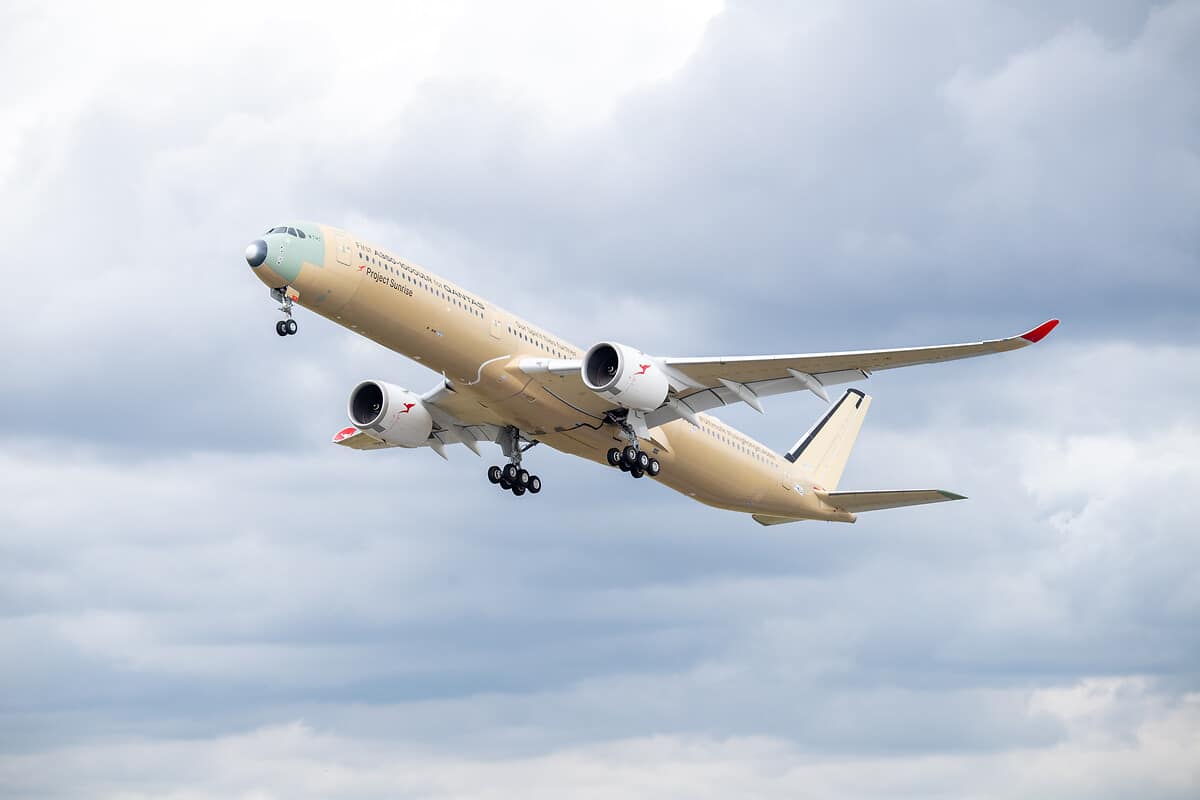
On the morning of 2 June, a pale green, primer-coated jet lifted off from Toulouse and climbed past 41,000 feet over the south of France. It carried no passengers, only test instrumentation and a hand-picked Airbus crew. It also carried a title: the longest-range airliner ever built.
This was the maiden flight of the A350-1000ULR — Ultra Long Range — registration MSN 707, the first of twelve such aircraft Airbus is building for Qantas. After three hours and 43 minutes aloft, it had begun the job it was designed for: erasing the last great gap in the world’s route map.
QUICK FACTS
| Aircraft | Airbus A350-1000ULR (MSN 707) |
| First flight | 2 June 2026, Toulouse — 3 hr 43 min, just above 41,000 ft |
| Built for | Qantas "Project Sunrise" |
| Mission | Nonstop Sydney–London and Sydney–New York |
| Distance | Almost 10,000 nautical miles, up to ~22 hours |
| Key change | 20,000-litre rear centre tank (+1,000 nm range) |
| On order | 12 A350-1000ULRs + 12 standard A350-1000s |
One tank changes everything
From the outside, the ULR is an A350-1000 like any other. The transformation is inside. Airbus has built an additional rear centre tank directly into the aircraft’s structure — a 20,000-litre reservoir that lifts the jet’s range by around 1,000 nautical miles. With it come a modified fuel system and a redesigned, lighter galley-cooling architecture meant to keep meals fresh across flights that can run most of a day.
The first flight focused on exactly these changes: general performance checks and a workout for the new fuel-system architecture. It opens a roughly two-month certification campaign to sign off the modifications before MSN 707 is retrofitted to Qantas’ commercial cabin standard. The aircraft was flown by Airbus experimental test pilots Thomas Wilhelm and Anthony Flynn, with a full test-engineering team aboard.

Project Sunrise, finally within reach
The mission has a name almost a decade old. In 2017, Qantas threw down a challenge it called Project Sunrise: link the east coast of Australia directly to London and New York, with no stop in between. The Sydney–London leg alone is close to 10,000 nautical miles and could keep passengers airborne for as long as 22 hours — the longest scheduled flights ever flown.
Qantas has ordered twelve A350-1000ULRs for the job, alongside twelve standard A350-1000s for the rest of its long-haul network. The second ULR — and the first due to be handed to the airline, in April 2027 — is already deep in final assembly. From there, the era of one-hop Australia-to-Europe travel finally begins.
A European answer to the long-haul question
The ULR becomes the fourth passenger member of the A350 family, joining the -900, the -900ULR and the -1000. It is a quietly significant moment for Europe’s aerospace champion: by the end of April 2026 the A350 had drawn 1,579 orders from 68 customers, with more than 700 already flying for 41 operators.
Where the four-engined superjumbo once defined long-haul ambition, the future now belongs to efficient twins able to fly further on less fuel. With the A350-1000ULR, the longest journey a passenger can buy will be flown on two engines — and built in Toulouse.
Sources: Airbus press release (2 June 2026); Aerotime; Simple Flying; The Points Guy; Aerospace Global News.
Related Questions
What is the world's longest-range airliner?
The Airbus A350-1000ULR (Ultra Long Range) is the world's longest-range airliner. First flown on 2 June 2026, it can fly almost 10,000 nautical miles — up to about 22 hours nonstop — thanks to extra fuel capacity built in for ultra-long-haul routes.
What is the Airbus A350-1000ULR built for?
It was built for Qantas's "Project Sunrise," which aims to fly nonstop from Sydney to London and Sydney to New York — among the longest commercial routes ever planned. The ULR's extended range is what finally makes those marathon flights possible.
How is the A350-1000ULR different from a normal A350?
From the outside it's identical, but inside Airbus added a 20,000-litre rear centre fuel tank that boosts range by about 1,000 nautical miles. That single change turns the standard A350-1000 into an ultra-long-range aircraft capable of 22-hour flights.
How far can the A350-1000ULR fly?
Almost 10,000 nautical miles nonstop — enough for flights of up to roughly 22 hours. That range lets airlines connect almost any two cities on Earth directly, including routes like Manila to Toronto and Qantas's planned Sydney–London.
What is Qantas Project Sunrise?
Project Sunrise is Qantas's plan to operate the world's longest nonstop passenger flights, linking Sydney directly with London and New York. It relies on the A350-1000ULR, of which Qantas has ordered 12 (plus 12 standard A350-1000s), to fly the ultra-long routes.
Related Posts
0 Comments