

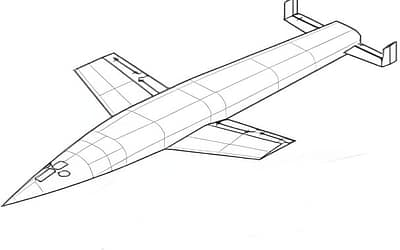
In 1960, in a hangar at the Bell Aircraft plant at Niagara Falls, New York, Bell unveiled the wildest single-seat fighter ever proposed by an American manufacturer. It had a needle-nosed fuselage, two wing-tip nacelles that could swivel through 100 degrees, and a total of eight turbojets — four in the wing-tip pods, two in the rear fuselage, and two lift jets behind the cockpit pointing straight down.
Bell called it the D-188A — and pitched the Air Force version as the XF-109, a designation the service never officially assigned. It was designed to take off vertically from any clearing, accelerate to Mach 2, intercept Soviet bombers, fight other fighters, and land vertically again. The mock-up looked terrifying. The performance estimates looked impossible.
And then, in the spring of 1961, the Air Force cancelled the entire programme and the XF-109 never flew.
Quick Facts
Designation: Bell D-188A (unofficial military designations: XF-109 USAF / XF3L-1 USN)
Configuration: Eight turbojets — 4 in tilting wing-tip pods, 2 in tail, 2 lift jets
Top speed (design): Mach 2+
Role: VTOL all-weather fighter-bomber and interceptor
Mock-up unveiled: 5 December 1960
Cancelled: Spring 1961, USAF — no prototypes ever built
Why it failed: Cost, mass, complexity, and the realisation that hot-jet ground erosion was unsolvable
A Bomber-Interceptor That Did Not Need a Runway
The reason the Air Force wrote the requirement in 1955 is the cleanest possible Cold War briefing: if the Soviets nuked the American forward airbases, the survivors needed fighters that could continue flying from the rubble. Conventional jet fighters needed thousands of feet of clean runway. A VTOL fighter that could take off vertically from any clearing — a parking lot, a road, the bombed-out remains of a base — would mean the air war went on regardless of how good Soviet bomber accuracy turned out to be.
Bell’s pitch to the Air Force and the Navy was the most ambitious answer anyone offered. The D-188A would do everything: vertical takeoff, supersonic dash, interception, ground attack, all-weather capability, and conventional runway operations as a backup. The configuration was the price.
Why Eight Engines
The maths for jet VTOL is brutal. To hover, an aircraft must produce thrust greater than its weight. A 25,000-pound fighter therefore needs around 26,000 pounds of vertical thrust. For an aircraft that also needs to fly at Mach 2, the thrust requirements explode.
Bell’s solution was to spread the load. Four General Electric J85 turbojets in two wing-tip nacelles provided both vertical and forward thrust depending on the nacelle angle. Two more J85s in the rear fuselage exhausted through tail ducts for primary forward propulsion. Two J85 lift jets behind the cockpit pointed straight down, augmenting lift during takeoff and landing.
Total engine count: eight. Total moving parts in the propulsion system: enormous. The Air Force’s own engineering studies concluded that synchronising eight engines through transitions between vertical and horizontal flight was a control problem nobody knew how to solve in 1961.

The Hot-Jet Problem That Killed It
The deeper problem was not even the engines. It was what those engines did to the ground. Each J85 was producing enough downward thrust during hover to blast loose any unpaved surface within ten metres. The engines exhausted at over 700°C. Bell’s own ground tests showed that the XF-109 would not just be limited to paved surfaces — it would actively destroy most paved surfaces it tried to operate from.
This problem killed the whole concept of jet VTOL fighters using direct downward thrust. The British, watching from across the Atlantic, picked a different solution: a single engine with vectored thrust nozzles, careful management of the exhaust footprint, and a much lower hover heat load. The result became the Hawker P.1127, and eventually the Harrier — the only Western jet VTOL fighter that actually saw operational service, until the F-35B arrived four decades later.
Bell VTOL: The Experimental Legacy
The Bell XF-109 was part of a broader family of experimental VTOL aircraft that Bell developed throughout the 1950s and 1960s. This video examines the Bell Model 65, another of Bell's ambitious VTOL designs, and traces the lineage of ideas that ran from these failed American experiments to the British Harrier — the only Western jet VTOL fighter that actually reached operational service before the F-35B.
Related Questions
What was the Bell XF-109?
The Bell XF-109 (designation D-188A) was a proposed American VTOL fighter of around 1960 with eight jet engines — some in tilting wingtip pods — meant to take off vertically yet reach Mach 2. Despite an impressive full-size mock-up, no prototype was ever built.
Why did the Bell XF-109 never fly?
It was cancelled in 1961 before any aircraft was completed. The eight-engine VTOL design was too costly, heavy and complex, and engineers couldn't solve the problem of hot jet exhaust eroding the ground during vertical takeoff. Only a mock-up was ever made.
How many engines did the Bell XF-109 have?
Eight turbojets — four in tilting wingtip pods, two in the tail and two dedicated lift jets. The tilting and lift engines were meant to provide vertical thrust for takeoff, then shift to drive the aircraft forward to supersonic speed.
Was the Bell XF-109 a real aircraft?
Only as a mock-up. Bell unveiled a full-scale mock-up on 5 December 1960, but the U.S. Air Force cancelled the programme the following spring without building a flyable prototype. Working VTOL jets of the era, like the Ryan X-13 Vertijet, did manage to fly.
What was the Bell XF-109 designed to do?
It was meant to be an all-weather VTOL fighter-bomber and interceptor that could operate without runways yet still fly at Mach 2+. Combining vertical takeoff with supersonic speed proved too ambitious for the technology of the time.
The D-188A was cancelled in spring 1961 with no flight-test article completed. Bell’s own engineering studies acknowledged that synchronising eight engines through vertical-to-horizontal transition was a control problem nobody knew how to solve at the time, and the ground exhaust footprint would have severely limited useful basing options.
What the Cancellation Cost
The XF-109 disappeared from public view in 1961 and never reappeared. The Air Force cancelled it. The Navy had already lost interest. The mock-up went into storage. The Bell engineers who had spent five years on it dispersed to other projects, several of them landing at the company’s helicopter division which was busy turning the UH-1 Huey into the iconic Vietnam War workhorse.
The dollar cost of the cancellation was relatively small — the programme never progressed beyond design work and the wooden mock-up. The bigger cost was the lesson. The XF-109 was the high-water mark of US jet-VTOL ambition. After 1961, the Pentagon largely gave up on the configuration. The only Western VTOL fighters that ever entered service were the Harrier (vectored thrust) and the F-35B (lift fan plus rotating nozzle) — both solutions that started from the assumption that direct-thrust VTOL was too punishing.
A Strange Footnote with Modern Echoes
The most peculiar legacy of the XF-109 is that its central design idea — tilting nacelles for VTOL — turned out to be correct, just in a different category. Bell would go on to develop the X-22 tiltrotor research aircraft in the mid-1960s, then the XV-15 tiltrotor in the 1970s, and finally the V-22 Osprey tiltrotor in the 1980s. None of them was a Mach 2 fighter. All of them carried forward the same engineering thinking that had produced the XF-109.
The Pentagon’s current DARPA programme — the X-76 SPRINT high-speed VTOL demonstrator — is the direct grandchild of the XF-109’s eight-nacelle ambition, scaled down to a sane number of engines and a saner mission. The lineage of failure-into-eventual-success in American VTOL is unbroken.
The XF-109 itself remains the mock-up that never flew, the fighter that promised everything and delivered nothing, and the cleanest possible illustration of an engineering era when ambition routinely outran capability. There are stranger paper aircraft from the Cold War. There are no stranger fighters that were actually built in metal.
Sources: Wikipedia (Bell D-188A); Fantastic Plastic Models; War History Online; Bell Aircraft archival material.
Related Posts
The Coléoptère: France’s Insane Annular-Wing VTOL Jet
0 Comments