
A commercial oil tanker was steaming through international waters toward Iran when a U.S. aircraft put Hellfire missiles into its smokestack. The ship stopped. It was, in the plainest terms, a blockade being enforced with air power — and it is happening every night over the Strait of Hormuz.
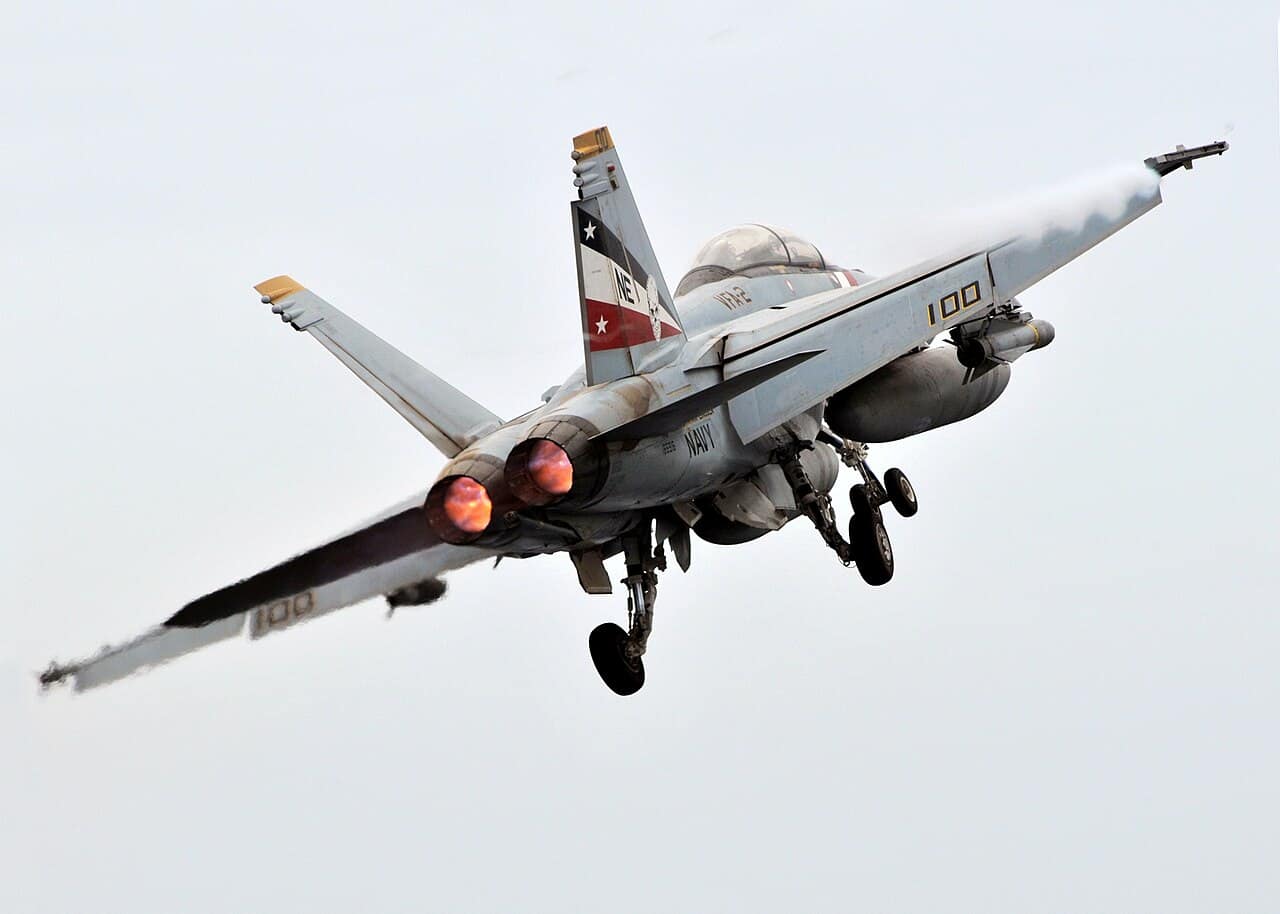
U.S. Central Command has resumed a naval blockade of Iranian ports and paired it with nightly precision strikes, aiming to strip away Iran’s ability to threaten shipping through the world’s most important oil chokepoint. Two U.S. aircraft carriers and their F/A-18 Super Hornet air wings sit at the centre of the operation.
QUICK FACTS
| Operation | U.S. blockade of Iranian ports + nightly strikes, Strait of Hormuz |
| 15 July | 90-minute wave hits coastal-defence & cruise-missile sites on Greater Tunb Island |
| The tanker | U.S. aircraft disables Curacao-flagged M/T Belma with Hellfire missiles |
| 16 July | Fifth straight night of strikes; jets, drones and warships hit air-defence & maritime targets |
| Force | 2 aircraft carriers, 20+ warships, 10,000+ personnel, dozens of aircraft |
| Why it matters | ~20 million barrels of oil a day transit the Strait (EIA) |
| Source | U.S. Central Command releases; CNN; NPR; Al Jazeera |
A blockade enforced from the air
The trigger was Iranian attacks on commercial tankers in the strait. Washington’s response was to reinstate a blockade it had run once before, from April to June, and to back it with force. When the Curacao-flagged M/T Belma pressed on toward Kharg Island despite warnings, a U.S. aircraft disabled it with Hellfire missiles fired into the ship’s funnel — a deliberately non-sinking way to stop a vessel dead.
That same day, CENTCOM said it completed a 90-minute wave of strikes against coastal-defence systems and cruise-missile storage and launch sites on Greater Tunb Island, along with targets near Bandar Abbas — all of it aimed, in the command’s words, at Iranian capabilities used to threaten vessels transiting the strait.

Carriers, drones and boarding parties
By 16 July the strikes had run five consecutive nights, with fighter jets, aerial drones and warships hitting coastal surveillance, air-defence sites, logistics and maritime targets. The blockade itself is a sprawling effort: more than 10,000 sailors, Marines and airmen, two carriers — among them USS George H.W. Bush with its 60-plus aircraft — and over 20 warships.
It is not all missiles. U.S. Marines from the 11th Marine Expeditionary Unit boarded the tanker M/T Wen Yao in the Gulf of Oman to verify compliance. During the earlier April-to-June blockade, CENTCOM says it redirected more than 140 compliant vessels, disabled nine that refused, and waved through over 50 ships carrying humanitarian aid.
The stakes beyond the strait
Around a fifth of the world’s seaborne oil — some 20 million barrels a day — passes through this 30-mile-wide gap between Iran and Oman. There is almost no way to route around it at scale. That is why a single disabled tanker and a night of strikes ripple far beyond the Gulf, into insurance markets, oil prices and the calculations of every government that depends on the crude flowing west and east from the Persian Gulf.
For now, the pattern holds: warnings, then Hellfires; a wave of strikes, then another the next night. The U.S. is betting that overwhelming, visible force keeps the strait open. Iran is betting it can make that force too costly to sustain.
Background: why the Strait of Hormuz is the world’s most important oil chokepoint.
Sources: U.S. Central Command public releases; CNN; NPR; Al Jazeera; Stars and Stripes; U.S. Energy Information Administration.


0 Comments