
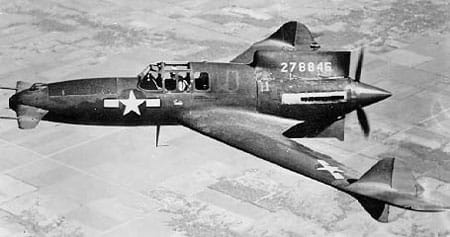
In 1939 the U.S. Army Air Corps did something unusual: it asked American industry to forget everything it knew about what a fighter should look like. The result included one of the strangest warplanes the country ever flew — a fighter with its engine at the back, its tail at the front, and a nickname no one at Curtiss said in polite company.
The Curtiss-Wright XP-55 Ascender flew tail-first. The propeller pushed from behind the pilot; a small elevator sat on the nose; the vertical fins perched at the wingtips. It was clever, it was radical, and it was, in the end, a failure — one that cost the lives of two pilots and four people on the ground.
QUICK FACTS
| Type | Experimental pusher-canard fighter |
| Origin | United States (Curtiss-Wright, CW-24) |
| First flight | 19 July 1943 — pilot J. Harvey Gray |
| Engine | Allison V-1710-95, 1,275 hp — mounted behind the pilot |
| Top speed | 390 mph (630 km/h) at 19,300 ft |
| Built | 3 prototypes; 2 lost in crashes |
| Survivor | 42-78846, Air Zoo (Kalamazoo), on loan from the Smithsonian |
A request for the unconventional
The Air Corps proposal, R-40C, was issued on 27 November 1939 and openly invited unorthodox layouts in the search for more speed, more firepower and better pilot visibility. Three manufacturers answered with pusher designs: Vultee with the XP-54, Northrop with the XP-56, and Curtiss with the aircraft that became the XP-55.
The engineering logic was sound. Put the propeller at the rear and the nose is free for guns and for an unobstructed forward view; sweep the wing and mount the fins at its tips, and the whole airframe becomes a single clean lifting surface. It was also the first Curtiss fighter to use tricycle landing gear. Because the propeller pushed rather than pulled, crews inevitably christened it the “Ass-ender.”

The experimental XP-55 Ascender explained.
The problem with flying backwards
Curtiss first built a lightweight flying mock-up, the CW-24B, powered by a modest 275 hp engine; it logged 169 flights at Muroc Dry Lake and suggested the concept could work. The Army ordered three true prototypes in July 1942. The first flew on 19 July 1943 with test pilot J. Harvey Gray at the controls, powered now by a 1,275 hp Allison V-1710.
One cockpit detail betrayed the designers’ unease: a lever that let the pilot jettison the propeller before bailing out, so he would not be cut down by his own engine on the way past. The concern was well founded.
Testing the first prototype’s stall behaviour on 15 November 1943, Gray watched the Ascender flip onto its back and drop into an uncontrolled, inverted plunge. The engine quit; power-off recovery was impossible. He fell nearly 5,000 metres before parachuting clear. The aircraft did not survive, and the double-delta’s vicious stall became the programme’s defining flaw.

Disaster at the air show
Engineers fought the stall with a larger nose elevator and four-foot wingtip extensions on the third prototype. But on 27 May 1945, at the closing day of the Seventh War Bond Air Show at Wright Field in Dayton, that aircraft was lost in the worst possible way. After a low formation pass flanked by a P-38 Lightning and a P-51 Mustang, pilot William Glasgow attempted a slow roll, lost height, and crashed into occupied vehicles on a nearby highway. Glasgow and four civilians on the ground were killed.
The verdict was already written. In testing, the XP-55 proved slower and harder to fly than the conventional fighters rolling off American production lines in the thousands. And by late 1944 the point was moot: German and British jets were operational and the Lockheed XP-80 was on its way. A radical piston fighter was a solution to a problem the jet age had already erased.
The short, strange career of Curtiss’s backwards fighter.
A curiosity, preserved
Of the three Ascenders, only one survives: 42-78846, the aircraft used for official performance trials, now displayed at the Air Zoo in Kalamazoo on loan from the Smithsonian. It is a reminder that the path to progress is lined with brave, logical ideas that simply did not work — and that in aviation, the difference between visionary and dangerous is often measured in a single stall.
Why the pusher-engine fighter never caught on.
Sources: National Air and Space Museum; Air Zoo; Green & Swanborough, US Army Air Force Fighters; Popular Science (1945); Vintage Aviation News.
0 Comments