
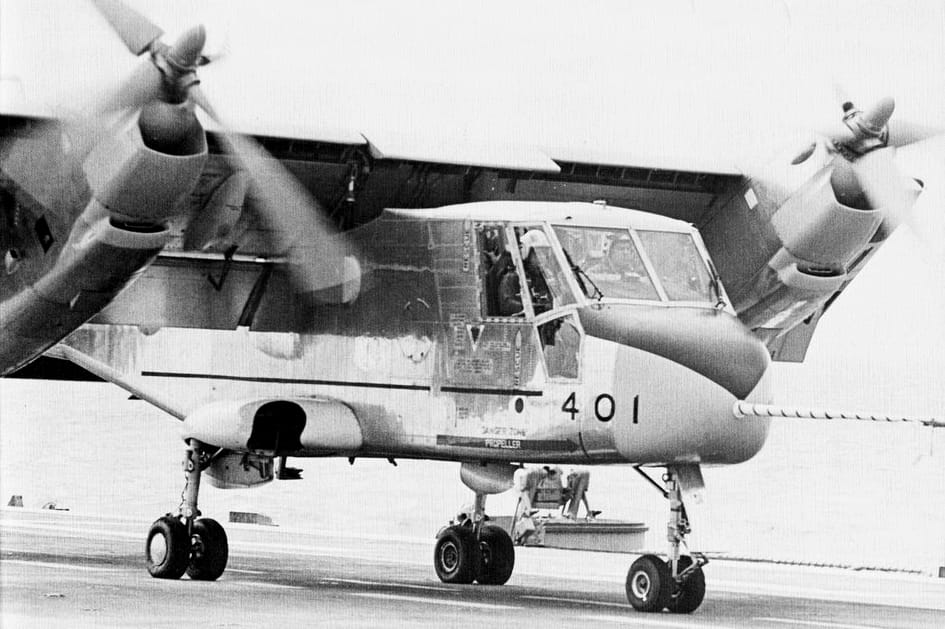
Picture a fat-bodied transport sitting on a Montreal ramp in 1965, engines spun up, and then the whole wing hinging skyward until the propellers point at the clouds. The aircraft rises straight up, hangs in the air, and then the wing tilts forward again until it is flying like any other machine. That was the Canadair CL-84 Dynavert, one of the boldest ideas Canadian aviation ever put into metal.
A wing that stood on end
The trick was the tilt-wing. Canadair's wing could rotate through roughly a right angle, swinging both Lycoming turboshaft engines and their big four-bladed propellers from horizontal to near-vertical. For vertical take-off the wing stood up and the props became lift rotors; once airborne, the wing rolled forward and the CL-84 became a conventional aeroplane.
Kurzinfo
| Typ | Experimental V/STOL tilt-wing aircraft |
| Erster Flug | 7 May 1965 |
| Kraftwerk | 2 x Lycoming T53 turboshafts (~1,500 shp each) |
| Höchstgeschwindigkeit | 517 km/h (321 mph) |
| Anzahl gebaut | 4 (three flew) |
| Verluste | 2 to mechanical failure, no fatalities |
| Schicksal | Cancelled 1974; one preserved in Ottawa |
Contra-rotating rotors in the tail handled pitch during the hover, and a mechanical mixing box, credited largely to Latvian-born designer Karlis Irbitis, kept the controls behaving normally no matter where the wing sat. Stick fore-and-aft was always pitch, side-to-side always roll. Fixed-wing pilots could master transitions on their very first flight.
Two 1,500-shaft-horsepower Lycoming T53 engines were cross-shafted, so if one quit the other could drive both propellers. It was clever, redundant engineering aimed squarely at making vertical flight survivable.
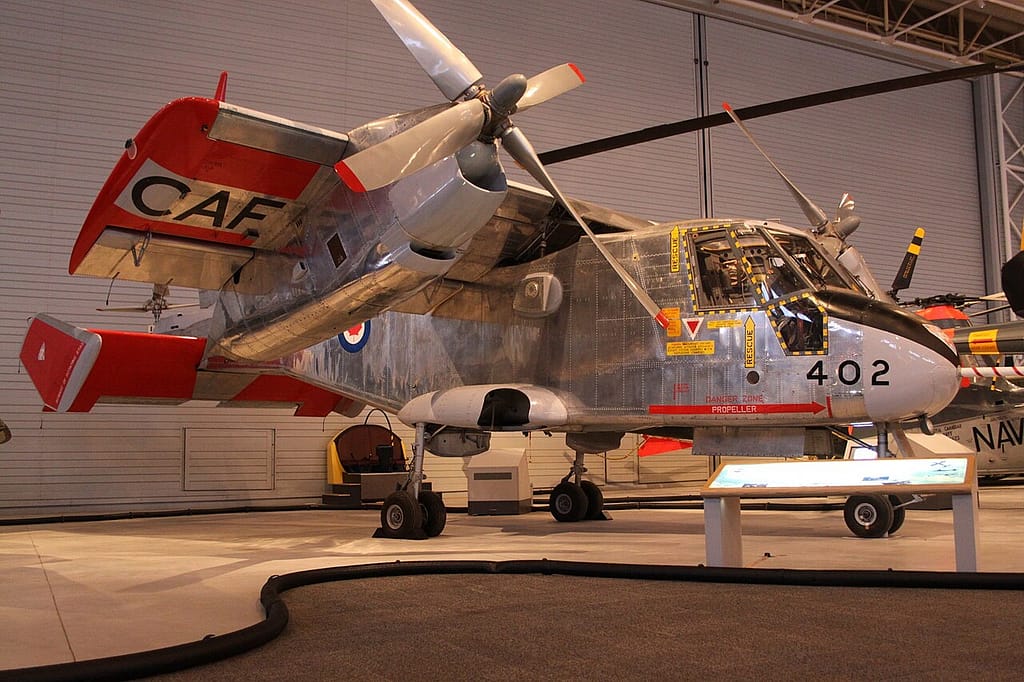
Brilliant, and orphaned
Only four were built and three flew. The first prototype was lost in 1967 when a propeller-control bearing failed; both crew ejected safely. A redesigned CL-84-1 followed with over 150 changes, dual controls and more power.
Test pilot Doug Atkins toured one across the United States, even landing on the White House lawn, and the type flew trials aboard the carrier USS Guam, demonstrating troop transport, surveillance and gun-platform roles. It could accelerate from a standstill to 100 knots in about eight seconds after transition.
The trials went well. The politics did not. With the Vietnam War winding down, the US Navy saw no mission for a tilt-wing, and no other buyer stepped forward. Canadair shelved arguably its most innovative creation. The idea did not die, though; the tilt-wing and tilt-rotor lineage led, decades later, to machines like the V-22 Osprey. The Dynavert simply arrived too early.
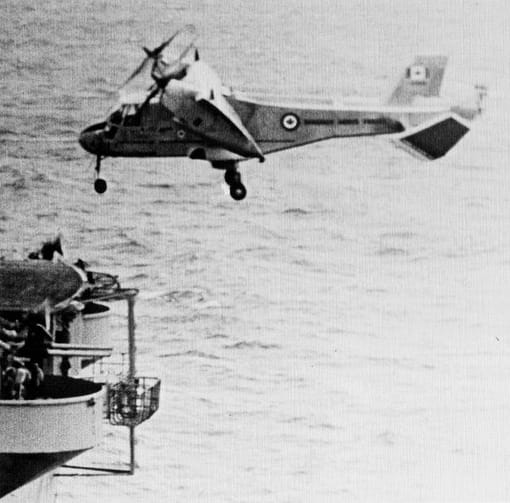
The tilt-wing masterpiece Canada built, then quietly shelved:
Sources: Canada Aviation and Space Museum (Ingenium); Wikipedia.

0 Kommentare