
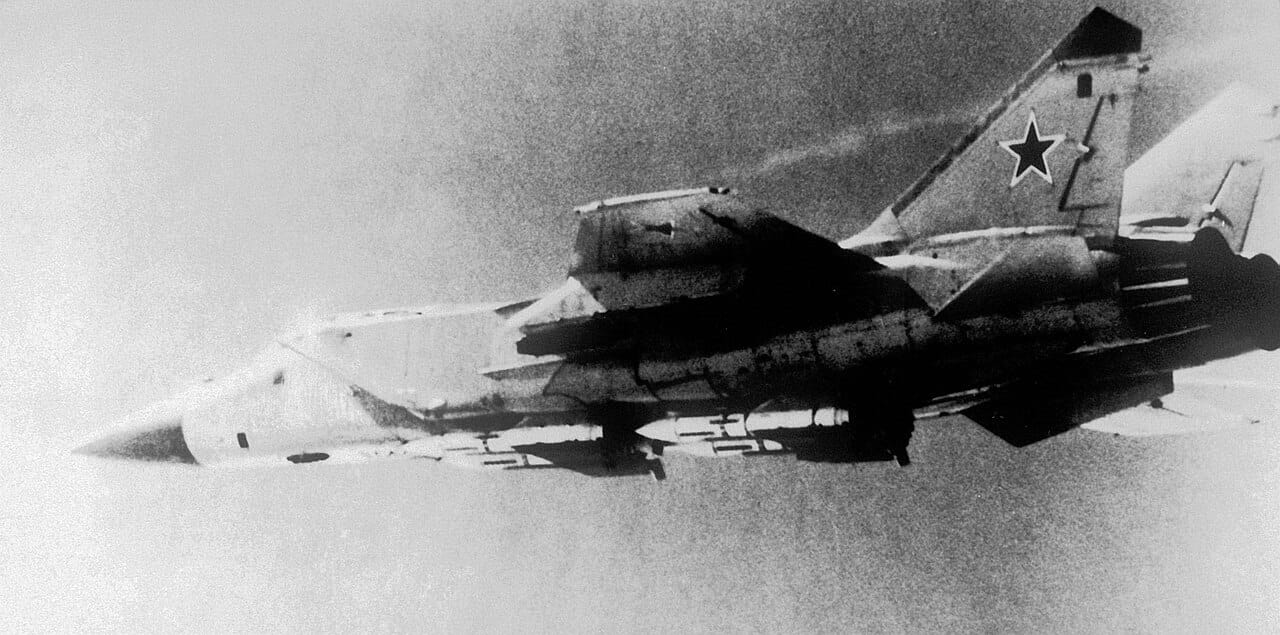
Most fighter jets are built to twist and turn. The MiG-31 Foxhound was built to do something far simpler and far more frightening: go very fast, in a straight line, and catch things nothing else could. Nearly half a century after its first flight, it is still the fastest interceptor on Earth, and it can climb so high that a lucky handful of civilians have ridden it to the very edge of space.
This is the story of a Cold War monster that refuses to retire, and of how, for a few years, an ordinary person could buy a seat in one.
Quick Facts: MiG-31 Foxhound
- Typ: Two-seat long-range interceptor
- Höchstgeschwindigkeit: About Mach 2.83 (beyond roughly Mach 3 risks engine damage)
- Ceiling: Above 25,000 metres (over 80,000 ft)
- Radar: Zaslon, the world’s first phased-array radar on an operational fighter
- First flight / service: 1975 / 1981
- Modern role: Launch platform for the Kh-47M2 Kinzhal hypersonic missile
Built to catch the uncatchable
The Foxhound was designed for one nightmare in particular: defending the vast, empty airspace of the Soviet north against American SR-71 Blackbirds and low-flying cruise missiles. That meant raw speed and, crucially, a radar that could look down and pick targets out from the ground clutter below. The MiG-31 carried the Zaslon system, the first phased-array radar ever fitted to an operational fighter, able to spot a bomber-sized target well over 300 kilometres away and track many at once, roughly two decades ahead of the West.
It is not a dogfighter, and it was never meant to be. With two crew, twin thundering D-30F6 engines and long-reaching missiles, the Foxhound is a high-speed sniper, not a knife-fighter. Today its MiG-31K version has found a grim second life carrying the Kh-47M2 Kinzhal, a hypersonic missile Russia has fired repeatedly in the war in Ukraine.
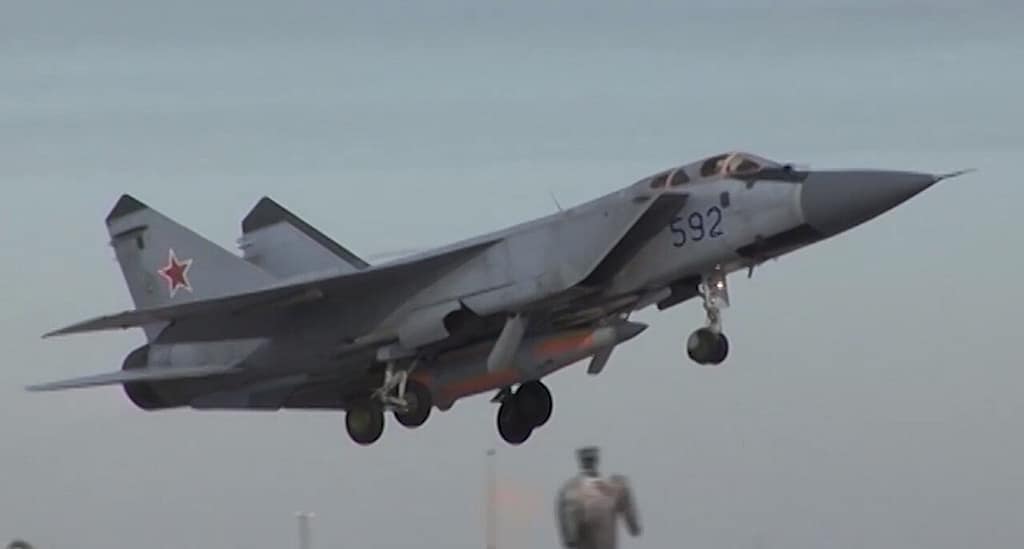
The civilian who rode a Foxhound to the stratosphere
Here is where the Foxhound’s story takes an unlikely turn. After Russia’s original tourist fighter flights at Zhukovsky ended in 2006, the Swiss company MiGFlug struck a deal with the Sokol plant in Nizhny Novgorod, where the MiG-31 is built, and began offering “Edge of Space” flights in the Foxhound itself. From around 2006 until roughly 2010, before the MiG-29 took over the role, paying passengers could strap into a real MiG-31, climb past 20 kilometres and look out at the curved rim of the planet.
No other aircraft in the world could do this for a member of the public. It was, quite literally, a ride to the doorstep of space in a frontline interceptor.
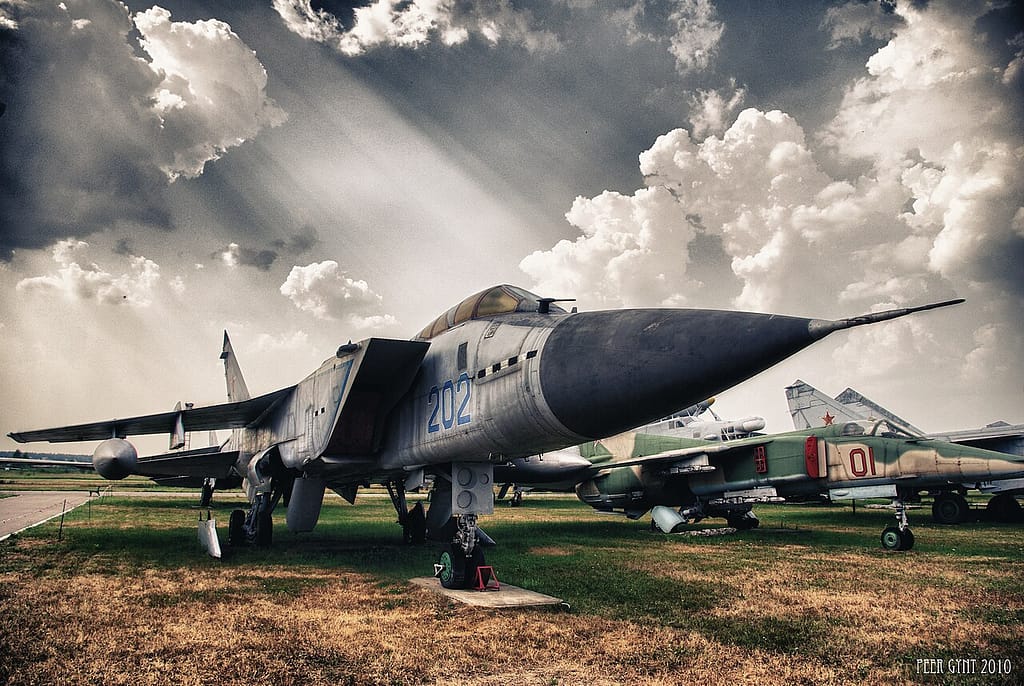
Still guarding the sky
The Foxhound should have been a museum piece by now. Instead, upgraded MiG-31BM and MiG-31K jets remain in front-line Russian service, prowling the edges of NATO airspace and lofting hypersonic missiles. Few combat aircraft have stayed relevant for so long, and fewer still can claim to have carried a fee-paying tourist to the threshold of space between missions.
Fast, brutal and strangely beautiful, the MiG-31 is a reminder that sometimes the simplest idea in aviation, go higher and faster than anyone else, never really goes out of style.
Sources: MiGFlug, Defence Aviation, The Aviation Geek Club, 19FortyFive, Wikipedia.

0 Kommentare