

For years, the race to build “robot wingmen” — uncrewed jets that fight alongside human pilots — looked like an American and Australian story. In a single week in June, Europe planted its flag.
At the ILA air show in Berlin, two very different European players pulled the covers off two very different combat drones within a day of each other. Airbus, the continent’s aerospace giant, revealed the U760 Ravenstorm. Helsing, a fast-rising defence-software startup, answered with the CA-1EA. Both are bets that the next fighter pilot will rarely fly alone.
Kurzinfo
| Ereignis | ILA Berlin air show, 10 June 2026 |
| Airbus U760 Ravenstorm | 13 m long, 6-tonne stealthy combat drone; service ~2032 |
| Helsing CA-1EA | 11 m, 4-tonne electronic-attack drone; in service ~2031 |
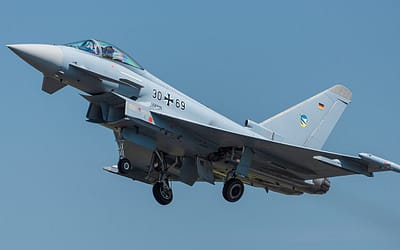
| Both team with | The Eurofighter Typhoon |
| Shared idea | AI “collaborative combat aircraft” that fly with crewed fighters |
| Why now | Europe wants sovereign robot wingmen — and fewer US strings |
Airbus brings the muscle
The Ravenstorm is a proper combat aircraft in miniature: 13 metres long, a 10-metre wingspan, around six tonnes, and more than 500 kilograms of weapons carried internally to keep it stealthy. Its swept wings, canted twin tails and a dorsal air intake all point the same way — it is built to slip into defended airspace ahead of crewed jets and carry missiles, bombs or jammers as the mission demands.
Crucially, Airbus is not selling a single drone but a family. The Ravenstorm shares a common autonomy “brain” — a system Airbus calls MARS — with its other uncrewed aircraft. And because a clean-sheet European design takes time, Airbus is fielding a near-term stand-in first: the U740 Valkyrie, based on the American Kratos XQ-58A, to give the German Air Force something to fly by 2029 before the home-grown Ravenstorm arrives around 2032.
Helsing brings the brains
If Airbus is the incumbent, Helsing is the disruptor — a software company that thinks the hard part of an autonomous warplane is the autonomy, not the airframe. Its CA-1 Europa, built with Grob Aircraft in Bavaria, now comes in two flavours: the CA-1KA for kinetic strike (first flight planned for 2027), and the newly revealed CA-1EA for electronic attack (in service targeted for 2031).
The EA variant is the eye-catcher. Rather than jamming from a safe distance, it is designed as an escort jammer — flying up to 100 kilometres voraus of a Eurofighter package, straight into the teeth of enemy radars, to blind them before the human pilots arrive. It even carries a second generator just to feed its power-hungry jamming suite. Europe has almost no aircraft that can do this today; the job has long belonged to the U.S. Navy’s EA-18G Growler.

Why Europe is suddenly in a hurry
The timing is not coincidence. Europe’s fighter pilots fly Eurofighters and Rafales that must stay relevant through the 2030s, while the next-generation FCAS and GCAP programmes grind slowly toward reality. Cheap, expendable, AI-flown wingmen are a way to add mass and survivability now — and to do it without depending on airframes Washington can restrict.
The field is already crowded: Boeing and Rheinmetall are pushing the MQ-28 Ghost Bat, General Atomics is selling its own design, and Baykar and Leonardo are flying the Kızılelma. What Berlin showed is that Europe no longer intends to watch this race from the grandstand. It wants its own machines flying point — so that, increasingly, it is a robot, not a pilot, that meets the first missile.
Sources: Army Recognition; FlightGlobal; The War Zone; Airbus; Helsing; ILA Berlin 2026.
Verwandte Fragen
What are “robot wingmen”?
Robot wingmen, or collaborative combat aircraft, are uncrewed jets that fly alongside human-piloted fighters, controlled by AI and the pilot to scout, jam or strike. At ILA Berlin in June 2026, Airbus and Helsing unveiled two European designs, joining efforts like a crewed jet commanding a drone in Turkey.
What is the Airbus Ravenstorm?
The U760 Ravenstorm is Airbus’s stealthy combat drone, revealed at ILA Berlin 2026. It is about 13 metres long with a 10-metre wingspan, weighs around six tonnes, and carries over 500 kg of weapons internally to preserve its stealth. Service entry is expected around 2032.
What is the Helsing CA-1EA?
The CA-1EA is an electronic-attack combat drone from Helsing, a fast-rising European defence-software startup. About 11 metres long and four tonnes, it is designed to team with the Eurofighter Typhoon and is expected in service around 2031.
Why does Europe want its own combat drones?
Europe wants sovereign “robot wingmen” to reduce reliance on the United States and keep control of critical defence technology. The push comes amid wider turbulence in European fighter projects, including the troubled FCAS sixth-generation programme.
What is a collaborative combat aircraft (CCA)?
A CCA is an AI-enabled uncrewed aircraft built to operate as a team with crewed fighters. The U.S. has moved fastest, recently clearing its first robot fighters for mass production, and now Europe, Australia and others are fielding their own.
What is the Kratos XQ-58A Valkyrie?
The XQ-58A Valkyrie is an American-built combat drone. Airbus is fielding a version, the U740 Valkyrie, as a near-term stand-in to give the German Air Force something to fly by 2029, before its home-grown Ravenstorm arrives around 2032.

0 Kommentare