
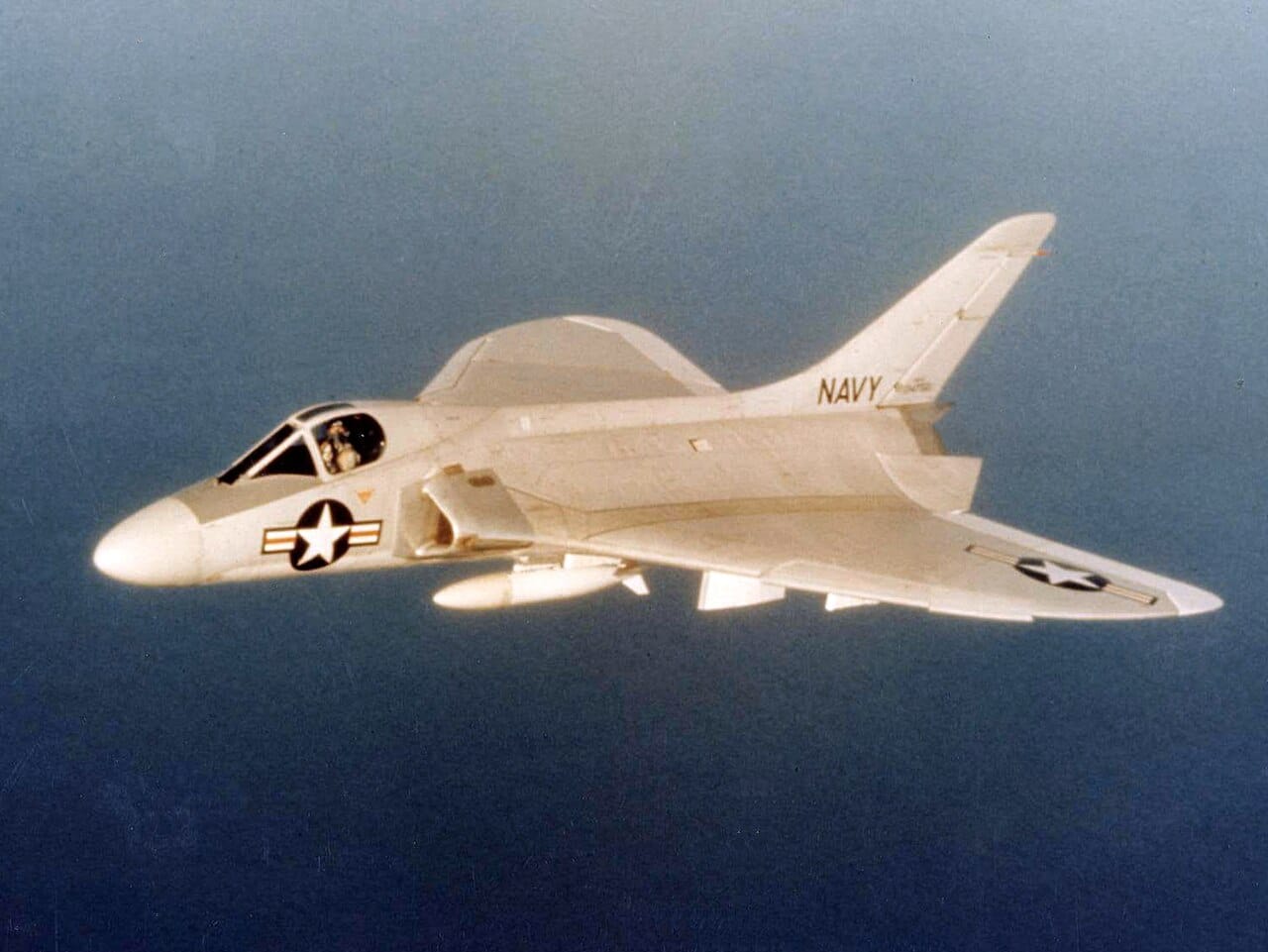
Look at it from above and the name explains itself. The Douglas F4D was a broad, tailless delta with gently rounded wingtips — the silhouette of a manta ray gliding through water. The Navy called it the Skyray. The pilots, with magnificent deadpan, called it the “Ford.”
It looked like science fiction, and it performed like it. In 1953 the Skyray became the first carrier-based aircraft ever to hold the world absolute speed record, and a few years later it rewrote the record books for sheer climbing power.
Quick Facts
| Type | U.S. Navy carrier-based interceptor |
| Designer | Ed Heinemann, Douglas Aircraft |
| Shape | Tailless delta — a “manta ray,” hence Skyray; pilots called it the “Ford” |
| Speed record | 752.944 mph world absolute record, 3 October 1953 |
| Climb records | Five time-to-climb records (1958); standing start to 49,221 ft in 2 min 36 sec |
| Engine | Pratt & Whitney J57 (after the planned Westinghouse J40 was cancelled) |
The fastest thing off a carrier deck
On 3 October 1953, Lieutenant Commander James B. Verdin pushed an XF4D-1 to 752.944 mph over a three-kilometre course — and the Skyray became the first carrier aircraft in history to hold the absolute world speed record. It was the work of Ed Heinemann, the Douglas designer also responsible for the A-1 Skyraider and the A-4 Skyhawk. The tailless delta gave the aircraft an enormous wing for its size, and with it, remarkable low-speed manners and explosive performance.
Straight up
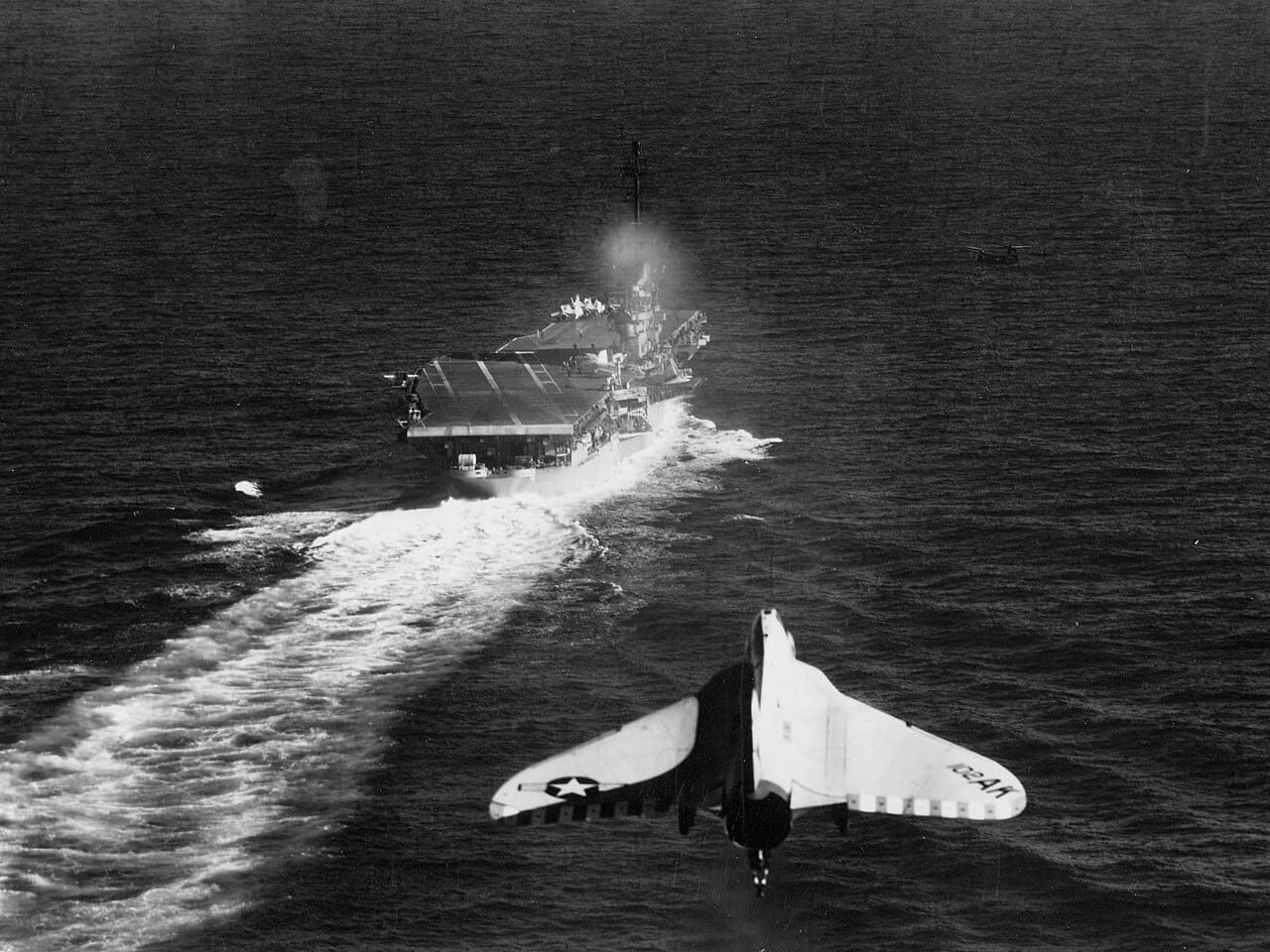
If the speed record made the Skyray famous, its climbing made it legendary. In 1958, Marine Major Edward N. LeFaivre set five world time-to-climb records over two days. In one run, the Ford went from a standing start on the runway to 49,221 feet in two minutes and 36 seconds, holding a 70-degree nose-up angle — climbing very nearly straight up. A big wing, a light airframe and the powerful J57 turned it into something close to a piloted rocket.
The engine that nearly killed it
The Skyray was originally built around the Westinghouse J40, an engine that failed so badly it dragged down several U.S. Navy programmes of the era. The Ford survived only because Douglas re-engineered it around the Pratt & Whitney J57. Once it was in service, it earned a unique distinction: the only U.S. Navy fighter ever assigned to the continental air-defence network alongside the Air Force’s interceptors.
Its career was short — the Skyray was gone by the mid-1960s, overtaken by faster, longer-ranged fighters. But for a few years in the 1950s, the fastest and the steepest-climbing aircraft in the world was a manta-shaped jet the Navy flew off a carrier deck. And the pilots, refusing to be impressed by any of it, just called it the Ford.
Sources: National Naval Aviation Museum; Wikipedia; Flight Journal.
Related Questions
What was the Douglas F4D Skyray?
The Douglas F4D Skyray was a U.S. Navy carrier-based interceptor of the 1950s, designed by Ed Heinemann. Its tailless delta shape resembled a manta ray, and it was notable for setting a world speed record and several time-to-climb records.
Why is it called the Skyray?
The name comes from the aircraft\u2019s shape. Viewed from above, its broad tailless delta wing with rounded tips resembles a manta ray, which inspired the name Skyray. Pilots also nicknamed it the \u201cFord,\u201d from its F4D designation.
Did the Skyray set a world speed record?
Yes. On 3 October 1953, Lieutenant Commander James B. Verdin reached 752.944 mph in an XF4D-1, making the Skyray the first carrier-based aircraft to hold the world absolute speed record.
What climb records did the Skyray set?
In 1958, Marine Major Edward N. LeFaivre set five world time-to-climb records over two days. In one flight the Skyray climbed from a standing start to 49,221 feet in 2 minutes and 36 seconds at a 70-degree angle.
What engine did the F4D Skyray use?
The Skyray was originally designed around the Westinghouse J40, but that engine was cancelled. The aircraft was redesigned around the Pratt & Whitney J57, which powered it in service.
Why was the Skyray nicknamed the Ford?
The nickname comes from its designation, F4D, which pilots read aloud as \u201cFord.\u201d It was an affectionate, understated name for an aircraft with record-breaking performance.
0 Kommentare