
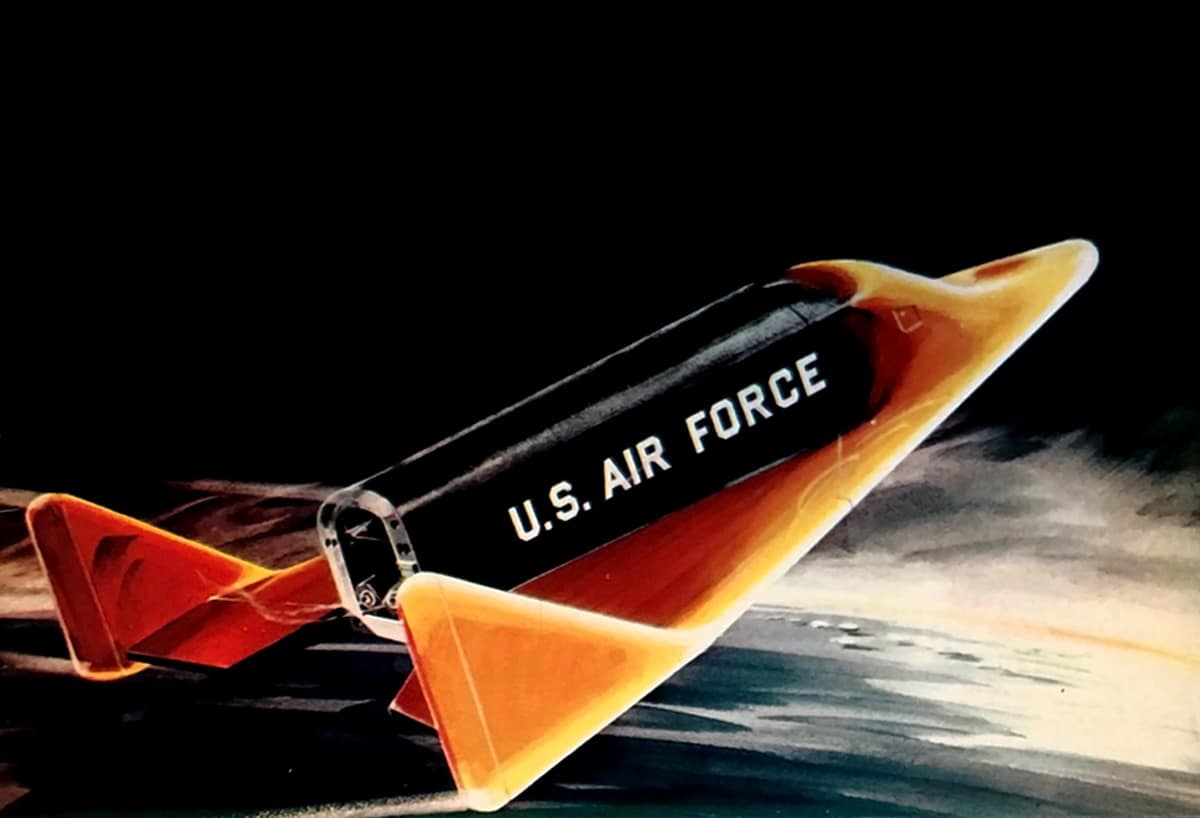
In 1960, a young civilian test pilot named Neil Armstrong was quietly picked to fly into space — not in a capsule on top of a rocket, but in a winged glider that would ride a booster to orbit and then fly home to a runway like an aeroplane. The machine was called the X-20 Dyna-Soar, and it was the boldest thing the U.S. Air Force ever tried to build.
It came within about a month of having its first vehicle assembled. Then, in December 1963, it was cancelled — not because it failed, but because nobody could agree on what it was for. Two decades later, America rebuilt the very same idea and called it the Space Shuttle.
Kurzinfo
- Flugzeug: Boeing X-20 Dyna-Soar (“Dynamic Soarer”)
- Typ: single-pilot, delta-winged, reusable military spaceplane
- Programm: October 1957 to 10 December 1963
- Launcher: Titan III rocket (after Titan I, Titan II and Saturn C-1 were considered)
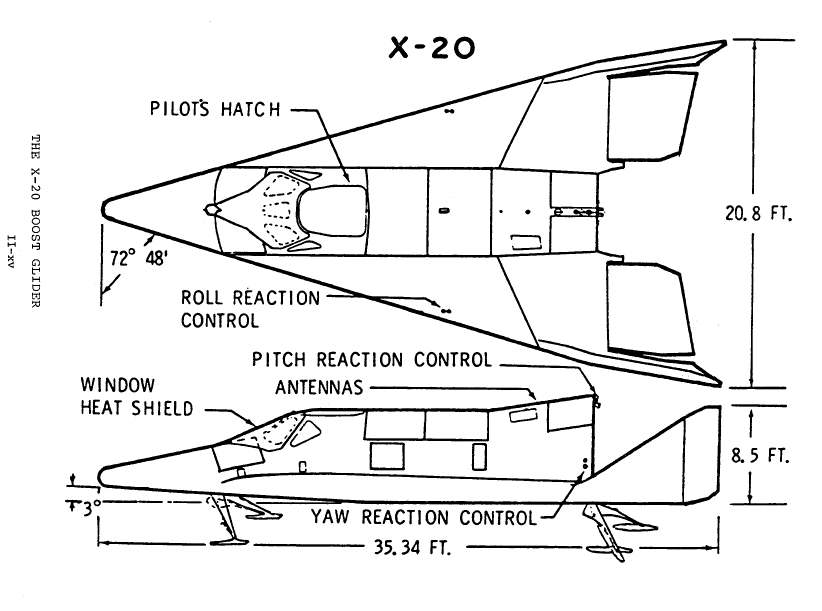
- Landung: on retractable skids, not wheels — reentry heat would have destroyed tyres
- Intended roles: reconnaissance, bombing, satellite inspection and space rescue
- Cost at cancellation: around $400 million; it never flew
- Vermächtnis: the mission is flown today by the X-37B and China’s Shenlong
A different way home
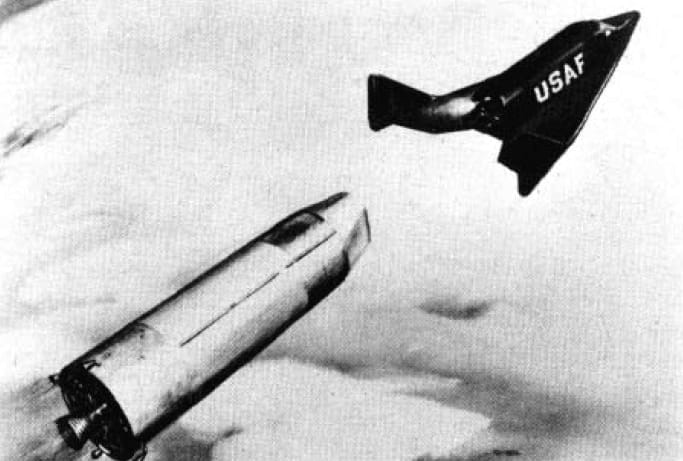
Everything else flying into space in the early 1960s came home the crude way. The American Mercury capsule and the Soviet Vostok both fell back on a ballistic arc and dangled under a parachute into the sea. The Dyna-Soar was designed to do something far more elegant: a single pilot, strapped into a stubby delta-winged glider, would be boosted to near-orbital speed and then fly back down through the atmosphere under his own control, gliding onto a runway.
The shape was unlike anything else in the sky — a tailless delta about thirty-five feet long, with the pilot up front and an equipment bay behind him. Engineers feared that the searing heat of reentry would melt rubber tyres, so they gave it retractable skids instead. It would land like a sled.
A 1962 Boeing promotional film introduces the Dyna-Soar — the winged spaceplane the company was building for the Air Force.
A machine built to do almost everything
The Dyna-Soar was a military project, and the range of jobs the Air Force imagined for it was staggering: reconnaissance, bombing, space rescue, satellite maintenance, and even the inspection or sabotage of enemy satellites. The plan ran in stages — first a research vehicle to prove the concept, then a reconnaissance version, and finally a strategic bomber meant to be operational by the mid-1970s.
The intellectual roots ran back to the wartime German Sänger-Bredt “Silbervogel” concept, a winged rocket-bomber meant to skip across the top of the atmosphere like a stone across a pond. The Air Force was now trying to turn that fantasy into flying hardware, and the glider underwent one of the most exhaustive wind-tunnel programmes in the history of flight.
The first man who almost flew it
The men chosen to fly the Dyna-Soar were among the best test pilots in the country, secretly selected in 1960. Among them was Neil Armstrong, then a civilian NASA pilot on the X-15 rocket-plane programme. His involvement was real but brief: he and fellow X-15 pilot Bill Dana left in the summer of 1962, and that September Armstrong was picked for NASA’s second astronaut group — the path that would take him to the Moon.
By the time the remaining pilots’ names were made public, Armstrong was gone. He had bet on the capsule programme instead of the spaceplane — and history proved him right.
Two problems it never solved
For all its ambition, the Dyna-Soar was dogged by two questions it never answered. The first was simply how to launch it. Planners churned through the Titan I, the Titan II and the Saturn C-1 before finally settling on the powerful Titan III — and every change cost months. While the Air Force argued about rockets, the Mercury programme was already putting Americans into orbit.
The second problem was fatal. Nobody could agree on what the vehicle was actually for. In January 1963, Defense Secretary Robert McNamara ordered a study comparing the X-20 against NASA’s two-man Gemini capsule. He concluded the Air Force had obsessed over how to come home from orbit without settling what it would do once it got there. On 10 December 1963 he cancelled the programme — and, the same day, announced its replacement, the Manned Orbiting Laboratory, which would itself be scrapped in 1969 without ever flying a crew.
The idea that came back
The cruel twist is what happened next. America killed its reusable winged spaceplane in 1963 — and then spent the 1970s building one from scratch. The Space Shuttle, which first flew in 1981, was the same fundamental idea: a piloted, reusable, winged craft that launched on a rocket and glided home to a runway.
And the military mission the Dyna-Soar was actually designed for never went away. Today the Space Force’s uncrewed X-37B slips into orbit for years at a time, doing work it will not discuss, while China flies its own reusable spaceplane, Shenlong. The vehicles finally work. The idea was simply half a century early.
A short history of the Boeing X-20 Dyna-Soar — the spaceplane that never flew.
Sources: National Museum of the U.S. Air Force; NASA Johnson Space Center Oral History (Neil Armstrong); Defense Media Network; 19FortyFive; Wikipedia.
0 Kommentare