
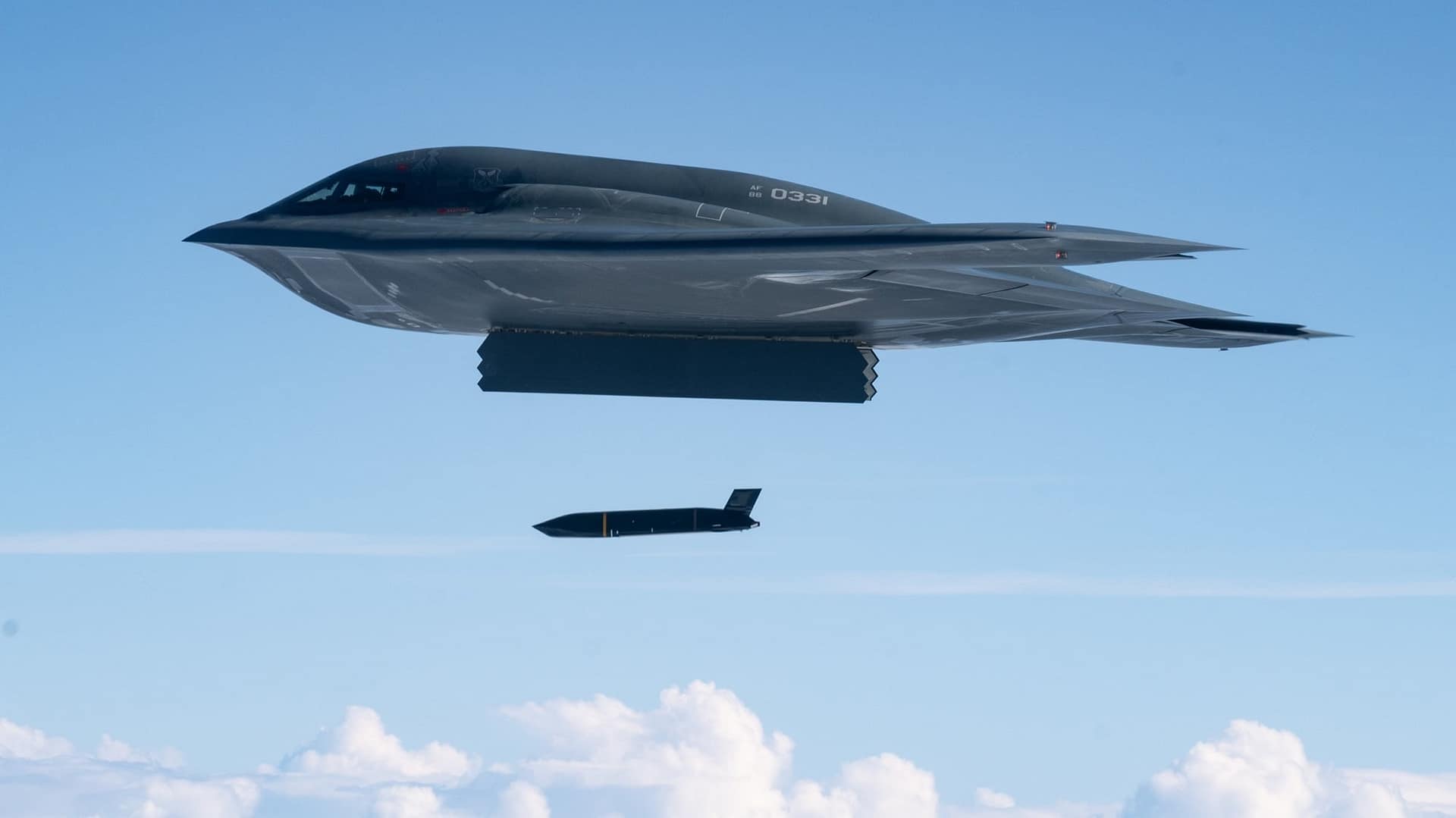
Somewhere over the Philippine Sea on 27 June, a B-2 Spirit opened its weapons bay and released something the world had never officially seen it carry: an AGM-158C LRASM, the US military’s stealthiest anti-ship missile. The target, more than 200 nautical miles off Guam, was the decommissioned amphibious ship ex-USS Juneau. Two days later, Pacific Air Forces quietly published the photos — and with them, a message aimed squarely across the Pacific.
The disclosure, first reported by The War Zone on 29 June, is the first public acknowledgment that the 19-jet B-2 fleet can employ the Long Range Anti-Ship Missile. Air Force Global Strike Command confirmed to Air & Space Forces Magazine that the bomber fired the weapon at ex-Juneau, while declining to say whether it was the type’s first such launch — the integration details remain classified.
Quick Facts: B-2 × LRASM
| Ereignis | SINKEX during Exercise Valiant Shield 26, Mariana Island Range Complex |
| Shot | 27 June 2026; disclosed by PACAF on 29 June |
| Waffe | Lockheed Martin AGM-158C LRASM, derived from JASSM-ER; published range “200+ nautical miles” (~370+ km) |
| Ziel | Ex-USS Juneau (LPD-10), Austin-class veteran of Vietnam and Desert Storm, decommissioned 2008 |
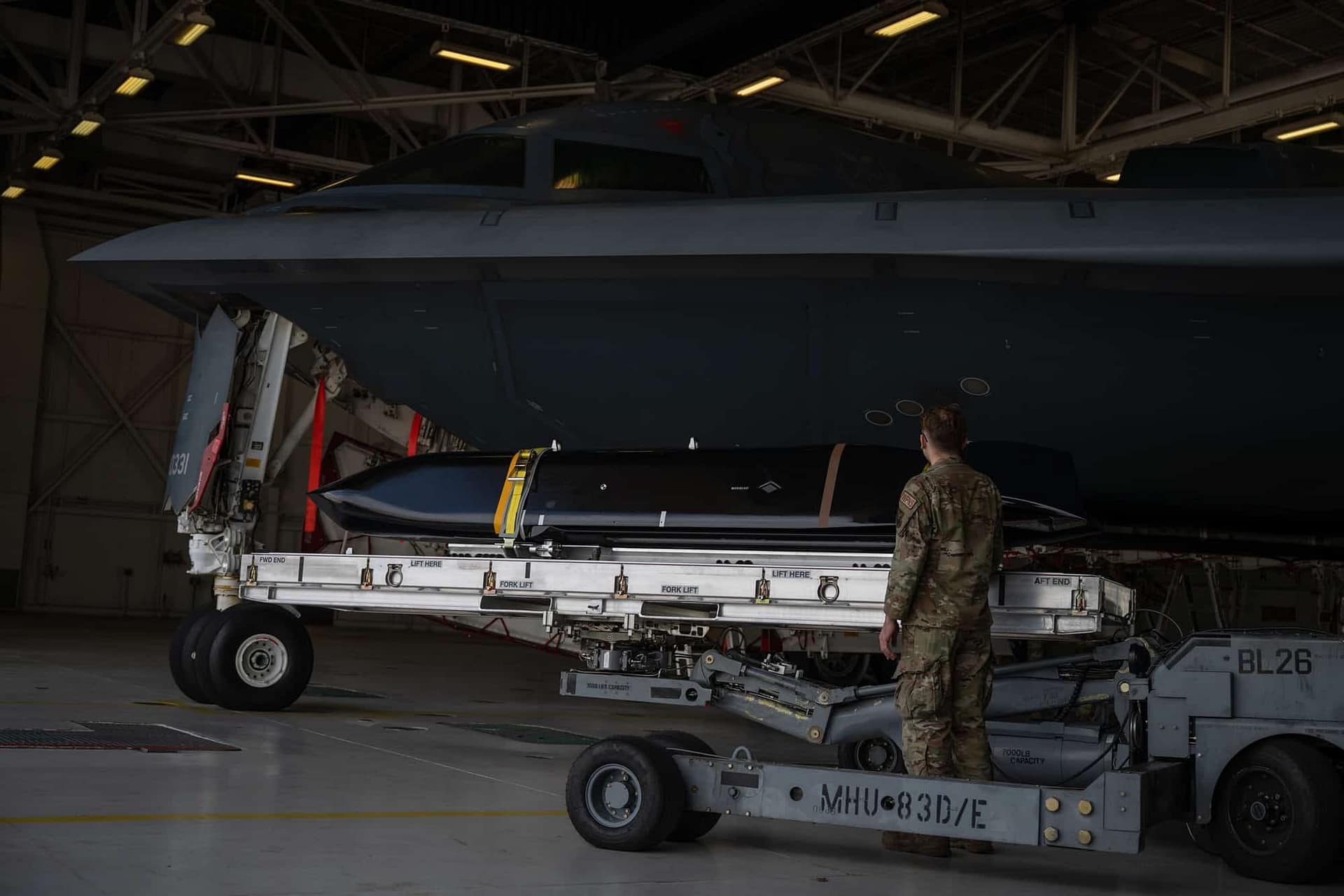
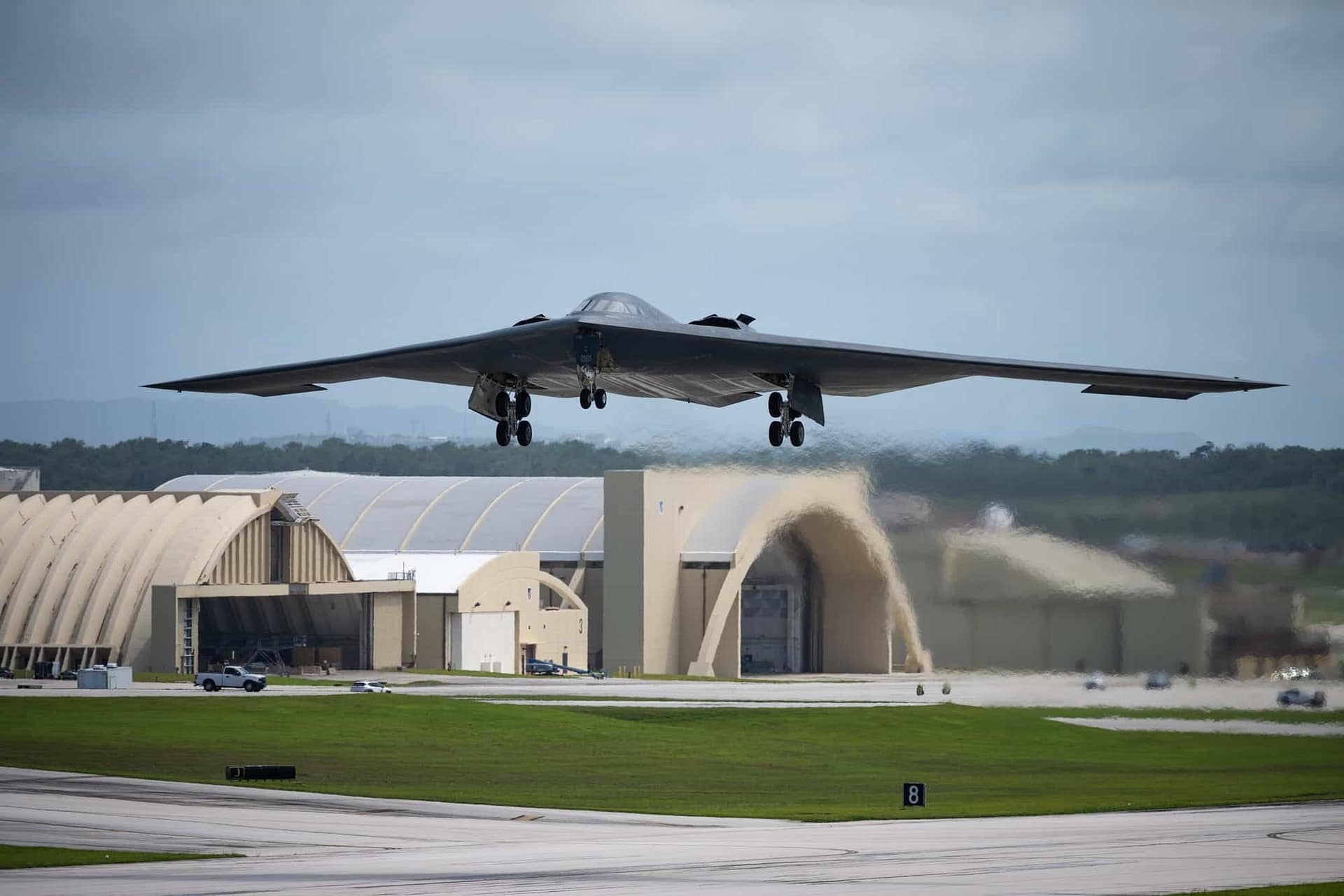
| Bomber | B-2 Spirit of the 509th Bomb Wing, flying from Andersen AFB, Guam; missile loaded at Whiteman AFB on 22 June |
| B-2 fleet | 19 aircraft (21 built; one lost in a 2008 crash on Guam, one retired after the 2022 Whiteman accident) |
Why This Pairing Changes the Maritime Math
The B-1B was the first bomber to carry LRASM, and the missile also arms the Navy’s F/A-18E/F Super Hornets. But the B-2 brings something neither can: it is built to penetrate defended airspace. A stealth bomber carrying a stealthy, autonomously-guided anti-ship missile with a published range beyond 200 nautical miles is a weapon combination designed for exactly one scenario — hunting warships inside a modern anti-access bubble.
The B-2 was already moving into the maritime strike business: at RIMPAC 2024 it demonstrated the low-cost Quicksink guided bomb against the ex-USS Tarawa. LRASM extends that reach from overhead to stand-off distance. The bomber can carry up to 16 JASSM-family cruise missiles; PACAF has not said how many LRASMs a B-2 can load.
One Ship, Six Nations’ Weapons
The Juneau did not go quietly. Over the course of the Valiant Shield sinking exercise, the old amphib absorbed a remarkable multinational arsenal: two Harpoons from a Royal New Zealand Air Force P-8A — the first missile shots ever for the RNZAF’s Poseidons — Hellfires from a Japanese SH-60, ASM-2 missiles from JASDF F-2 fighters, a Type 90 ship-to-ship missile from a Japanese destroyer, and finally a torpedo from a JMSDF submarine that sent her down. F-35Cs and Super Hornets from USS George Washington flew support.
“A Decisive Edge”
Pacific Air Forces framed the shot in unusually direct language for a peacetime exercise release: the B-2, it said, demonstrated an “enhanced ability to achieve strategic objectives within range of potential threats.”
The subtext is not subtle. China’s navy is the largest in the world by hull count, and the Pentagon’s Pacific planning increasingly revolves around holding that fleet at risk from range. A bomber that can slip inside defended airspace and put ship-killers into the water from beyond the horizon is precisely the capability that calculus demands — and now Beijing knows it exists.
Lockheed Martin’s official footage shows how the missile flies its final attack profile — low, autonomous and without GPS if it has to:
Sources: Pacific Air Forces; The War Zone; The Aviationist; Air & Space Forces Magazine; Naval News; USNI News
Verwandte Fragen
What is the AGM-158C LRASM?
The AGM-158C LRASM (Long Range Anti-Ship Missile) is a stealthy, precision-guided anti-ship cruise missile built by Lockheed Martin. Derived from the JASSM-ER land-attack missile, it has a published range beyond 200 nautical miles and is designed to strike heavily defended warships, joining a long lineage of ship-killers like the Exocet.
Can the B-2 Spirit bomber carry anti-ship missiles?
Yes. In June 2026 US Pacific Air Forces publicly confirmed for the first time that the B-2 Spirit stealth bomber can employ the AGM-158C LRASM anti-ship missile, after a B-2 sank a decommissioned ship during an exercise. The capability turns the long-range stealth bomber into a maritime-strike platform able to threaten ships across the Pacific.
What is a SINKEX?
A SINKEX, or sinking exercise, is a live-fire drill in which a decommissioned ship is deliberately sunk to test weapons under realistic conditions. During Exercise Valiant Shield 2026, a B-2 bomber used a SINKEX to sink the ex-USS Juneau with an LRASM more than 200 nautical miles off Guam.
Was ist die Übung Valiant Shield?
Valiant Shield is a large US military exercise held in the Pacific around the Mariana Islands, focused on joint operations across the air, sea, land and cyber domains. The 2026 edition included the first public demonstration of a B-2 Spirit sinking a ship with an anti-ship missile.
How many B-2 Spirit bombers does the US have?
The US Air Force operates a fleet of 19 B-2 Spirit stealth bombers, the survivors of 21 originally built. Each is a flying-wing aircraft able to penetrate dense air defences. In 2026 the fleet gained a new anti-ship role, alongside its nuclear mission within a bomber force that also fields the B-52 and its air-launched cruise missiles.
What is the range of the LRASM anti-ship missile?
The AGM-158C LRASM has a publicly stated range of more than 200 nautical miles (about 370 kilometres), though its exact reach is classified. Derived from the extended-range JASSM-ER, it flies a stealthy, low-observable profile to reach ships before defences can react. In 2026 a B-2 used one to sink a target off Guam.
0 Kommentare