
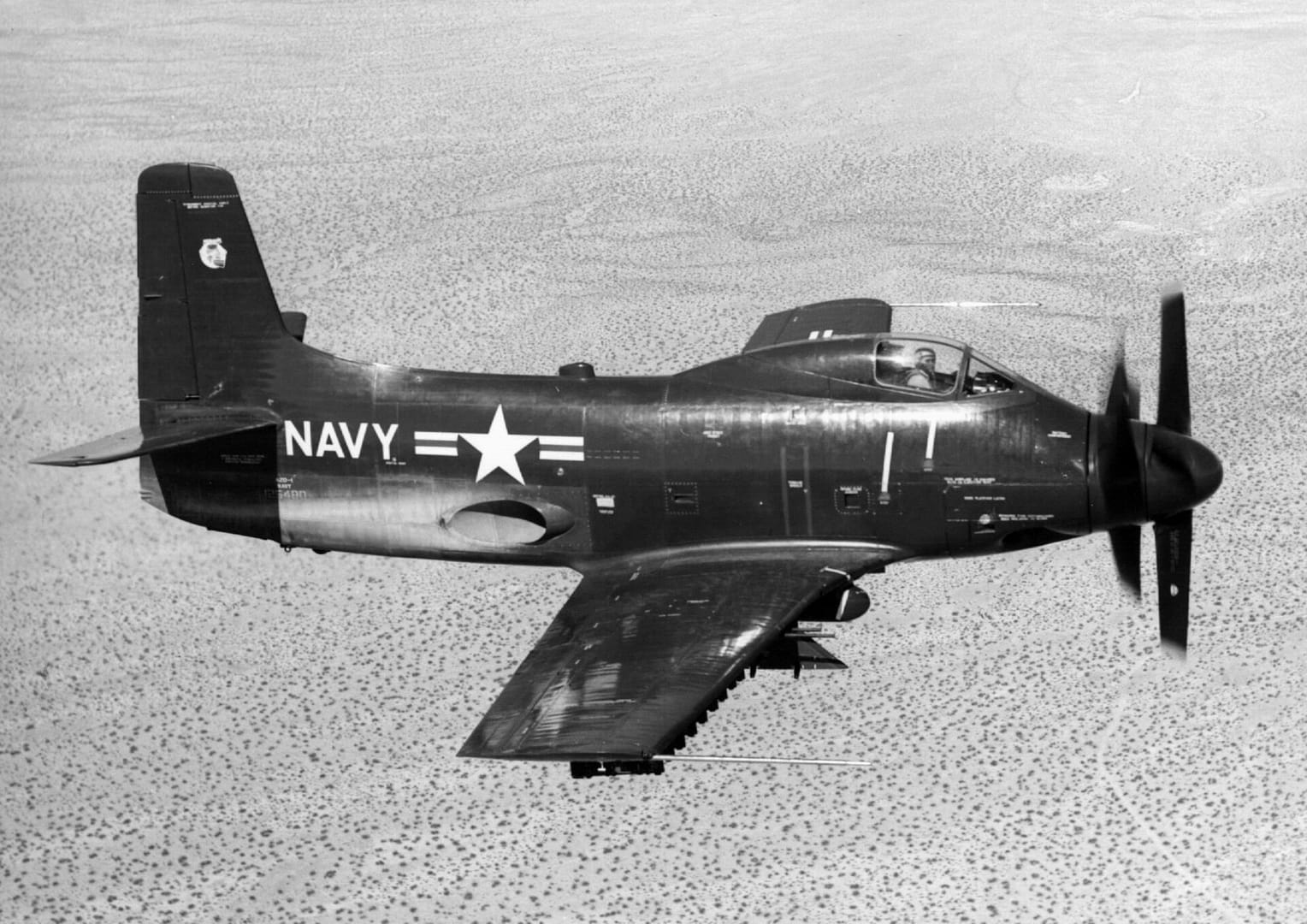
On paper, it should have worked. Take the superb Douglas Skyraider, replace its thundering piston engine with a modern turboprop of more than 5,000 horsepower, and the U.S. Navy would have a carrier attack aircraft faster and harder-hitting than anything afloat. Instead it produced the Douglas A2D Skyshark: a machine undone by the one component it could not do without.
The Skyshark looked like a Skyraider and shared its ancestry, but it was a wholly new aeroplane — and it never worked properly. The reason was almost entirely its engine.
Kurzinfo
| Flugzeug | Douglas A2D Skyshark |
| Rolle | Carrier-based turboprop attack aircraft |
| Motor | Allison XT40 (two coupled T38s), ~5,100 shp, contra-rotating props |
| Erster Flug | May 26, 1950 (test pilot George Jansen) |
| Gebaut | 12 (only 8 ever flew) |
| Abgesagt | August 1954 |
A turboprop bet
In the late 1940s, early jet engines were thirsty and slow to respond — awkward traits for an aircraft that has to be waved off and go around over a pitching carrier deck. A faction inside the Navy believed the answer was the turboprop: a gas turbine turning a propeller, combining jet-age power with propeller-driven control at low speed.
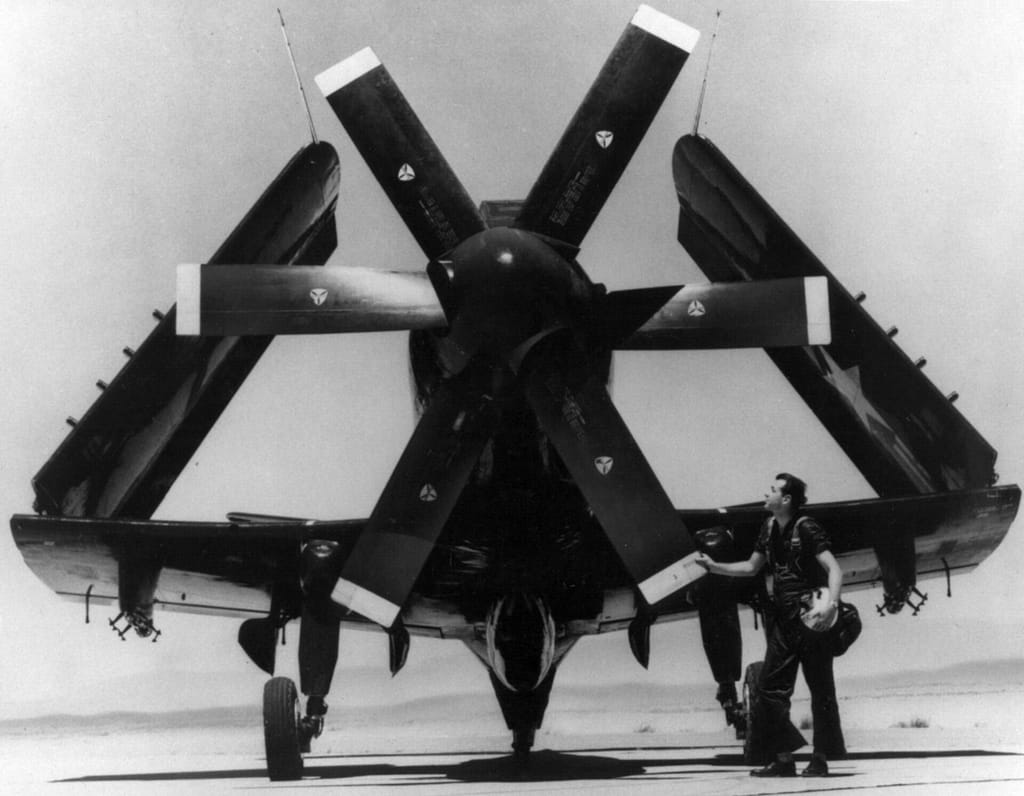
Douglas answered with the A2D. Its Allison XT40 engine was really two Allison T38 turboprops geared together to drive a pair of contra-rotating propellers, promising some 5,100 shaft horsepower. Not everyone was convinced. When a Navy officer inspected the mock-up in 1947, he was blunt.
The gearbox that killed
George Jansen took the first XA2D-1 aloft on May 26, 1950 at Edwards Air Force Base. Violent vibration forced him back onto the lakebed after just two minutes. Flight testing resumed, but was plagued by gearbox failures, bearing failures, overheating and throttle problems — nearly all traceable to that coupled engine and its gearbox.
The danger became lethal on December 19, 1950. When one of the engine’s two power sections failed in flight, it did not disconnect from the gearbox; the surviving section wasted much of its power dragging the dead one, and the propellers would not feather. The aircraft sank uncontrollably, and Navy test pilot Lieutenant Commander Hugh Wood was killed in the crash. Later gearbox failures forced other pilots, including Jansen, to bail out.
Overtaken by the jet
The Navy had once been ambitious enough to order 331 Skysharks. But the engine never became reliable, the aircraft was large and heavy, the small escort carriers it was meant for were being retired, and — decisively — the jet had arrived. Douglas’s own designer Ed Heinemann was already championing a small, simple jet attack aircraft: the A4D, later the A-4 Skyhawk, which first flew in June 1954 and served for decades.
The Navy terminated the Skyshark in August 1954. Just twelve were built and only eight ever flew. And yet the programme was not entirely wasted: the troublesome XT40 was the ancestor of the reliable Allison turboprops that later powered the C-130 Hercules, the P-3 Orion and the E-2 Hawkeye. The engine that ruined the Skyshark went on, in refined form, to become one of the great success stories of military aviation. The Skyshark itself simply had the misfortune to fly it first.
Sources: Defense Media Network (Robert F. Dorr), Naval History and Heritage Command, GlobalSecurity, Wikipedia.
0 Kommentare