

India’s largest fighter purchase in a generation is not stuck on money. It is not stuck on delivery dates, offsets, or how many aircraft get built in Nashik rather than Bordeaux. It is stuck on lines of code.
New Delhi wants access to the software architecture at the heart of the Dassault Rafale — deep enough to bolt on its own missiles, its own electronic warfare kit, and its own future upgrades without asking Paris for permission each time. Paris has said no. Not to the sale. To the source code.
Until that is resolved, 114 fighters worth somewhere north of $35 billion are sitting in a negotiating room.
Kurzinfo
| Programm | Multi-Role Fighter Aircraft (MRFA), Indian Air Force |
| Menge | 114 Dassault Rafale |
| Wert | Reported at $35–40 billion, depending on source and configuration |
| Build split | A first batch delivered flyaway from France (reported as 18 or 20), the remainder assembled in India |
| Knackpunkt | Access to source code for the RBE2 AESA radar, the MDPU mission computer and the SPECTRA electronic warfare suite |
| Meilensteine | Acceptance of Necessity cleared 12 February 2026; Indian Letter of Request issued May 2026 |
| If signed | India’s Rafale fleet would reach 176 aircraft across Air Force and Navy |
Three Boxes Nobody Wants to Open
The dispute, first reported by the French business paper L’Essentiel de l’Eco and since picked up widely, comes down to three systems.
The Thales RBE2 is the Rafale’s active electronically scanned array radar. The Modular Data Processing Unit is the mission computer that fuses what the aircraft’s sensors see into a single picture. And SPECTRA is the integrated electronic warfare suite — the system that tells a Rafale it has been illuminated, decides what to do about it, and is widely regarded as the single most closely held piece of technology on the aeroplane.
Together they are not accessories. They are the combat aircraft. A modern fighter is a software platform that happens to have wings, and whoever controls the software controls what the aircraft can be asked to do.
What India Actually Wants
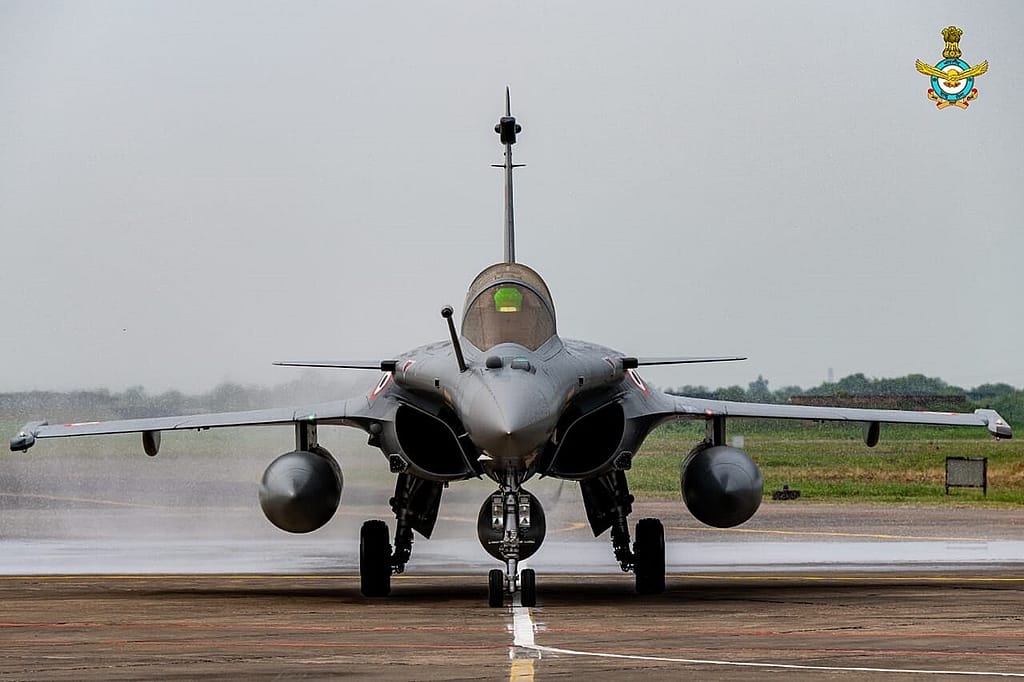
India’s position flows directly from two decades of policy. New Delhi has spent heavily building indigenous air-launched weapons, electronic warfare systems and networked battle management, and it intends to put them on the Rafale. The BrahMos supersonic cruise missile — an Indian-Russian joint development — is high on that list.
Doing that without source-code access means going back to Dassault for every integration, every validation, every software drop. That is a commercial dependency, and in a crisis it is an operational one. Indian planners call the alternative software sovereignty, and they mean it literally: the ability to sustain and adapt your own combat capability without a foreign supplier in the loop.
A summary of the source-code dispute and what it means for the MRFA programme.
Why Paris Is Saying No
France’s reluctance is not simple commercial protectionism, though intellectual property is part of it. The reported concern in Paris is exposure: India maintains a large Russian-origin inventory and a defence relationship with Moscow that goes back decades, and French officials are said to be wary of what unrestricted access to SPECTRA’s inner workings could eventually reveal.
The compromise on the table is a familiar one in European defence exports. France has signalled it is willing to integrate Indian weapons onto the aircraft — but through controlled interfaces, with Dassault retaining responsibility for the integration and the validation, rather than handing over the underlying code.
The timetable has slipped repeatedly. Dassault chief executive Eric Trappier said in early March that he wanted the contract signed this year, having previously pointed to the end of 2025. It was originally meant to be concluded in February of that year during President Macron’s visit to New Delhi. India’s Defence Acquisition Council granted Acceptance of Necessity on 12 February 2026, New Delhi issued its Letter of Request in May, and Paris asked for additional time into mid-August to formally respond. Commercial negotiations on price begin only after that. Realistic signature is now put at some point in 2026 or the first half of 2027.
The Air Force Cannot Wait Forever
This is the part that gives the negotiation its edge. The Indian Air Force is authorised 42 fighter squadrons and has been operating well below that for years. MiG-21s and other legacy types have left service faster than replacements have arrived. The indigenous LCA Mk1A has slipped; the Mk2 and the Advanced Medium Combat Aircraft are years further out.
The MRFA competition began with a 2018 request for information that drew almost every fighter on the market — Rafale, Eurofighter Typhoon, Gripen E, MiG-35, Su-35, Super Hornet, F-15EX, the F-21, and later the Su-57. Attrition did the rest. Russia’s war in Ukraine complicated long-term support for Russian types. Introducing a wholly new logistics chain held little appeal for an air force already juggling one of the world’s most varied inventories. Gripen is single-engine, which does not match Indian preference across many mission profiles.
That left the aircraft India already flies, already trains on, and already supports — and which the Indian Navy separately ordered in Rafale Marine form in April 2025. The Rafale won the competition partly by outlasting it.
Abu Dhabi Got the Same Answer
India is not the first customer to test this line. The United Arab Emirates, which ordered 80 Rafales in 2021, also pushed for broader software access and was reportedly offered the same controlled-interface arrangement rather than source code. That disagreement is said to have contributed to the UAE stepping back from co-financing development of the future Rafale F5 standard, leaving France to fund it alone.
Which is the real story here, and it is bigger than one contract. For thirty years the export fight was about thrust, radar range and price per airframe. It is now about who holds the keys. France has decided that keeping them is worth the risk of a slower sale — and possibly a smaller one. India has to decide whether a fighter it cannot rewrite is still the right fighter.
Neither government has commented publicly on the reported disagreement. Both know exactly what is at stake.
Sources: L’Essentiel de l’Eco; Aerospace Global News; Defence Security Asia; Militarnyi; ANI; The Aviationist; Indian Ministry of Defence statements.

0 Kommentare