
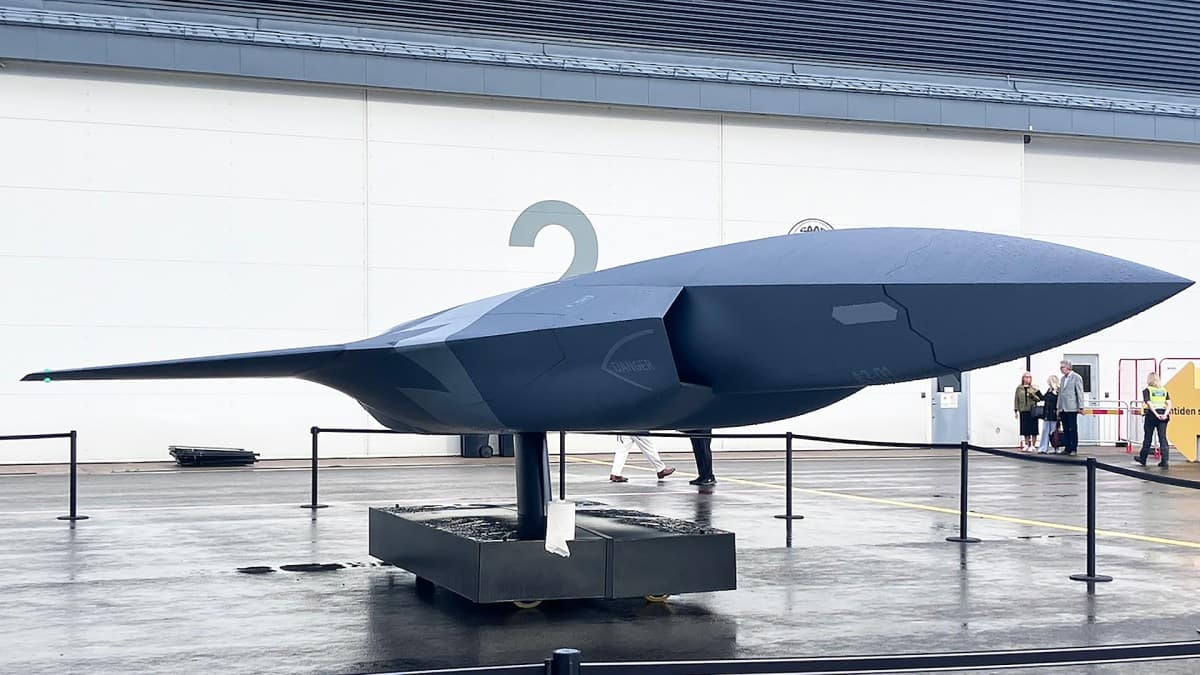
On Aug. 21, 2026, at Malmen Air Base in Sweden, Saab chose the Swedish Air Force’s 100th birthday to pull the cover off its vision of the next one hundred years. Standing on the floor was a full-scale mock-up of a tailless, stealthy, supersonic drone, an uncrewed machine built not to loiter at the edges of a war but to fly straight into its most dangerous skies.
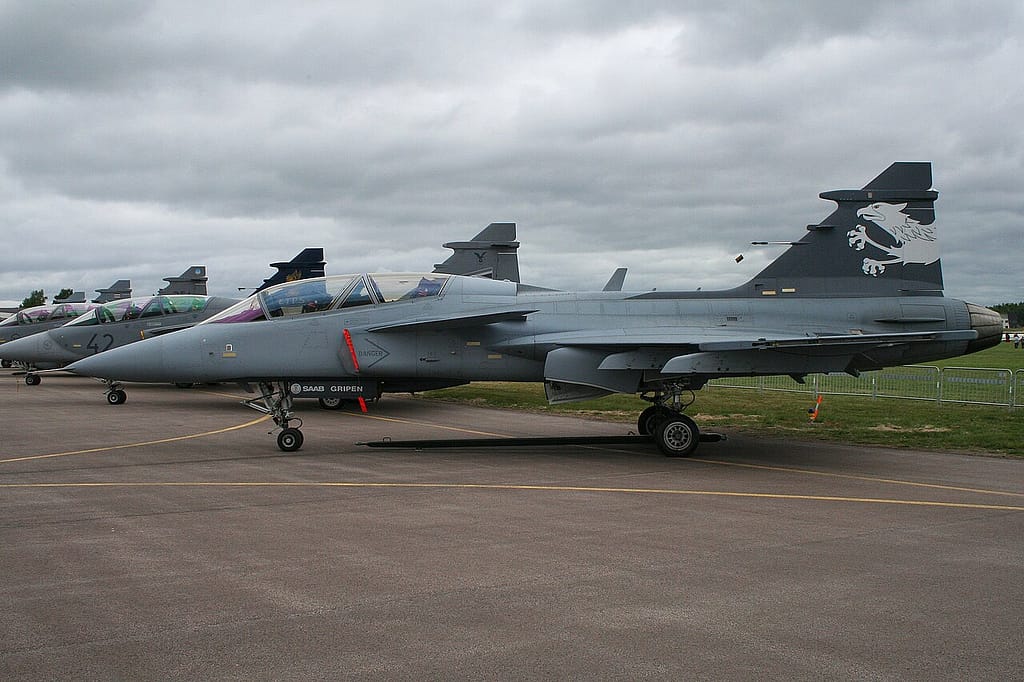
Saab calls the effort the Autonomous Collaborative Platform, or ACP. In plainer language, it is a fighter drone: a low-observable, fast, heavily armed “loyal wingman” designed to fly alongside the Gripen E and, one day, perhaps replace the crewed fighter altogether. Saab pointedly frames it as a higher-end proposition than the American Collaborative Combat Aircraft, larger, more advanced and faster.
Quick Facts: Saab ACP Fighter Drone
- Enthüllt: Aug. 21, 2026, Malmen Air Base, Sweden
- Programm: Autonomous Collaborative Platform (ACP)
- Typ: Stealthy, supersonic uncrewed “fighter drone”
- Demonstrators: A1 and A2, funded by the Swedish MoD
- First flight (A1): Expected within about 15 months
- Motor: GE F414, the same as the Gripen E/F
- Im Einsatz: Potentially mid-2030s, if funded
A drone with a fighter’s ambitions
The star of the show was a production-oriented concept Saab labels aircraft A3. It is a sleek, tailless, blended wing-and-body shape with cropped wings, chisel-type stealth intakes on each flank and a serrated, low-observable engine nozzle. A prominent chine runs around the arrow-like nose, giving it a faint family resemblance to the Cold War Saab 35 Draken and its famous double-delta.
This is no reconnaissance drone. Saab wants the ACP to survive “high-risk missions in heavily defended airspace,” flying air-to-air combat, electronic warfare, the suppression of enemy air defences and deep precision strike. In other words, the jobs that today demand a crewed stealth fighter and a very brave pilot.
Three aircraft, A1 to A3
Behind the glossy mock-up sits real hardware. Saab is already building two uncrewed technology demonstrators, A1 and A2, funded by the Swedish Ministry of Defence. The first, A1, is expected to fly within roughly 15 months, part of a deliberately punishing brief to go from concept to first flight in 36 months. It uses the GE Aerospace F414 turbofan, the same engine that powers the Gripen E/F, producing around 22,000 pounds of thrust and giving the drone genuine supersonic performance.
A1’s real purpose is simply to prove Saab can build and fly a low-observable aircraft. A2 goes further, adding an internal weapons bay and testing new materials and sensors. Saab is contracted to develop both through 2030. The A3 concept shown at Malmen is where those lessons are meant to lead, a survivable production aircraft, if and only if the Swedish government pays for the next step.
Cheap enough to change the maths
The number that makes defence planners lean in is cost. Nilsson suggested the ACP’s life-cycle cost could be about a third that of a Gripen, with a single drone potentially costing roughly half as much as a Gripen E, itself a relative bargain at an estimated $70 to $80 million flyaway. That would let an air force field two or three ACPs for every crewed fighter. As Nilsson wryly put it, the real problem is that the Gripen is already “too low cost” to beat easily.
The stakes reach well beyond one drone. The same architecture could seed a future crewed Gripen successor that Sweden will eventually need after 2055. Somewhere between 2028 and 2030, Stockholm must decide whether to build its own next fighter, join a foreign sixth-generation programme, or embrace a force blending crewed jets and drones.
For now the ACP is a proposal, not a signed programme. But with two demonstrators already taking shape, Saab is betting it can be the first-mover in the high-end loyal-wingman game, and that a small country with a stubborn independent streak can once again punch far above its weight.
Background: Sweden’s push to define its future combat aircraft, of which the ACP is the uncrewed piece.
Sources: The War Zone (TWZ), FlightGlobal, Saab, Defence Blog.
0 Kommentare