
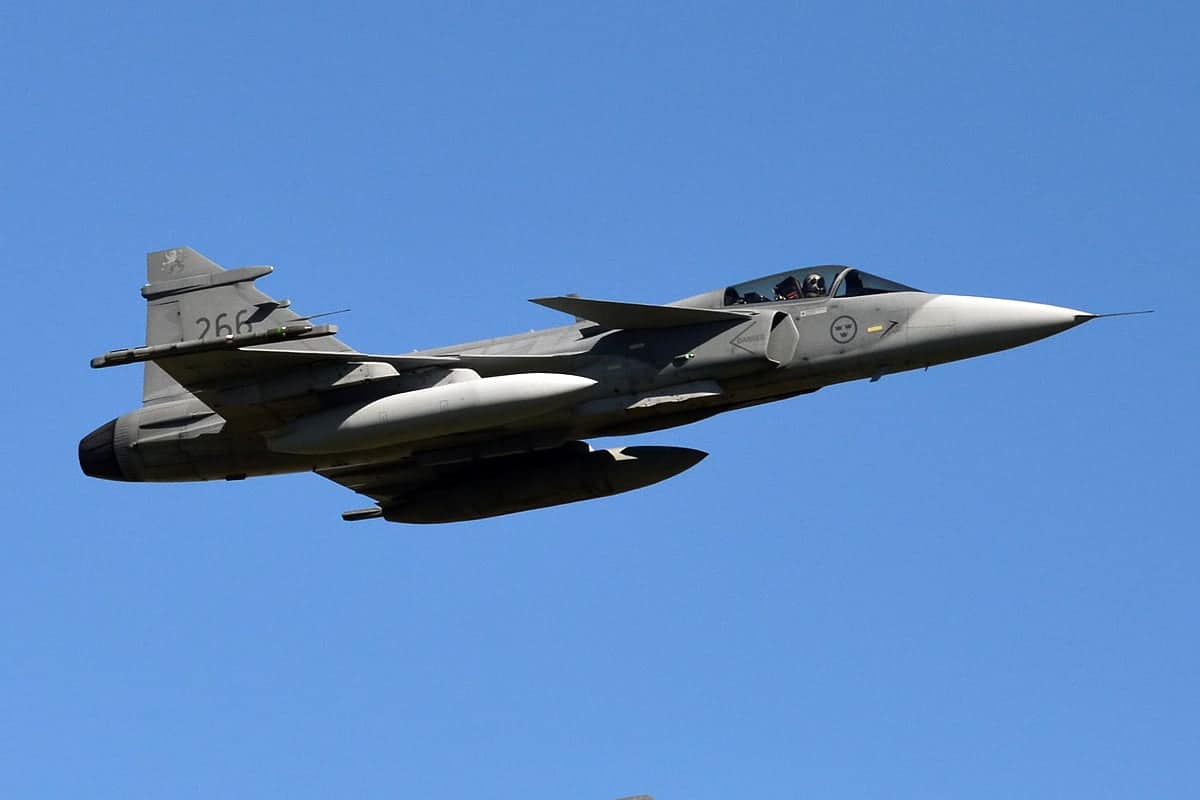
For the first time, one of the smallest and cheapest fighters in Europe has reached far beyond the horizon. On Aug. 21, 2026, a Swedish Air Force JAS 39 Gripen C released a live Taurus KEPD 350 cruise missile over the Vidsel Test Range in Norrbotten, in the Arctic north of Sweden. It was the first time a Gripen has ever fired the weapon, and it hands Stockholm a capability it has never before possessed: the ability to strike hardened, high-value targets from more than 500 kilometres away.
The Swedish armed forces published the moment in a short video, and the yellow band around the missile told the story to anyone who knew what to look for. This was no dummy round or captive-carry mock-up, but a live weapon on a real trajectory. For a nation that spent the Cold War building its entire air arm around the defence of its own skies, it is a striking change of posture.
Quick Facts: Gripen Fires the Taurus KEPD 350
- Datum: Aug. 21, 2026
- Flugzeug: Saab JAS 39 Gripen C, Swedish Air Force
- Waffe: Taurus KEPD 350 stand-off cruise missile (live round)
- Reichweite: More than 500 km
- Cruise profile: As low as 35 m, about Mach 0.95
- Sprengkopf: 481 kg MEPHISTO penetrator
- Range used: Vidsel Test Range, Norrbotten, Sweden
A first over the Arctic range
The test took place at Vidsel, the vast overland range in Swedish Lapland where the Defence Materiel Agency (FMV) has wrung out weapons for decades. The Swedish Air Force, Flygvapnet, announced the launch on Aug. 21 with imagery credited to the FMV, describing it plainly as the first firing of a Taurus from a Gripen.
No range figures or target details were released, in keeping with a live-fire trial. But the significance is not in the numbers. It is in the fact that the shot happened at all, years of integration work now proven with a weapon leaving the rail and flying its own programmed route toward a target.
The urgency is deliberate. In-service use of the Taurus was originally pencilled in for 2028, but Sweden has been pushing to field it sooner, with the air force, the FMV and industry working in parallel to compress the timeline.
What the Taurus actually does
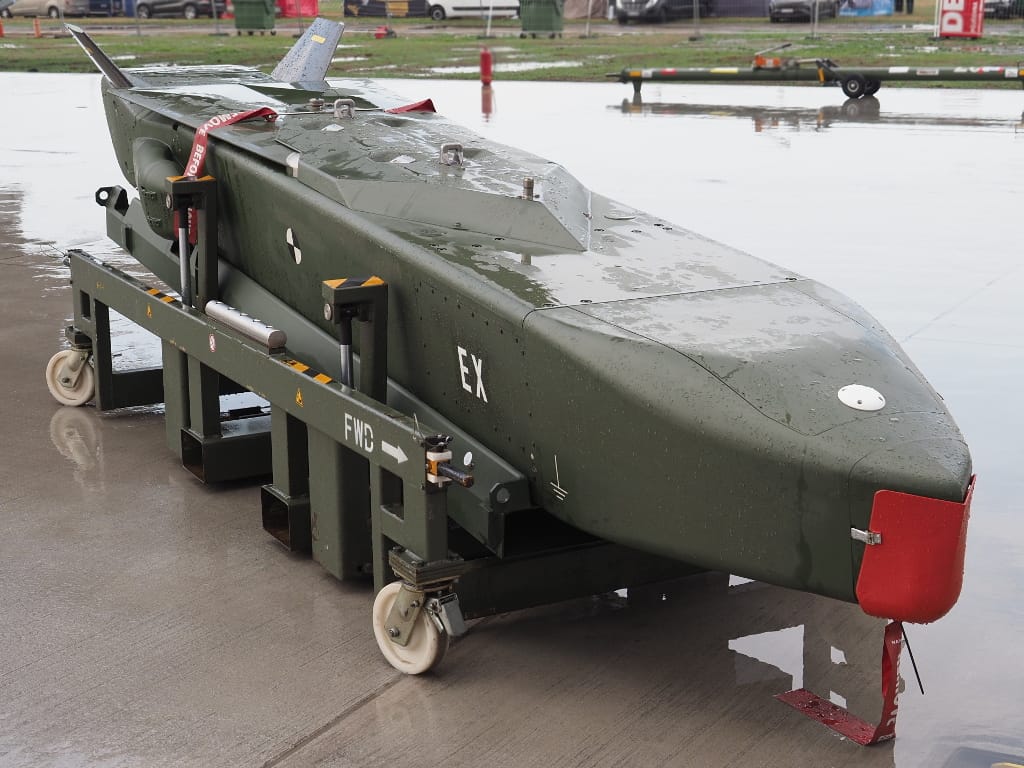
The Taurus KEPD 350 is a long-range, air-launched stand-off cruise missile built by Taurus Systems GmbH, a German-Swedish joint venture between MBDA Deutschland and Saab. It is designed for exactly the targets a defensive air force could never previously reach: hardened command posts, buried bunkers, airfields, bridges and other high-value infrastructure.
With a range of more than 500 kilometres, it lets the launch aircraft stay well clear of enemy air defences. The missile itself then hugs the earth, cruising as low as 35 metres at around Mach 0.95, and navigates with a blend of inertial, satellite, terrain-reference and image-reference guidance, so it can still find its target even if GPS is jammed. Its 481 kg MEPHISTO warhead is a multi-stage penetrator tuned to punch through concrete before detonating deep inside.
A defensive air force learns to hit back
Sweden formally began integrating and buying the Taurus only in February 2025, even though Saab had listed the Gripen as a Taurus-capable platform as far back as 2002. The plan is to upgrade 60 Gripen C/D jets to the MS20 Block 3 standard, with deliveries from 2026 and a further Block 4 configuration following in 2028. Those older Gripens will soldier on alongside the new Gripen E, which Saab says can also carry the weapon once integration work is done.
The strategic backdrop matters. Sweden abandoned two centuries of non-alignment to join NATO in 2024, and a deep-strike missile changes what it brings to the alliance. A country once content to defend its own airspace can now hold targets at risk hundreds of kilometres inside hostile territory. For a fighter often dismissed as the budget option, the Gripen just grew a very long reach.
Sources: Swedish Air Force (Flygvapnet), Swedish Defence Materiel Agency (FMV), The Aviationist, Defense News, Saab.
0 Kommentare