
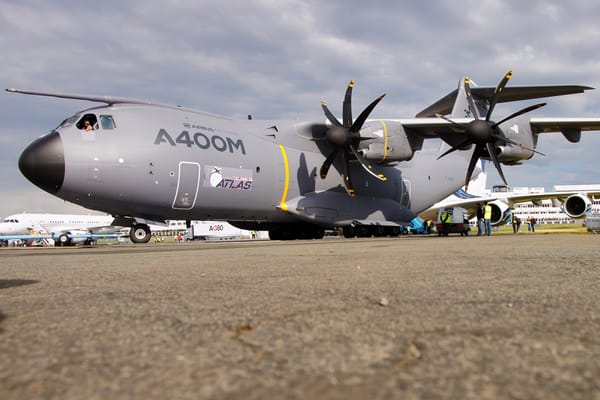
Strategische und taktische Fähigkeiten
Die brandneue A400M wurde sorgfältig entwickelt, um den heutigen Anforderungen moderner Streitkräfte weltweit an den Transport von Ausrüstung gerecht zu werden. Die A400M kann Missionen durchführen, für die zuvor zwei oder mehr verschiedene Flugzeugtypen erforderlich waren und die selbst dann nur eine unvollkommene Lösung boten. Ihre Außenbreite von 5,64 Metern entspricht der der Großraumflugzeuge der A330/A340-Familie. Der Frachtraum bietet eine nutzbare Innenbreite von vier Metern, eine Höhe von bis zu vier Metern und eine nutzbare Länge von 17,71 Metern.
Mit einer maximalen Nutzlast von bis zu 37 Tonnen (81.600 lb) und einem Volumen von 340 m³3 (12.000 Fuß)3Der A400M kann verschiedene übergroße Frachtstücke transportieren, darunter Fahrzeuge und Hubschrauber, die für taktische Transportflugzeuge der vorherigen Generation zu groß oder zu schwer sind, beispielsweise einen NH90 oder einen CH-47 Chinook, oder zwei schwer gepanzerte Fahrzeuge für militärische Zwecke. Er kann auch einen schweren Lkw, ein Rettungsboot oder große Hebezeuge wie Bagger oder Mobilkräne transportieren, die für die Katastrophenhilfe benötigt werden, wie sie bereits mehrfach stattgefunden hat.
Die A400M kann rund 116 Fallschirmjäger oder einfach Personal transportieren, was mehr ist als in einer A318. Dank der Breite des Flugzeugs können sie in vier Reihen entlang der beiden Seiten des Rumpfes und entlang der Mittellinie platziert werden.
Die A400M, ein Gemeinschaftsprojekt der Regierungen und sogar der Industrie aus rund sechs europäischen Ländern, wird den Einsatz der Joint Rapid Reaction Force unterstützen und der Royal Air Force (RAF) ein strategisches und taktisches Flugzeug zur Verfügung stellen, das alle drei Teilstreitkräfte unterstützen kann und interoperabel mit anderen Streitkräften ist.

Die A400M wurde abgeschaltet.
Nein, reden wir lieber über die Leistung der A-400M.
Hohe Geschwindigkeits-/Höhenfähigkeiten der A400M
Dank modernster Technologie, insbesondere des einzigartigen Europrop International TP400-Turboprop-Triebwerks – dem leistungsstärksten Turboprop-Triebwerk der westlichen Welt –, ist das Flugzeug leichter, wartungsfreundlicher und verbraucht 201 Tonnen weniger Treibstoff pro Flug. Dadurch kann es Langstreckenflüge von bis zu 4.700 Seemeilen (8.700 km) absolvieren. Bei einer Reiseflughöhe von bis zu 37.000 Fuß und einer Geschwindigkeit von Mach 0,72 entspricht die Leistung in etwa der eines turbofangetriebenen Transportflugzeugs. In besonderen Einsatzsituationen kann es sogar bis zu einer Höhe von 40.000 Fuß fliegen.
Der Innenraum des A400M
Ein neues, hochmodernes Verteidigungssystem wird in das Flugzeug eingebaut, das Funk- und Infrarot-Frequenzdetektoren, elektronische Gegenmaßnahmen und Täuschkörperwerfer umfasst. Der Frachtraum der Atlas wird von einem einzigen Lademeister gesteuert und kann für zahlreiche Aufgaben konfiguriert werden, darunter:
- Reiner Truppentransport oder eine Mischung aus Truppen und Unterstützungsausrüstung;
- Eine Mischung aus leichten und schweren Maschinenbaugeräten;
- Palatalisierte Fracht- oder militärische Rad- und Kettenfahrzeuge;
- Zwei Kampfhubschrauber wie der Apache oder der Puma;
Die A400M verfügt über zwei Head-up-Displays (HUDs), die den Piloten alle notwendigen primären Fluginformationen sowie Anweisungen des Flugdirektors (FD) und Flugführungshilfen in kritischen Missionsphasen liefern, beispielsweise bei taktischen Landungen auf unbefestigten Flugplätzen, Luftbetankungen oder Tiefflügen. Das Cockpit der Atlas ist zudem mit acht großen, austauschbaren LCD-Head-down-Displays ausgestattet. Sechs davon, drei pro Pilot, zeigen primäre Fluganzeigen (PFDs), Navigationsanzeigen, Management- oder Videoinformationen an, während zwei der allgemeinen Systemüberwachung dienen. Diese modernen Bildschirme des Flugmanagementsystems (FMS) werden über alphanumerische Tastaturen programmiert, um die benötigten Daten einfach einzugeben. Das optionale Enhanced Vision System (EVS) auf Basis der FLIR-Technologie (Forward Looking Infrared) erzeugt bei schlechten Sichtverhältnissen ein hochauflösendes, sensorgestütztes Bild der Umgebung vor dem Flugzeug. Das EVS-Bild wird auf dem HUD angezeigt und liefert den Piloten im Cockpit zusätzliche visuelle Hinweise, die mitunter von entscheidender Bedeutung sind.

Das Cockpit der Atlas.
Ein weiteres Hauptmerkmal der A400M ist ihre computergesteuerte Fly-by-Wire-Flugsteuerung, die bereits in anderen modernen zivilen Transportflugzeugen weit verbreitet ist. Der Ersatz der herkömmlichen Kabel und Rollen durch elektrische Leitungen, die mit den vier unabhängigen Flugsteuerungsrechnern verbunden sind und Signale an die Aktuatoren senden, reduziert nicht nur das Gewicht erheblich, sondern auch den Wartungsaufwand – ein entscheidender Faktor bei hohem Flugaufkommen. Zudem ermöglicht dies eine höhere Präzision der Flugzeugbefehle. Im Normalflugbetrieb erlaubt die Fly-by-Wire-Steuerung die Implementierung des “Flugbereichsschutzes”. Dieser verhindert einen Strömungsabriss und das Gelangen in eine kritische Situation und ermöglicht dem Piloten, durch einfaches Zurückziehen des Steuerknüppels die optimale Leistung des Flugzeugs in einem kritischen Ausweichmanöver zu erreichen. Das Fly-by-Wire-System steuert dann die gesamte Flugzeugkonfiguration. Der Fly-by-Wire-Flugbereichsschutz trägt wesentlich zur Überlebensfähigkeit des Flugzeugs in Gefahrensituationen bei und ermöglicht extreme Ausweichmanöver, wodurch Kosten und Menschenleben gerettet werden. Dank der Fly-by-Wire-Technologie kann die sperrige zentrale Steuersäule durch leichte und einfach zu bedienende Sidestick-Controller ersetzt werden. Dadurch haben die Piloten freie Sicht auf die großen, fernseherähnlichen Bildschirme vor ihnen, und bei Bedarf kann ein Klapptisch ausgeklappt werden.
Kosten
Die A400M wurde von Grund auf als das zuverlässigste Transportflugzeug aller Zeiten konzipiert. Dank des bewährten Airbus-Designkonzepts für Verkehrsflugzeuge profitiert sie von der hohen Zuverlässigkeit ihrer Komponenten. Ihr neues Wartungskonzept, das maßgeblich von Erfahrungen mit zivilen Verkehrsflugzeugen inspiriert ist, führt zu einer sehr hohen Einsatzbereitschaft von 98,7 Prozent bei Inbetriebnahme. Dies reduziert die aktuellen Lebenszykluskosten erheblich. Über eine Gesamtbetriebsdauer von 12 Jahren beträgt die vorgeschriebene Standzeit der A400M lediglich 84 Tage.
Niedrigere Lebenszykluskosten und höhere Produktivität
Dank ihrer sorgfältig konzipierten Leistungsfähigkeit und Fähigkeiten bietet eine Flotte von acht A400M die gleiche Produktivität (gemessen in Tonnen pro Seemeile und Jahr) wie eine Flotte von achtzehn älteren taktischen Transportflugzeugen. Die Lebenszykluskosten dieser achtzehn Transportflugzeuge der vorherigen Generation sind um mehr als 501.000 Tonnen höher als die der acht neuen A400M. Zudem können sie keine übergroßen Lasten wie Hubschrauber oder gepanzerte Fahrzeuge, einschließlich MRAP-Fahrzeuge (minenresistente, geschützte Fahrzeuge), transportieren, die von der A400M befördert werden können.
Die negative Seite.
Obwohl die A400M nach einem großartigen Flugzeug klingt, weist sie sicherlich einige Probleme auf. Vor einigen Monaten wies Airbus ausdrücklich auf die negativen Kosten und das hohe Risiko von Entwicklungsverzögerungen bei der A400M hin. Airbus-Chef Tom Enders sagte: “Wir haben nicht die gewünschten Ergebnisse erzielt und ich muss mich dafür entschuldigen. Ich versichere Ihnen, dass dies Konsequenzen für Management und Organisation haben wird. Wir werden unsere Lehren daraus ziehen.” Mehrere Länder sind über diese Verzögerungen empört. Frau Von DVon der Leyen verfolgt gegenüber Airbus einen harten Kurs, um eine umfassende Reform des deutschen Verteidigungshaushalts durchzusetzen und den Zustand der bereits im Einsatz befindlichen Ausrüstung zu verbessern. Sie räumte ein, dass Deutschland zwar die meisten seiner Auslandseinsätze durchführen könne, seine NATO-Verteidigungsverpflichtungen jedoch nicht erfüllen könne.Weiterführende Lektüre –
- Wie es ist, bei einer Mission gegen IS-Kämpfer Luftnahunterstützung zu fliegen
- Die größten Verteidigungsunternehmen der Welt
- Ist die russische Marine größer als die der USA?
Autor - Jake Meilak
Verwandte Fragen
Was ist der Airbus A400M Atlas?
Der Airbus A400M Atlas ist ein viermotoriges Militärtransportflugzeug von Airbus Defence and Space. Er wurde als Nachfolger älterer Transportflugzeuge wie der C-130 Hercules und der C-160 Transall entwickelt und vereint taktische und strategische Lufttransportkapazitäten in einem einzigen Flugzeug. Er kann übergroße Fracht wie Hubschrauber und gepanzerte Fahrzeuge transportieren, die von kleineren Transportflugzeugen nicht befördert werden können.
Wie viel kann der Airbus A400M transportieren?
Der A400M hat eine maximale Nutzlast von rund 37 Tonnen. Sein Laderaum bietet eine nutzbare Breite von etwa vier Metern, eine Höhe von bis zu vier Metern und eine Länge von etwa 17,7 Metern, was einem Ladevolumen von knapp 340 Kubikmetern entspricht. Dadurch kann er Fahrzeuge, Hubschrauber und Ausrüstung transportieren, die für frühere taktische Transporter zu groß waren.
Welche Triebwerke treiben den Airbus A400M an?
Die A400M wird von vier Europrop TP400-D6-Turboprop-Triebwerken angetrieben, die jeweils einen großen achtblättrigen Propeller antreiben. Das TP400 zählt zu den leistungsstärksten Turboprop-Triebwerken der westlichen Welt. Obwohl es sich um ein Propellerflugzeug handelt, erreicht die A400M Reisegeschwindigkeiten im hohen Unterschallbereich und Flughöhen, die eher denen von Düsenflugzeugen als denen älterer Turboprop-Konstruktionen ähneln.
In welchen Ländern wird der Airbus A400M eingesetzt?
Die A400M wurde für eine Gruppe europäischer NATO-Staaten entwickelt. Zu ihren Hauptbetreibern zählen Frankreich, Deutschland, Spanien, Großbritannien, die Türkei, Belgien und Luxemburg sowie der Exportkunde Malaysia. Das Programm wurde für militärische Lufttransporte, humanitäre Hilfe und … eingesetzt. Luftbetankung Missionen.
Kann der Airbus A400M als Luftbetankungsflugzeug eingesetzt werden?
Ja. Die A400M kann als Tankflugzeug konfiguriert werden und andere Flugzeuge im Flug mithilfe von Unterflügeltanks betanken. Sie kann auch selbst von anderen Tankflugzeugen betankt werden. Diese Flexibilität ermöglicht es einem einzigen Flugzeug, sowohl Transport- als auch Betankungsaufgaben zu übernehmen – ein großer Vorteil für Luftstreitkräfte, die die Anzahl spezialisierter Flugzeugtypen in ihrer Flotte reduzieren möchten.
Wie schneidet die A400M im Vergleich zur C-130 und C-17 ab?
Die A400M positioniert sich zwischen der kleineren Lockheed C-130 Hercules und der deutlich größeren Boeing C-17 Globemaster III. Sie kann mehr Nutzlast transportieren als eine C-130 und übergroße Lasten befördern, die die Hercules nicht bewältigen kann, und benötigt dabei kürzere und weniger leistungsfähige Start- und Landebahnen als die schwere C-17. Mehr über den größeren Jet erfahren Sie in [Link einfügen]. Boeings Pläne zur Wiederaufnahme der C-17-Produktion.
Ist der Airbus A400M ein Strahlflugzeug oder ein Turboprop-Flugzeug?
Die A400M ist ein Turboprop-Flugzeug, kein Jet, und wird von vier Turbinentriebwerken angetrieben, die die Propeller antreiben, anstatt von Turbofans. Turboprop-Flugzeuge sind in den für taktische Lufttransporte typischen mittleren Höhen und Geschwindigkeiten treibstoffsparender und kommen besser mit kurzen, unbefestigten Start- und Landebahnen zurecht. Dank ihrer leistungsstarken TP400-Triebwerke kann die A400M schneller und höher fliegen als die meisten früheren propellergetriebenen Transportflugzeuge.
Jake, du hast keine Ahnung, wovon du redest! Das sind Fake News – die A400 ist ein Chaos und wird es immer bleiben.