

History of the Air Force Boneyard
Established in 1925 as Davis-Monthan Landing Field, the host unit headquartered the 355th Fighter Wing assigned to Twelfth Air Force, which was part of the Air Combat Command (ACC). The base was named after Tucson native WWI pilots Lieutenants Samuel H. Davis and Oscar Monthan. Davis attended University of Arizona prior to enlisting in the Army in 1917. He died in a Florida aircraft accident in 1921. Monthan enlisted in the Army as a private in 1917. In 1918, he was commissioned as a ground officer and later became a pilot. Monthan was killed in the crash of a Martin bomber in Hawaii in 1924. World War II When the USAF prepared for WWII in 1940, Davis-Monthan Airport became Tucson Army Air Field. It became the Davis-Monthan Army Air Field on 3 December 1941. Boeing B-29 Superfortress, B-24 Liberato and Douglas B-18 Bolo started training and observation missions from here.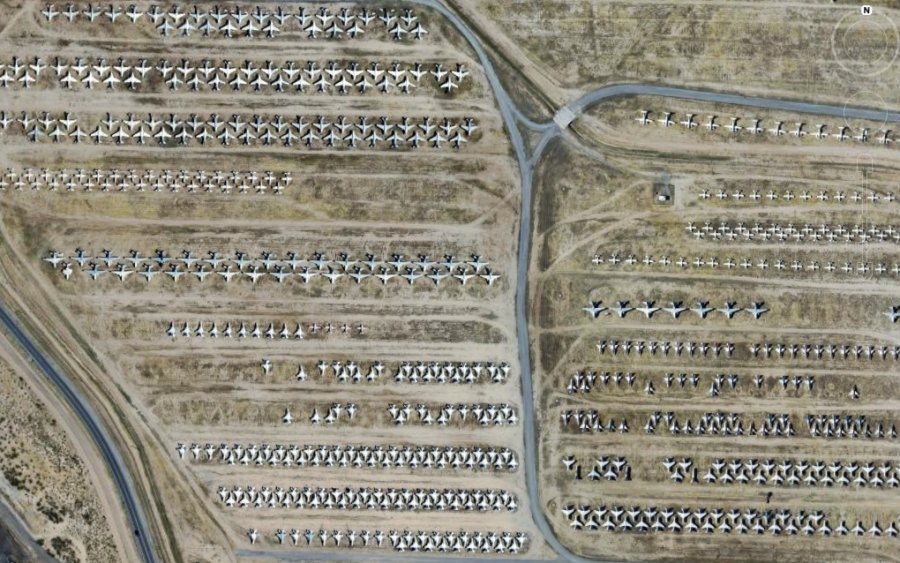 Postwar years
With the end of the WWII, operations ended and the airbase was selected as a storage site for countless decommissioned aircraft. As mentioned before, Tucson's low humidity and alkali soil made it an ideal location for storage and preservation of decommissioned aircraft, ready to be disassembled or reused. F-15s and F-16s sitting there for example could be brought back to service within 72h if needed.
The airfield still has this role today, with a huge storage area. All the aircraft sitting there would be 2nd largest Air Force in the World!
Postwar years
With the end of the WWII, operations ended and the airbase was selected as a storage site for countless decommissioned aircraft. As mentioned before, Tucson's low humidity and alkali soil made it an ideal location for storage and preservation of decommissioned aircraft, ready to be disassembled or reused. F-15s and F-16s sitting there for example could be brought back to service within 72h if needed.
The airfield still has this role today, with a huge storage area. All the aircraft sitting there would be 2nd largest Air Force in the World!
Related Questions
What is the aircraft boneyard?
The aircraft boneyard is a large desert facility where retired or surplus military and government aircraft are stored and preserved. The most famous is the 309th Aerospace Maintenance and Regeneration Group (AMARG) at Davis-Monthan Air Force Base in Arizona, whose stored fleet is so large it has been likened to a major air force. See the strangest aircraft graveyards on Earth.
Where is the US military aircraft boneyard?
The main US military aircraft boneyard is at Davis-Monthan Air Force Base, located south-southeast of Tucson, Arizona. It is home to the Air Force Materiel Command's 309th AMARG and is the sole storage site for excess US military and government aircraft.
Why is the aircraft boneyard in Arizona?
Tucson's dry desert climate, low humidity and hard alkali soil make it ideal for storing aircraft. The arid conditions slow corrosion, and the firm ground lets aircraft be parked without paved surfaces, so airframes can be preserved for years or stripped for parts. Stored aircraft are a spare-parts goldmine.
How big is the Davis-Monthan boneyard?
The Davis-Monthan boneyard at AMARG holds thousands of aircraft spread across the desert, so many that its combined fleet has been described as large enough to rank among the biggest air forces in the world. Aircraft are kept for possible reactivation, parts reclamation or eventual disposal.
Who is Davis-Monthan Air Force Base named after?
Davis-Monthan Air Force Base is named after two Tucson-born World War I pilots, Lieutenants Samuel H. Davis and Oscar Monthan. Davis died in a Florida aircraft accident in 1921, and Monthan was killed in the crash of a Martin bomber in Hawaii in 1924. The field was established in 1925.
What is AMARG?
AMARG is the 309th Aerospace Maintenance and Regeneration Group, the US Air Force unit that runs the aircraft boneyard at Davis-Monthan Air Force Base. It stores, maintains and regenerates retired military and government aircraft, and reclaims valuable parts from them.


I can only imagine how amazing it must be to visit all these outdated aircrafts. As an aeronautical enthusiast this graveyard is on my list of places to visit.