
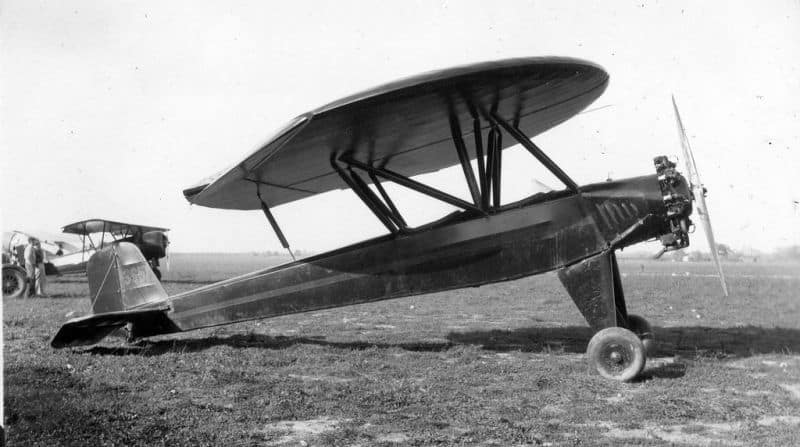
In 1934, Americans looked up over Miami and saw something that made no sense: an aeroplane flying under what appeared to be a giant garden umbrella. It was not a stunt or a cartoon. It was the Nemeth Parasol, one of the strangest aircraft that ever actually left the ground — and, briefly, one that seemed to work.
Instead of the long, straight wings of a normal aircraft, the Parasol carried a single circular wing, roughly 15 feet across, perched on struts above the fuselage like a lid on a saucepan. Onlookers had an obvious name for it.
Datos rápidos
- Aeronave: Nemeth Parasol (the “Umbrella Plane” or “Roundwing”)
- Diseñador: Steven P. Nemeth, built with University of Miami students
- Primer vuelo: 1934; only one was ever built
- Wing: a circular airfoil about 15 feet across, mounted parasol-style above the fuselage
- Residencia en: a lengthened Alliance Argo fuselage; 110 hp Warner radial engine
- Party trick: reported to take off in ~63 feet and settle gently when stalled, the wing acting like a parachute
- Destino: flew successfully, but never went into production
Why a round wing?
The man behind it was Steven P. Nemeth, a flight instructor from Dayton, Ohio, who built the machine with students at the University of Miami using the lengthened fuselage of an Alliance Argo biplane and a modest 110-horsepower Warner radial engine. His circular wing was not just for show: a big, low-loading disc, he reasoned, would let the aircraft fly very slowly, take off and land in almost no distance, and behave gently when it ran out of speed.
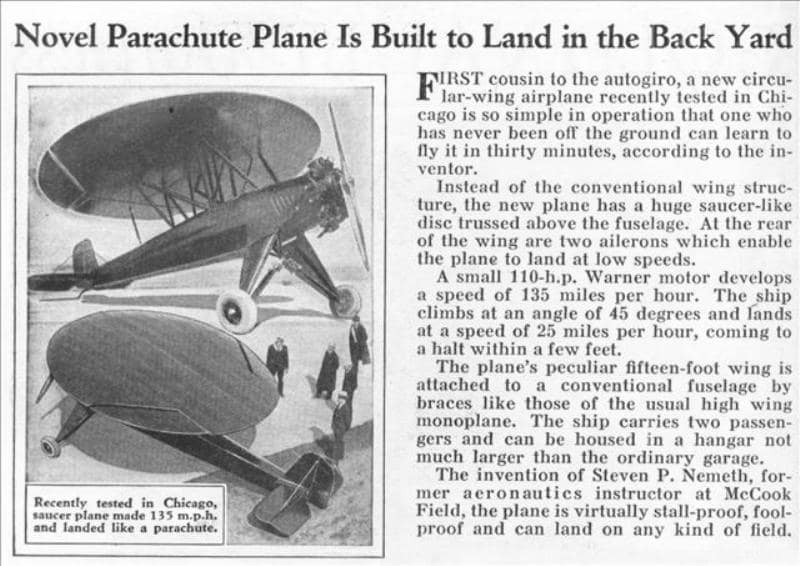
On paper the numbers were remarkable. The Parasol was said to unstick in about 63 feet, and when it stalled, the big wing let it mush down to a soft landing rather than dropping a wing and spinning. Nemeth pitched it as an aeroplane so docile and compact that it could live in a large garage and be flown by almost anyone.
It really flew — and then it vanished
The remarkable part is that it worked. The Parasol genuinely flew, and reasonably well, reaching around 135 mph despite that ungainly wing. The press of the day, from Modern Mechanix to Popular Science, ate it up, and you can see in it an early flicker of the “everyman’s aeroplane” and even flying-car dreams that would resurface after the war.
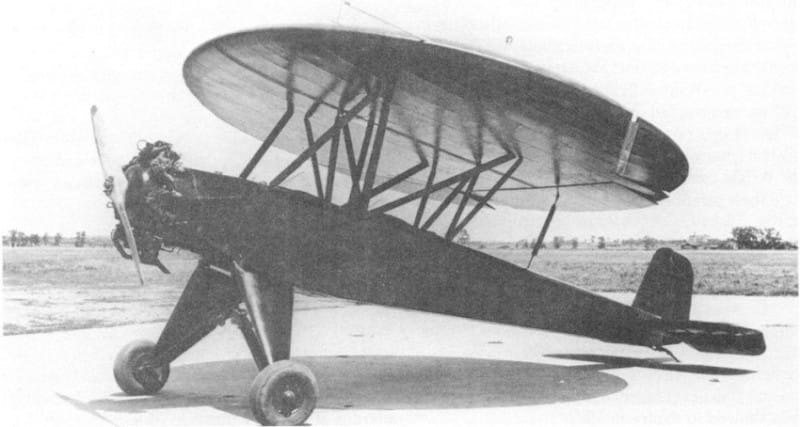
But novelty was not enough. Only one was ever built. It was later modified — the control surfaces moved, the fuselage shortened, a larger engine fitted — and then it simply slipped out of the record, its ultimate fate unknown. Perhaps it was even converted back into the ordinary biplane it had started as.
The Nemeth Parasol never founded a dynasty of round-winged aircraft. But in an age full of brave, strange ideas about how to fly, it stands out even now — proof that sometimes the maddest-looking machine in the sky is the one that actually gets off the ground.
Sources: Inch High Guy (Jeff Groves); PlaneHistoria; Modern Mechanix (1934); Wikipedia.


0 Comentarios