
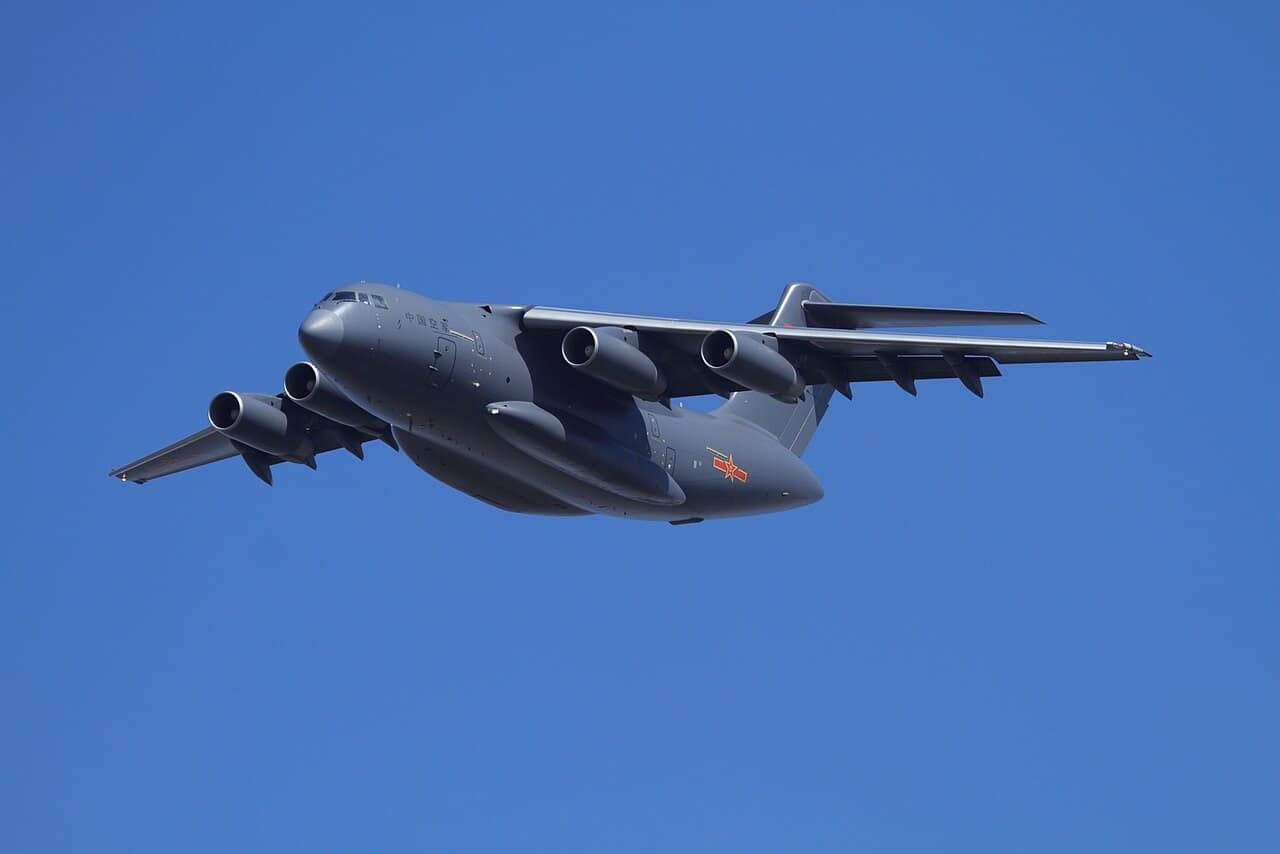
Fresh, far clearer imagery of China's new turboprop tactical airlifter surfaced around 21 August 2026, reported first by The War Zone and picked up across the defence press. The photographs, taken at an unidentified test airfield, give the best look yet at a four-engine transport that appears to carry the designation Y-15.
The designation itself is part of the news. The programme was for years widely referred to as the Y-30, a name that stuck after a model appeared at the 2014 Zhuhai Airshow. The prototype's apparent 15001 serial, and a growing body of open-source reporting, now point to Y-15 instead. Beijing has confirmed almost nothing officially, so a degree of caution is warranted throughout.
What is clear is the aircraft's broad role: a medium tactical airlifter to sit below the large, jet-powered Xian Y-20 and above, or in place of, the ageing Y-8 and Y-9 turboprop fleet.
Datos rápidos
| Aeronave | Shaanxi Y-15 (reportedly; long referred to as Y-30) |
| Tipo | Four-engine turboprop tactical / medium transport (apparent) |
| Operador | People's Liberation Army Air Force (PLAAF), reportedly |
| Class | Between the C-130J and A400M; a counterpart to the Y-9 |
| Estado | In flight testing; maiden flight reported December 2025 |
| Nota | Little is officially confirmed by China; figures are estimates |
A C-130-class hauler, not another Y-20
Developed by Shaanxi Aircraft Corporation, the Y-15 is a high-wing design with four turboprops driving six-blade propellers, a broad fuselage, a rear loading ramp, heavy-duty landing gear, a T-tail and prominent winglets. That configuration places it in the same broad category as the Lockheed Martin C-130J and, visually at least, the Airbus A400M, though it should not be confused with either the Y-20 (a much larger four-jet strategic transport) or the A400M itself.
The A400M resemblance is only skin-deep. TWZ notes the European aircraft's four engines each produce around 11,000 horsepower, whereas the Y-15's WJ-10 turboprops are understood to deliver substantially less, on the order of 6,800 horsepower apiece. Unlike the A400M's swept wing, the Chinese aircraft carries a comparatively straight high-lift wing, suited to short-field work. Unconfirmed estimates put payload near 30 tonnes, but that figure should be treated with care while the aircraft is still in testing.
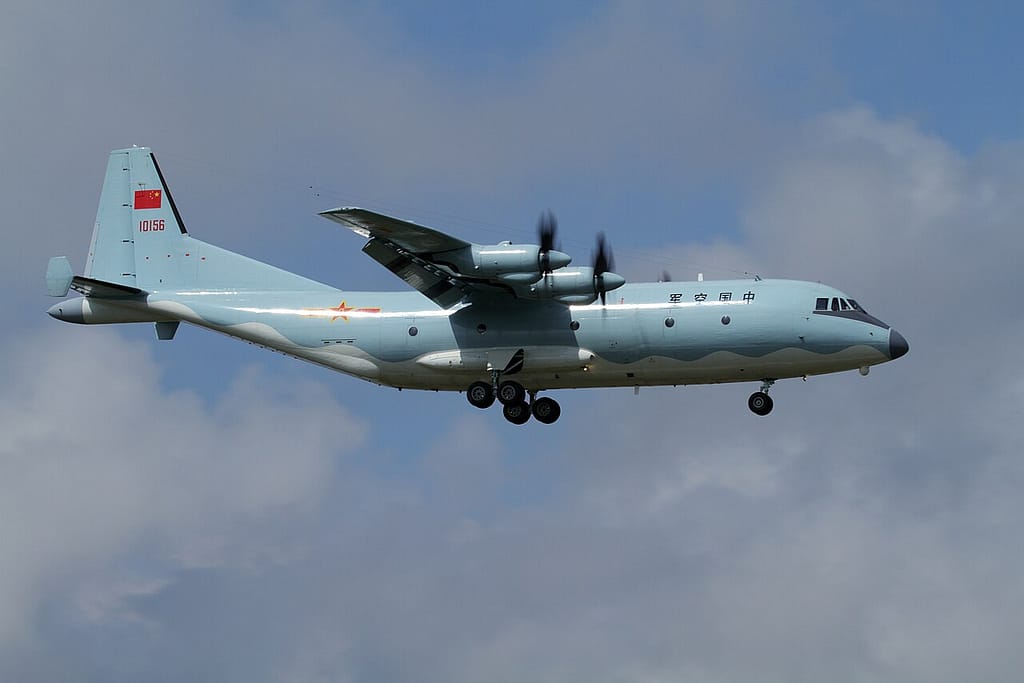
Chinese PLA Y-20 strategic airlifters, the larger jet-powered type the turboprop Y-15 is meant to complement.
The distinction from the Y-9 matters most. The Y-9 is a modernised derivative of the Y-8, itself a copy of the Soviet Antonov An-12 first flown in 1957. Analysts assess the Y-15 offers a taller, wider cargo hold and more power, addressing exactly the shortcomings that have limited the older type.
For the PLAAF, the emphasis on austere-field performance is the point. A turboprop with rugged undercarriage and a rear ramp is built to operate closer to the battlefield, at dispersed bases, remote outposts, island facilities and regions such as Tibet, where flying a large Y-20 would be impractical. Airborne assault and airdrop missions are obvious secondary roles. TWZ also notes that no inflight-refuelling probe is currently fitted; the long nose spike is an air-data boom for flight testing, not a probe.
An export drive is considered likely, since the Y-15 would sit outside the tight export controls that constrain comparable Western types. For now, much remains unconfirmed: how closely the aircraft's real performance matches the estimates around it, and how quickly China moves from a single prototype to a production fleet.
Sources: The War Zone, FlightGlobal, Army Recognition
Publicaciones relacionadas
0 Comentarios