
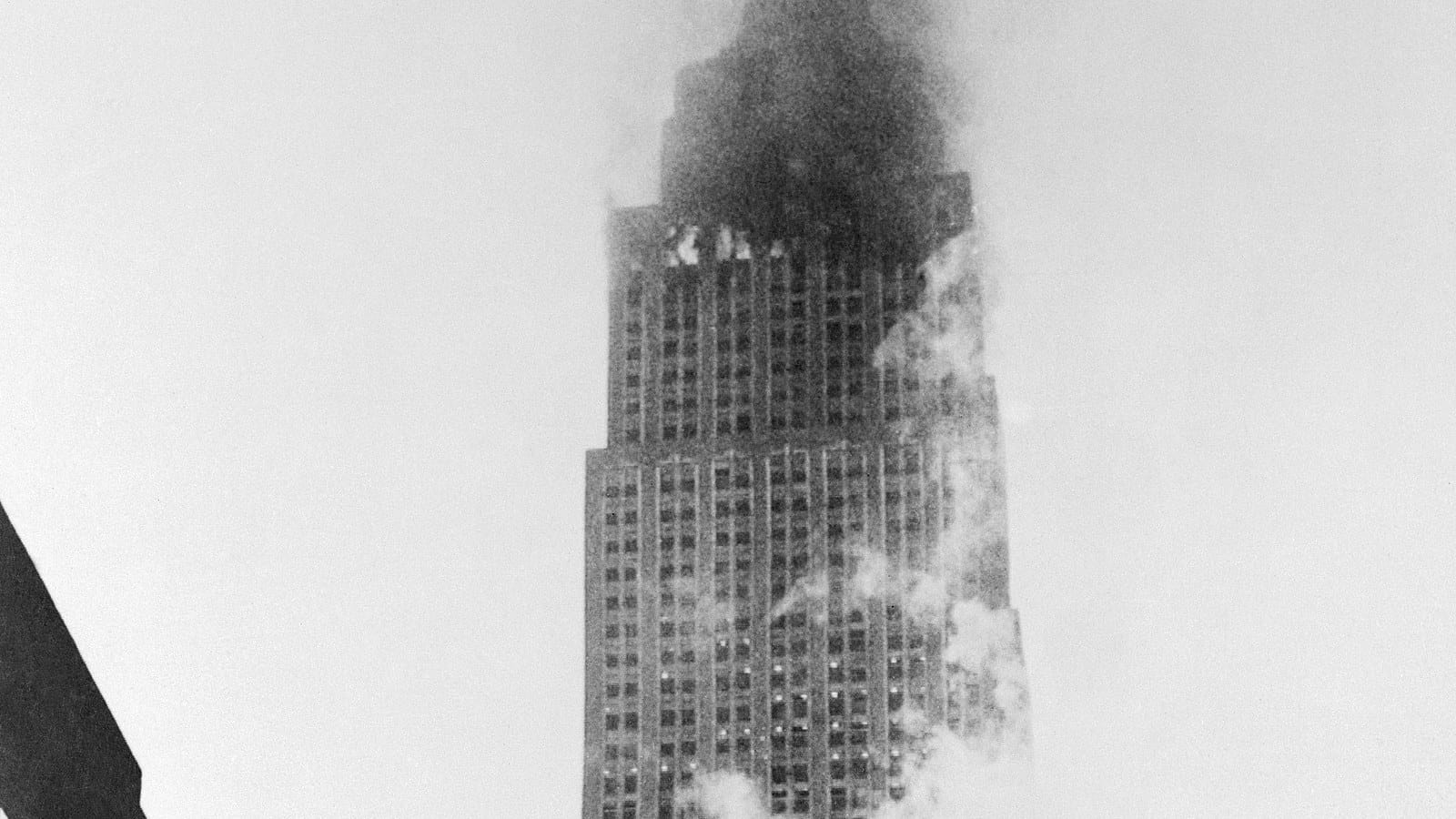
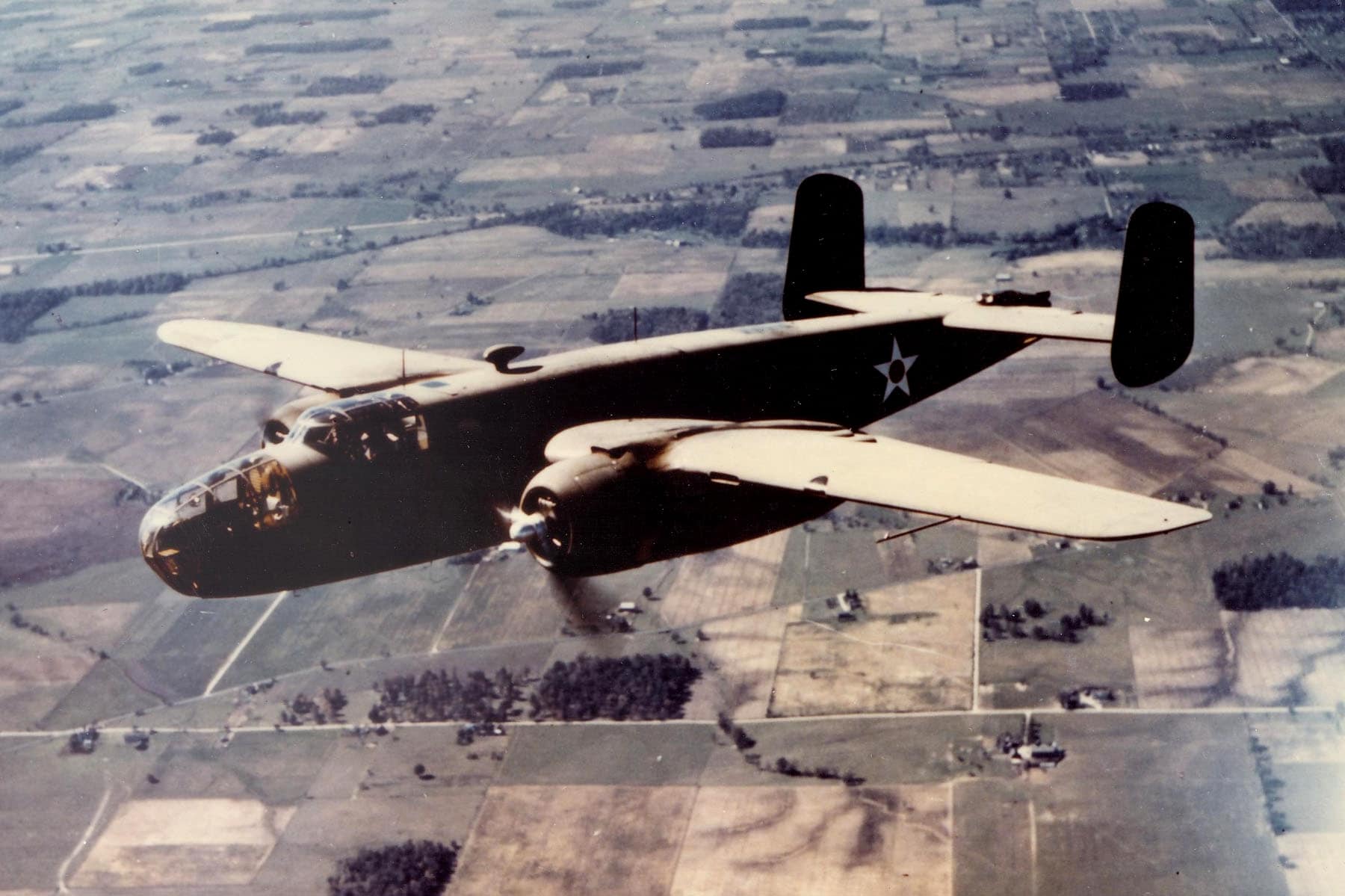
Saturday morning, 28 July 1945. New York is wrapped in fog so thick that the top third of the Empire State Building has simply vanished. At 9:40 a.m., office workers on the 79th floor hear a sound no office worker should ever hear: aircraft engines, close, and getting louder. Seconds later a ten-ton B-25 Mitchell bomber, lost in the murk at more than 200 miles per hour, slams into the north face of the tallest building on Earth.
Fourteen people die. A fireball rolls through the offices of a wartime Catholic relief agency. An engine punches clean through the building and falls out the other side. And a 20-year-old elevator operator named Betty Lou Oliver is about to survive something no human being has survived before or since.
Quick Facts: The Empire State Building Crash
| Date | Saturday, 28 July 1945, 9:40 a.m. |
| Aircraft | North American B-25D Mitchell “Old John Feather Merchant”, US Army Air Forces |
| Pilot | Lt. Col. William F. Smith Jr., 27 — decorated B-17 pilot, 42+ combat missions over Europe |
| Impact | 79th floor, north face, ~200+ mph, an 18-by-20-foot hole |
| Toll | 14 dead (3 aboard, 11 in the building), ~two dozen injured |
| The record | Betty Lou Oliver survived a 75-storey elevator fall — still the Guinness record |
Lost Over Manhattan
William Smith had flown through the worst flak in Europe and come home with medals. That morning his mission was mundane: a personnel run from Bedford, Massachusetts, to New York, then on to Newark to collect a passenger. Descending into the fog, cleared toward Newark but warned about visibility — the tower noting it could not see the top of the Empire State Building — Smith became disoriented among the towers of midtown. He skirted the Chrysler Building over 42nd Street, banked the wrong way, and ran out of sky.
Catherine O’Connor was at her desk in the War Relief Services office on the 79th floor when the north wall exploded:
Eleven people in the relief office died, many of them young women doing wartime charity work. The three men aboard the bomber — Smith, Staff Sergeant Christopher Domitrovich, and a Navy machinist’s mate hitching a ride home — were killed instantly.
The Longest Fall Anyone Ever Survived
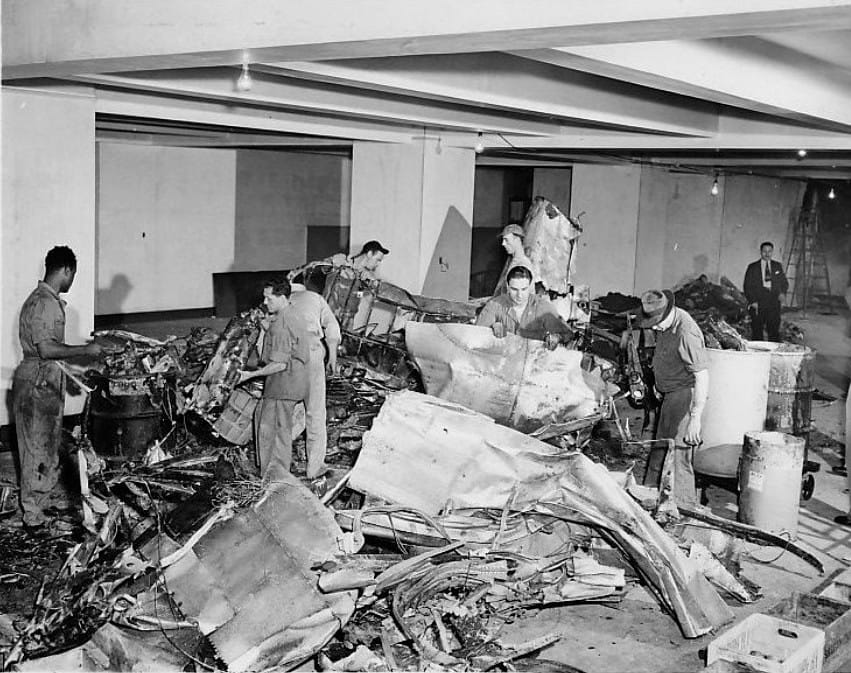
The bomber’s two engines became wrecking balls. One crossed the full width of the tower, exited the south wall, and crashed through the roof of a penthouse art studio a block away. The other sheared into an elevator shaft — and severed the cables above a car.
Betty Lou Oliver, badly burned at her 80th-floor post, had just been helped into an elevator to be taken down for treatment. The weakened cables snapped. Her car fell seventy-five storeys — roughly a thousand feet — into the sub-basement. A cushion of compressed air in the sealed shaft and a spring of coiled cable beneath the car slowed the impact just enough. Rescuers cut through the wreckage and found her alive: broken pelvis, broken back, broken neck — and a Guinness World Record that has never been approached since. She went back to work as an elevator operator five months later.
The Building That Shrugged
The New York Fire Department fought the blaze 935 feet above the street — the highest structural fire ever brought under control at that time — and had it out in forty minutes. The Empire State Building’s steel frame swallowed the ten-ton impact without a groan; engineers found no structural damage beyond the gash. Many floors reopened for business on Monday morning, less than 48 hours later.
The disaster’s longest shadow fell on the law books: because the government initially could not be sued, Congress passed the Federal Tort Claims Act in 1946 — with retroactive provisions shaped by this very crash — finally letting citizens seek damages from the United States. And sixteen years before anyone drew plans for the World Trade Center, New York had learned that its greatest skyscraper could take a direct hit from a bomber and stand.
The History Guy’s telling of the crash is the best short documentary on it:
And the original 1945 newsreel — the fog, the hole, the crowds on 34th Street:
Sources: NYC Municipal Archives; Guinness World Records; NPR; History.com; Warfare History Network; Britannica; TIME
Related Questions
What aircraft crashed into the Empire State Building?
A US Army Air Forces B-25D Mitchell bomber, nicknamed “Old John Feather Merchant,” crashed into the north face of the Empire State Building on Saturday 28 July 1945, at 9:40 a.m. The ten-ton bomber was lost in thick fog at more than 200 miles per hour when it struck the 79th floor.
How did the Empire State Building plane crash happen?
Pilot Lt. Col. William F. Smith Jr. was on a routine personnel flight to New York and Newark. Descending in fog so dense the tower could not see the top of the skyscraper, he became disoriented among midtown's towers, skirted the Chrysler Building, banked the wrong way, and flew into the Empire State Building.
How many people died in the Empire State Building crash?
Fourteen people were killed — the three crew aboard the bomber and eleven people in the building, mostly in the offices of a wartime Catholic war-relief agency — and about two dozen more were injured. The impact tore a roughly 20-foot hole in the building.
Who was Betty Lou Oliver?
Betty Lou Oliver was a 20-year-old elevator operator who survived the crash and then plunged 75 storeys when her elevator cables, weakened by the impact, gave way. She survived the fall — still recognised by Guinness World Records as the longest survived elevator fall in history.
Did the Empire State Building survive the B-25 crash?
Yes. Despite the fire and a 20-foot hole, the skyscraper's steel-framed structure held, and the building was open for business two days later. The incident became a landmark case in aviation safety and building resilience, part of the long history of military aviation shaping how cities manage aircraft risk.
Has an aircraft hit a skyscraper before?
The 1945 B-25 strike on the Empire State Building was the most famous early case of an aircraft hitting a skyscraper, occurring in an era before modern radar guidance and air-traffic control. It is remembered both as a wartime tragedy and, like fallen aviators honoured by the missing man formation, as a solemn chapter in aviation history.
0 Comentarios