
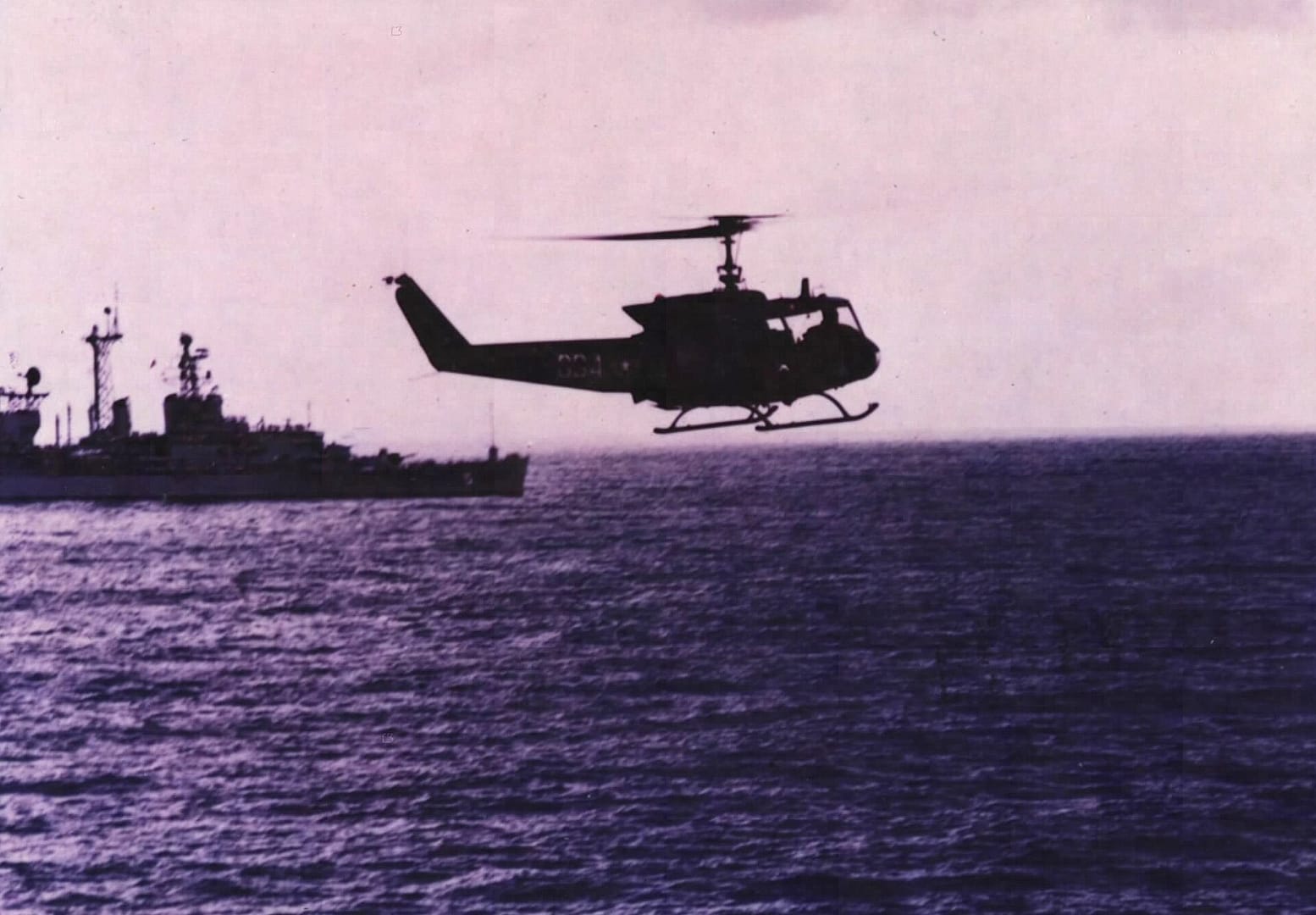
Just after eight on the morning of 29 April 1975, American Radio Service in Saigon interrupted its programming to announce that the temperature was “105 degrees and rising.” Then it played White Christmas. In a city where it never snows, in the last April of a thirty-year war, that was the signal: get to your evacuation point. Now.
Over the next nineteen hours, US Marine, Air Force and Air America helicopters lifted roughly 7,000 people out of a collapsing city and out to a fleet waiting offshore — about 1,400 Americans and 5,600 Vietnamese and third-country evacuees. It remains the largest helicopter evacuation ever flown, and its images — Hueys shoved into the sea, a queue snaking up a rooftop ladder — became the closing frames of the Vietnam War.
Quick Facts: Operation Frequent Wind
| Date | 29–30 April 1975, Saigon, South Vietnam |
| Evacuated | ~7,000 people by helicopter in ~19 hours (1,373 Americans, 5,595 Vietnamese and others) |
| Sorties | 444 by USMC and USAF helicopters, plus Air America Hueys shuttling rooftops |
| Ships | USS Blue Ridge, Midway, Okinawa, Hancock, Coral Sea and escorts, including USS Kirk |
| Trigger | Shelling of Tan Son Nhut killed Marines Charles McMahon and Darwin Judge — the last US servicemen to die in Vietnam |
| Last out | 11 Marines from the embassy roof at 07:53, 30 April 1975 |
When the Runways Died
The plan had never been helicopters. Fixed-wing flights from Tan Son Nhut airport had been hauling people out for weeks — until the pre-dawn hours of 29 April, when North Vietnamese rockets and artillery began falling on the airfield. One rocket killed Corporal Charles McMahon, 21, and Lance Corporal Darwin Judge, 19, at their guard post — the last American servicemen to die on Vietnamese soil. With a burning C-130 blocking operations and the runways under fire, Ambassador Graham Martin was driven to the airport, looked for himself, and conceded what his generals already knew. At 10:48 the order went out for Option IV — the helicopters.
All day and into the night, CH-53s and CH-46s beat a shuttle between the fleet and two main points in the city: the Defense Attaché Office compound, and — when the crowds made planned pickup points impossible — the US Embassy itself, where the queue up to the rooftop pad never seemed to shrink. Air America’s civilian Hueys worked the smaller rooftops, including the apartment block at 22 Gia Long Street where Hubert van Es took the most famous photograph of the day — a picture almost universally miscaptioned as the embassy ever since.
The Bravest Man in the South China Sea
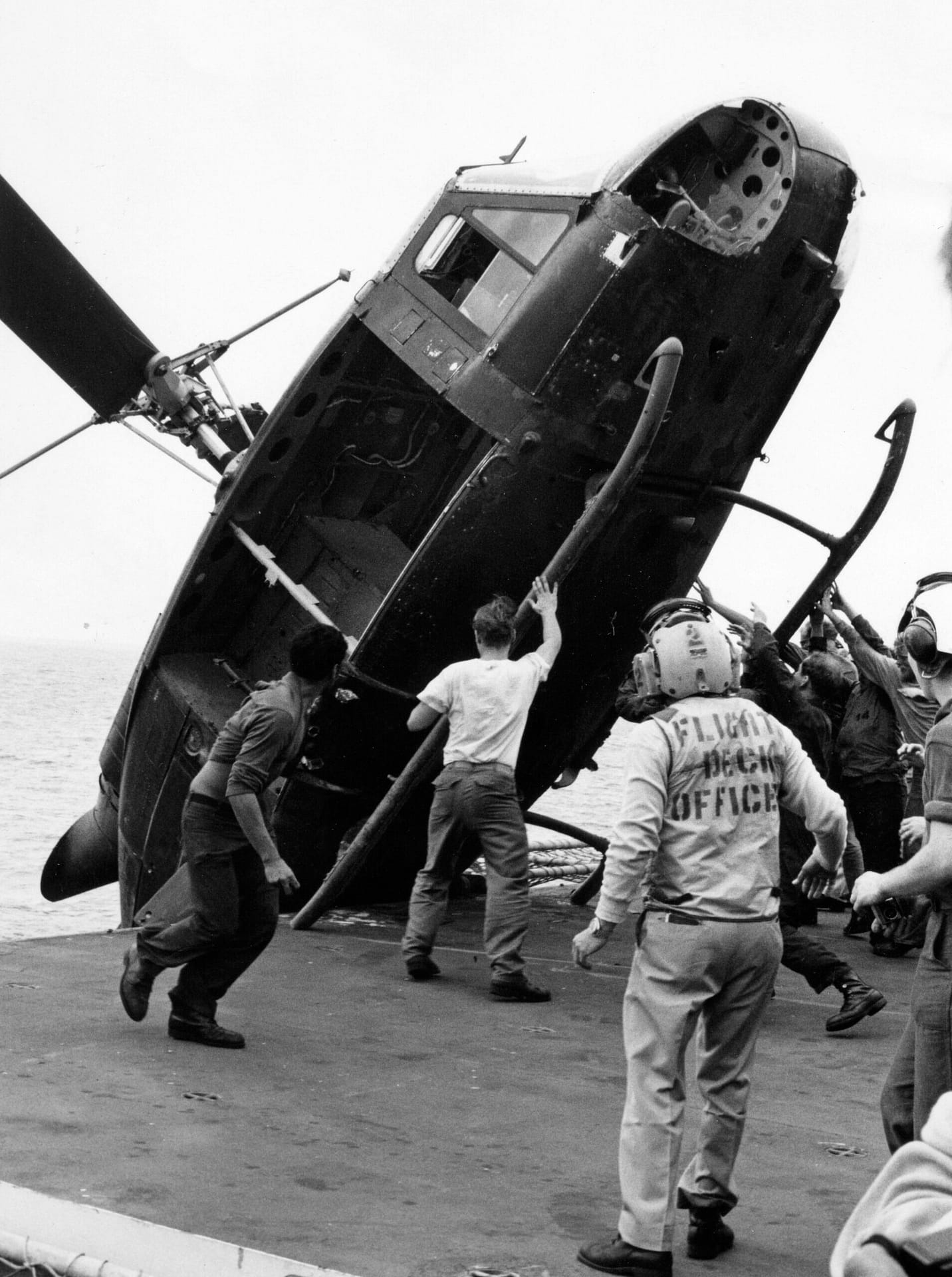
Out over the water, the fleet had its own problem: South Vietnamese pilots were arriving uninvited, in anything that would fly, packed with families. Deck crews waved some aboard, and when the decks jammed, they started pushing empty Hueys into the sea to make room — millions of dollars of aircraft, traded without hesitation for human beings.
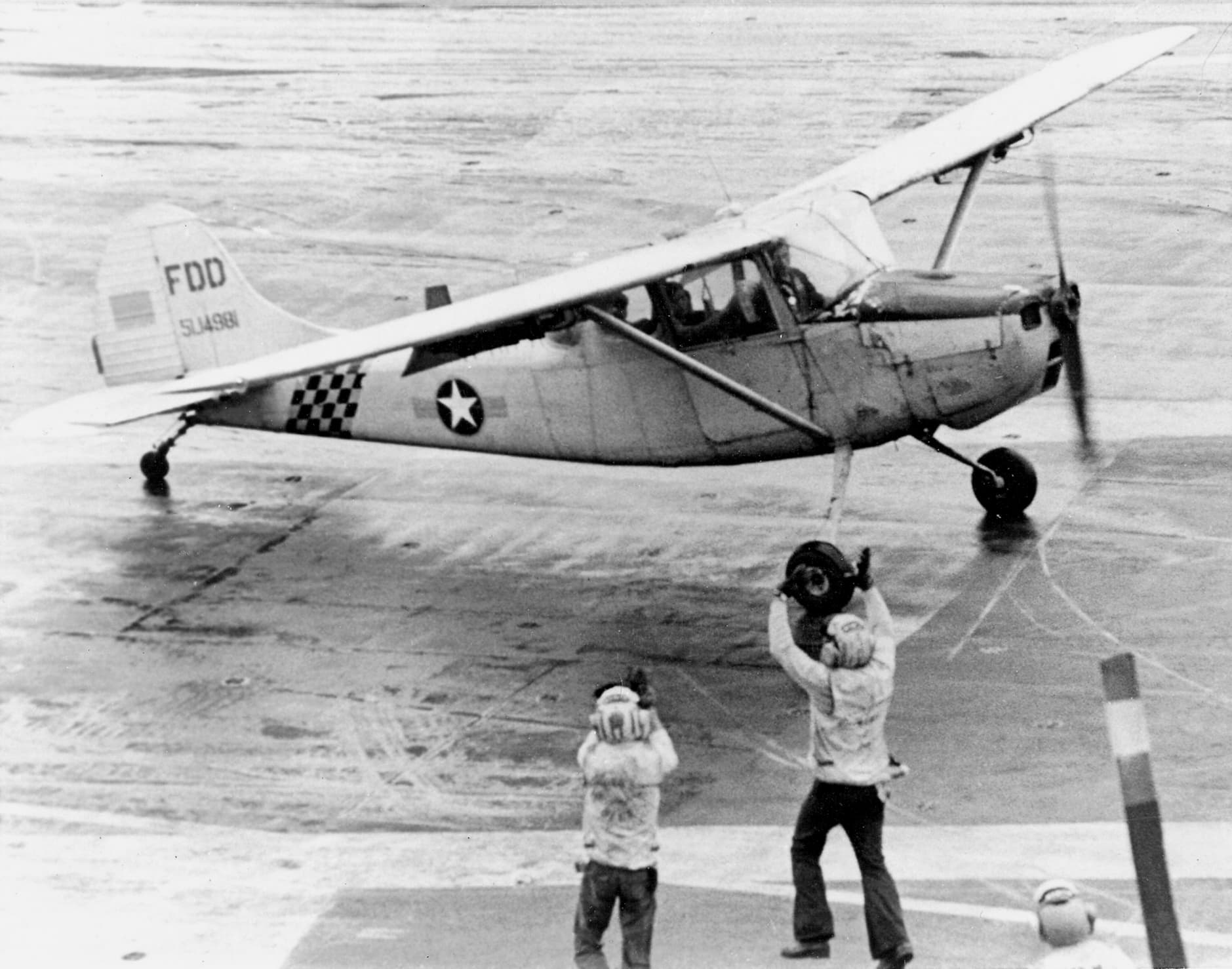
Then a tiny single-engine O-1 Bird Dog spotter plane appeared over USS Midway and dropped a note wrapped around a pistol holster: Major Buang-Ly of the South Vietnamese air force, aloft with his wife and five children, asking the carrier to move helicopters so he could land. Captain Lawrence Chambers — the first Black officer to command a US aircraft carrier — ordered his deck cleared, Hueys and all.
Buang had never landed on a ship. He came aboard without a tailhook, without a radio brief, into a 15-knot wind over the deck — and stopped straight and true as the crew erupted in cheers. Chambers later called him the bravest man he ever met.
Eleven Men on a Roof
At the embassy, the arithmetic turned cruel after midnight. Washington capped the remaining sorties; Ambassador Martin was ordered aboard a CH-46 called Lady Ace 09 just before five in the morning. When the last helicopter settled onto the roof at dawn, eleven Marine security guards were still holding the stairwells against a city pressing in below.
At 07:53 on 30 April, Swift 2-2 lifted off with Valdez aboard — the last American helicopter out of Saigon. Hours later, North Vietnamese tanks pushed through the gates of the presidential palace. Some 420 evacuees were left waiting in the embassy courtyard; the guilt of that unfinished list would follow the pilots and Marines for decades.
Period footage of the day — including Buang’s astonishing carrier landing — survives in remarkable quality:
ITN’s contemporaneous report captures the embassy airlift and the fall of the city:
Sources: US Naval History and Heritage Command (H-Gram 090); US Naval Institute; NBC News; NPR (USS Kirk series); HistoryNet; Wikipedia
Related Questions
What was Operation Frequent Wind?
Operation Frequent Wind was the helicopter evacuation of Saigon on 29–30 April 1975, the final act of the Vietnam War. Over roughly 19 hours, US Marine, Air Force and Air America helicopters lifted about 7,000 people — some 1,400 Americans and 5,600 Vietnamese and third-country evacuees — out of the collapsing city to a fleet waiting offshore. It remains the largest helicopter evacuation in history.
What was the signal to begin the Saigon evacuation?
The coded signal was a radio announcement that the temperature was “105 degrees and rising,” followed by the song “White Christmas.” In a tropical city where it never snows, this told Americans and at-risk Vietnamese to move immediately to their designated evacuation points.
Why did Saigon's evacuation use helicopters instead of planes?
The plan had relied on fixed-wing flights from Tan Son Nhut airport, but in the pre-dawn hours of 29 April, North Vietnamese rockets and artillery hit the airfield and a burning C-130 blocked the runways. With fixed-wing flights impossible, Ambassador Graham Martin conceded and the order went out for Option IV — the helicopter lift, flown by aircraft including Marine CH-53s and CH-46s and gunships like the AC-130 supporting operations.
Who were the last Americans to die in the Vietnam War?
Marine Corporal Charles McMahon, 21, and Lance Corporal Darwin Judge, 19, were killed by North Vietnamese rocket fire at their guard post at Tan Son Nhut on 29 April 1975 — the last US servicemen to die on Vietnamese soil.
How many people were evacuated from Saigon by helicopter?
About 7,000 people were flown out in roughly 19 hours — approximately 1,373 Americans and 5,595 Vietnamese and third-country nationals — across some 444 US Marine and Air Force helicopter sorties, plus additional Air America flights.
Who were the last people out of Saigon?
The last group was eleven Marines lifted from the roof of the US Embassy at 07:53 on 30 April 1975. Their departure marked the final American exit as North Vietnamese forces entered the city, closing thirty years of war in Vietnam — a conflict that also saw fierce air combat by aircraft like the F-8 Crusader.
0 Comentarios