

Fifteen minutes past midnight, 26 September 1983. In a command bunker called Serpukhov-15, south-west of Moscow, Lieutenant Colonel Stanislav Petrov is settled into the commander’s chair for a night shift he was not originally scheduled to work. In front of him: the readouts of Oko, the Soviet Union’s brand-new satellite early-warning system, watching the missile fields of the American Midwest from 40,000 kilometres out. It has been a quiet autumn night. Then every siren in the room goes off at once.
A screen above him switches to a single backlit word in red: LAUNCH. The system is reporting a Minuteman intercontinental ballistic missile rising from Malmstrom Air Force Base in Montana, and it is reporting its own confidence as maximum. Petrov would describe the moment many times in later life, always the same way: the siren howling, the red screen, and his own body refusing to move.
He had, by the machine’s arithmetic, about half an hour of missile flight time. Whatever he passed up the chain in the next few minutes would land on desks where men were already primed to believe the worst. What Petrov did instead of the obvious thing is why he is remembered — and why the rest of that night deserves to be reconstructed carefully, minute by minute.
Quick Facts: The 1983 Nuclear False Alarm
| Date and time | 26 September 1983, shortly after 00:15 Moscow time |
| Place | Serpukhov-15 early-warning command centre, south-west of Moscow |
| System | Oko (“Eye”) — US-K satellites in high Molniya orbits watching US missile fields |
| The alarm | One, then a total of five Minuteman ICBM launches reported from Malmstrom AFB, Montana |
| The duty officer | Lt Col Stanislav Petrov, 44, an engineer by training |
| Actual cause | Sunlight reflecting off high-altitude clouds, mistaken for booster plumes |
| His call | Reported a system malfunction — and waited 23 minutes to learn he was right |
| Public since | 1998, via the memoirs of his former commander Yuri Votintsev |
The Eye Above the Horizon
Oko existed to solve a geometry problem. Ground radars cannot see over the curve of the Earth; against missiles fired from the continental United States, they would give the Soviet leadership perhaps 10 to 15 minutes of warning. The US-K satellites bought more time by watching from above — parked in highly elliptical Molniya orbits, staring at the edge of the Earth so that a rising booster’s exhaust plume would appear in silhouette against the black of space rather than against the bright, cluttered background of the planet itself.
It was clever engineering, and in September 1983 it was also very new — the system had been declared operational only the year before. Petrov, one of its senior analysts, knew both of those facts intimately. He had helped write the procedures he was now supposed to follow.
The procedure was simple. His job that night was to validate the alert and report it upward — to men with far less time and far less technical context than he had. Decades later, he was blunt about what those first seconds felt like.
Five Missiles
The system did not stop at one. Within minutes it reported a second launch from the same base, then a third, a fourth, a fifth. The status display escalated from “launch” to “missile strike”. The computers, checking their own work through every layer of validation built into them, kept insisting the data was good. Five Minuteman ICBMs — each carrying warheads measured in hundreds of kilotons — would take roughly 30 minutes to fly the 8,000-plus kilometres (about 5,000 miles) to Soviet territory.
The arithmetic of retaliation ran backwards from impact. Soviet doctrine needed a launch decision from the leadership with enough margin to get its own missiles out of their silos. Every minute Petrov spent thinking was a minute subtracted from Yuri Andropov’s.
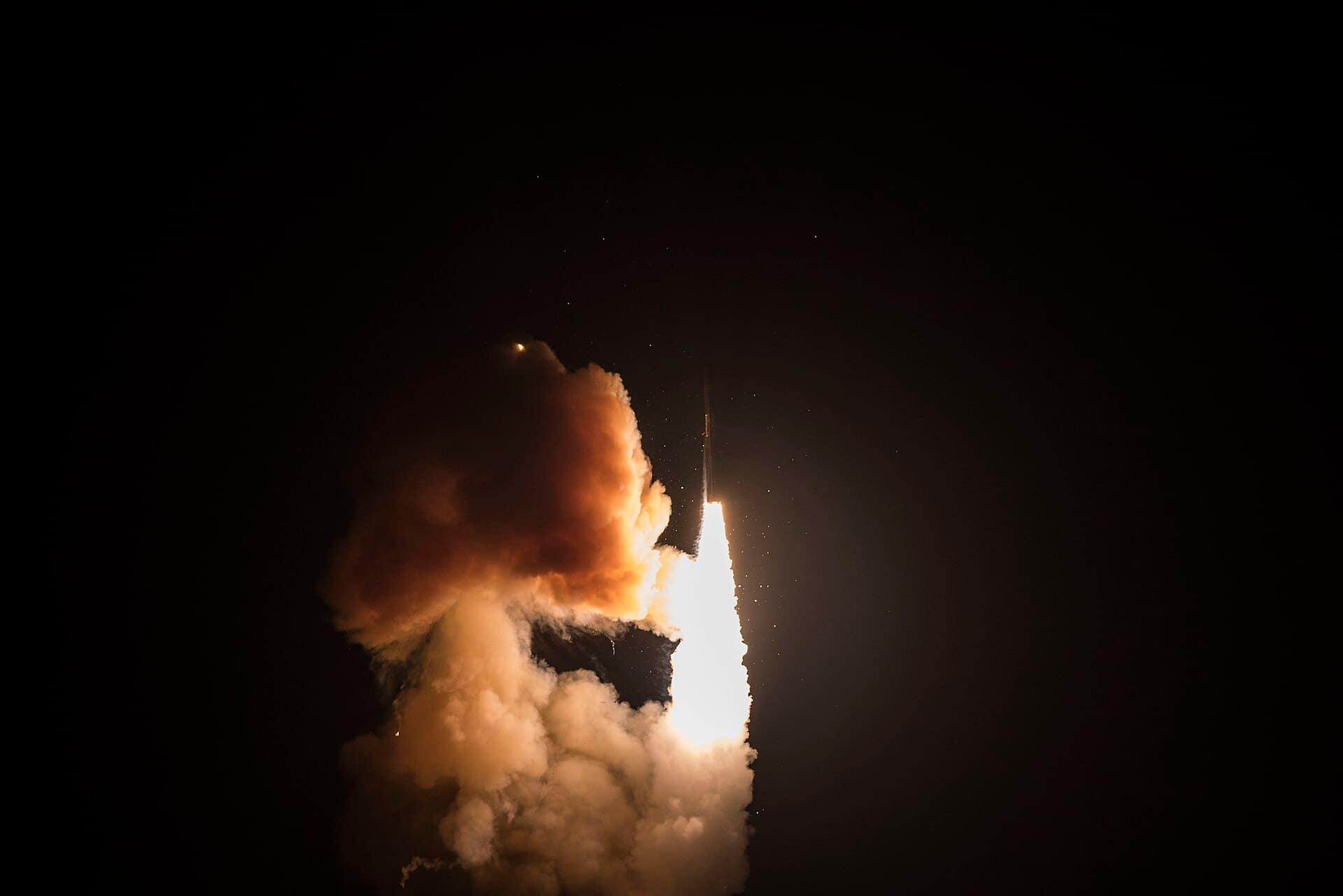
He had perhaps 15 minutes before the incoming warheads — if they existed — would cross the radar horizon and become visible to ground stations. Fifteen minutes in which the only evidence was the word of a one-year-old satellite system, and the only counter-evidence was its newness. He later admitted the responsibility sat on him physically.
The Decision
Petrov’s reasoning, as he reconstructed it afterwards, was a chain of engineering doubts rather than a flash of intuition. The satellite constellation was new and, in his own estimation, not yet fully trustworthy. The ground radars — a completely independent sensor chain — were seeing nothing. And the attack itself made no strategic sense: a real American first strike would be an avalanche designed to destroy Soviet missiles on the ground, not a five-missile gesture that would guarantee retaliation. “When people start a war, they don’t start it with only five missiles,” he told the Washington Post in 1999.
Against all of that stood the machine’s own certainty, repeated five times. Petrov picked up the phone to the duty officer at headquarters and reported a system malfunction. Then he sat with the possibility that he was wrong — that the warheads were already over the pole. “I had a funny feeling in my gut,” he said later. He waited.
The investigation that followed found the cause within months: sunlight glancing off high-altitude clouds, at a rare seasonal geometry near the autumn equinox, had mimicked booster plumes precisely in the satellite’s field of view. The constellation’s designers added a cross-check against a geostationary satellite to prevent a recurrence. The system had performed exactly as built. That was the problem.
The Worst Possible Autumn
Context is what makes the night terrifying rather than merely interesting. Three weeks earlier, on 1 September 1983, a Soviet Su-15 had shot down Korean Air Lines Flight 007 near Sakhalin, killing all 269 people aboard, after air defence mistook the wandering Boeing 747 for an American reconnaissance aircraft. The Kremlin under Yuri Andropov was running Operation RYaN, an intelligence programme built on the assumption that NATO might be preparing a genuine surprise first strike.
Six weeks after Petrov’s shift, NATO’s Able Archer 83 command exercise — rehearsing the procedures for nuclear release — would push parts of the Soviet apparatus to a state of alarm historians still debate. Into that season of institutional paranoia, imagine a formal report from Serpukhov-15: five American ICBMs, inbound, confidence maximum. Petrov himself never claimed to know what would have followed. He only pointed out that the men above him had less time, less data and less reason to doubt the machine than he did.
Neither Rewarded nor Punished
There was no medal. Petrov was questioned intensively, and while he was not formally punished, he was reprimanded over gaps in his combat log from the night — paperwork he had declined to falsify after the fact, since regulations forbade writing it up later. The false alarm was buried as a state secret. He left the service in 1984, worked as an engineer at the institute that had designed the system, and eventually retired to a flat in Fryazino, outside Moscow, caring for his ill wife.
The world found out by accident. In 1998 the memoirs of his former commander, Colonel General Yuri Votintsev, revealed the episode; journalists eventually found Petrov himself, baffled by the attention. Honours arrived late and from odd directions: an award at the United Nations, the Dresden Peace Prize in 2013, a Danish-made documentary — The Man Who Saved the World — in 2014. He kept insisting, in interview after interview, that he had simply been the right man on the right shift: an engineer who distrusted his own machine for sound engineering reasons.

Stanislav Petrov died on 19 May 2017, aged 77. Characteristically, his death went unreported for months, until a German filmmaker telephoned to wish him a happy birthday and learned the news from his son. The obituaries, when they finally came, all reached for the same title the documentary had used. Petrov had always waved it off — he did not consider himself a hero, and said so plainly to anyone who asked.
The engineering lesson of 26 September 1983 has not aged a day. Early-warning systems fail in ways their designers cannot fully anticipate, and they fail with maximum confidence. The only circuit breaker that worked that night was a human being with the technical depth to doubt his own tools and the nerve to act on the doubt — with roughly a quarter of an hour to do it. Every proposal to shorten decision timelines, or to hand them to automation, has to answer for that night.
Sources: BBC (2013 interview); Washington Post (David Hoffman, 1999); NPR; RFE/RL; Nuclear Museum / Atomic Heritage Foundation; Wikipedia.


0 Comentarios